


Table of Content
- What are the 4Cs Of Marketing ?
- Why Do the 4Cs Matter in Today's Marketing Landscape?
- Who Should Apply for the 4Cs Framework?
- Where Is the 4Cs Framework Applied in Real Business Scenarios?
- When Should You Use the 4Cs Instead of the 4Ps?
- How to Apply the 4Cs of Marketing in Your Projects and Career
- Conclusion
Ask any marketing student to explain Amul's success and they will rattle off the 4Ps of marketing in seconds - Product, Price, Place, Promotion like a well-rehearsed exam answer. But ask them a harder question: why does a middle-class household still trust Amul over a dozen flashier, cheaper alternatives?
That is because the 4Ps were built to explain what a business does and not why a customer stays loyal for decades. This is the blind spot that costs students marks in case studies and costs freshers confidence in interviews. The real answer lies in the 4Cs of Marketing: Customer, Cost, Convenience, Communication. The framework that decodes buying psychology, not just business operations. It's not extra theory to cram. It's the lens that recruiters, professors, and India's most-loved brands already think in and once you learn to see it, you won't unsee it.
What Are the 4Cs of Marketing?
The 4Cs of marketing is a customer-first framework that completely redefines the traditional 4ps of Marketing. It shifts the entire lens from “ what company wants to sell” to “ what the customer actually experiences." Where the traditional 4Ps of marketing were built around business decisions, the 4Cs are built around buyer psychology.
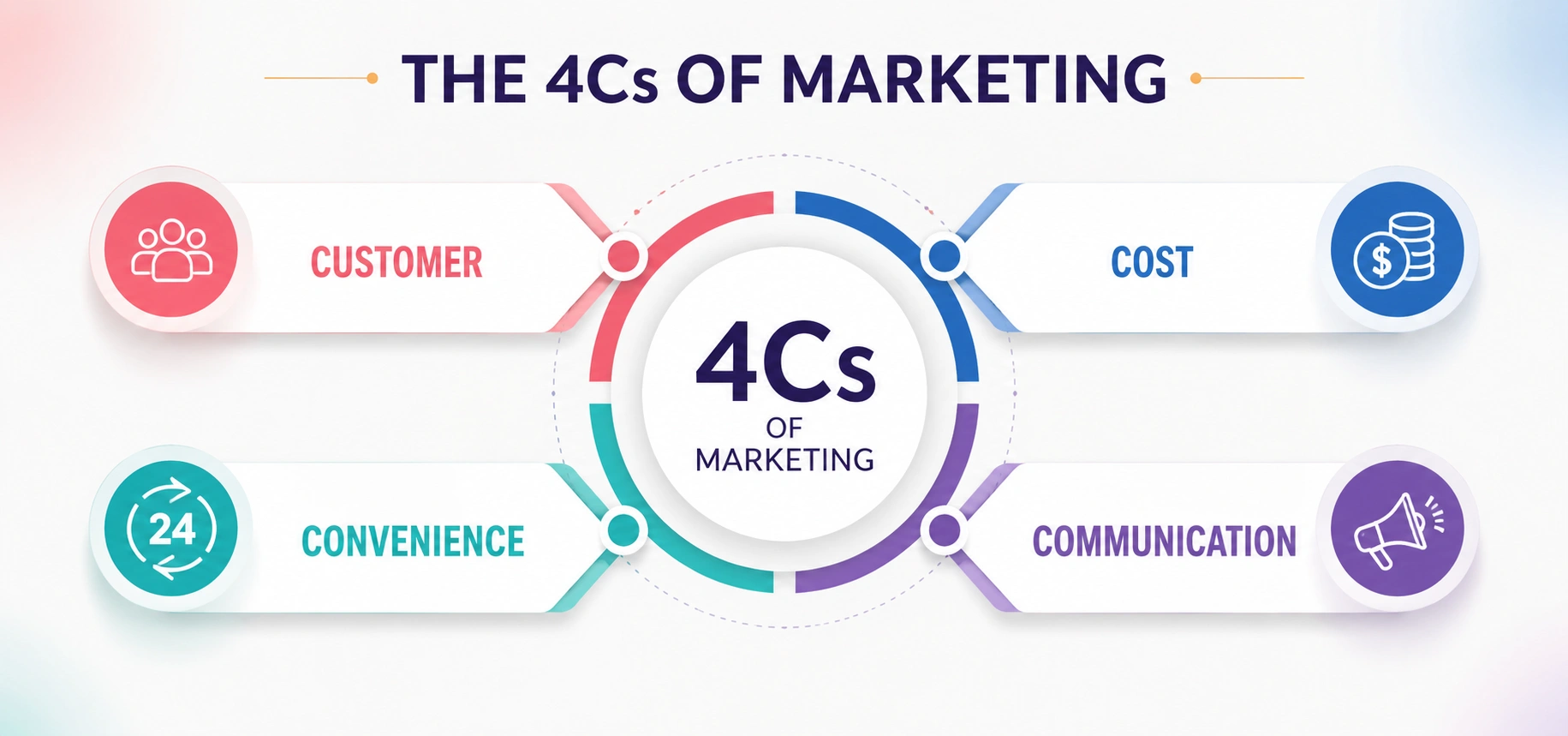
1. Customer (instead of Product):
This isn’t just about swapping a word; it is about swapping the mindset. A company obsessed with its product asks, “ What can we build and sell?” On the other hand, the company is well aware that "Customer" asks, "What problem is genuinely keeping our buyer up at night, and how do we solve it?" This shift changes everything from R&D decisions to feature prioritization that leads to aggressive selling of the product.
2. Cost (instead of Price):
Cost is the broader concept rather than the price. Cost includes everything a customer gives up to get that product while the price is just one number on the tag. Cost includes the time spent researching options, the effort of comparing alternatives, the learning curve of using something new and even the psychological cost of "did I make the right choice?" A product priced lower than competitors can still lose if it costs the customer more time, more confusion or more regret.
3. Convenience (instead of Place)
“Place” used to mean where a product was physically available, such as on a store shelf or within a distributor network. On the other hand, “ Convenience” means something far bigger than that. How effortlessly can a customer discover, evaluate, purchase and actually use the product? Convenience today spans app design, one-click checkouts, delivery speed, return policies and even how quickly a query gets resolved. A brand can be available everywhere and still lose customers if the experience of buying feels like work.
4. Communication (instead of Promotion)
Promotion was one-directional: a company talking, a customer listening. Communication is a two-way relationship, with a company listening as much as it talks. This shows up in how brands respond to comments, personalize messaging and build trust through consistency rather than volume of advertising. Customers today can tell the difference between a brand spamming to them and a brand genuinely engaging with them and the customers reward the latter with loyalty in the form of repeating business.
Together, these four elements don't just rename the 4Ps but they also represent a complete shift in perspective: from asking "how do we sell this?" to asking "why would someone actually want this?" That single shift in thinking is what separates a textbook answer from a strategy recruiters and professors actually want to see.
Why Do the 4Cs Matter in Today's Marketing Landscape?
The real-world problem is that most students underestimate the fact that the 4Ps framework was built in the 1960s for a world of mass production and one-way advertising. But in the present scenario, the customer doesn't passively absorb a billboard message but they conduct complete research like they Google the brand, scroll through Instagram reviews, compare prices across five tabs and expect a reply within minutes of sending a DM.
If you walk into a placement interview or a live brand project and only quote the 4Ps, your analysis will sound outdated the moment you say it out loud. Recruiters, especially in digital marketing, D2C and e-commerce roles, are actively screening for candidates who think from the customer's chair, not the boardroom's. The 4Cs framework isn't a supplementary theory to memorize alongside the 4Ps. It is the lens the entire industry has already shifted toward, and academia is catching up.
Who Should Apply for the 4Cs Framework?
Most of us assume that the 4Cs of marketing are reserved for the marketing domain. In such a competitive market, it is directly relevant for:
-
Marketing and MBA students who are building brand audits, case studies, or capstone projects that need to go beyond textbook definitions.
-
Entrepreneurship and startup enthusiasts, if you are sketching a business idea or a go-to-market plan, then these 4cs will help you to answer questions that founders usually skip: will the customer actually trust the brand?
-
Product and business management students, when you have to justify the pricing model or distribution model, the 4Cs will help you to justify from the customer's perspective not from the company’s balance sheet.
-
Anyone preparing for internship or placement interviews in brand management, digital marketing, or customer experience roles. Everyone is actively testing for customer-first thinking. A candidate who can naturally reframe a company problem in terms of Customer, Cost, Convenience, and Communication immediately stands out from one who defaults to Product, Price, Place, and Promotion.
Where Is the 4Cs Framework Applied in Real Business Scenarios?
The 4Cs don't live only in lecture slides in the classroom; but this is something we experience every single day of our lives:
-
Amul builds "Cost" trust through consistent, affordable pricing that never feels like it's exploiting loyal customers
-
E-commerce platforms redesign checkout flows to reduce "Cost" in terms of customer effort and decision fatigue, not just rupees
-
D2C brands use WhatsApp and Instagram DMs to strengthen "Communication," replacing one-way ad broadcasts with real conversations
-
Subscription services focus entirely on "Convenience," one-click renewals, easy cancellations and frictionless access
-
FMCG companies run customer surveys before every product launch, prioritizing "Customer" needs over internal assumptions about what will sell
When you analyze a brand for an assignment using the 4Cs instead of the 4Ps, your answer immediately reads sharper, more current, and more aligned with how the industry actually thinks.
When Should You Use the 4Cs Instead of the 4Ps?
This is where most students get stuck, treating it as an either-or choice. In reality, both frameworks serve different purposes:
-
Use the 4Ps when explaining internal business operations, production processes, logistics, distribution channels and pricing structures
-
Use the 4Cs when explaining customer perception, buying psychology, or brand loyalty the "why" behind a purchase, not just the "what"
For most modern assignments, especially those involving digital marketing, D2C brands, or customer experience, professors and recruiters increasingly expect the 4Cs lens by default because it demonstrates you understand why a strategy works, not just that it exists.
How to Apply the 4Cs of Marketing in Your Projects and Career
Understanding the framework of the 4Cs of marketing is one thing while practising in real life is another thing. Below is the step-by-step guide to start using it immediately.
1. Start with the Customer, not the product.
The process of the 4Cs starts by describing the real problem the consumer is facing in the real world, in their own words rather than in the company’s marketing language.
2. Calculate the true Cost.
Go beyond the price tag on the label. Consider the factor in the time a customer spends researching and comparing, the learning curve of switching to something new and the effort of unlearning a habit tied to a competitor's product.
3. Map the Convenience.
Trace the customer's entire journey like visiting the website, app, in-store experience, delivery, returns and customer support as if you were the buyer yourself. Highlight every single point where friction slows them down like a confusing checkout page, a delayed delivery window, a returns process buried three clicks deep.
4. Audit the Communication.
Look closely at how a brand actually talks to its customers. Does it reply to comments and DMs, personalize its messaging, and build an ongoing relationship or does it simply push one-way advertisements and hope for conversions?
Practising this shift consistently in assignments, mock interviews, and personal brand analyses will make you visibly more confident and current when discussing marketing strategy in any professional setting.
Conclusion
The shift from the 4ps to the 4cs isn’t just an update in academics but this is how marketing genuinely works today. People don't experience your “Place” strategy; they just experience convenience. They don't just experience a “promotion” budget but they care about real communication. Brands like Amul didn't succeed by accident but they succeeded through understanding the customer needs and perspective. Making this shift in how you think, write, and analyze will set you apart in exams, interviews and eventually, your career.