

The Big Question
A degree is often seen as the destination. In reality, it is a starting point.
The final assignment has been submitted. The examinations end. The results arrive. For a brief moment, there is a sense of accomplishment. Then comes the question that matters most: What now?
An Online MSc is not simply about earning a postgraduate qualification. It is about what that qualification makes possible. For some, it becomes a gateway to specialised technical roles. For others, it creates opportunities to move into research, leadership positions, or fast-growing industries that value advanced expertise. In many cases, it helps in a career transition that once seemed out of reach.
As online education continues to gain acceptance across industries, employers are placing greater emphasis on skills, knowledge, and problem-solving ability rather than on the mode of learning itself. This has significantly expanded the opportunities available to Online MSc graduates.
So, what does the career landscape look like after completing an Online MSc? The answer is broader, more diverse, and more promising than many expect.
Why Online MSc Is Gaining Acceptance in the Job Market?
The Indian corporate landscape has undergone a total transformation over the last few years, accelerated by a global push toward digital-first operations. There was a time when online degrees were viewed with a side-eye, but those days are firmly in the rearview mirror. A massive reason for this is the institutional backing provided by the University Grants Commission (UGC) and the Distance Education Bureau (DEB). Under current Indian regulations, an online degree from a recognized, accredited university is legally equivalent to a traditional on-campus degree.
Beyond the legalities, there is a practical respect for people who pursue an online MSc while working. When a hiring manager sees that you managed a full-time job at an MNC while simultaneously mastering complex algorithms or clinical psychology theories, they see more than a scientist. They see a professional with elite time management, self-discipline, and a "growth mindset."
In an economy that is shifting toward "skill-first" hiring, your ability to demonstrate a portfolio of work developed during your MSc is what closes the deal, not the physical location of your university’s registrar's office.
- UGC-DEB Regulatory Parity: This is the gold standard. Legal equivalency ensures your degree is valid for both private-sector growth and government job eligibility across India.
- Flexibility for Career Continuity: You don’t have to take a two-year hiatus from the workforce. You continue to earn, gain work experience, and apply your learning in real-time.
- Industry-First Curricula: Many online MSc programs are designed alongside corporate partners, ensuring you learn exactly what is being asked for in current job descriptions.
- Mastery of Digital Tools: Navigating a Virtual Learning Environment (VLE) proves you are comfortable with the digital infrastructure that defines modern business.
- Lower Opportunity Cost: By eliminating relocation, hostel fees, and travel, you significantly increase your Return on Investment (ROI) compared to traditional residential programs.
Exploring the Career Scope After Completing an Online MSc
Gone are the days when an MSc was seen only as a precursor to a life spent behind a laboratory microscope. While the scientific foundation remains the core, the modern MSc has branched out into the very heart of the global economy. It is now a gateway to high-finance, technical leadership, and specialized consulting.
An Online MSc provides the specialized toolkit required to navigate this complexity, allowing you to transition from a task-oriented role into a strategic leadership position across diverse sectors like IT, Banking, Pharmaceuticals, and even global NGOs.
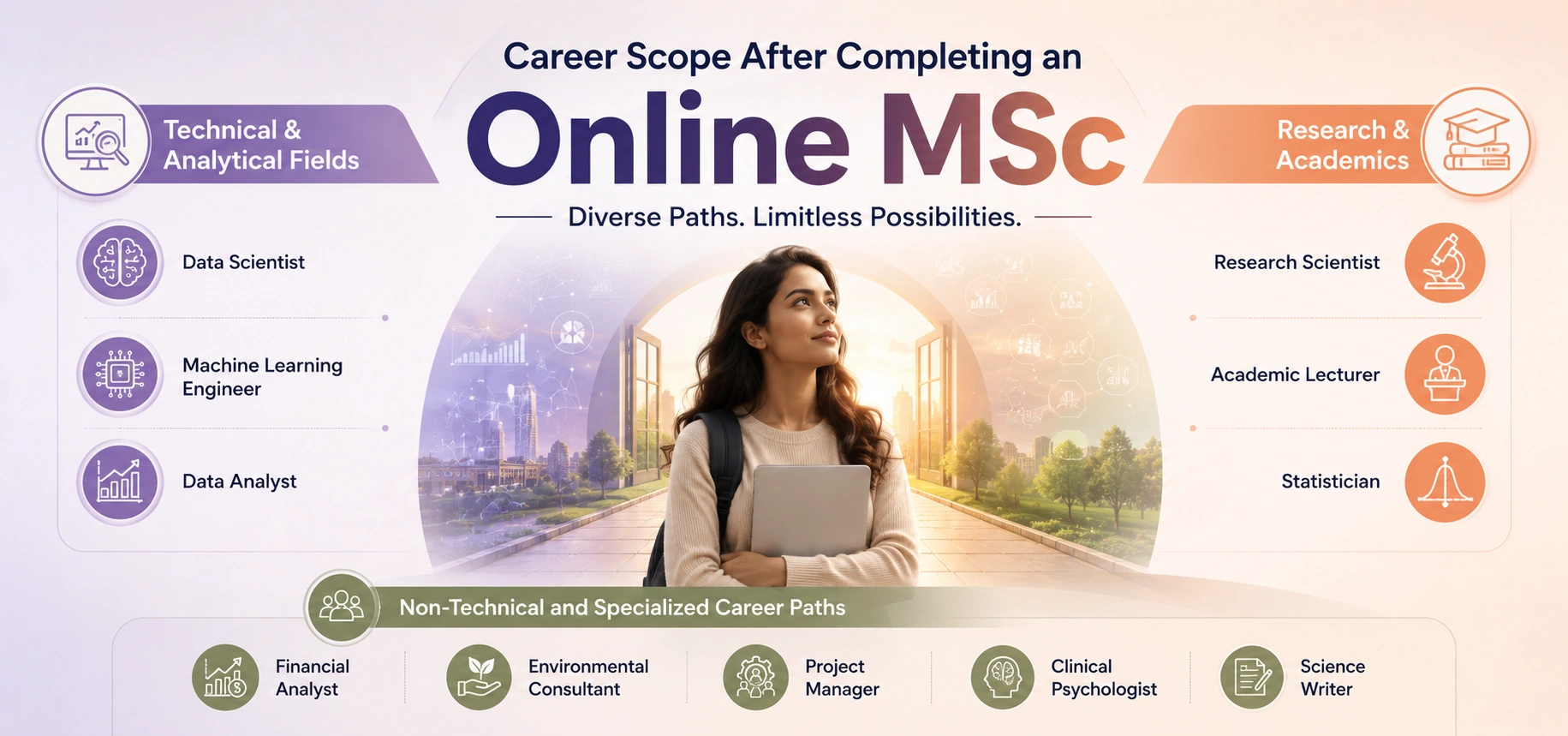
Online MSc Jobs in Technical & Analytical Fields
This is where the majority of MSc graduates realistically land, particularly those coming from Mathematics, Statistics, or Computer Science backgrounds. The demand for specialized analysts is massive, but a significant rise in remote work perks for these roles allows you to work for a tech giant from any corner of India.
- Data Scientist: This is the most lucrative path, but let’s be grounded about the pay. While top-tier senior roles hit ₹25 LPA, the realistic average base pay for someone with 2–5 years of experience is closer to ₹14 LPA. You’ll be building the predictive models that companies like Infosys or Wipro use to solve business bottlenecks.
- Machine Learning (ML) Engineer: If you enjoy the technical side of AI coding algorithms that help machines learn autonomously, this is your destination. With an average salary of around ₹12 LPA, you are essentially the architect of the automation boom.
- Data Analyst: Often the entry point for freshers or those switching fields. You transform raw data into reports for leadership. Salaries start around ₹4 to 7 LPA, but once you master tools like Tableau or SQL, you can quickly scale to ₹9 LPA within a few years.
Career Options in Research & Academics
The transition from an online MSc to a Junior Research Fellow (JRF) is becoming quite common. However, the academic path is a marathon. It’s not just about the degree; most students find they need to clear the NET or GATE exams to gain real traction in India.
- Research Scientist: A classic choice for Biotechnology, Chemistry, or Physics graduates. You’ll find yourself in labs at companies like Cipla or Biocon, or even national bodies like ISRO. Salaries typically range from ₹6 LPA to ₹12 LPA.
- Academic Lecturer: For those with a passion for teaching, an MSc is the gateway to universities. While you can start as a lecturer (₹3 – 6 LPA), be prepared to look at PhD programs eventually if you want a long-term tenure-track position.
- Statistician: You apply mathematical theories to solve real-world problems for government agencies or healthcare firms. These roles offer steady growth, with salaries often falling between ₹5 LPA and ₹11 LPA.
Non-Technical & Specialized Career Paths
Not everyone wants to spend their life in a lab or behind a console. There are "hidden gems" in the market that combine scientific knowledge with communication or leadership.
- Financial Analyst: Often overlooked by science graduates, those with an MSc in Math or Statistics are highly valued in banking for quantitative research. You'll evaluate investment trends with a starting potential of ₹5 to 12 LPA.
- Environmental Consultant: With the surge in climate policy, roles in sustainability are growing. You’ll advise firms on green regulations. It’s a great fit if you have a background in Environmental Science, offering ₹6 to 13 LPA.
- Project Manager: This is the destination for those "moving into leadership." In industries like construction or IT, they need people who understand the technical science but can also manage a budget and a team. Mid-level professionals often see salaries reaching ₹15 LPA.
- Clinical Psychologist: A meaningful path for Psychology graduates. A practical warning: This role strictly requires licensing and specific supervised training. You cannot practice independently without these additional steps. Average salaries sit between ₹3 LPA and ₹7 LPA.
- Science Writer: If you have a flair for writing, this is a gem for work-life balance. You could be creating content for EdTech platforms or media houses like India Today, translating complex research for the public. Salaries range from ₹4 LPA to ₹8 LPA.
Online MSc Degree Value: What Employers Actually Look At
Recruiters do not sit around with a magnifying glass looking for the word "Online" on your degree just so they can reject you. In fact, most modern degree certificates from top universities don't even make a major distinction. What they do look at is the accreditation and the brand of the university. If your degree comes from an institution with an NAAC A++ rating and clear UGC-DEB approval, the "Online" tag becomes a non-issue. These certifications are shorthand for quality; they tell the recruiter that the curriculum met the highest national standards.
Beyond the name on the degree, employers in a skills-driven economy are looking for evidence. They want to see what you built during those two years. Did you create a machine learning model to predict stock prices? Did you write a research paper on organizational behavior? They are looking for a portfolio that proves you can apply theoretical concepts to solve real-world business problems. They value the discipline it takes to balance a job with a Master’s program, as it serves as a "real-life" proof of your organizational abilities and work ethic.
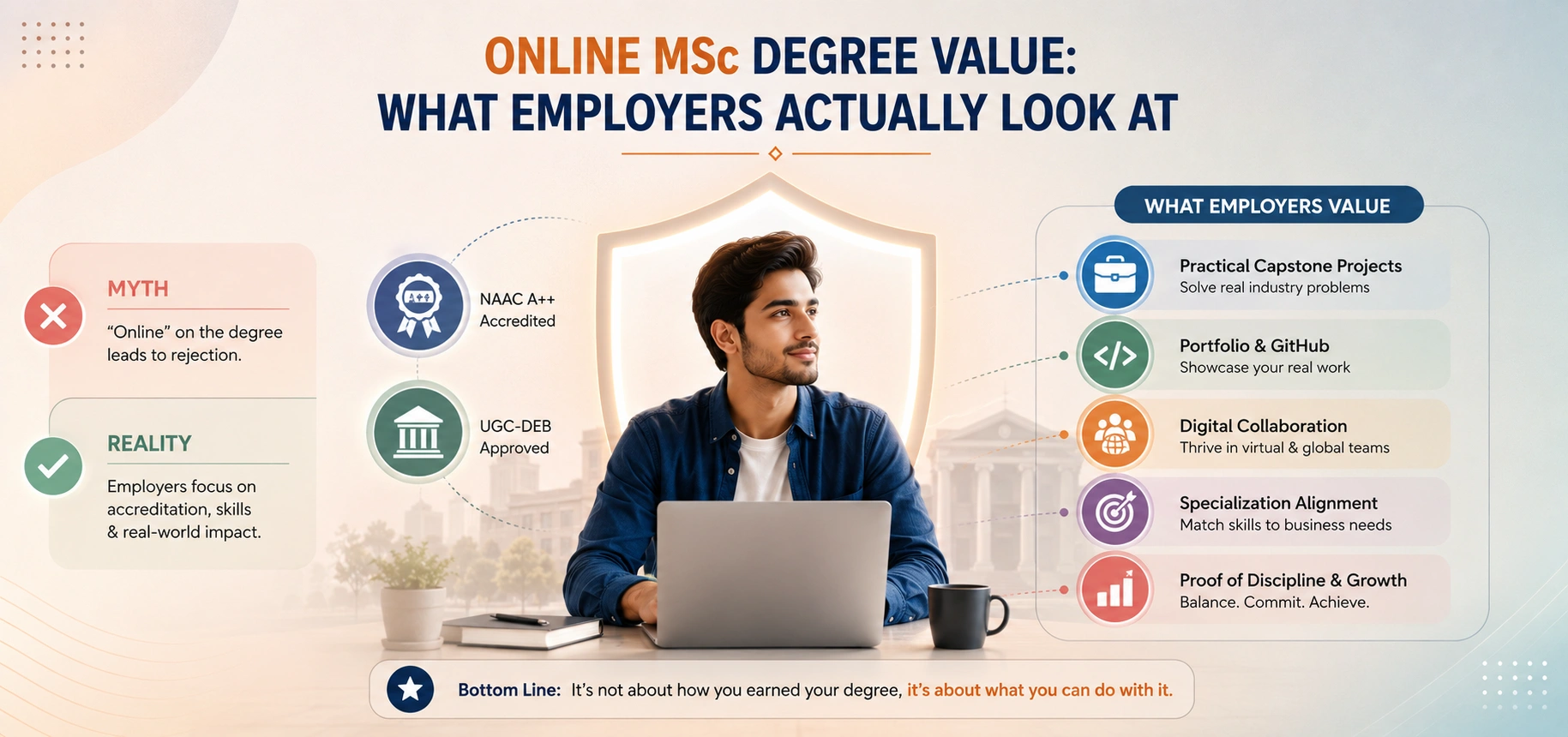
- Accreditation Status: This is your primary shield. Ensure the university has the highest NAAC rating (A++) and is explicitly approved by the UGC-DEB.
- Practical Capstone Projects: A strong final project that solves an industry-specific problem is worth more than a high GPA in a vacuum.
- Portfolio and GitHub: For technical roles, your code and project history are your true resume.
- Digital Collaboration Proficiency: Your experience using virtual labs and global discussion forums is a major plus for hybrid work environments.
- Specialization Alignment: Recruiters look for how well your MSc specialization matches the specific "pain points" of their company.
MSc Future Scope in a Skills-Driven Economy
As we move deeper into the "AI-era," the job market is ruthlessly moving away from generalists. A Bachelor’s degree used to be the ticket to a stable middle-class life, but today it is merely the starting line. The "AI-era" requires deep specialization. We are seeing a shift where tasks that used to require a team of generalists are now handled by one specialist equipped with the right tools.
An MSc provides the technical depth that allows you to be that specialist. Whether it is ensuring the ethical deployment of an AI system or managing a complex global supply chain, the responsibility and the salary will go to those with post-graduate training.
Think about the long-term career trajectory of a mid-level professional.
Conclusion: The Roadmap to Your Next Move
The career scope after an online MSc is not just expansive; it is future-proof. The flexibility of the online format allows you to keep your foot in the door of the professional world, while the MSc provides the technical weight you need to eventually kick that door open for a senior role.
When you are ready to make your move, the most important thing is to choose a "safe" and recognized path. This means opting for an institution that removes the "validity anxiety" from the equation.
Universities like LPU Online are frequently considered by students because they are UGC-DEB-Entitled and offer structured placement assistance. Such features are excellent tools to check for, but remember: the "right fit" always depends on whether the specialization aligns with your 5-year goal. Take a deep breath. You’ve already done the hard part of deciding to grow; now it is just about the execution.