


Table of Content
A company doesn't run on decisions made overnight. Every expansion plan, every cost cut, every hiring freeze traces back to a report someone built weeks earlier. That someone, in most mid-size and large firms, is a corporate analyst.
The role sounds vague to outsiders. Ask five people what a corporate analyst does, and four will confuse it with a business analyst or a financial analyst. The confusion isn't accidental, since the roles overlap on paper. But the day-to-day work, and the kind of thinking each one demands, is different enough to matter.
What is a Corporate Analyst?
A corporate analyst looks at a company’s operational information and then uses that information to make suggestions that the leaders of the company can use. Their work closely revolves around finance. The Strategy part of the company and the things they produce, such as reports and forecasts help the company make decisions about money, investments and plans for growth.
To put it simply, a corporate analyst is the person who helps figure out what the company’s numbers really mean, not just what the numbers are.
The corporate analyst role is not just for people who work with money. Analysts who work in parts of the company like operations or strategy do similar work, but they look at things from a different perspective. One person might look at how much money's coming in and how much the company is spending, another person might look at how the company compares to its competitors and another person might study how the company can work more efficiently.
How does a Corporate Analyst separate from a Business and Financial Analyst?
The biggest source of confusion is that financial analyst, business analyst, and corporate analyst are often used interchangeably in job postings, even though their responsibilities differ.
A financial analyst focuses on financial modelling, forecasting, valuation, and investment decisions. A business analyst improves business processes by identifying gaps and translating business needs into actionable requirements. A corporate analyst combines elements of both, using financial and operational data to support company-wide strategic decisions.
In reality, these roles often overlap. Smaller companies may combine them into a single position, while larger organizations define them more clearly. In such companies, corporate analysts typically work within corporate strategy teams or report to the CFO's office, helping shape long-term business direction.
What Does a Corporate Analyst Do?
The roles of the corporate analyst differ by the company’s size and industry type, but a few common tasks consistently show up across most job descriptions (JDs).
Data collection and analysis: Data from Finance and operations are sourced via multiple channels to clean and use them efficiently.
Reporting and forecasting: Monthly or quarterly periodic reports are used to track performance against targets, while forward-looking models estimate what's likely to come next.
Spotting problems early: Marginal dips and rise is osmethingtha happens frequently in organisations and are closely monitored to detect early problems through pattern recognition.
Translating numbers for non-finance audiences: A CFO or a department head usually wants the conclusion, not the formula behind it. Turning a dense analysis into a two-line recommendation is half the job.
Supporting decisions on budgets, pricing, and expansion: The analyst rarely makes the final call, but the recommendation shapes it more than most people outside the room realise.
Where Do Corporate Analysts Work?
Banks, NBFCs, and other financial institutions hire strenuously for this role, given the sheer volume of financial data they handle. Large corporations across manufacturing, retail, and technology hire too, wherever a strategy or finance team needs someone dedicated to turning operational data into decisions. Consulting firms bring corporate analysts on as well, often placing them on client projects where the work looks like an internal analyst role, just applied to someone else's company.
Most analysts report into a finance, strategy, or corporate development function. Titles vary by company. Some call it a business analyst, some a corporate finance analyst, and some drop the corporate qualifier altogether and just call it an analyst.
Skills a Corporate Analyst Needs
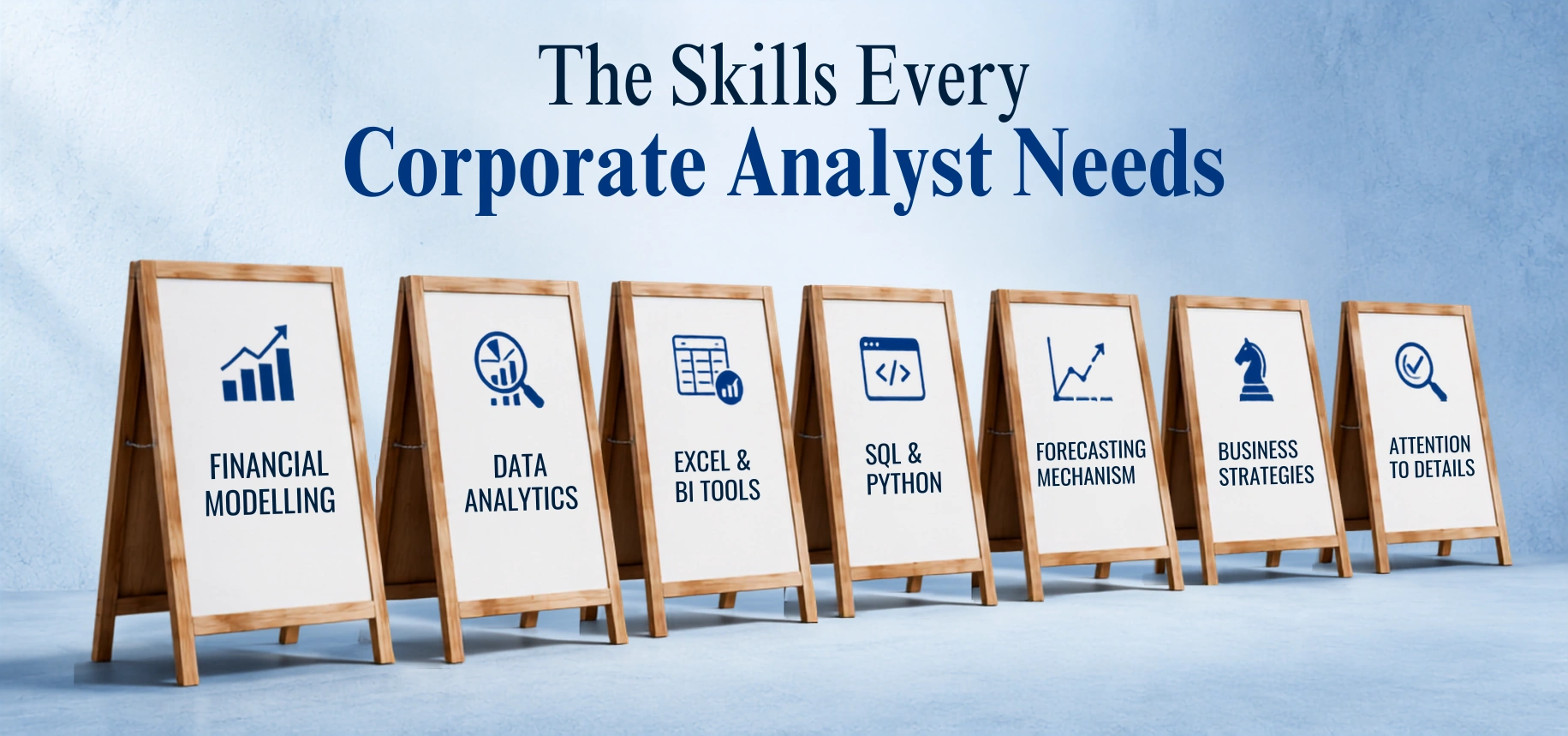
A Corporate Analyst should have some technical skills, like being good at modelling, really comfortable with Excel, and familiar with tools like SAS or Bloomberg; this is very important when you are working with a lot of data. These days, companies also want Corporate Analysts to know the basics of SQL or Python, not to make software but to be able to get and clean data on their own without having to wait for someone else to do it.
Being able to communicate is also very important. If a Corporate Analyst makes a model but cannot explain it in a short meeting, they are not doing their job properly.
Problem-solving and paying attention to details are also skills for a Corporate Analyst. A big part of the job is finding mistakes in a dataset that others might have missed and asking questions about them before they become problems.
Corporate Analyst Salary in India
The salary of a Corporate Analyst in India varies depending on the company size, location and experience. New Corporate Analysts in India usually start with a salary between ₹4 to 7 LPA. As they gain experience, their salary can go up to ₹10 to 15 LPA. In cities like Mumbai, Bangalore and Gurugram, experienced Corporate Analysts with more than five years of experience or a CFA or MBA can earn even higher salaries. However, these numbers are variable. It would be a good idea to check current sources like Glassdoor or AmbitionBox for the latest information on Corporate Analyst salaries.
How to Become a Corporate Analyst
Most people get here through a bachelor's degree in commerce, economics, or business administration, usually. A BCom or BBA is still what most job postings ask for at entry level, and it's the safest place to start.
A postgraduate degree isn't compulsory. Plenty of analysts skip it and do fine. But an MCom, MBA, or a master's in finance tends to speed things up, the modelling and analytical skills expected at the next level come easier with that background already in place.
Certifications matter less early on than people assume. CFA, CMA, and FMVA show up often in job listings, though almost nobody asks for them at entry level. They start counting later, usually around the time someone's up for a promotion or eyeing a bigger company.
What actually teaches the job is the job itself. An internship during college, followed by two years in an entry-level analyst seat, tends to outpace a certificate earned on its own..
Conclusion
The corporate analyst role is something that sits in the intersection of the business and the financial analyst. They usually monitor end-to-end operations of the organization through data. And the career in this domain is not so cluttered, as few of the job seekers are aware of it. And it might sometimes confuse you with other analyst roles, depending on companies provided positions.
For anyone building toward this career, a strong foundation in commerce or business administration is the starting point. LPU Online MBA and MCom programs are built for exactly this, with the flexibility for working professionals to study without stepping away from a job.