

You wouldn’t walk into someone’s house without permission. You wouldn’t open their personal diary or pretend to be them to access their money. In the real world, these lines are clear. But online, those same boundaries blur more often than we realise.
Because the truth is, you are not just one person on the internet.
There’s another version of you quietly existing in the background. It carries your passwords, your search history, your habits, and even the things you clicked on without thinking twice. And unlike your real self, this version is constantly exposed. Every time you reuse a password, ignore permissions, or casually hit “Accept All”, you give up a little more control over it.
That’s where ethics in cybersecurity comes into the picture. It’s not just about protecting systems or preventing attacks. It’s about understanding responsibility in a space where actions feel invisible but have very real consequences. Because in the end, cybersecurity is not only about technology. It is about how we choose to behave when no one is watching.
So What Exactly Is Cyber Ethics?
Cyber ethics, in plain terms, is the study of how people should use digital technology responsibly. It looks at the moral side of how individuals, organisations, and whole societies interact through the internet, and asks whether those interactions are fair, honest, and safe.
The way we think about the internet shifted dramatically in 1982, when science fiction author William Gibson introduced the idea of "cyberspace." He described it as a kind of mental space where computer activity happens, not just a tool, but almost a place. That framing still matters today. Because once the internet became a "space," the lines between public and private behaviour got much harder to draw. Cyber ethics tries to redraw those lines clearly.
The Four Pillars of Information Security Ethics
For anyone working with tech, these four principles act as a compass before things get complicated.
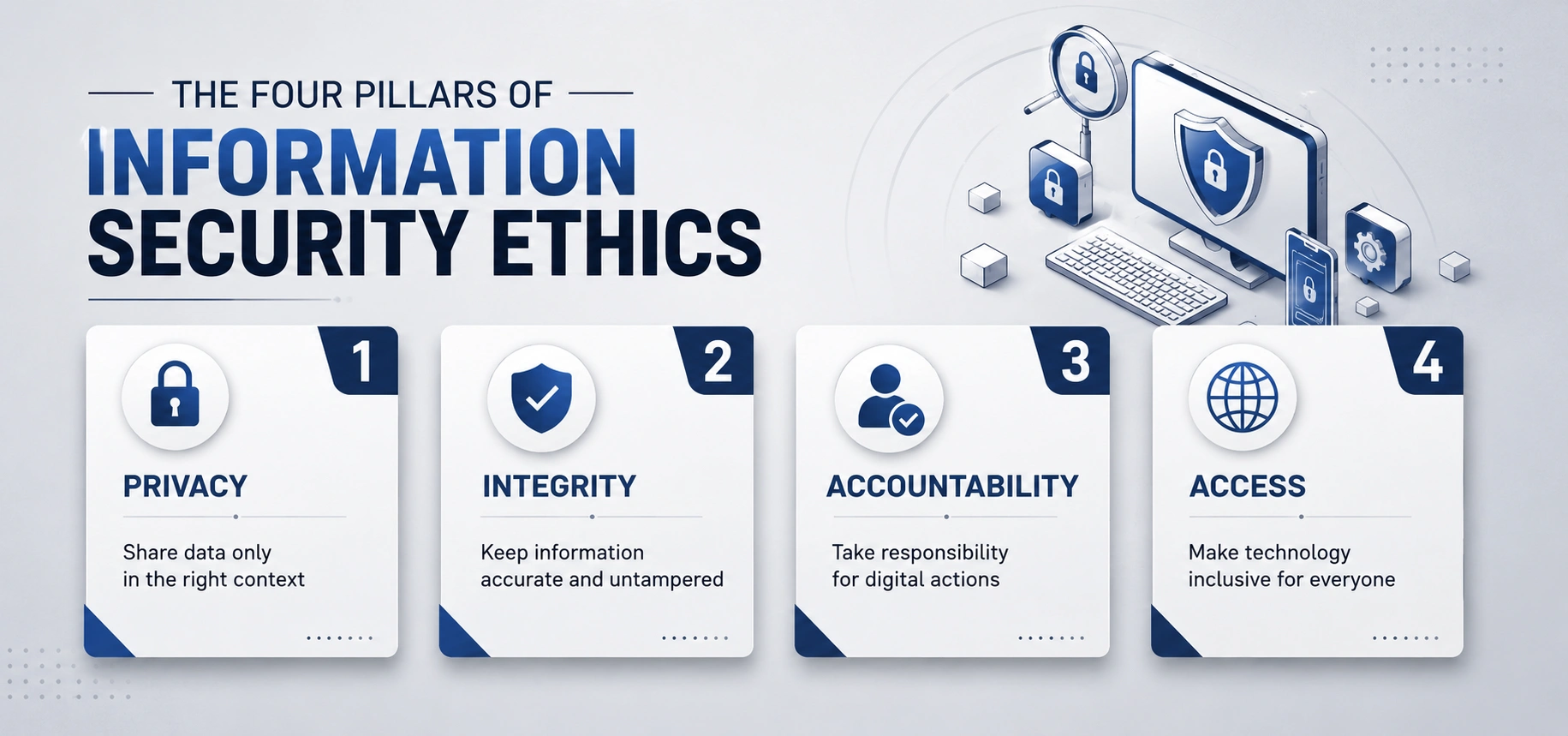
1. Privacy - It Is Not Just About Hiding Things
Privacy has never been as simple as just “keeping data secret.” There is a concept called contextual integrity, which basically means: information should only be shared in ways that fit the original context it came from.
Sharing your medical records with a doctor makes sense. Sharing the same data with an advertiser doesn’t feel right, even if it’s technically allowed. What makes this more complicated today is that even so-called “anonymised” data isn’t always as secure as it appears. Researchers showed that just three data points, like zip code, gender, and date of birth, are enough to identify a large portion of people in a dataset. So calling something anonymous does not automatically make it harmless.
2. Integrity - Honesty Is Non-Negotiable
In digital terms, integrity means making sure data is not tampered with and that false information is not deliberately pushed out. This sounds obvious, but when you consider how much of modern business runs on data like transactions, contracts, and medical records. Even those small manipulations can have massive ripple effects. Integrity is not just about ethics in the abstract; it is the bedrock that keeps digital commerce and communication functional.
3. Accountability - Someone Has to Own It
Accountability means that when something goes wrong online, someone should be answerable for it. This applies to individual users, as well as to the companies that build the algorithms and platforms we rely on every day. Secretly, search engines and social platforms are increasingly treated as "controllers" of personal data, not just neutral pipes. With that status comes a real responsibility to handle the Right to Erasure properly, to flag misinformation, and to stay transparent about how information gets filtered and ranked.
4. Access - Technology Should Not Leave People Behind
The digital divide is very real. Not everyone has the same access to the internet, reliable devices, or even the basic skills needed to use technology safely. Ethical leadership in tech means acknowledging this gap and doing something about it. It involves designing inclusive products, supporting efforts to expand access in underserved areas, and ensuring that the benefits of technology don’t stay limited to those who are already ahead
Even after knowing all these terms and their needs, you can’t ensure digital safety until the cyber breaches are clear to you. It will make you understand how the security is compromised on the servers.
Common Cyber Breaches and What They Actually Violate
Cybercrime has come a long way from the clunky viruses of the 1980s. Today it is sophisticated, targeted, and often designed to cause real harm to real people. Here is a quick breakdown of the most common types and the ethical principles they break:
|
Attack Type |
What Actually Happens |
Ethical Violation |
|
Phishing |
Fake emails or links trick users into handing over passwords, card details, or login credentials. |
Trust and Integrity |
|
Man-in-the-Middle (MITM) |
An attacker secretly positions themselves between two people communicating, reading, and sometimes altering messages in real time. |
Privacy and Secrecy |
|
DDoS Attacks |
A flood of fake traffic sent from thousands of hijacked devices, which overwhelms a server until it crashes completely. |
Availability and Access |
|
Rogue Software |
Programs that look legitimate (like fake antivirus tools) but secretly steal data or damage systems once installed. |
Honesty and Security |
These attacks cause more than financial loss. Each breach erodes public trust, and when confidence in data security declines, the reliability of the entire digital ecosystem is compromised.
Why This Actually Matters: The Bigger Picture
There is a common tendency to treat cybersecurity ethics as simply “doing the right thing.” While that sounds admirable, it creates the impression that ethics is optional. In reality, it is not.
Researchers now use the term human-harming research to describe situations where careless handling of data causes real harm. Even information that seems harmless on its own can lead to reputational, psychological, or financial damage when misused. The key point is simple: direct interaction is not required to harm someone. Mishandling their data is enough.
Another critical concern is search engine bias, which often goes unnoticed. Search engines are not neutral platforms. They act as gatekeepers, deciding what information users see and what remains hidden.
Researchers Robert Epstein and Ronald E. Robertson introduced the concept of the Search Engine Manipulation Effect (SEME). Their findings highlight that biased search rankings can significantly influence the opinions of undecided users, often without their awareness.
The implications of this are serious. When platforms subtly shape what “informed” looks like for millions of users, they influence perception without obvious intervention. Over time, this leads to the creation of “filter bubbles,” where individuals are exposed only to information that aligns with their existing beliefs.
This is not just a technical issue or a poor user experience. It is a structural challenge that affects how information flows in society. For anyone working in or leading within the digital space, addressing these ethical concerns is not optional. It is central to responsible and informed decision-making.
Best Practices: The Ten Commandments of Computer Ethics
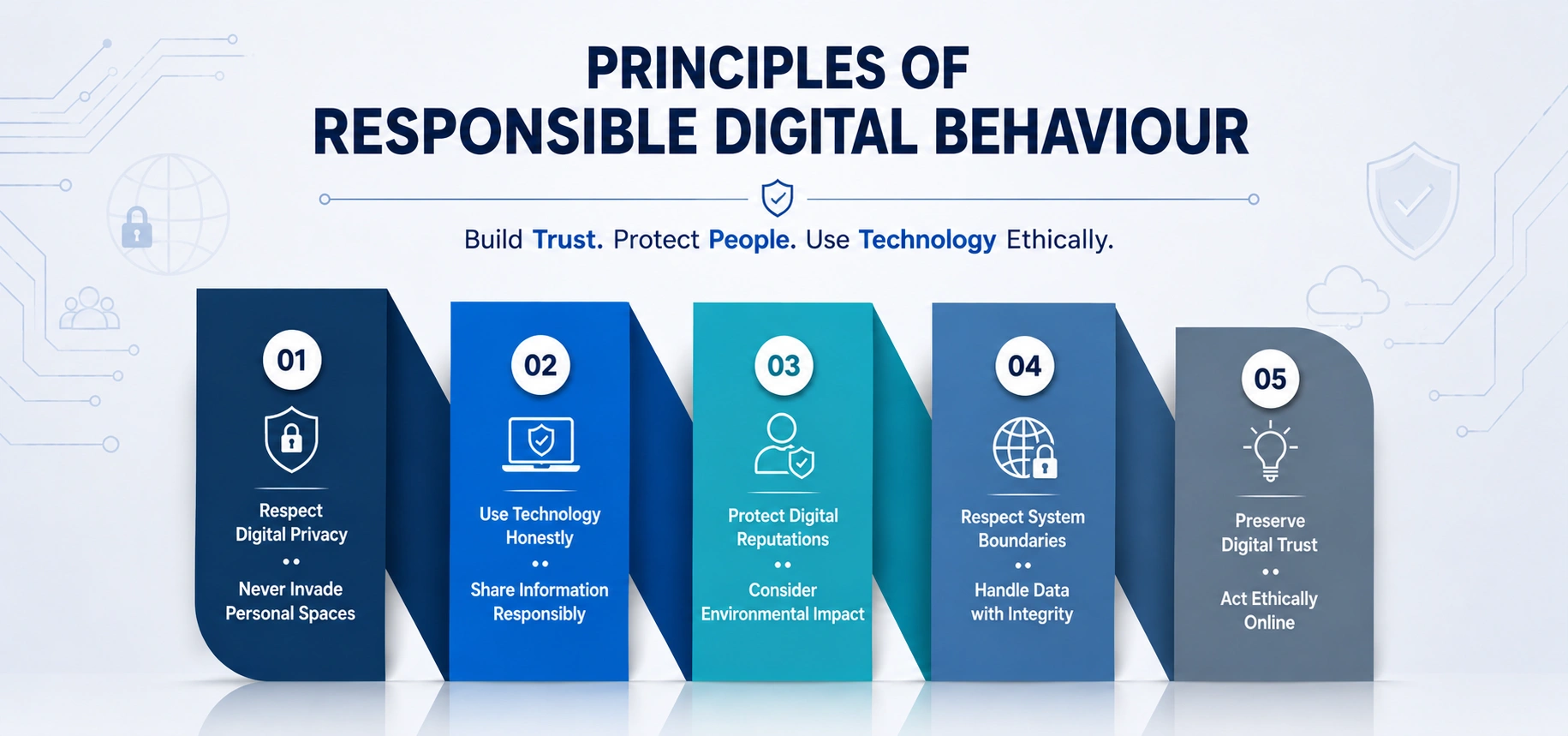
Back in 1992, the Computer Ethics Institute laid out ten simple rules for digital behaviour. They hold up remarkably well today:
- Do not use technology to harm others.
- Do not snoop into other people's digital lives.
- Do not use technology to steal data, money, or anything else.
- Do not spread misinformation or false content.
- Do not use technology to damage someone's reputation.
- Do not use technology in ways that harm the environment.
- Do not hack into systems that are not yours.
- Do not access or delete data you have no right to touch.
- Do not alter someone's emails or documents without permission.
- Use technology responsibly.
For individuals, these act as everyday reminders to build better digital habits. For organisations, however, ethics must be formalised into clear policies. That means written guidelines, regular staff training, clear consequences for violations, and periodic reviews to make sure the rules actually keep pace with new technology.
Why Education Is the Missing Piece
Technical skill alone does not make a great cybersecurity professional. Anyone can learn to configure a firewall. What is harder and more important is learning to think through the ethical implications of the systems you build. How should big data be handled? What happens when an AI system starts making biased decisions? Who is accountable when an algorithm causes harm?
This is why formal academic programmes in cybersecurity are increasingly important. An online MCA in cybersecurity, for example, does not just train students in technical tools; it builds a framework for ethical reasoning that can be applied throughout a career. Learning to deconstruct how predictive analytics or algorithmic processing can harm people, and then designing systems that account for that, is what separates a technician from a genuine digital leader.
Conclusion: Building a Moral Firewall
At its core, the “moral firewall” is not a tool or a system. It is a mindset grounded in privacy, integrity, accountability, and access. The human element in cybersecurity is not a gap to fix, but a central factor that shapes how secure any system truly is.
As AI becomes more integrated into everyday life, these challenges will only grow. Issues like data surveillance, algorithmic bias, and filter bubbles are not future concerns. They already exist. Leaders who approach ethics as a strategic priority, rather than a compliance requirement, will be better equipped to handle what lies ahead and build systems that people can genuinely trust.