


What if your fascination with art could go beyond museum visits and coffee-table books?
What if studying the stories behind masterpieces didn’t require relocating, resigning from work, or putting life on hold?
And what if advanced learning in art history could adapt to you, rather than demanding that you adapt to rigid academic structures?
For many students, the passion for art history is deep and enduring, yet traditional postgraduate education often places this ambition out of reach. Limited access to specialised institutions, inflexible schedules, geographical barriers, and financial considerations frequently force learners to postpone or abandon their academic goals. In this evolving educational landscape, the online master’s in art history emerges as a transformative alternative. By combining academic rigour with digital accessibility, it enables learners to engage critically with global visual culture, develop advanced research skills, and pursue meaningful careers, without compromising professional or personal responsibilities.
Why Do Students Struggle to Pursue Art History at an Advanced Level?
Often, questions come to mind: Why must students often choose between professional stability and intellectual growth? And why should geography dictate access to quality education in the first place?
Traditional or regular master’s programmes in art history are often restricted to selected institutions and cities, requiring physical attendance and full-time commitment. But this structure causes hindrance for working professionals, international learners, and students from smaller regions. It also adds the rising cost of relocation and living expenses, and advanced education becomes an unrealistic aspiration.
The online master’s in art history responds directly to these challenges by offering academic depth without any physical relocation, allowing students to pursue the degree from anywhere in the world.
What Is an Online Master’s in Art History?
Often, confusion arises:” Can Art history be studied in an online format without losing its visual culture and authenticity? How does one analyse visual culture and historical context in a digital classroom?
An online master’s is a well-structured postgraduate programme designed to deliver the same academic value as traditional degrees have through an online platform. It focuses on historical, theoretical and practical aspects of art across various centuries, periods and cultures.
Through interactive lectures, digital archives, virtual museum access, and guided research, students gain a comprehensive understanding of art history in a flexible and accessible format.
Curriculum Overview: What Will You Learn?
“What does a future-ready art history curriculum look like?”How does it balance tradition with contemporary relevance?” An online master’s in art history is thoughtfully designed to balance historical knowledge with critical frameworks relevant to today’s world.
Core Subjects
An online master's in art history includes:
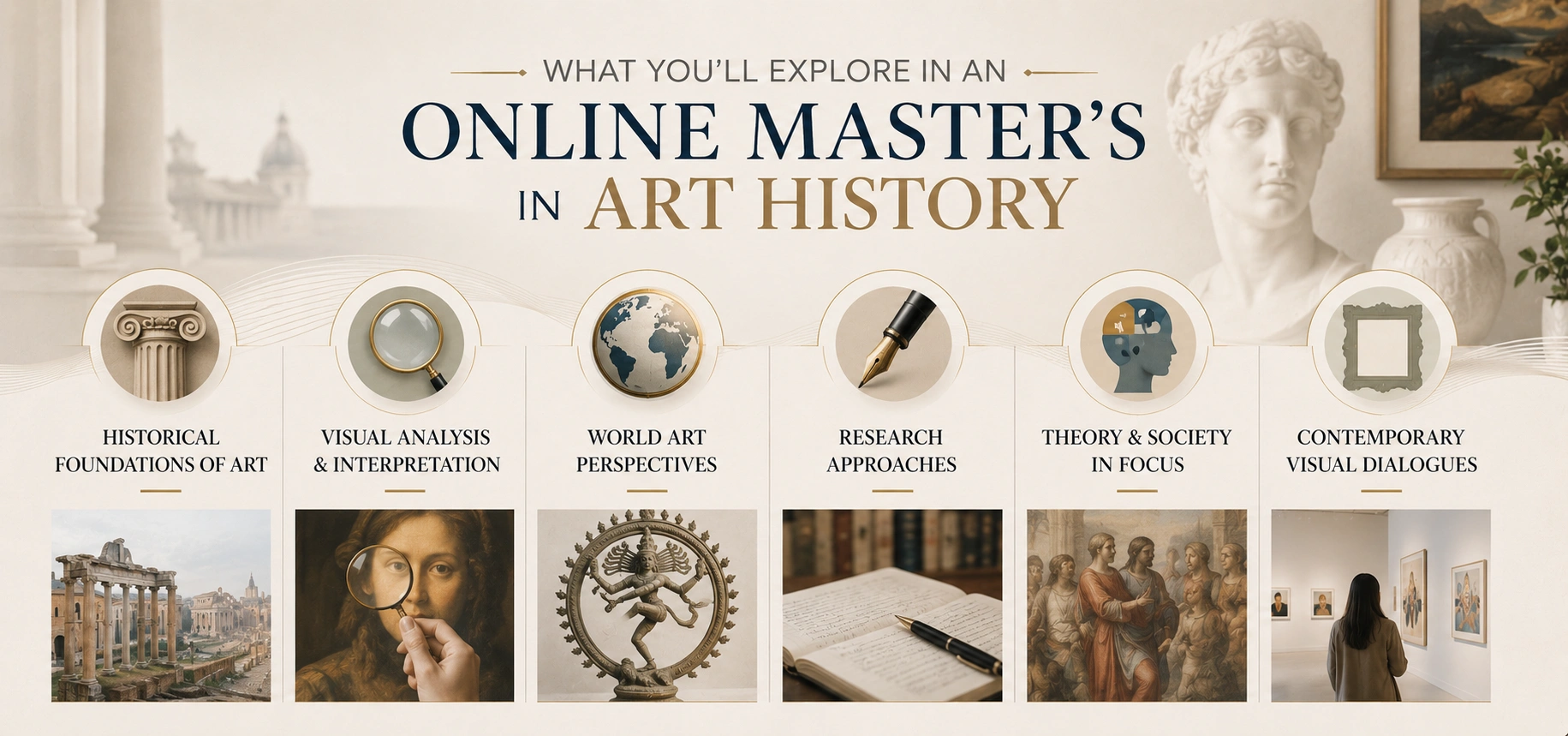
- Foundations of Art History – The module introduces students to the chronological development of art across major civilisations and historical periods. The course examines how artistic traditions emerged, interacted, and evolved in response to religion, patronage, technology, and societal change.
- Visual Analysis & Interpretation – Students learn how to read artwork critically. The focus is on formal elements such as composition, colour, material, and technique alongside symbolism and historical context.
- Global Art Histories – This module explores artistic traditions from Asia, Africa, the Americas, and indigenous cultures. Students examine cross-cultural exchanges, colonial encounters developing a more inclusive and representative understanding of art history in a connected world.
- Research Methodologies – This subject equips students with the tools needed for academic research. From framing research questions and engaging with primary and secondary sources to writing critically and ethically, learners develop methodological rigour essential for dissertations, publications, and scholarly work.
- Critical Theory & Visual Culture – This module situates art within broader theoretical debates. Students engage with perspectives on power, identity, gender, race, class, and media to understand how images function within society.
Each subject encourages questioning, debate, and analytical thinking skills essential for advanced academic and professional work.
How Does Online Learning Enhance the Study of Art History?
An online master’s in art history seamlessly combines advanced digital tools to strengthen academic engagement and visual understanding. Through virtual museum tours and exhibitions, students gain exposure to global boundaries, which otherwise may be restricted to local areas. High-resolution visual databases allow close analysis of form, technique, and detail, while interactive timelines and archival resources help place artworks within their historical and cultural contexts.
Learning is further enhanced through recorded lectures for self-paced revision and live discussion with experts, enabling real - time academic exchange, encouraging critical thinking and scholarly dialogue.
Is the Learning Experience Interactive or Is It Self-Study Only?
On hearing the word “ Online master’s”, a question strikes: “Will students learn in isolation?”
How do discussions and debates happen in an online environment?” Will our doubts clear or catch the new technique in an online format?”
Online programmes are designed to foster active participation. Students engage through:
- Live virtual classrooms
- Peer discussion forums
- Group research projects
- Faculty-led webinars
This ensures that learning remains collaborative, reflective, and intellectually stimulating, mirroring the academic vibrancy of traditional classrooms.
Assessment & Academic Rigour
A common concern of students is whether online education is an effective measure of academic performance. In reality, well-structured online courses use diverse and structured assessment methods to ensure comprehensive learning evaluation. In an online master's program, students' performance is evaluated on the following parameters:
- Research Essays - In-depth written assignments that evaluate students' ability to analyse themes, visuals, and historical significance.
- Visual analysis assignments - It interprets the artwork of a student, focusing on form, style, and cultural relevance.
- Presentations and seminars - Interactive and doubt-clearing sessions that encourage discussions, innovative ideas, and peer learning.
- Case studies - Application-based tasks that connect real-world artistic work with theoretical knowledge and historical contexts.
- Final Dissertation or capstone project - An extensive research project demonstrating subject mastery, originality, and academic rigour.
Who Should Pursue an Online Master’s in Art History?
A common question often arises, “Is an online master’s in art only for art graduates?”Can professionals from other academic or creative backgrounds apply?”
An online master's program is designed to welcome students from diverse and professional backgrounds. While a background in the humanities can be helpful, but not a mandatory requirement. What matters is a genuine interest in visual culture, historical contexts, forms, and critical interpretation.
This programme is particularly well-suited for professionals:
Humanities and Arts graduates:
Students from fine arts, history, humanities or other fields can deepen their theoretical knowledge along with practical exposure, research-driven study across different centuries, periods, and cultures.
Museum and gallery professionals:
Individuals working in museums or galleries can strengthen their knowledge, improve collection management skills, and engage more critically with exhibitions and artworks..
Educators and researchers:
Teachers or other working professionals can gain advanced expertise, enhance their methodologies, and build a strong foundation in research, including their doctoral studies.
Cultural managers and curators working in heritage organisations, cultural institutions, or creative industries who aim to combine practical experience with theoretical grounding.
Creative professionals such as designers, writers, and media practitioners who want to enrich their creative practice with historical perspective and critical frameworks.
Lifelong learners passionate about visual culture who value structured academic growth and wish to engage deeply with art beyond casual appreciation.
When intellectual curiosity about art aligns with the desire for formal academic development, an online master’s in art history offers a clear and flexible pathway to expand knowledge, sharpen critical thinking, and engage meaningfully with global visual cultures.
Career Scope: What Can You Do After Graduation?
A common concern of art students is: Can a degree in art history lead to stable and rewarding career opportunities? Are career options available beyond academia?
The answer is absolutely yes. An art history graduate is equipped with analytical, research, and interpretive skills that are valued across various industries. Today, career opportunities are broader than traditional roles:
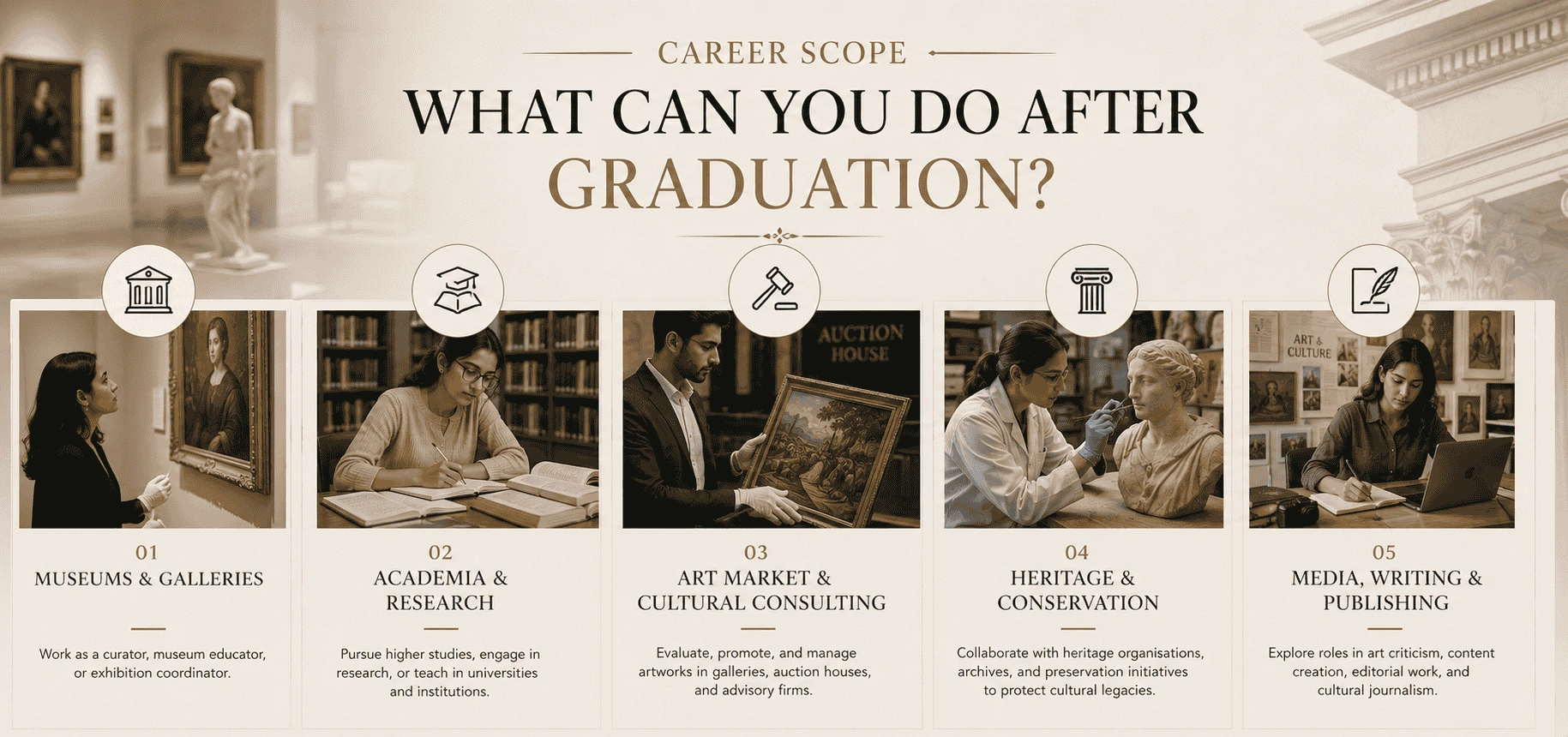
1. Museums & Galleries
Museums and galleries are one of the most prominent career opportunities. Graduates can take a role such as curators, museum educators, or exhibition coordinators.
2. Academia & Research
Professionals who are inclined towards academics, art history provides a strong foundation for the same. Graduates can pursue doctoral studies, contribute to research, and take up teaching roles in universities.
3. Art Market & Cultural Consulting:
A global market offers a wide range of opportunities in galleries, auction houses, and art advisory firms. The role is to evaluate, promote, and manage artworks for collectors and institutions.
4. Heritage & Conservation:
Work with cultural heritage organisations, archives, and preservation initiatives focused on safeguarding artistic legacies.
5. Media, Writing & Publishing:
Art criticism, content creation, editorial roles, and cultural journalism are natural extensions of art historical training.
Why Is the Demand for Art History Professionals Growing?
“Is art history still relevant in today’s competitive environment?
Why are institutions investing in cultural expertise?
With the expansion of museums, digital archives, cultural tourism, and creative industries, professionals who can interpret, contextualise, and communicate visual culture are increasingly valued. The online master’s in art history equips learners with transferable skills such as critical analysis, research proficiency, communication, and cultural literacy, making graduates adaptable across sectors.
How Does This Degree Compare to Traditional On-Campus Programmes?
Does online education offer equal credibility?
What advantages does it bring?
Key benefits include:
- Flexibility for working professionals
- Cost-effectiveness
- Global classroom exposure
- Access to international resources
- Balance between career and education
The academic outcomes remain comparable, while accessibility and convenience significantly improve.
How to Choose the Right Online Master’s in Art History?
What should students look for before enrolling?
Consider:
- Institutional accreditation
- Curriculum depth and research focus
- Faculty expertise
- Student support services
- Digital learning infrastructure
- Career guidance and academic mentoring
A well-structured programme ensures both academic excellence and professional readiness.
Conclusion: Is an Online Master’s in Art History Worth It?
Can passion and profession truly align?
Is it possible to study the past while preparing for the future?
The online master’s in art history offers more than a degree-it offers access, opportunity, and academic empowerment. By removing traditional barriers and embracing digital innovation, it enables learners to study art history with depth, flexibility, and global relevance.
For those who seek intellectual fulfilment, cultural understanding, and meaningful career pathways, this programme represents a future-ready approach to postgraduate education, where learning adapts to the learner, and not the other way around.