

You've Been There. We All Have.
You spend weeks building a website. The design is clean, the copy is sharp, and the product is genuinely good. You hit publish, and then... silence. No traffic. No leads. No traction. Just you, refreshing Google Analytics, wondering what went wrong.
Here's the uncomfortable truth: your website isn't invisible because it's bad. It's invisible because it has no address.
Think about it this way. Imagine opening a luxury boutique having premium interiors, curated inventory, and exceptional service, in the middle of a desert. No signage. No roads. No GPS pin. The boutique exists, but no one can find it. That's exactly what a website without SEO looks like in 2026's AI-first internet.
We are no longer navigating a simple web of static links. We're interacting with a living digital ecosystem where billions of pages, videos, and products compete for a millisecond of human attention. In this environment, being "good" isn't enough. You have to be found. And in 2026, SEO is the only reliable mechanism that makes that happen.
When I started tracking how brands succeed (and fail) in the age of Large Language Models and Generative Search Experiences, I noticed a pattern. The companies that panicked about AI "killing SEO" were the ones who treated SEO as a box to check. The ones thriving? They understood something fundamental: AI didn't bury SEO. It made SEO more critical than ever. Here's why.
From Blue Links to Answer Engines - Search Has Grown Up
Remember when Googling something meant scanning through ten blue links and picking the one that looked most trustworthy? That era is over.
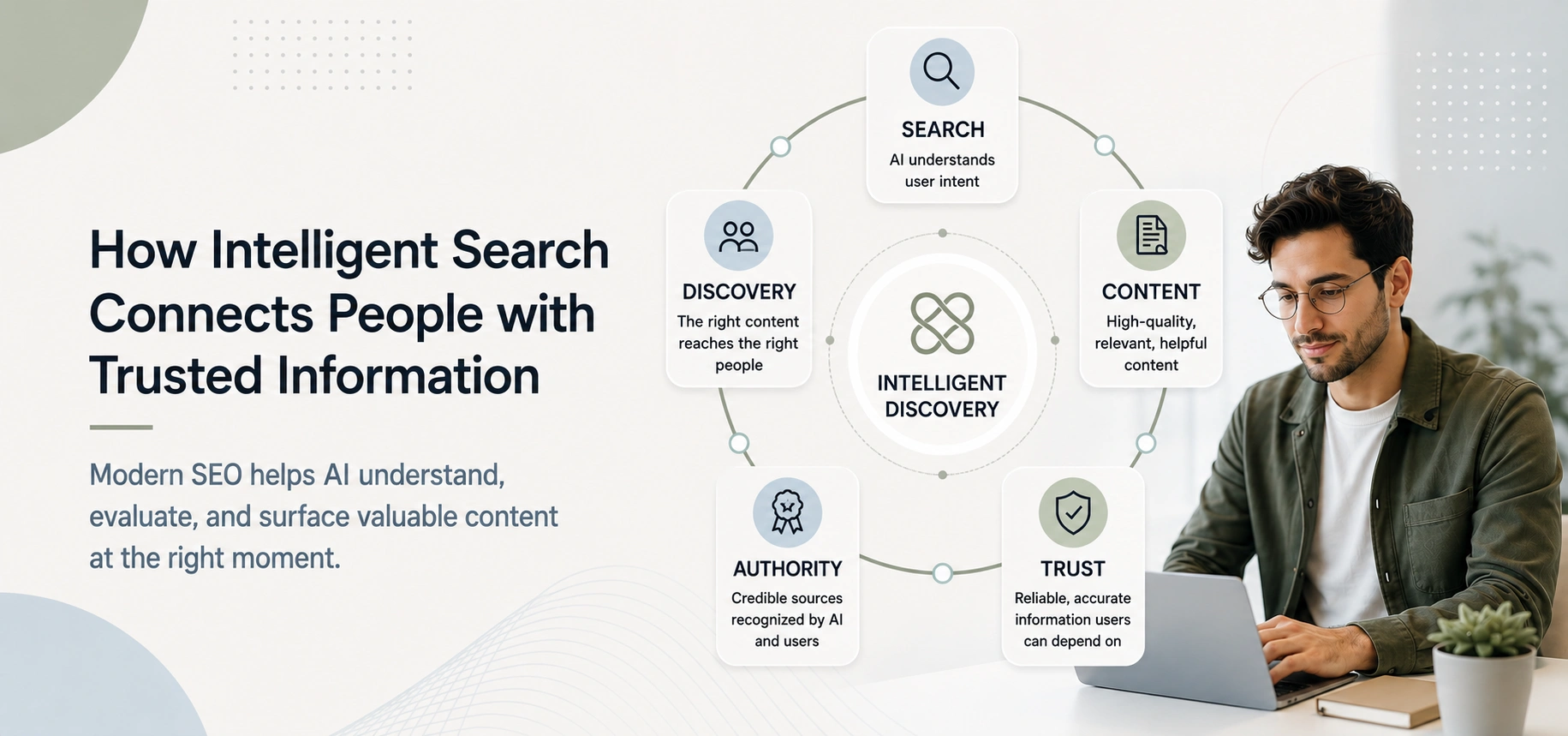
In 2026, Google, Bing, and emerging AI-native search platforms have fully evolved into what industry insiders are calling "answer engines." They don't just index pages anymore; they understand context, synthesise information, and serve curated solutions directly to users. The search engine has become less of a librarian and more of a highly opinionated research assistant.
Before AI entered the picture, the web was a chaotic repository of "floating content", blog posts, product pages, and videos existing in a vacuum with no real connection to the people who needed them. AI changed that. It brought structure to the chaos by acting as a sophisticated recommendation engine, connecting content to real human intent at scale.
For brands and content creators, this shift has forced a fundamental rethink of how websites are built. Modern sites are being designed as modular data environments, structured not just for human readers, but for AI agents to crawl, understand, and extract meaning from. If your website isn't built with that in mind, the AI gatekeepers simply won't know what to do with you.
"If SEO is not done, your website is like a shop with no address. Posting content without SEO is like uploading a video to a platform where no one has the link. The content exists. But it does not live."
This is the core tension of 2026: the internet has more content than ever before (much of it AI-generated spam), but less of it is actually discoverable. That's a massive opportunity for brands willing to invest in SEO properly. The signal cuts through the noise, but only if it's built right.
For modern strategists, this means our role has moved well beyond "ranking for keywords." We're now architects of digital trust. Every piece of content must align with how AI evaluates quality and authority. The framework that governs this? E-E-A-T: Expertise, Experience, Authoritativeness, and Trustworthiness. Without these signals embedded throughout your content, your brand remains "floating", technically online, but effectively invisible to the AI systems that determine who gets seen.
SEO and Performance Marketing: The Power Couple Nobody's Talking About
For years, marketing teams ran SEO and paid advertising as completely separate operations. Different budgets. Different KPIs. Different teams that rarely talked to each other. In 2026, that siloed approach is leaving serious revenue on the table.
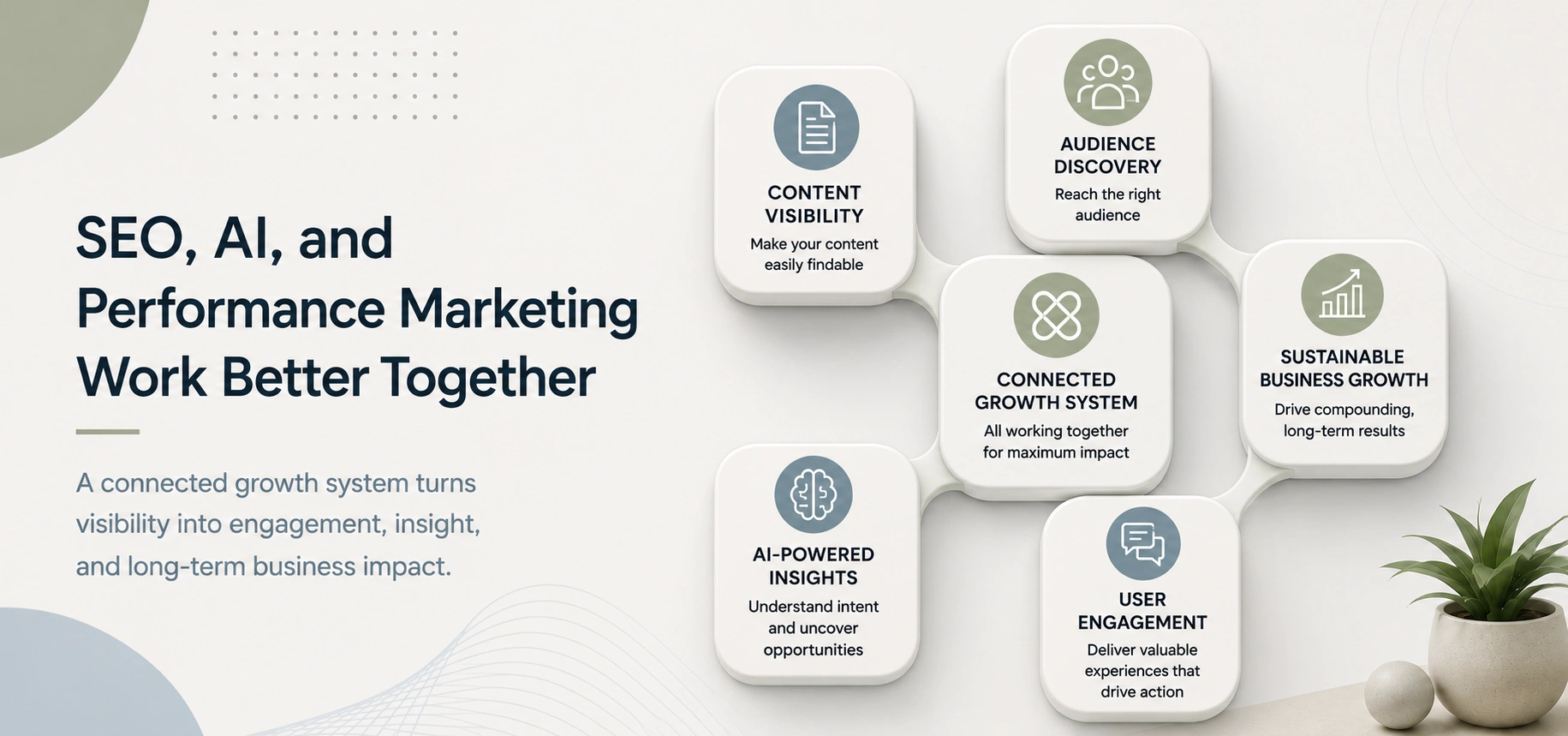
The most profitable companies today treat SEO and performance marketing as a unified circulatory system. SEO is the quiet engine that keeps the whole machine running, feeding the high-intent audience data that makes every paid campaign dramatically more efficient. Here's how it actually works in practice.
The 2026 Integrated Funnel: Step by Step
- Search & Discovery: A potential customer types a high-intent query like "best online MBA in AI and ML" into a search tool or AI assistant. They're not browsing; they're actively looking for a solution.
- The Organic Visit: Because your content is properly optimised, your site appears as a top recommendation. The user clicks through voluntarily; no ad spend required for this first touchpoint.
- Intent Mapping: Once on-site, tracking tools capture this user's behaviour. The system now knows they're deeply interested in a specific solution.
- Smart Retargeting: Ads begin appearing on social media, YouTube, and AI-driven content feeds, but these aren't cold ads reaching strangers. They're tailored reminders to someone who already showed intent.
- Conversion: The user, who already trusts your brand from their organic discovery experience, returns and converts.
Three Approaches, One Clear Winner
The Ads-Only Trap: This is a high-risk, low-sustainability model. The moment you stop spending, traffic drops to zero. No equity. No residual authority. Just a recurring bill with no long-term return.
The SEO-Only Limitation: Organic traffic builds authority beautifully, but without a mechanism to re-engage visitors who didn't convert, you're leaving money on the table. Your competitor who retargets will win the sale you earned.
The 2026 Synergy: The winning formula is simple: SEO opens the door; ads bring the person back. SEO fills the top of your funnel with high-intent, already-interested users. Performance marketing re-engages them at the right moment. AI optimises the timing, message, and channel to maximise ROI. Together, they compound. Separately, they underperform.
AI-Driven SEO in Practice: What's Actually Changed
SEO in 2026 is not what it looked like five years ago. It's a multi-dimensional discipline powered by automation and predictive analytics. Understanding the distinct layers is essential for anyone looking to get serious about organic growth.
On-Page SEO has evolved into what practitioners now call "Intent-Based Creation." It's no longer about hitting a word count or stuffing in keywords. It's about information density, giving users and AI agents the most valuable, contextually rich answer possible in the most parseable format.
Technical SEO has become the bedrock of "AI readiness." Site speed, Core Web Vitals, and structured Schema markup aren't optional extras anymore. They're the foundation that allows search engines to find, crawl, and understand your site's context without friction. If your technical foundation is weak, everything built on top of it is compromised.
Off-Page SEO has shifted from link quantity to link quality. AI tools are now incredibly good at identifying authentic "digital footprints", genuine brand mentions, citations, and digital PR that signal real-world authority. Gaming this with low-quality backlinks is a losing strategy in the age of AI evaluation.
Local and E-commerce SEO have both been transformed by voice search and AI assistants. Local SEO now serves AI agents looking for proximity and real-time reviews. E-commerce SEO leverages AI to optimise massive product catalogues, turning individual product pages into direct conversion points from search.
AI-Driven SEO is the most significant addition to the modern toolkit. It uses automation and predictive analytics to anticipate user needs before they even finish typing a query. More importantly, it helps search engines distinguish between genuinely helpful content and the AI-generated spam flooding the internet. The algorithmic gatekeepers of 2026 are too sophisticated to be fooled by keyword density or surface-level content. They reward real value, delivered with strategic precision.
Why SEO Careers Are Booming; Despite (and Because of) AI
Here's the irony that's reshaping the job market: despite AI being capable of producing a thousand blog posts per minute, the demand for skilled human SEO professionals has never been higher. And it makes sense when you understand what AI actually does.
AI is a tool of efficiency. It processes data, identifies patterns, and automates repetitive tasks at scale. What it can't do is think strategically about a brand's unique goals, understand the cultural nuances of a target audience, or make judgment calls about what actually matters to real humans. That's where SEO professionals come in, and why they're being compensated accordingly.
In 2026, SEO is recognised not as a technical expense, but as a genuine business asset. When a skilled strategist applies SEO correctly, a blog post becomes a perpetual traffic engine. A product page becomes a lead generator that works 24/7 without ad spend. The ROI compounds over time in ways that paid advertising simply cannot replicate.
The 2026 Career Landscape
In-House SEO Strategists are in high demand as corporations bring SEO talent inside to manage brand signals and build long-term organic authority. These roles are focused on converting content into measurable revenue.
Agency Specialists are thriving by offering high-level AI tool integration, helping diverse clients navigate backlink analysis, technical audits, and content strategy across complex portfolios.
Freelance Consultants are carving out a thriving niche by helping startups compete with established players. With the right AI tools, a single skilled consultant can now execute strategies that previously required entire departments.
Compensation reflects this "business asset" reality. High-level SEO strategists who can demonstrate a direct correlation between organic discovery and marketing ROI are commanding premium salaries. It's a career-proof skill because it requires something AI genuinely cannot replicate: understanding the "why" behind human behaviour and translating that into digital architecture.
Let's Kill the Myths: An Honest Reality Check
The rapid evolution of AI has spawned some genuinely damaging myths in the SEO world. Let's address the three biggest ones directly.
|
SEO Myth (2026) |
Reality (What Actually Happens) |
What This Means in Practice |
|
“SEO is dead because AI search and LLMs answer everything directly.” |
Search behaviour is not disappearing, it is changing form. People still look for sources they can trust. In 2026, SEO is about making sure your brand becomes the source that AI cites and recommends. If your content is not optimised, AI will route users to competitors who are. |
SEO now means optimising for AI discovery, brand credibility, and being cited in AI answers. Ranking is not just about blue links anymore. It is about becoming the trusted source AI pulls from. |
|
“AI will replace SEO professionals entirely.” |
AI generates output, but humans create outcomes. AI can scale content production, but human strategists decide what to build, why it matters, and how it aligns with brand voice, business goals, and user intent. Strategy is the real differentiator, and strategy is human-led. |
SEO professionals who understand strategy, user intent, and brand positioning will become more valuable, not less. AI becomes a tool, not a replacement. |
|
“Just get the right tools, and you’ll be fine.” |
Tools provide data, not direction. Using AI tools without a clear strategy is like owning a high-performance car with no one who knows how to drive it. When everyone has access to similar tools, clear thinking and strategy become the true advantage. |
Winning in SEO in 2026 depends on decision-making, prioritisation, and clarity of thinking. Tools help execution, but strategy decides outcomes. |
Your 2026 Roadmap: How to Actually Get Good at This
If you're ready to lead in this new era rather than play catch-up, the path forward is clear. It requires combining the foundational principles of search with expert-level fluency in modern tools.
- Start with Technical Foundations. Master the mechanics of crawling and indexing in an AI-heavy environment. Develop a deep understanding of Core Web Vitals and Schema markup; these are the "contextual maps" that tell AI agents exactly what your site is about and why it should be trusted.
- Build fluency across the essential tool categories: technical audit tools that verify your site's structural integrity, backlink and digital PR tools that measure and build authority signals, rank tracking and analytics platforms that monitor visibility across both traditional and AI-led search, and AI-powered content optimisation tools that ensure everything you publish is high-quality and intent-aligned.
- Prepare for Multi-Modal Search. Text is no longer the only game in town. Voice search, visual search, and AI agents who search on behalf of users are all growing rapidly. Future-proofing your SEO strategy means building content and technical infrastructure that serves all of these modes.
- Practice Intent-Based Creation. Shift your mindset from "what keywords do I want to rank for" to "what questions is my audience actually asking?" High-intent queries like "how to learn SEO in 2026" or "AI SEO tools for beginners" are goldmines because they signal someone who's ready to engage.
- Build something real. Theoretical knowledge is not enough. Create a practice website. Implement Schema markup. Run technical audits with AI tools. Watch your content move from "floating" to "living." There is no substitute for hands-on experience, and there is no better time to start than now.
Conclusion: SEO Is Your Most Durable Investment
In 2026, SEO is no longer an optional marketing tactic. It is the core of sustainable digital growth. It is the practice of building compounding equity, the kind that appreciates over time instead of evaporating the moment your ad budget runs out.
Paid ads give you a temporary spike. SEO builds a permanent foundation of trust, discoverability, and revenue. The gap between brands that are winning and brands that are struggling in today's digital marketplace is, more often than not, a visibility gap, and SEO is how you close it.
The internet of 2026 is noisier, more competitive, and more AI-mediated than anything we've seen before. In that environment, the brands that treat SEO as a genuine business asset will see their content live, breathe, and compound. The ones who ignore it will find their content floating in the noise of a billion other voices, technically online, effectively invisible.
So here's the question worth sitting with: In this age of AI-driven discovery, does your content currently have a living address, or is it just floating in the noise?
FAQs:
Is SEO still relevant in 2026 when AI answers most queries directly?
Yes. SEO is more relevant than ever, but its role has evolved. In 2026, SEO is not just about ranking links. It is about making your brand the source that AI search engines trust, cite, and recommend. If your content is not optimised for AI discovery, AI systems will surface your competitors instead.
Will AI tools replace SEO professionals?
No. AI improves speed and scale, but it does not replace strategy. SEO professionals are needed to define goals, understand audience psychology, shape brand voice, and connect SEO outcomes to business growth. AI executes tasks. Humans decide what actually matters.
Is SEO still a good career choice for students and working professionals?
Yes. SEO has become a core business skill rather than a narrow technical role. Professionals who can link SEO performance to leads, sales, and brand growth are in strong demand across startups, agencies, and enterprises. It is a durable career path because it sits at the intersection of technology, psychology, and business strategy.
Can beginners still learn SEO effectively in the AI era?
Yes. AI tools have lowered the barrier to entry by automating research and analysis. What beginners need to focus on is understanding fundamentals, search intent, technical structure, and how content connects to real business goals. Hands-on practice accelerates learning far more than theory alone.
How do SEO and performance marketing work together in 2026?
SEO brings high-intent users to your website organically. Performance marketing re-engages those users with tailored ads after they leave. SEO fills the top of the funnel with qualified traffic. Paid campaigns convert that interest into measurable revenue. AI optimises timing, channels, and messaging across both.
If this shift toward AI-driven search and strategic SEO resonates with you, it might be time to formalise your skills. A structured program can help you move beyond tools and into real-world strategy, performance marketing, analytics, and leadership.
The LPU Online MBA in Digital Marketing is designed for professionals and graduates who want to build strong foundations in SEO, performance marketing, AI-driven growth, and brand strategy. It focuses on practical, industry-aligned learning that prepares you for how digital growth actually works in 2026, not how it used to work.