

.png)
Humans are no longer making decisions. Open any news app today, and you’ll see it everywhere.
Algorithms deciding who gets a loan. Systems screening resumes before a human ever sees them.
AI is predicting diseases, risks, trends, and even human behaviour.
Innovation is no longer working at the backend. It’s shaping real lives, real opportunities, and real consequences. And somewhere in this speed and scale, data has become a living part of every individual’s life. But the question is: Just because we can build something with data, does it mean we should?
This is the shift most professionals feel but struggle to put into words. Some individuals don’t want to just work with data but want to learn how to use it responsibly. This is what separates specialists from leaders.
If you’re considering becoming an expert in understanding how data could be more than mere numbers. An Online MBA in Data Science will equip you to make decisions, not just dashboards. You will be able to innovate without losing ethics, trust, or hampering your day-to-day jobs and responsibilities.
This blog will explain what responsible innovation really means in the age of AI, why technical skills alone are no longer enough, and how an Online MBA in Data Science equips you to lead data-driven decisions with clarity, accountability, and purpose.
What “Responsible Innovation” Really Means in the Age of AI
Remember how people used to send emails for communication, and now it's just so many applications for interaction. You can now virtually interact with each other over video calls, making you feel close in real time. This is how innovation today moves. Faster than policies. Faster than awareness. Faster than most people can fully understand its impact.
It takes days to innovate data models. AI tools scale to millions of users overnight. Decisions that once took teams and weeks are now automated in seconds.
But not every creativity is useful, and not every innovation can be termed as responsible. It is all about not how fast something can be built, but how thoughtfully it should be used.
At its core, responsible innovation means creating data-driven solutions that are ethical, transparent, fair, and accountable, while keeping real human consequences in focus. It’s about ensuring that progress doesn’t come at the cost of trust, inclusion, or long-term harm.
And in the age of AI, this mindset is no longer optional.
Why Technical Skills Alone Are No Longer Enough
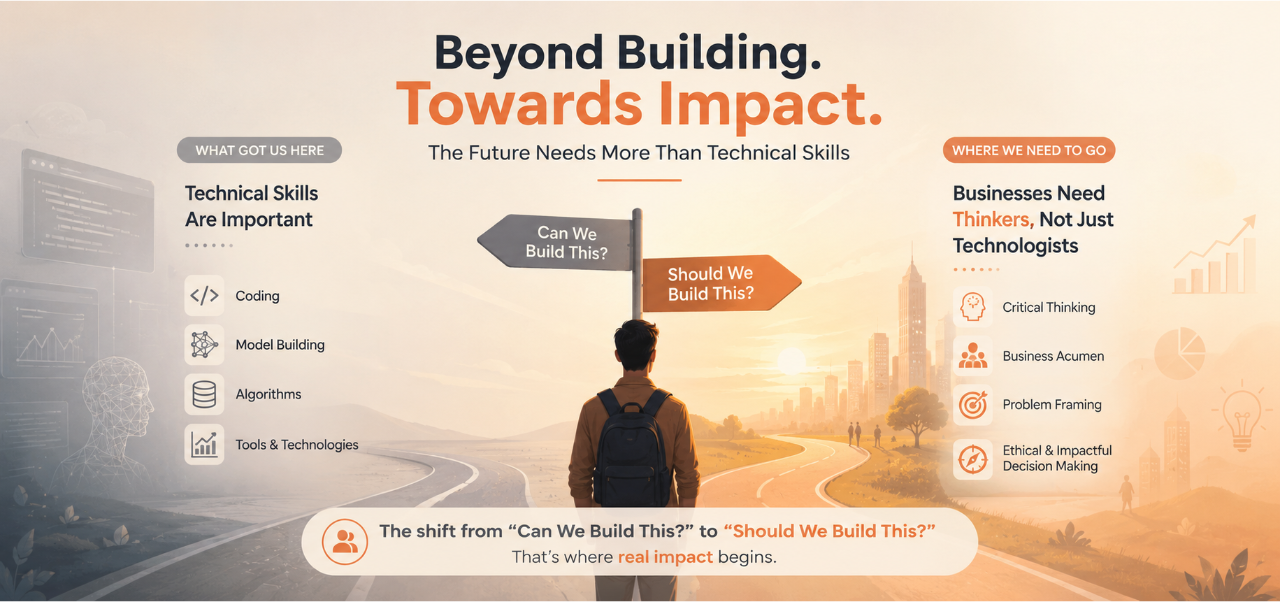
Every job posting now has a basic requirement of “Technical skills”. Many misunderstand it as knowing how to code faster, build models better, or deploy systems quicker. But No. It is not only about understanding the technicalities but also about how to adapt this technology to meet the industry's requirements wisely.
Technology is no longer experimental. It’s embedded in decision-making, customer experiences, compliance, and long-term business strategy. Every line of code now carries consequences beyond the screen.
Knowing how something works is important.
Understanding when, why, and whether it should be used is what now defines readiness.
The Limits of Pure Coding and Model Building
Have you ever seen a coder writing clean code or training accurate models? But it’s only one piece of a much larger puzzle.
An application model created can be technically perfect and still fail in the real world.
It can be accurate on paper, but misaligned with business goals.
It can perform well in testing but create confusion, mistrust, or unintended consequences when deployed.
Technical training alone can often focus on what can be built, not what should be built. It teaches execution, but not evaluation. Performance, but not perspective.
In real organisations, not every problem is just technical. The problems could be focused on budget, users, regulations, ethics, timelines, and long-term impact. And these are questions code alone cannot answer.
Businesses Need Thinkers, Not Just Technologists
To make a single decision, businesses require a deep deliberation and discussion on not just how that decision will be implemented, but also how the impact and effects are expected, and what could go wrong.
That’s why companies don't trust resumes filled with tools and certifications. They’re looking for professionals who can:
- Interpret insights in context
- Explain technical outcomes to non-technical stakeholders
- Balance innovation with risk
- Align data solutions with business objectives
A strong professional today is someone who understands data, but also understands people, processes, and purpose. Someone who can sit at the intersection of technology and strategy and make sense of both.
The Shift from “Can We Build This?” to “Should We Build This?”
You are a working professional, working in an industry where your ideas and perspectives are heard, paid attention to, but might not always be accepted. It is not because your ideas were not strong enough or the company lacks resources; it is about the responsibility the implementation holds now. Possibilities are everywhere. But not every possibility holds positive consequences.
Suppose you are given a task to build an application holding all important documents of in-house company employees. You know coding, so you can make it effectively. But does it eradicate the risk of the application not being hacked? Before launching a system, leaders are asking deeper questions:
- What problem are we truly solving?
- Who will this affect?
- What are the risks if it fails or is misused?
- How do we monitor and correct it over time?
And this shift is exactly why advanced programs, especially an MBA in Data Science, focus not just on tools, but on judgment, governance, and long-term thinking.
Because in today’s world, readiness isn’t about knowing everything. It’s about knowing what matters.
How an Online MBA in Data Science Bridges Technology and Judgment
There comes a stage in every data professional’s journey where learning new tools no longer feels like progress. You may know how to analyse data, build models, or interpret trends, but when those insights start influencing real business decisions, the stakes change.
This is where judgment becomes as important as technical skill.
An Online MBA in Data Science is designed for this exact moment. It goes beyond teaching how data works and focuses on how data should be used in real organisations where decisions involve ethics, business impact, risk, and long-term responsibility.
It prepares professionals not just to work with data, but to lead with it, even while managing ongoing careers and responsibilities.
Understanding the Business Impact of Data Decisions
An Online MBA in Data Science trains you to evaluate consequences before conclusions. You learn to look beyond accuracy and ask:
- Will this decision scale responsibly?
- How does it affect customers, teams, and trust?
- What risks come with automation or prediction?
- How will leadership and stakeholders respond?
By studying business, management, and data together, you learn to align insights with outcomes: a skill that purely technical programs rarely develop.-
This is what makes MBA-trained data professionals more effective in leadership roles.
Turning Data Insights into Responsible Action
One of the biggest gaps in data-driven organisations today isn’t analysis, but it’s action.
An Online MBA in Data Science focuses on bridging this gap. It trains you to translate insights into decisions that can be implemented, justified, monitored, and improved over time.
You learn how to:
- communicate insights clearly to non-technical stakeholders
- balance innovation with ethical responsibility
- make decisions that create value without creating risk
This ability to move from insight to responsible action is at the heart of what employers now look for in data leaders.
Why an Online MBA in Data Science Makes Sense Today
Companies aren’t just looking for data experts. They’re looking for people who can balance intelligence with intention. This is not something you should learn, but it is what the market is asking for. As per a survey conducted by The Financial Express, India now leads the world in demand for data analytics skills. Nearly one out of every five job postings (17.4%) actively looks for professionals who can understand and work with data, almost twice the demand seen in the US.
Careers don’t pause anymore, and learning shouldn’t demand that they do. An Online MBA in Data Science is built for professionals who want to grow without stepping away from work or life responsibilities. It offers:
- flexibility without compromising depth
- industry-aligned curriculum with real-world relevance
- LIVE sessions and recorded lectures
- Online examinations and personalised date sheet
Core Skills You Develop in an Online MBA in Data Science
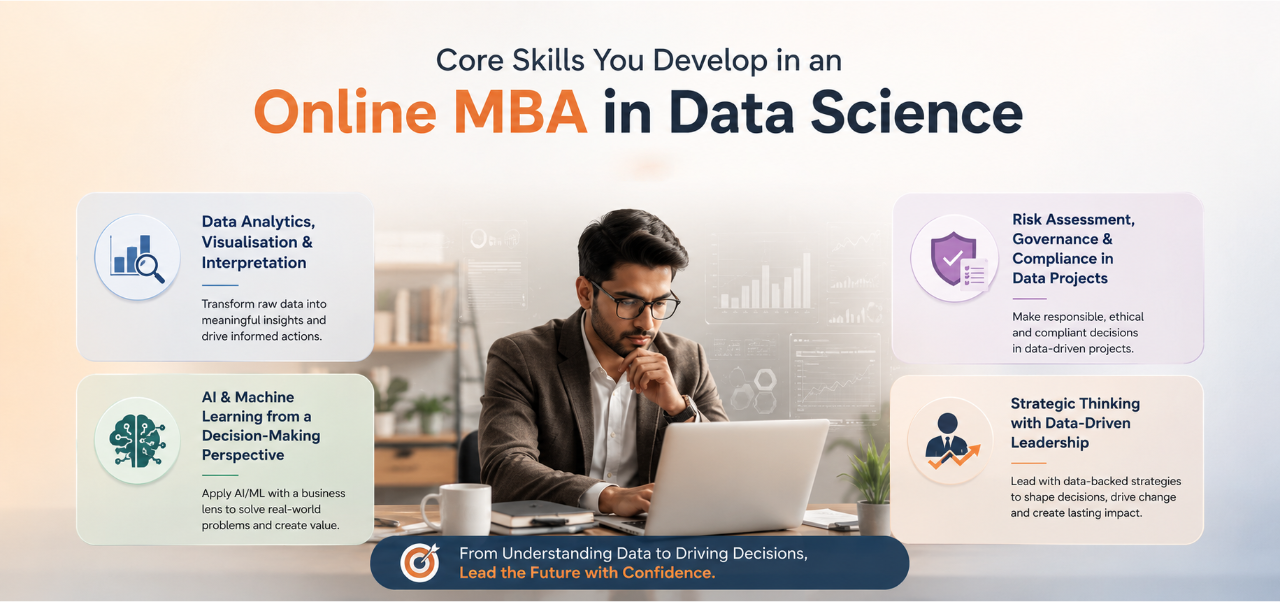
Sitting in a work meeting, listening to people talk about data, reading analytics charts, and coding an application. You want to learn all of it, too, but your work commitments leave no time to pursue a degree. An Online MBA in Data Science isn’t about turning into a pure coder or a research scientist. Its
The skills you develop aren’t isolated. They build on each other, helping you move from analysis to insight, and from leadership insight. This is where technical knowledge meets responsibility, clarity, and confidence.
Data Analytics, Visualisation & Interpretation
You are someone who loves to play with numbers, understand patterns hidden behind data, and make sense of it. Predicting future trends, analysing customer behaviour, and finding out the results of implemented decisions.
In an Online MBA degree in Data Science, you understand what data is saying, what it’s not saying, and what questions it’s pushing you to ask next.
Visualisation becomes more than charts and dashboards. It becomes a communication tool: one that helps decision-makers quickly grasp patterns, risks, and opportunities.
This skill is critical because in real organisations, the value of data lies not in complexity, but in clarity.
AI & Machine Learning from a Decision-Making Perspective
You are stuck on a problem, the first thing you do nowadays is open an AI tool and seek solutions. Whether it is a work situation or day-to-day confusion. This algorithm, which is working behind AI assisting you in seconds, is not a technical subject. You can learn it too with an Online MBA as a decision-making tool.
Instead of focusing only on algorithms and accuracy scores, you learn:
- Where AI adds value
- Where automation makes sense and where it doesn’t
- How predictions influence strategy and operations
- What happens when models fail or behave unexpectedly
You begin to see AI not as a black box, but as a system that must be questioned, monitored, and aligned with business goals. This perspective is essential for professionals who want to lead AI adoption, not just support it.
Risk Assessment, Governance & Compliance in Data Projects
Everything you do holds the risk of failure, but you still do it, mitigating the risks. Similarly, every data-driven decision carries risk, whether it’s privacy, bias, compliance, or reputation.
An Online MBA in Data Science prepares you to identify these risks before they turn into problems. You learn how governance frameworks work, why compliance matters, and how ethical lapses can undo years of trust.
More importantly, you learn how to design data projects that are accountable and sustainable, not just innovative. This skill is what allows organisations to make reliable decisions in high-stakes environments.
Strategic Thinking with Data-Driven Leadership
At its highest level, data science is not about analysis, but it’s about direction.
An Online MBA program in Data Science develops your ability to think strategically: to connect insights with long-term goals, to balance short-term wins with long-term impact, and to lead teams through uncertainty.
You learn how to:
- frame the right questions
- guide conversations using evidence
- influence decisions across functions
- lead with confidence in data-backed environments
This is the skill that turns data professionals into leaders and analysts into innovators.
Conclusion
You know data, you know how to build models, you know how to code. But it's not enough! In a world where algorithms influence lives, careers, and opportunities, how you use data matters as much as how well you understand it.
This is where careers begin to diverge. Some professionals remain focused on tools, outputs, and execution.
Others step forward: questioning impact, understanding responsibility, and leading decisions with clarity and intent.
The difference is in preparation.
LPU Online offers an Online MBA in Data Science that prepares you for this shift. It helps you move from analysing information to shaping outcomes, from supporting decisions to owning them. It combines data science, business strategy, ethics, and leadership into one future-ready degree.
You don’t just learn how innovation works. You will be able to mould data as per the organisation’s demands.