

Every year, thousands of graduates walk out with degrees that took three years to complete and job descriptions that did not exist when they enrolled. That is not bad luck. That is the speed at which industries are moving now.Companies are not struggling to find hardworking people. They are struggling to find people who can look at a dataset and tell a room full of decision-makers what to do next. That skill is rarer than it sounds, and the gap between those who have it and those who do not is quietly becoming one of the most consequential divides in the modern workplace.
Business analytics is the bridge across that gap. A Master's gives you the depth to not just run the numbers, but interrogate them, reframe the question, and change what a business actually does.
And the online format today goes beyond convenience. The best programmes are structured around live industry problems, built for professionals who want to apply what they learn the same week they learn it. That combination of academic rigour and immediate real-world application is what makes it a genuinely distinct choice in 2026.
So is it actually worth it? Let's find out.
Why Business Analytics Has Become a Career Magnet in 2026
The world is not short of data. It is short of people who know what to do with it.
Every transaction, every customer interaction, every operational decision leaves behind a trail of information that most organisations are sitting on without fully understanding. The companies winning right now are not the ones with the most data. They are the ones with professionals who can turn that data into a direction.
That shift has made business analytics one of the most sought-after skill sets across industries, and it is only accelerating.
The Demand That Is Reshaping Hiring
Employers today are not just looking for experience. They are looking for a specific kind of thinking. The ability to clean raw data, identify what it is actually saying, build a case around it, and recommend a course of action with confidence. That capability used to live in specialised technical teams. Now it is expected across functions, from marketing and finance to operations and product.
The result is a hiring environment where analytics-trained professionals are not competing for a narrow set of roles. They are being pulled across industries, geographies, and seniority levels simultaneously.
What Makes It a Smarter Career Bet
Business analytics does something most traditional paths do not. It compounds. The skills transfer across sectors, the roles command strong salaries, and the demand is not tied to any single industry cycle. Whether the economy is expanding or contracting, organisations need people who can make sense of what is happening and advise on what to do next.
That cross-industry relevance, combined with faster career growth and genuine global applicability, is why students and working professionals alike are choosing analytics not as a backup plan, but as a deliberate first choice.
Why an Online Master's in Business Analytics Is a Serious Degree in 2026
There was a time when listing an online degree on your resume came with an unspoken asterisk. That time has passed.
In 2026, the question is no longer whether an online degree is credible. The UGC settled that by declaring online degrees fully equivalent to traditional ones for employment and higher education. The more relevant question now is whether the programme you choose is actually preparing you for the work that exists today. And on that front, the best online Master's programmes in business analytics have a compelling case to make.
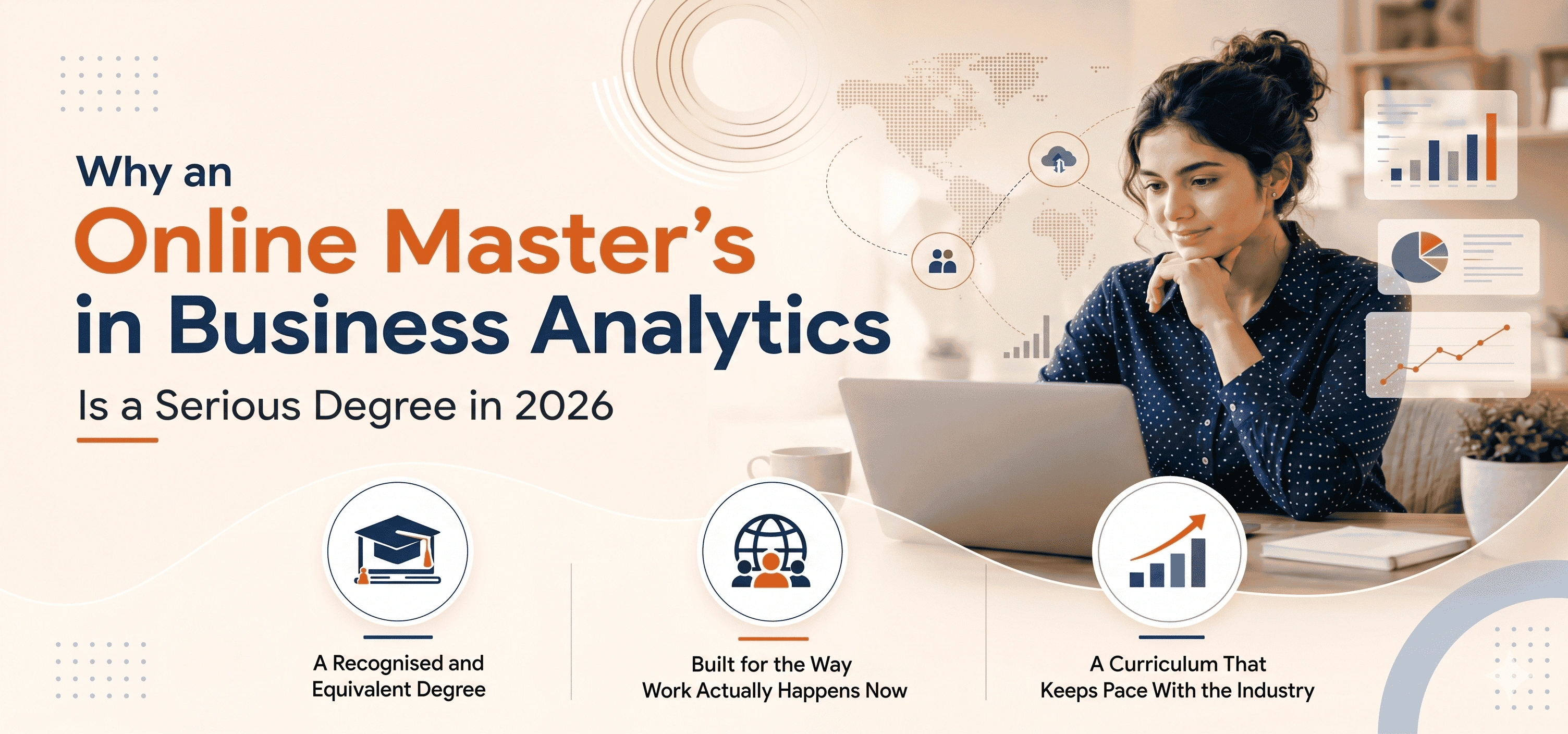
Built for the Way Work Actually Happens Now
The modern workplace does not look like a classroom. It looks like a shared dashboard, a cross-functional thread, a client presentation built the night before from live data. Online learners are already operating in that environment, and employers building remote and hybrid teams know it.
- They collaborate across time zones without needing to be taught how
- They manage deliverables independently, without hand-holding
- They work comfortably inside the same digital infrastructure most organisations now run on entirely
- They bring a level of digital fluency that translates directly into day-one productivity
A Curriculum That Keeps Pace With the Industry
Business analytics is not a static field. The tools, techniques, and expectations shift continuously. The strongest online programmes are structured to reflect exactly that.
- Curricula are updated regularly to reflect current industry standards
- Industry practitioners are involved in course design and delivery
- Learning is structured around real problems, not hypothetical scenarios
- Students work with tools that are actually being used in the market right now
- Capstone projects and case studies ensure application, not just absorption
The outcome is a graduate who does not need a transition period between study and practice. They are already thinking and working like professionals before the degree is complete.
The Profile That Stands Out
Completing an online Master's while managing work, life, or both requires a specific kind of discipline that does not go unnoticed. Recruiters who have hired online graduates consistently point to one thing: they tend to show up differently.
- They demonstrate accountability without needing an external structure
- They have proven they can stay consistent without a fixed timetable
- They are comfortable with ambiguity and self-directed progress
- They bring maturity that comes from balancing real responsibilities alongside rigorous study
These are not soft qualities. They are exactly what fast-moving, output-driven organisations are trying to hire for. And an online degree, completed well, is quite evidence that you have them.
What Do Employers Really Want in 2026? A New Hiring Mindset
Here's the rewritten section:
What Employers Actually Want in 2026
The conversation in hiring rooms has changed. A decade ago, the first thing a recruiter looked at was the institution's name. Today, that is rarely the deciding factor. What sits across the table matters far more than where the candidate studied.
HR leaders across industries are now saying it plainly: they hire for what a candidate can do, not for the format of their education. And that shift has quietly levelled the playing field in ways that benefit analytically trained professionals more than almost anyone else.
Here is what the modern employer is actually screening for:
- The ability to work with data tools and extract meaning from them
- Digital fluency across platforms, not just theoretical understanding
- Real project experience that demonstrates applied thinking
- Problem-solving under pressure with incomplete information
- Communication skills are strong enough to translate complex findings into clear decisions
- Adaptability in roles that did not have a fixed job description two years ago
The good news for anyone pursuing an online Master's in Business Analytics is that these are precisely the qualities such a programme is designed to build. Project-based learning, live industry tools, capstone work, and the discipline of self-directed study all feed directly into the profile that employers in 2026 are actively looking for.
The degree format is no longer the question. The capability is.
How Online Graduates Stand Out During Hiring
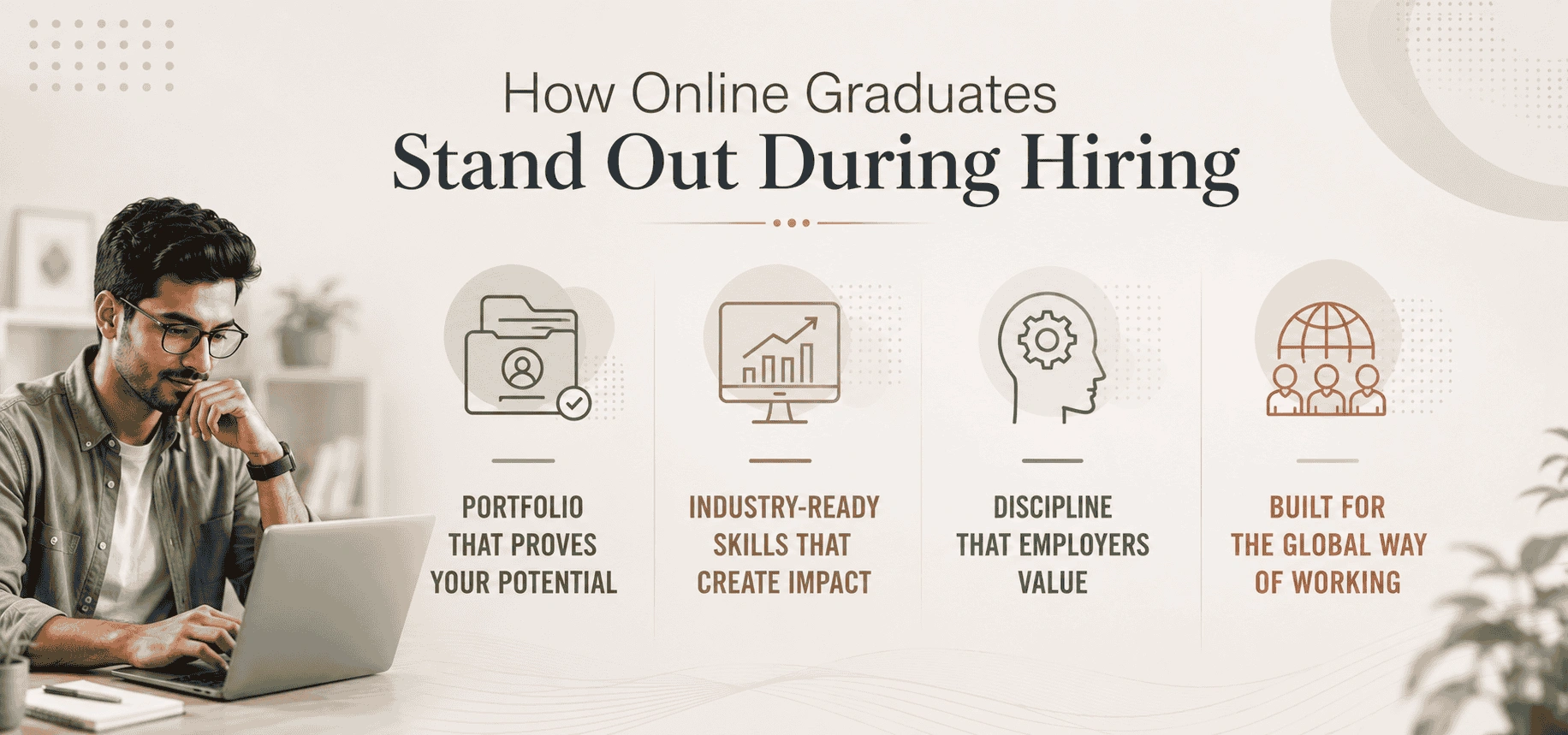
Credentials open doors. But what sits behind the credential is what actually gets people hired. Online graduates pursuing a Master's in Business Analytics tend to arrive at interviews with something that increasingly matters more than grades: evidence.
Evidence of applied thinking. Evidence of tool proficiency. Evidence of the kind of discipline that only comes from managing serious study alongside real life.
A Portfolio That Speaks Before You Do
While traditional assessment ends at marks, online programmes build something more tangible. By the time an online graduate walks into a hiring conversation, they typically have a body of work that a recruiter can actually evaluate.
- Capstone projects built around real business problems
- Data-led case studies with documented methodology and outcomes
- Tool-based assessments that demonstrate practical capability
- Industry assignments that mirror the kind of work the role requires
That portfolio does not just support the resume. In many cases, it replaces the need for a lengthy explanation of what the candidate can do.
Tool Proficiency That Translates Immediately
Business analytics roles do not have a learning curve budget. Employers want professionals who can open the right tool and get to work. Online programmes integrate industry-standard platforms directly into the curriculum, which means graduates arrive already fluent in the tools their teams are using.
- Power BI and Tableau for data visualisation
- SQL and Python for data querying and analysis
- R for statistical modelling
- Advanced Excel for business reporting
- Google Analytics, IBM and AWS modules for applied industry contexts
This is not supplementary knowledge. It is the core of what makes an analytics hire immediately productive.
The Discipline That Hiring Managers Notice
There is a particular kind of candidate that stands out in competitive hiring processes. Not the one with the longest list of qualifications, but the one who clearly knows how to get things done without being managed. Online graduates who have balanced rigorous study with professional or personal responsibilities carry that quality into every room they enter.
- They have demonstrated commitment over an extended period without external accountability
- They have managed competing priorities without compromising on either
- They bring a maturity and drive that show up in how they approach problems, not just how they describe them
And for organisations building hybrid and global teams, there is one more advantage. Online learners have spent their entire programme collaborating digitally, navigating virtual tools, and working across time zones. They do not need to be onboarded into that way of working. They already live in it.
How Different Sectors in India Are Hiring Online Analytics Graduates
Acceptance of online degrees is no longer limited to a handful of forward-thinking companies. Across industries, hiring managers are evaluating candidates on capability first, and the sector breakdown reflects exactly that shift.
- Information Technology and Software: Skill-based hiring dominates here. Proficiency in Python, SQL, cloud platforms, and analytics matters far more than how or where the degree was completed.
- Digital Marketing and Media: These industries move at digital speed and actively prefer graduates trained through programmes that match that pace and agility.
- Banking, Financial Services and Insurance: Data modelling, forecasting, and risk analytics are now core functions, not specialist ones. Online analytics graduates are performing strongly in this space.
- E-Commerce and Startups: Adaptability, hands-on capability, and the ability to hit the ground running are exactly what fast-scaling organisations need. These are traits online learners develop naturally through the format itself.
- Consulting and Management: The combination of business understanding and data fluency is increasingly what consulting firms are building their teams around, and online analytics graduates sit squarely at that intersection.
The common thread across all of these sectors is the same. What you can do with data, and how quickly you can apply it, matters far more than the classroom it was taught in.
The Future of Hiring Is Already Pointing in One Direction
The shift toward hiring online graduates is not a temporary adjustment. It is a structural change, and the signals are consistent across every major industry.
- Online education quality is rising steadily, with more universities investing seriously in programme design and delivery
- Skills-based hiring is replacing degree-based hiring across sectors, putting capability at the centre of every recruitment decision
- Remote and hybrid work are now permanent fixtures, not pandemic-era experiments
- Government recognition and UGC equivalence have removed the last institutional barriers
- Industries are becoming more digital by the quarter, creating continuous demand for analytically trained, tech-comfortable professionals
The future belongs to professionals who can learn continuously and adapt quickly. Online programmes do not just teach that. They require it.
Conclusion
The professionals who will lead the next decade are not waiting to see how things unfold. They are already building for it.
Companies are deepening their dependence on data, employers are hiring for capability over credentials, and analytics fluency has moved from differentiator to baseline expectation. The window to get ahead of that curve is open, but it will not stay that way.
A Master's in Business Analytics puts you on the right side of that shift. And if you are looking for a programme built for exactly this moment, LPU Online's MBA in Business Analytics combines industry-aligned curriculum, real-world application, and recognised academic rigour into one strategic investment in your future.