

You're about to order your favourite product online. Maybe it's a limited-edition sneaker you've been waiting to buy, a gadget you've spent weeks researching, or simply your go-to snack that you reorder every month.
You open the website, search for the product, and get ready to click "Buy Now." Then you see two words no customer wants to encounter: Out of Stock.
Most of us react the same way. We feel disappointed, close the tab, and look for alternatives. But have you ever stopped to wonder what actually caused that product to go out of stock?
What appears to be a simple inventory issue is often the result of multiple business functions working together-or sometimes failing to do so effectively.
This is where logistics, supply chain management, and operations come into the picture. Although these terms are frequently used interchangeably, they represent distinct functions within an organisation. Understanding the logistics vs supply chain vs operations relationship can help students, professionals, and aspiring managers better understand how businesses create, move, and deliver products in today's interconnected world.
In this article, we'll explore the key differences between these functions, how they work together, and the career opportunities they offer in the modern business landscape.
Why an "Out of Stock" Message Isn't Always What It Seems
When customers see an out-of-stock notification, they often assume the company simply ran out of products. In reality, the situation is usually much more complex.
A product may be unavailable because demand suddenly increased beyond expectations. Production teams may not have manufactured enough units. Suppliers may have struggled to deliver raw materials on time. Inventory could be sitting in a warehouse but not where customers need it. Transportation delays may have prevented products from reaching stores or distribution centres.
In other words, an out-of-stock situation can be caused by challenges at different stages of the business process.
To understand where these challenges originate, it's important to understand three closely related but distinct functions: operations, supply chain management, and logistics.
Logistics vs Supply Chain vs Operations: Key Differences Explained
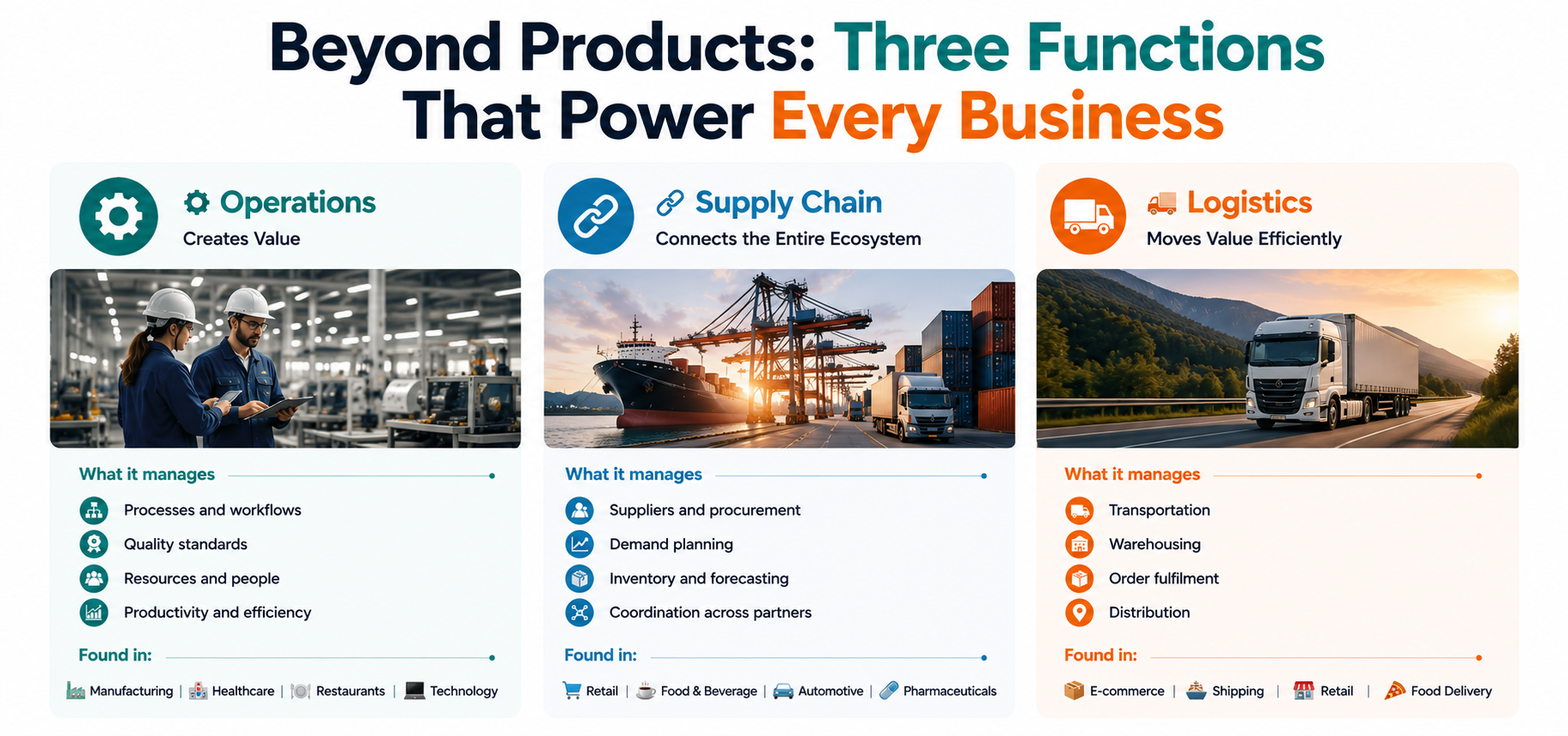
Although all three functions contribute to getting products into customers' hands, they differ in terms of focus, scope, and responsibilities.
Operations
Operations focuses on how products or services are created efficiently within an organisation. It involves managing resources, production processes, quality standards, and workforce productivity to ensure that business activities run smoothly.
In a manufacturing company, operations teams oversee the production process. In a restaurant, they ensure food preparation, staffing, and service quality meet customer expectations. Regardless of the industry, the goal of operations is to maximise efficiency while maintaining quality.
Supply Chain
Supply chain management focuses on the entire journey of a product, from sourcing raw materials to delivering the final product to customers. It involves coordinating suppliers, manufacturers, warehouses, distributors, and retailers to ensure products flow smoothly across the network.
Rather than focusing on a single process, supply chain management takes a broader view of how different organisations and activities work together to meet customer demand.
Logistics
Logistics is a specialised component of supply chain management that focuses specifically on the movement and storage of goods. It includes transportation, warehousing, inventory handling, order fulfilment, and distribution.
The primary objective of logistics is to ensure that products reach the right place at the right time while maintaining efficiency and controlling costs.
|
Aspect |
Operations |
Supply Chain |
Logistics |
|
Primary Focus |
Creating products and services |
Managing the end-to-end product journey |
Moving and storing products |
|
Scope |
Internal business activities |
Entire network from suppliers to customers |
Transportation and distribution activities |
|
Objective |
Efficiency and productivity |
Coordination and availability |
Timely delivery and inventory movement |
|
Key Activities |
Production, quality control, workforce management |
Procurement, planning, inventory, supplier coordination |
Warehousing, transportation, fulfilment |
A simple way to remember the difference is this:
Operations create. Supply chain coordinates. Logistics delivers.
Following the Journey of a Product: Where Each Function Fits
To better understand these functions, imagine a company launching a new smartphone.
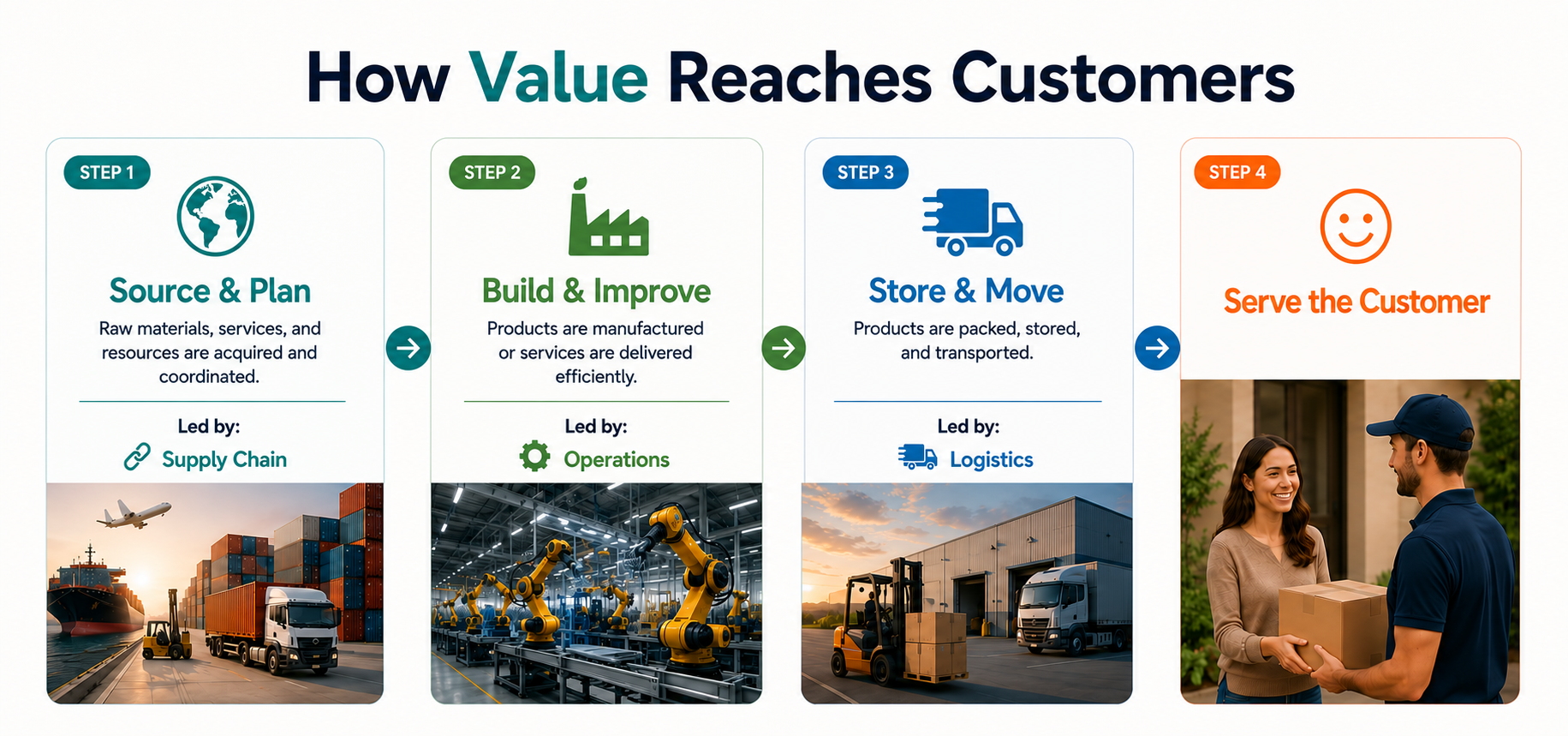
The journey begins long before customers place an order. Raw materials and components must first be sourced from suppliers around the world. Managing these supplier relationships and ensuring materials arrive on time falls within the broader scope of supply chain management.
Once the materials arrive at the manufacturing facility, operations teams take over. They oversee production schedules, monitor quality standards, manage resources, and ensure the smartphones are assembled efficiently.
After production is complete, logistics teams become heavily involved. The finished smartphones must be stored in warehouses, transported to regional distribution centres, shipped to retailers, and eventually delivered to customers.
Throughout this entire process, supply chain professionals continue coordinating activities across all stages, ensuring suppliers, manufacturers, warehouses, and logistics providers remain aligned.
This example highlights why these functions are interconnected yet distinct. While they share the same ultimate goal-satisfying customer demand-each contributes in a different way.
Career Opportunities in Logistics, Supply Chain, and Operations
As global commerce becomes increasingly complex, organisations are investing heavily in professionals who can improve efficiency, manage resources, and optimise business processes.
Some popular logistics management careers include Logistics Coordinator, Warehouse Manager, Transportation Manager, and Distribution Manager. These roles focus on ensuring products move efficiently across supply networks.
Supply chain professionals may pursue careers such as Supply Chain Analyst, Procurement Manager, Demand Planner, Inventory Manager, or Supply Chain Consultant. These roles often involve planning, forecasting, supplier management, and strategic decision-making.
Operations professionals commonly work as Operations Managers, Process Improvement Specialists, Production Managers, or Quality Assurance Managers. Their focus is on improving internal efficiency and ensuring smooth day-to-day operations.
Because these fields are closely connected, many professionals transition between them throughout their careers, building versatile skill sets that are highly valued across industries.
How Technology Is Transforming Logistics, Supply Chain, and Operations
Technology is reshaping all three functions in significant ways.
Artificial Intelligence and machine learning are helping businesses forecast demand more accurately, optimise inventory levels, and identify potential disruptions before they occur. Automation is improving warehouse efficiency and streamlining production processes. Meanwhile, data analytics is providing organisations with deeper insights into performance across the entire value chain.
Technologies such as IoT sensors, predictive analytics, robotics, and cloud-based platforms are also enhancing visibility and enabling faster decision-making.
As businesses continue embracing digital transformation, professionals who understand both traditional management principles and emerging technologies will be well-positioned for future opportunities.
Conclusion
The next time you encounter an "Out of Stock" message, you'll know there's often more behind it than a simple inventory shortage.
A product's availability depends on multiple interconnected functions working together effectively. Operations ensures products are created efficiently. Supply chain management coordinates the entire journey from suppliers to customers. Logistics ensures products are transported, stored, and delivered where they're needed.
Understanding logistics vs supply chain vs operations is essential for anyone looking to build a career in business, management, or operations-related fields. While these functions differ in scope and responsibility, they share a common purpose: ensuring businesses can meet customer needs efficiently and consistently.
As organisations continue navigating increasingly complex markets, professionals with expertise in these areas will remain critical to business success. For learners interested in building knowledge in business operations, supply chain management, and emerging industry practices, programmes offered through LPU Online can provide valuable insights and practical skills for future-ready careers.