

Table of Content
- Why Do Online Degree Myths Still Exist?
- What Defines the Academic Rigor and Credibility of Digital Learning?
- How Does the Student-Faculty Dynamic Function in a Virtual Space?
- Which Practical Requirements Actually Shape the Online Journey?
- Who Values Online Degrees in the Modern Indian Job Market?
- Conclusion
“I want to do an online degree.”
That was the moment you announced your intent to pursue an online degree in front of your parents and the agreement to it came with questions for which nobody had prepared answers. What is an Online degree? Which university is it from? Is it even valid? Why not just go to a regular college?
The problem was never that the questions were unfair. The problem was that they were built on conditioned perceptions shaped by years of watching education happen only inside a physical classroom. So the idea of studying from home did not feel like pursuing a degree. It felt like being home tutored.
But perceptions and truths are not always the same thing. And when it comes to online degrees in 2026, it becomes important to separate the two.
Why Do Online Degree Myths Still Exist?
From nursery onwards, going to school meant getting dressed, stepping out, and sitting in a building. Then COVID-19 arrived and forced schools online overnight. That rushed, unplanned experience became most people’s only reference point for online learning, and the myths have lived there ever since.
A few reasons these myths have stuck around are:
- Online learning during the pandemic felt incomplete and those impressions got permanently attached to online degrees.
- For parents who spent their entire academic lives in physical classrooms, anything outside that model does not feel equally valid.
- Misconceptions fill the silence that open conversations about online degrees should have.
- If there is no commute, no campus and no fixed schedule, then somehow it feels less legitimate even when the degree and curriculum are identical to that of a regular degree.
These misconceptions are not due to a lack of clarity but because the understanding of online degrees is built on an abrupt, unplanned shift, which contradicted with what was believed about a degree.
What Defines the Academic Rigor and Credibility of Digital Learning?
Here is where most of the real doubt lives. Not just through parents' questions but in the back of your own mind too. Is the quality actually the same? Does the degree hold any real weight? And honestly, is it even that hard?
Fair questions. Here is what the reality actually looks like.
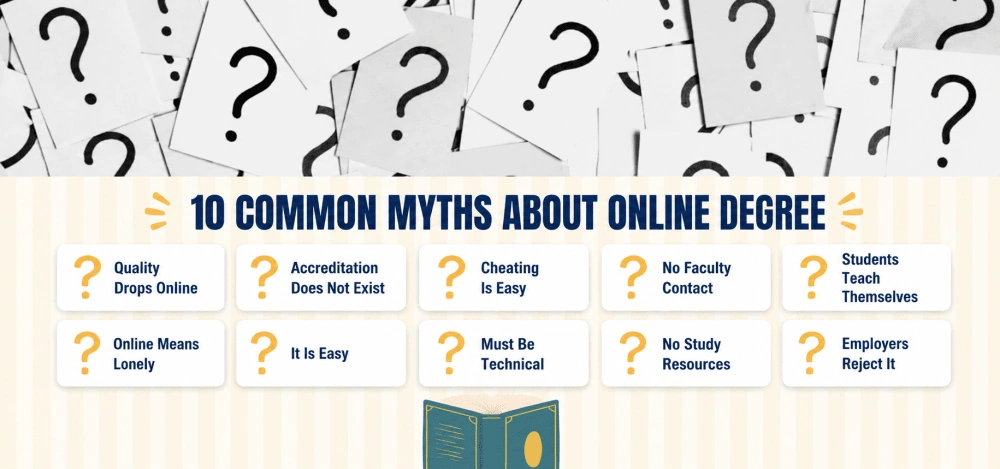
Myth 1: Online Degrees Have Lower Academic Quality
The curriculum does not change because the classroom did. If anything, online programs have an edge that physical classrooms do not: study material can be updated the moment new research, industry trends, or developments emerge. A textbook from three years ago stays a textbook. A digital course does not have to.
Myth 2: Online Degrees Are Not Accredited or Legally Valid
This one needs to be put to rest clearly. In India, online degrees offered by UGC-entitled universities carry the same legal validity as a regular on-campus degree. The delivery method is different. The recognition is not.
Myth 3: It Is Easier to Cheat in Online Exams
If anything, the opposite is true. Online institutions use advanced plagiarism detection software and proctoring tools that monitor exams in real time. Academic dishonesty is not easier online. In many cases, it is significantly harder.
The degree is real. The standards are real. The only thing that is not real is the myth that online means less.
How Does the Student-Faculty Dynamic Function in a Virtual Space?
The transition from a physical room to a digital platform does not mean the erasure of mentorship. The dynamic between learner and educator has simply been recalibrated:
Myth 4: Zero Tutor Contact.
This remains a persistent falsehood. While lectures are often pre-recorded to allow students to pause and re-watch sections at a convenient pace, these are supported by active one-to-one guidance and feedback on assignments.
Myth 5: The Requirement to Self-Teach.
Remote study is not a synonym for self-instruction. Online tutors are responsible for engaging with and teaching their students, providing the same pedagogical support found in traditional settings.
Myth 6: The Burden of Loneliness.
Isolation is a relic of the past. Modern digital ecosystems include degree forums, WhatsApp groups, and global discussion circles. These tools allow learners to build a global network of peers, often creating a more diverse social experience than a local campus could provide.
Which Practical Requirements Actually Shape the Online Journey?
Success in a digital environment requires more than just an internet connection. It demands a level of discipline that often exceeds that of traditional students:
Myth 7: The "Easy Option" Fallacy.
Pursuing a degree online is not a shortcut. It requires intense self-management and planning to balance academic requirements with family and professional duties. The workload remains as challenging as any traditional program.
Myth 8: The Need to be a "Tech Whizz".
Technical expertise is not a prerequisite. Modern learning platforms, such as the Arden University "iLearn" system, are designed to be intuitive and user-friendly, requiring only basic digital literacy. Support teams remain available to resolve any technical friction.
Myth 9: The Search for Resources.
Students are not left to forage for their own materials. Reputable universities supply all necessary resources, including digital texts, journals, and video materials, ensuring a full digital library is accessible from home.
Who Values Online Degrees in the Modern Indian Job Market?
The ultimate test of a degree is its value in the eyes of a recruiter. The narrative that employers reject digital qualifications is rapidly collapsing:
Myth 10: Employer Skepticism.
Modern recruiters increasingly prioritize "upskilling" and the demonstrated ability to manage complex schedules. Consider a scenario where an employer promotes a staff member specifically because they completed a degree while staying in their role. This demonstrates significant time-management skills and a commitment to professional growth that a standard graduate may lack.
Institutions now work closely with business leaders to ensure digital courses produce workplace-ready graduates. This collaboration ensures the curriculum meets the specific needs of modern industry, making the medium of delivery secondary to the skills acquired.
Conclusion
Ten myths. Ten moments where doubt could have won. And every single one of them had the same root cause: not a flaw in online education, but unfamiliarity with it.
The degree is valid. The faculty is real. The exams are rigorous. The employers are noticing.
Remember that moment: "I want to do an online degree." The room went quiet and the questions followed. But the answers were always there, they just needed the right information to show up.
In 2026, online degrees will not be an alternative to real education. For thousands of students across India, they have become the smarter version of it.
The only misconception left is the one about waiting too long to start.