

Imagine yourself standing at a railway station during peak hours.
Three trains stand on three different platforms, all displaying the same destination on their boards. Same city. Same endpoint. Yet the journeys couldn’t feel more different.
In many ways, choosing between an Online MBA, Distance MBA, and Regular MBA feels exactly like this.
All three lead to the same MBA degree, but the learning experience, flexibility, costs, and career impact of each journey are completely different.
One is built for full-time campus life. Another for independent, self-paced learning. And the third is for professionals who want career growth without stepping away from work or existing responsibilities.
And that’s exactly where the confusion begins.
Every year, thousands of students and working professionals ask the same questions:
- Which MBA format is actually better?
- Is an Online MBA in India worth it?
- Does a Distance MBA still hold value?
- Or is a Regular MBA the only “real” MBA experience?
Most comparisons explain MBA formats academically.
Very few explain them practically.
So consider this the honest explanation most people never receive - a simple, practical comparison between Online MBA, Distance MBA, and Regular MBA programmes, and how to choose the one that truly fits your goals, lifestyle, and future ambitions.
First, Let’s Clear the Confusion
Here’s the most important thing to understand:
All three formats lead to an MBA degree.
What truly changes is how you learn, where you learn, and how well the programme fits into your life.
Think of it like reaching the same destination through different routes.
- A Regular MBA is a full-time campus journey with fixed schedules, classrooms, and complete immersion.
- A Distance MBA is largely self-driven, where study material is provided and you learn independently.
- An Online MBA blends flexibility with interaction - allowing you to learn from anywhere while still staying connected to faculty, classmates, mentorship, and career support. All without leaving your job.
“The degree may be the same. The experience is not.”
Regular MBA: The Traditional Campus Experience
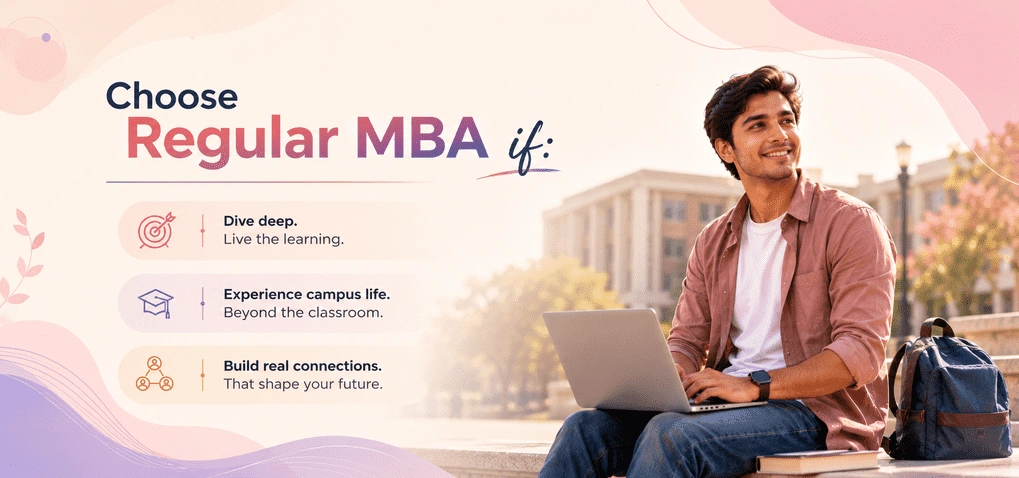
A Regular MBA is the classic full-time programme most people imagine when they think of business school.
You attend classes on campus every day. You collaborate with classmates on projects, participate in presentations, interact directly with professors, and experience college life beyond academics- clubs, networking events, competitions, internships, and placements.
What it offers
- Immersive campus learning
- Strong peer interaction and networking
- Direct access to faculty and mentors
- Campus placements and recruiter visits
- Exposure to clubs, events, and business competitions
- A structured environment focused entirely on learning
The challenges
- Requires leaving or pausing your job
- Fixed schedules with very little flexibility
- Higher overall cost due to tuition, relocation, and living expenses
- Competitive entrance exams like CAT, MAT, or GMAT are often required
A Regular MBA works best for fresh graduates or professionals who can fully dedicate two years to campus life and career transformation.
Distance MBA: The Independent Learning Route
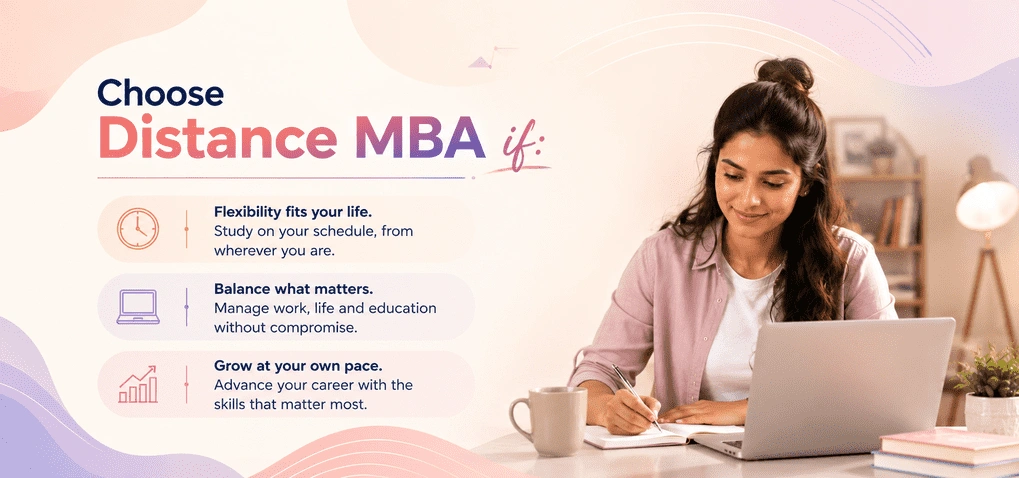
Distance MBA programmes were created to make higher education accessible for people who couldn’t regularly attend a campus.
In this format, universities typically provide printed or digital study material, recorded lectures, and assignments. Learning is mostly self-paced, with minimal live interaction. Exams are conducted at designated centres, and occasional contact sessions may be organised.
What it offers
- High flexibility
- Lower fees compared to regular programmes
- Suitable for working professionals with unpredictable schedules
- UGC and DEB recognition when pursued from approved universities
The limitations
- Limited interaction with faculty and peers
- Minimal real-time support or mentorship
- Requires strong self-discipline
- Learning can feel isolated
- Placement support is often limited
Distance MBAs have helped many professionals continue learning alongside work, though the experience may feel less interactive, as most of the learning occurs independently.
Online MBA: Modern Learning for Modern Professionals

This is where education has truly evolved.
An Online MBA is not simply a Distance MBA on a laptop. It is a more dynamic, interactive, and career-focused learning model designed for professionals who want to grow without putting their life and career on hold.
Instead of learning entirely alone, you stay connected through LIVE classes, recorded sessions, discussions, projects, mentorship, and career support, all delivered digitally.
And that difference matters.
What does an Online MBA offer?
LIVE + Recorded Learning
Attend LIVE weekend classes in real time or revisit recorded lectures whenever your schedule allows. Learning adapts to your routine and not the other way around.
UGC-Entitled & AICTE-Approved Programmes
Look for UGC-entitled programmes from a NAAC-accredited university. This ensures that the degree carries recognised academic value across industries.
Industry-Relevant Curriculum
The programme focuses on practical business understanding through:
- Case studies
- Simulations
- Capstone projects
- Real-world business applications
The goal isn’t just theoretical knowledge, it’s professional transformation.
Placement Support
Online learners also gain access to career services, recruitment support, industry connections, and opportunities through their extensive hiring network.
Interactive Peer Learning
Your classmates include professionals, entrepreneurs, managers, and learners from different industries and cities. That diversity brings perspectives no single classroom can fully replicate.
Multiple Specialisations
Choose the MBA path aligned with your goals:
- Marketing: Understand consumer behaviour, brand strategy, advertising, and sales techniques that help businesses attract and retain customers.
- Human Resource Management (HRM): Learn how organizations hire, manage, motivate, and develop talent while building strong workplace culture and leadership practices.
- Finance: Gain knowledge of corporate finance, investment planning, budgeting, financial analysis, and risk management.
- Operations Management: Focus on improving business processes, supply chains, production systems, quality management, and operational efficiency.
- International Business: Explore global markets, international trade practices, cross-border business strategies, and global financial operations.
- Information Technology (IT): Combine business management with technology, digital innovation, and IT-driven business strategy.
- Digital Marketing: Learn modern marketing techniques, including SEO, social media marketing, content strategy, paid advertising, and online consumer engagement.
- Business Analytics: Develop the ability to interpret business data, identify trends, and support strategic decision-making through analytics.
- Data Science: Build expertise in handling large datasets, analytical tools, and data-driven problem-solving to support business growth and innovation.
- Logistics & Supply Chain Management: Understand inventory management, transportation systems, warehousing, distribution, and end-to-end supply chain operations.
- Hospital and Healthcare Management: Focus on healthcare administration, hospital operations, patient services, healthcare systems, and policy management.
- Banking and Financial Services: Learn about banking operations, financial services, investment products, risk analysis, and financial regulations.
The Real Difference: Side-by-Side
|
Parameter |
Regular MBA |
Distance MBA |
Online MBA (LPU Online) |
|
Learning Mode |
Full-time campus |
Self-paced study material |
Live + recorded digital learning |
|
Flexibility |
Low |
High |
High |
|
Peer Interaction |
Strong, in-person |
Limited |
Active & collaborative |
|
Faculty Access |
Daily classroom interaction |
Minimal |
Regular live interaction |
|
Placement Support |
Strong campus placements |
Limited |
Dedicated career support |
|
Cost |
Higher overall expense |
Affordable |
Moderate, value-driven |
|
Best For |
Fresh graduates |
Independent learners |
Working professionals, career switchers or homemakers |
|
Recognition |
UGC/AICTE approved |
UGC/DEB approved |
UGC/AICTE approved |
So, Which MBA Should You Choose?
The right MBA depends less on trends and more on your current stage of life.
Choose a Regular MBA if:
- You can commit full-time to studies
- You want the traditional campus experience
- You’re early in your career and seeking immersive networking opportunities
Choose a Distance MBA if:
- You prefer completely self-paced learning
- Your budget is the primary deciding factor
- You are comfortable learning independently with minimal guidance
Choose an Online MBA if:
- You want to continue working while studying
- You need the flexibility of “drawing your exam datesheet” as per your schedule
- Flexibility matters, but interaction still matters too
- You’re looking for recognised education without relocating
- You want career growth without pressing pause on your responsibilities
The Final Verdict: Which One Is TRULY Better?
The best MBA isn’t simply the most traditional one.
It’s the one that aligns with your life, your goals, and the future you want to create.
There is no universal “best.”
Only what fits your life and goals is best.
Remember-
If you want guidance, interaction, flexibility, and career support → choose online.
If you want campus experience and can commit full-time → choose regular.
If you want the degree with full control of pace → choose distance.
If you’re ready to grow professionally without putting everything else on hold, explore the Online MBA programme from LPU Online.
Learn more about eligibility, specialisations, and admissions today.