

Artificial Intelligence has quietly moved from research labs into everyday tools. From writing emails and code to analysing data and creating content, AI systems are now assisting humans at every level. However, the real power of AI does not come automatically – it depends heavily on how well humans communicate with it. This is where prompt engineering enters the picture.
Many people assume AI outputs are random or magical. In reality, AI responds precisely to the instructions it receives. A vague input produces a vague response, while a clear and structured prompt can unlock remarkably accurate and useful results. Prompt Engineering is the skill that bridges human intent and machine intelligence, making it one of the most practical AI skills today.
For Indian students and professionals navigating a competitive job market, this skill offers a unique advantage. It does not require deep mathematics or years of coding experience, yet it opens doors to high-impact roles across technology, education, marketing, analytics, and business.
What is Prompt Engineering?
Prompt Engineering is the art and science of designing effective inputs (called prompts) that guide AI models to produce accurate, relevant, and meaningful outputs. A prompt can be a question, instruction, context, or example given to an AI system such as ChatGPT, Gemini, or Claude.
Instead of simply asking AI to “write something”, a prompt engineer carefully structures the request by defining the role, tone, constraints, examples, and desired outcome. This transforms AI from a generic responder into a specialised assistant.
In simple terms, Prompt Engineering teaches you how to talk to AI in a way that it understands best.
Why Prompt Engineering is Important Today
As AI tools become more accessible, the difference between average and exceptional results lies in prompt quality. Two people using the same AI tool can get drastically different outputs based on how they frame their prompts.
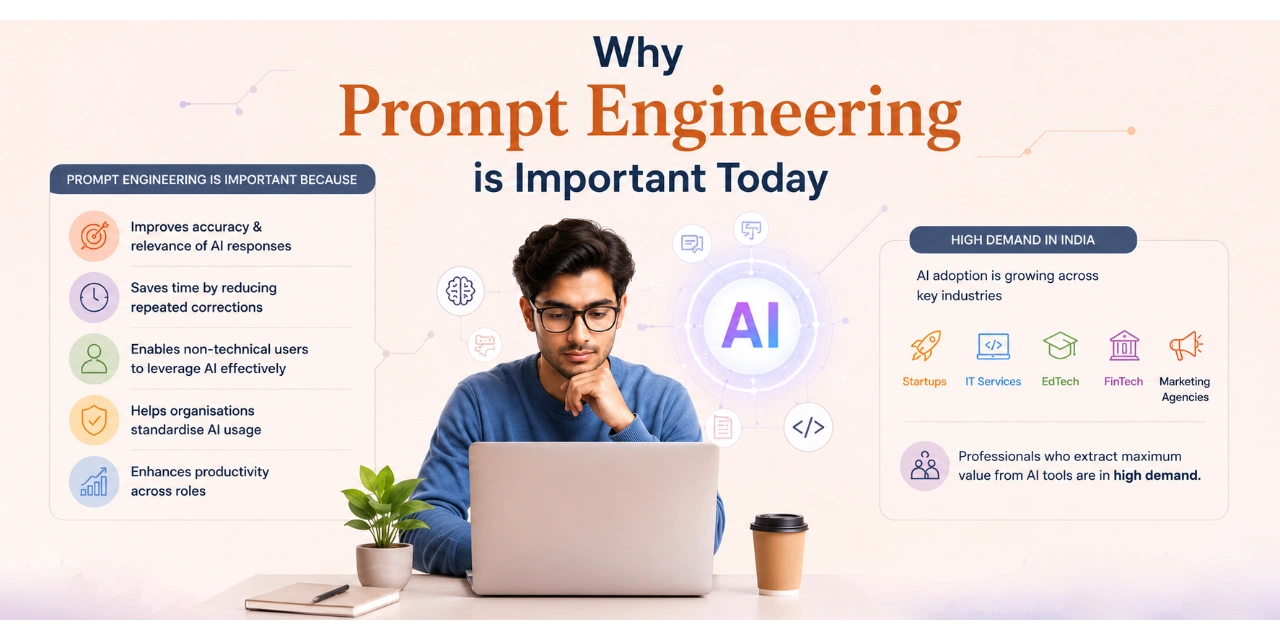
Prompt Engineering is important because it:
- Improves the accuracy and relevance of AI responses
- Saves time by reducing repeated corrections
- Enables non-technical users to leverage AI effectively
- Helps organisations standardise AI usage
- Enhances productivity across roles
In India, where AI adoption is rapidly increasing across startups, IT services, edtech, fintech, and marketing agencies, professionals who can extract maximum value from AI tools are in high demand.
Core Skills Required for Prompt Engineering
Prompt Engineering is not just about typing instructions; it requires a mix of technical thinking, creativity, and communication skills. These skills develop gradually through practice and experimentation.
Critical Thinking and Problem Breakdown
A good Prompt Engineer first understands the problem clearly. They break down complex tasks into smaller steps that AI can process efficiently. This mindset is similar to logical thinking used in programming, but applied in a conversational format.
Key abilities include:
- Identifying objectives clearly
- Anticipating possible AI misunderstandings
- Structuring step-by-step instructions
Communication and Clarity
Since prompts rely on natural language, clarity is essential. The ability to express intent without ambiguity plays a major role in output quality.
Effective communicators:
- Use precise language
- Define tone, format, and audience
- Avoid unnecessary complexity
Domain Knowledge
Prompt Engineers often specialise in specific domains such as coding, marketing, education, or data analysis. Domain understanding helps frame realistic constraints and expectations.
For example:
- A marketing prompt differs from a coding prompt
- Academic prompts require factual accuracy
- Business prompts focus on outcomes and KPIs
Creativity and Experimentation
AI responses improve through iteration. Creative thinking helps explore multiple prompt styles to find what works best.
Prompt Engineers regularly:
- Test variations of prompts
- Compare outputs
- Refine structure based on results
Practical Examples of Prompt Engineering
Understanding Prompt Engineering becomes easier through real-world examples, as given below:
Example 1: Basic Vs Engineering Prompt
Basic Prompt:
“Write about digital marketing.”
Engineered Prompt:
“Act as a digital marketing expert. Write a 500-word beginner-friendly article on digital marketing for Indian college students. Include real-life examples, simple language, and a short conclusion.”
The second prompt provides a role, audience, tone, length, and structure – resulting in a significantly better output.
Example 2: Coding assistance
Simple Prompt:
“Fix this code.”
Engineered Prompt:
“You are a senior Python developer. Analyse the following Python code, identifying logical errors, explaining the issue step by step, and suggest an optimized solution.”
This approach improves both learning and code quality.
Prompt Engineering use cases across industries
Prompt Engineering is not limited to tech roles. Its applications span multiple industries:
- In education, it helps create personalised learning materials, quizzes, and explanations.
- In marketing, it enables faster content creation, ad copy optimisation, and audience analysis.
- In software development, prompt engineering assists in debugging, documentation, and code generation.
- In business and consulting, it supports data summarisation, report generation, and decision-making.
- In healthcare and legal research, structured prompts help analyse large volumes of information responsibly.
Career Scope of Prompt Engineering in India
Prompt Engineering is emerging as a standalone skill as well as a complementary capability across roles. In India, companies increasingly expect employees to work efficiently with AI tools.
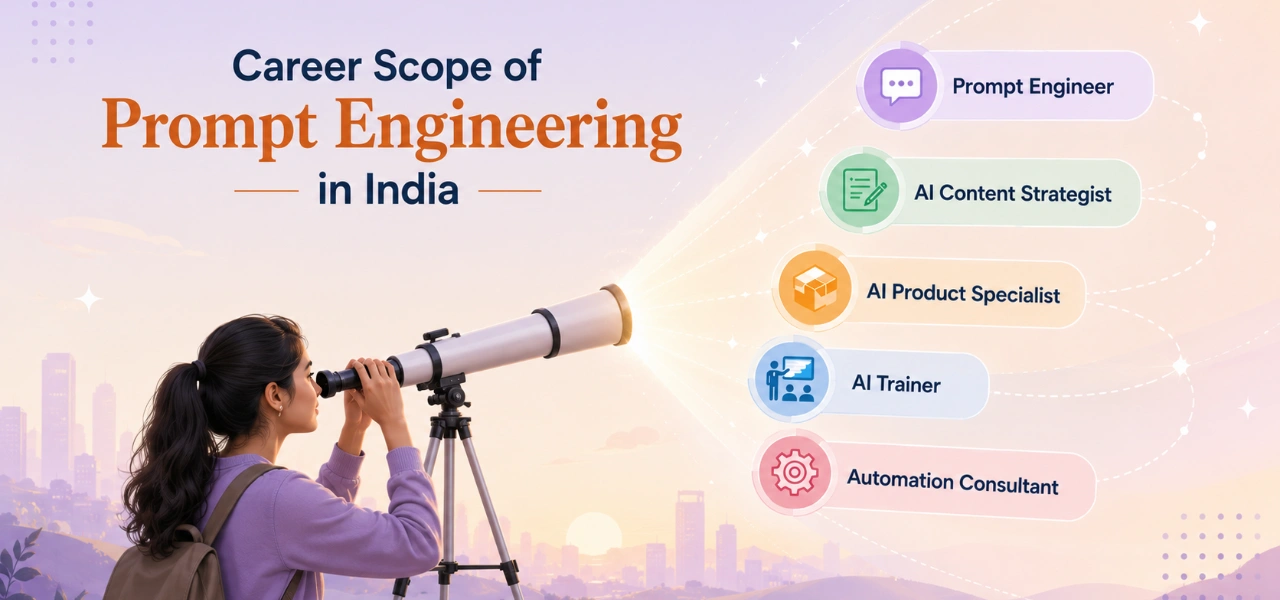
Career paths include:
- Prompt Engineer
- AI Content Strategist
- AI Product Specialist
- AI Trainer
- Automation Consultant
Startups, MNCs, edtech platforms, and digital agencies are actively hiring professionals with strong prompt design skills.
Salary Trends and Job Roles in India
While Prompt Engineering is still evolving, salary trends are promising.
Entry-level professionals with AI tool expertise can earn between INR 6 and 10 LPA. Mid-level professionals integrating prompt engineering into business workflows earn INR 12 to 20 LPA. Senior specialists and consultants may earn even higher depending on industry and impact.
Freelancers with strong portfolios also find opportunities on global platforms, earning in foreign currencies.
How Students and Professionals Can Start Learning Prompt Engineering
Learning Prompt Engineering does not require expensive courses or advanced degrees. Consistent practice and curiosity matter more.
Beginners should:
- Experiment with AI tools daily
- Study prompt examples and templates
- Analyse why certain prompts work better
Students from BCA, MCA, MBA, and non-technical backgrounds can all benefit from this skill.
Prompt Engineering Vs Traditional Programming
While traditional programming uses strict syntax and logic, Prompt Engineering relies on natural language and contextual reasoning.
Both skills complement each other. Programmers use Prompt Engineering to speed up development, while non-programmers use it to unlock AI capabilities without coding.
Future Outlook of Prompt Engineering
As AI models grow more powerful, the need for skilled human guidance will increase, not decrease. Prompt Engineering will evolve into AI workflow design, governance, and optimisation. India’s digital transformation, combined with global demand for AI talent, positions Prompt Engineering as a future-ready skill.
Conclusion
Prompt Engineering is quickly becoming one of those skills that quietly changes how you learn, work, and grow – without needing years of technical training. In a world where AI tools are already part of everyday tasks, knowing how to ask the right questions and give clear instructions makes a real difference. For students, it means learning faster and building better projects. For professionals, it means working smarter and delivering stronger results with the same resources.
In the Indian job market, where competition is high and roles are constantly evolving, Prompt Engineering acts as a practical edge rather than a theoretical concept. It complements existing skills, adapts across industries, and grows with experience. Those who start using AI thoughtfully today – guiding it instead of depending on it – will find themselves better prepared for future roles, new opportunities, and a workplace shaped increasingly by intelligent systems.