


For decades, sales had a clear identity.
You picked up the phone. You dialed. You pitched. You handled rejections. You dialed again. It was a craft built on persistence, thick skin, and the ability to hold a conversation with a stranger and make it feel worthwhile for both of you.
And for its time? It worked. Cold calling built entire industries. It created careers, closed deals, and kept businesses alive. The people who were good at it were genuinely skilled, and there was real respect in mastering it.
But here's the truth: not everyone is wired that way.
Some people dread unsolicited conversations. Some find it difficult to perform energy they don't naturally have. Some are far better at listening than launching into a pitch, and no amount of training fully changes that.
So when sales were almost entirely synonymous with cold calling, a lot of capable, thoughtful people quietly stepped aside. Not because they lacked drive. Not because they couldn't sell. But because the primary method on offer simply didn't match how they naturally operate.
If that's been your story, you weren't wrong to hesitate.
But the landscape has shifted in a way that changes things considerably.
And the version of sales that exists today? It might be a very different conversation than the one you walked away from.
So What Actually Changed?
The buyer changed. And when the buyer changes, everything downstream changes with it.
Think about your own behavior when you're considering a purchase. You search. You compare. You read reviews, watch demos, ask around in communities, and cross-reference opinions before you ever speak to anyone from the company. By the time you reach out, you've already done most of the thinking.
This isn't unique to you. Research consistently shows that nearly 70–80% of the buying journey is complete before a customer speaks to a salesperson. People arrive informed, not clueless. They're not waiting to be educated about what they need; they already have a sense of it. What they're looking for is someone to help them decide with confidence.
That single shift rewired what sales actually require.
Companies stopped investing purely in outbound volume and started building systems that attract interested buyers, content, search, targeted campaigns, and lead generation funnels. The result? Sales professionals today are increasingly working with people who already have intent. People who came to them, not the other way around.
The job is no longer to convince.
It's to guide, clarify, and help someone cross the finish line on a decision they've already started making.
And that is a fundamentally different kind of work.
What Does This Mean for People Who Were Never Built for Cold Calling?
Quite a lot, actually.
Because the skills that define success in modern sales aren't the ones that made cold calling effective, it's not about how quickly you can recover from rejection or how naturally you can command a stranger's attention in the first ten seconds.
It's about something quieter. More considered.
It's about listening well, understanding deeply, and communicating clearly. Building trust over time.
And here's the part that surprises most people: those qualities don't belong to any single personality type. They belong to people who are curious, patient, and genuinely interested in solving problems, regardless of whether they're the loudest person in the room.
If you've always been the one who asks a better question rather than talks over people, modern sales has room for you.
If you're someone who'd rather understand a problem fully before offering a solution, modern sales has room for you.
If relationships have always come more naturally to you than cold introductions, modern sales, in many of its current forms, was practically designed around how you think.
The Sales Roles That Reflect This New Reality
Let's get specific because this isn't abstract. These roles exist, they're growing, and they operate almost entirely on the principles we've been talking about.

Inbound Sales Representative
No dialing strangers. Instead, you're speaking with people who already raised their hand, filled out a form, clicked an ad, and sent an inquiry. Your job is to understand what they're looking for and help them make the right call. The conversation starts warmly because the interest is already there.
Account Manager
Your focus is entirely on existing clients. You already have the relationship and the trust. You're there to deepen it, ensuring they're getting value, solving problems before they escalate, and identifying natural opportunities to grow the partnership. It's long-game work that rewards consistency over aggression.
Customer Success Manager
This role sits right at the intersection of service and sales, and it's one of the most relationship-driven careers in the business world. You help customers actually succeed with what they've purchased. When they see real results, renewals and upgrades follow naturally. You're not selling, you're making people successful, and success is its own best argument.
Inbound Sales Development Representative
Marketing brings the leads in. Your job is to qualify them, understand their intent, ask the right questions, figure out who's genuinely ready to move forward, and pass them to the right team. It's more analytical than persuasive, and it rewards people who can read between the lines of what someone is actually asking for.
Pre-Sales Consultant
If you enjoy breaking down complexity and showing exactly how something works, this role will feel natural. You're walking potential customers through demos, tailored presentations, and consultations, not pushing a product, but demonstrating how it solves a specific problem. Your credibility does most of the heavy lifting.
Social Selling Specialist
This is where relationship-building meets content. You show up consistently on platforms like LinkedIn, sharing useful perspectives, engaging thoughtfully, and building a presence that makes people want to come to you. By the time a prospect reaches out, they already know who you are and why they trust you. The outreach flows naturally from the relationship.
E-Commerce or Chat-Based Sales Executive
Customers arrive with questions. You're there to answer them in real time, through live chat or messaging. It's low-pressure, customer-led, and entirely built around helping someone who's already considering a purchase move forward with confidence.
Each of these roles has its own rhythm and requirements, but what they share is a foundation of genuine conversation over scripted interruption.
The Skills That Actually Define Success Here
If the method has changed, so have the skills worth developing.
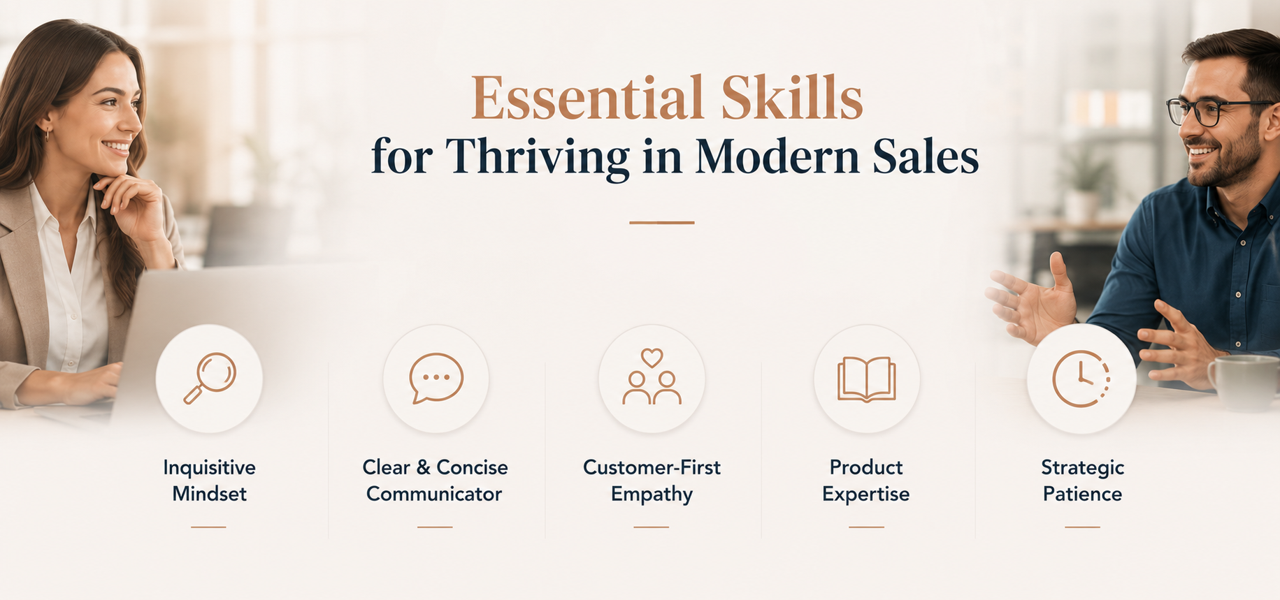
Genuine Curiosity The best question you can ask a prospect often has nothing to do with your product; it's about their world, their pressures, their goals. People can feel when someone is actually interested versus just looking for an opening to pitch.
Clarity of Communication: Can you explain something complex without drowning it in jargon? Can you make someone feel informed rather than overwhelmed? That ability to simplify without dumbing down is rarer than most people think.
Empathy Not performed. Real empathy. The kind that picks up on what someone isn't saying and addresses it anyway. Customers today have very well-tuned detectors for when someone actually cares about their outcome versus just their own commission.
Deep Product Knowledge The more genuinely you understand what you're offering, its strengths, its limitations, who it's actually right for, the less you need to push it. Confidence built on real knowledge is far more persuasive than enthusiasm built on nothing.
Patience. Sometimes the best sales move is to slow down. To let the customer speak. To resist filling every silence. The salespeople who've mastered this consistently build stronger relationships and close with far less friction.
A Realistic Picture - Because This Isn't a Shortcut
It's worth being straightforward here.
These roles aren't effort-free. They come with targets, performance expectations, follow-up discipline, and the ongoing pressure of results. That doesn't go away just because the method is different.
But there's a meaningful difference between effort that depletes you and effort that builds something. Cold calling, for many people, was the former a daily grind against resistance that left little to show beyond the quota. Modern sales roles, when matched to the right person, tend to be the latter. The relationships are compound. The understanding deepens. The results build on themselves.
So before writing sales off entirely, it's worth sitting with one honest question:
Was it the career you didn't want or just one approach within it that never felt like yours?
The Bigger Picture: Where Sales Is Actually Heading
Sales are not shrinking. It's diversifying.
Digital platforms, inbound marketing, content-led growth, and customer-centric business models have collectively created space for a much wider range of professionals to succeed in this field. The archetype of the relentless, high-volume closer is still out there and still effective in certain contexts. But it's no longer the only path, or even the dominant one.
What's growing is the demand for salespeople who think before they speak. Who builds trust before they pitch? Who understands that in a world where buyers have more information than ever, the value of a good salesperson isn't in what they say, it's in how well they listen and how clearly they help someone make sense of their options.
That's a space where thoughtfulness wins. Where patience is a strategy. Where the ability to make someone feel genuinely understood is worth more than any script.
So, Where Does This Leave You?
If you've spent years assuming sales weren't for you, this might be the moment to revisit that assumption.
Not because sales have suddenly become easy, or because every role will feel like a perfect fit. But because the field has genuinely expanded into territory that rewards a different kind of strength than it used to.
The people who will define the next chapter of sales aren't necessarily the ones who were fearless on the phone. They're the ones who ask better questions. Who builds real relationships? Who show up consistently and make people feel like they're talking to someone who actually gets it.
If that sounds like you even a little, the door is more open than you think.
Sales didn't leave you behind. It just took a while to catch up to the way you naturally work.
And now that it has, the only real question is whether you're ready to take another look.