


Table of Content
“Congratulations On Your New Certification!”
These applauding messages are what probably fill your LinkedIn feed every time someone completes short-term courses. And these applauding messages might make you want to take on some job-oriented short-term courses yourself, hoping it will be the nudge your career needs. But once the applause fades and the notifications stop, an important question gets highlighted: Did these certificates actually change anything beyond your profile?
For a lot of people, the honest answer is No. They finish the course, update the status, collect some congratulatory comments and then go straight back to applying the same roles they were applying for before. The certificate looks impressive but it doesn’t bring about the expectations which are held in mind while enrolling for a short-term course.
The reason behind this is not that short-term courses are useless. It is because they were never meant to be a career change on their own. In a market where thousands of professionals hold the same six-week certification, having one doesn't make you stand out anymore. It just makes you look like everyone else scrolling the same feed.
So, let’s take a look at what short-term courses are actually good for, which job-oriented ones are worth your time and most importantly, how to make an impact after completing these courses.
What are Short-Term Courses?
Somewhere in a 9-5 working shift, a recruiter is scrolling through hundreds of resumes and every third one lists the same six-week certification course. In-demand skills have quietly turned into “everyone already has this”.
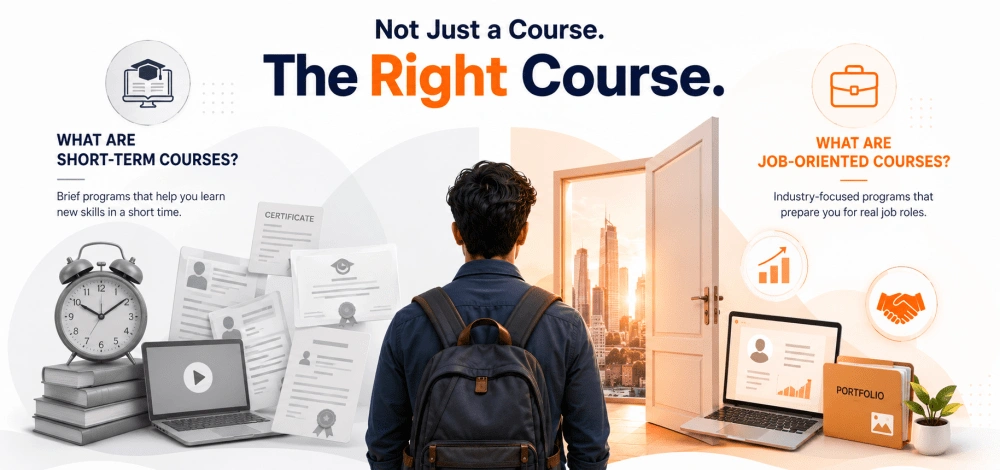
Talking about what short-term courses are, these are brief, skill-based programs designed to be completed in a short timeframe, ranging from a few weeks to 12 months. These help to gain high-impact knowledge, technical, creative or managerial which could be easily applied almost immediately without years of buildup or theory.
Here’s what characterizes them:
-
Duration: Concentrated learning units spanning from a few weeks to 12 months, designed for quick comprehension rather than long-term persistence.
-
Practical Emphasis: The focus is on hands-on experience and real-world projects rather than extensive theoretical concepts, as employers value what you can accomplish not merely what you understand.
-
Flexibility: Digital learning formats enable individuals to enhance their skills without disrupting their jobs, ensuring that their careers can continue without interruption as they improve their abilities.
However, not all short-term courses are the same. Some refine a pastime. While others silently update your resume. The distinction rests on a single word: Intent.
What Are Job-Oriented Courses?
Job-oriented courses are a category of short-term programs which are designed with a clear and single objective: to enhance employability. Not interest, not growth, but job readiness.
Where a general short-term course might teach you photography for fun, a job-oriented one teaches you photo editing because a marketing agency is hiring for exactly that skill next month. Every module, every project, every assignment is reverse-engineered from what recruiters are looking for
Three things set them apart:
-
Outcome-first design: Curriculum is created by working backwards from job descriptions rather than progressing forward from a textbook index.
-
Industry Alignment: Tools, software, and workflows reflect what businesses utilize currently, rather than what was typical five years ago.
-
Integrated proof of work: Portfolios, case studies, and real projects serve as the genuine currency, as a badge indicates, while a project demonstrates.
In short, all job-oriented courses are short-term courses. But not all short-term courses are job-oriented. And that one distinction decides whether your next certificate opens doors or just adds another badge to a feed full of them.
The Best Short-Term Courses Actually Worth Your Time
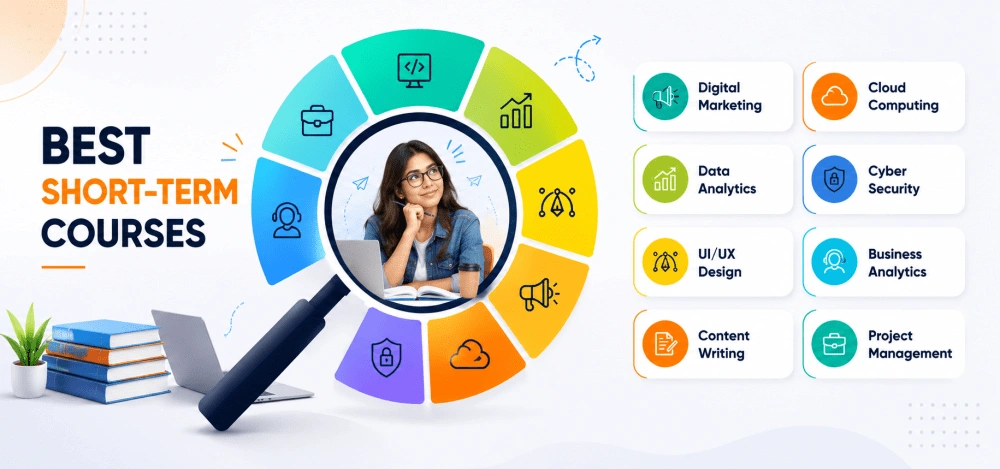
Short-term courses are of various types; some offer job-oriented skills, others might just be hobby-based. Due to this distinction, it is important to understand which are the best and trending short-term courses which are opening doors and paying real dividends almost immediately. Here's where the smartest professionals are actually investing their time right now, and where each of these skills can eventually lead.
Project Management and Consulting
Each sector operates on timelines, financial constraints and resources that never seem to reach their full potential. This is precisely why project management is one of the most consistent and valuable skills for an individual, no matter the industry they are involved in.
This short-term course develops practical skills in risk management, resource planning and execution utilising tools such as Jira and Trello which are now essential in modern workplaces.
-
Duration: 3 to 6 months
-
Learning Mode: Online, self-paced or cohort-based
Once this foundation is built, the natural next step is depth, not just knowing how to manage a project, but knowing how to lead the strategy behind dozens of them, which is exactly where a specialization in Finance within an Online MBA starts to matter.
Investment Banking and Financial Modelling
Numbers convey narratives that many individuals never fully understand. Financial risk management, investment banking and financial modelling help you understand precisely what a balance sheet communicates and how to respond to it.
These courses focus heavily on real world application, from interpreting corporate valuations to identifying financial risk before it becomes a crisis.
-
Duration: 4 to 9 months
-
Learning Mode: Online, often with live case studies and simulations
Understanding numbers is one thing. Being trusted to make million-dollar decisions based on them is another entirely, and that's the exact gap an MBA specialization in Finance is built to close.
SEO, SEM, and Digital Marketing Strategy
Every shopping decision, purchasing choices and location of destination all start with searching it on search engines. When every act performed begins with a search online it indicates the pace at which digital marketing is running. SEO (Search Engine Optimization), SEM (Search Engine Marketing) and content strategy have quietly become some of the most in-demand skills across the industry, not just in marketing agencies.
These courses are built around practical execution, teaching you to run real campaigns rather than simply study theory about them.
-
Duration: 3 to 6 months
-
Learning Mode: Online, project-based learning
HR Analytics and Organizational Development
People used to make decisions based on gut feeling. Now they run on data. HR Analytics and organizational development courses teach professionals to approach hiring, retention, and workforce planning as strategic problems worth solving with evidence, not instinct.
These programs blend behavioral insight with hard data, preparing professionals to influence how companies build and keep their talent.
-
Duration: 3 to 6 months
-
Learning Mode: Online, flexible scheduling
Data Science and Business Intelligence
You might come across various organizations hiring for ‘Data Analyst’ roles that require making sense of the numbers and making data-backed informed decisions. Data Science and Business Intelligence courses built around tools like Tableau and Power BI teach professionals to turn raw data into decisions.
These programs emphasize visualization, pattern recognition, and translating complex datasets into insights leadership can actually act on.
-
Duration: 4 to 9 months
-
Learning Mode: Online, hands-on projects with real datasets
Knowing how to read data is valuable. Knowing how to build an entire business strategy around it is rare, and that's exactly the territory an Online MBA specialization in Data Science and Analytics is designed to take you into.
Here's The Catch Nobody Mentions About Short-Term Courses
A short-term course can help you acquire a skill but it rarely teaches you how to handle genuine authority once you have it. That ceiling is exactly where MBA specializations come into play, exchanging a specialized skill set for the strategic depth that executive leadership truly requires. Programs such as those provided by LPU Online elevate professionals from merely completing tasks to guiding the teams that perform them.
-
Marketing: Investigates consumer behavior and strategies for digital expansion, equipping you for positions such as Marketing Manager or Digital Strategist.
-
Finance: Focused on corporate finance and investment evaluation, tailored for individuals aspiring to be Financial Controllers or Investment Analysts.
-
Human Resource Management: Centred on managing personnel and talent data, leading to positions such as HR Director.
-
Data Science and Analytics: Merges large data tools with forecasting models, leading to roles such as Analytics Manager or Solutions Architect.
Conclusion
The truth is that no certificate will ever bring a career with itself: a short-term course can teach you a skill but it's what you do with that skill next that builds an actual career. Those profiles you visit often on LinkedIn, those professionals have certifications and are in a great position in career. It is not because they have several certifications but it is because they keep applying what they learn and back their certifications with degrees and skills.
So if you're chasing a career switch, a better offer, or a seat at the leadership table, stop treating short-term courses like the finish line. They were only ever meant to be the starting. Build the proof. Do the work. And when you're ready for more, let advanced learning carry you the rest of the way. Careers aren't built in a single click of "Complete Course." They're built one deliberate step at a time.
This blog incorporates insights and industry perspectives referenced from "Annual Cost of Cybercrime Worldwide 2018-2029," published by Statista, and "AI Statistics: Market Growth, Emerging Trends, and What's Next for Artificial Intelligence," published by Procurri.