


Marketing today looks busy.
Reels every day. Ads are running constantly. Brands are talking non-stop about their products.
And yet… most of it is forgotten within seconds.
Because in marketing, being seen is easy. Being remembered is rare.
That’s the gap most people don’t notice.
Many brands believe that more content means more growth.
More visibility means more impact.
But real marketing doesn’t work that way.
The brands that actually stand out aren’t the ones posting the most.
They are the ones who understand the customer deeply, what catches attention, what creates interest, and what turns a thought into a decision.
They don’t just promote products.
They shape perception.
They create relevance, even when the need did not exist before.
And that’s where the real difference lies.
Because executing campaigns is easy to learn.
But understanding how marketing truly works, how it drives growth, builds positioning, and influences choices, is what most professionals struggle with.
This is exactly where an MBA in Marketing starts to matter.
Not as just another degree, but as a shift from doing more marketing to understanding what actually makes marketing work.
So, if you’re ready to elevate your potential, lead with purpose, and turn ambition into action, exploring MBA marketing courses could be the smartest career move you’ll ever make.
The New Age of Marketing: Why strategy outshines everything
Have you ever wondered why certain brands instantly connect with you?
Why do you trust some companies more than others?
It’s not just what they say. It’s how they position, time, and deliver it.
Marketing today goes far beyond slogans and sales.
It’s about understanding behaviour, reading data, and anticipating what customers will respond to, sometimes even before they realise it themselves.
This shift towards strategy isn’t just a trend.
It’s changing what it actually means to be a marketer today.
And this is exactly where an MBA in Marketing begins to stand out.
Not by teaching you more tools, but by reshaping how you think about marketing.
Here’s how that transformation shows up in real terms:

1. It Turns Creativity into Strategy
Every marketer is creative - but not every creative person becomes a leader. Why? Because ideas alone don’t scale; strategy does. An MBA in marketing course teaches you how to turn creative ideas into actionable business strategies - how to back intuition with data and insight.
Example:
A digital agency executive with creative instincts might design a viral ad. But an MBA-trained strategist will design an entire campaign ecosystem - mapping ROI, customer retention, and cross-platform engagement. The difference is vision.
2. It Helps You Speak the Language of Business
When a marketing head says, “This campaign will increase ROI by 15% through market segmentation,” they aren’t making an estimate; they are leading with confidence rooted in business. That’s where an MBA bridges the gap; you not only communicate but present yourself with facts and figures.
The course equips you with business fluency - finance, economics, analytics, leadership- so you can connect creativity with corporate strategy. You’ll be able to present marketing campaigns not just as ideas, but as measurable investments.
3. It Future-Proofs Your Career
In an era where AI writes, influencers drive trends, and data defines creativity. An MBA in Marketing helps to adapt to these transformations. You come across digital analytics, social media management, consumer psychology, and leadership -skills that can’t be automated.
Example:
When Netflix uses AI to recommend shows, it’s not the algorithm alone that decides - it’s guided by marketers who understand why people watch what they do, and how to turn that insight into retention. Will these changes replace marketers? Not really. They will change what marketers need to know.
4. It Opens Doors to Global Opportunities
Marketing is universal in nature, applicable from luxury fashion in Milan to tech startups in Bengaluru. With an MBA in marketing, you become globally relevant with endless opportunities.
Imagine managing a global campaign that runs across cultures and time zones, a challenge that requires cultural empathy, analytical insight, and global market understanding. That’s the level of exposure an MBA prepares you for.
5. It Expands Your Earning and Leadership Potential
Ambitious professionals don’t just want to work but want to lead. They want impact, growth, and purpose. An MBA in marketing doesn’t just raise your salary potential; it positions you for leadership. Graduates often advance into roles like Marketing Manager, Brand Director, or Chief Marketing Officer (CMO).
As one graduate famously said, “Before my MBA, I sold ideas. After my MBA, I sold vision.”
What You’ll Learn in an MBA in Marketing Course
The Modern MBA curriculum is far beyond theories and textbooks. It’s all about mastering the art of business in a digital field and data-driven world. Marketers aren’t storytellers but strategists, analysts, and decision makers.
Before you dive into the fascinating world of branding, consumer psychology, and digital analytics, the MBA ensures you build a strong foundation in core business disciplines. Why?
Core Business Modules
Before you specialise, you will have a foundation in:
Strategic Management - Learn to see the broader picture and align the long-term goals with marketing initiatives.
Business Analytics- Helps predict consumer behaviour, enable data-driven decision-making, and identify market trends.
Financial Accounting- Learn how to prepare budgets, pricing, and profitability to shape marketing strategy.
Operations & Supply Chain- Discover how seamless logistics and operations deliver customer satisfaction and brand trust.
Organisational Behaviour- Develop leadership skills and learn how to motivate teams, manage culture, and build collaborative environments.
Marketing Specialisation Modules
Once your business foundation is in place, it’s time to explore the beating heart of your degree - marketing specialisation. This is where your curiosity meets creativity, and your ideas start shaping real-world impact.
But what does it actually mean to “specialise in marketing”?
It means learning to understand people - their choices, emotions, and motivations - and then using that understanding to design strategies that connect meaningfully.
Consumer Behaviour: What makes people choose one brand over another? You will explore perception, motivation, and buying patterns to craft marketing strategies and emotional storytelling that help in purchase intent.
Customer Relationship Management: How do brands like Coca-Cola stay relevant for decades? Brand management teaches you how to build, nurture, and protect a brand’s identity. You’ll learn everything from logo psychology to long-term brand positioning - how to make customers not just buy from you, but believe in you.
Digital and social Media Marketing: This module immerses you in the fast-paced world of digital marketing - from SEO, social media strategy, and influencer marketing to paid ads and online consumer journeys.
Sales & Distribution: This module teaches you how to design effective channel strategies, build high-performing sales teams, and ensure that products reach the right customer at the right time.
Service Marketing: How can you predict what your customers will want next? It teaches the quality of service that customers want from a particular brand.
Digital Transformation Focus
2025 marketing isn’t just about billboards - it’s about bytes.
Modern MBA courses now integrate AI in Marketing, Search Engine Optimisation, Influencer Strategy, CRM systems, and E-commerce Analytics to make you future-ready and data-driven decision-making
Real-World Projects and Internships
Top MBA programs emphasise hands-on learning. You’ll work on live brand campaigns, real client briefs, and digital simulations - applying classroom theory to real-world impact.
How to Apply for an MBA in Marketing
Step 1: Check Your Eligibility
In order to pursue a Master's in Marketing course, a bachelor's degree in any discipline is typically required. Work experience can give you an edge, but it isn’t mandatory.
Step 2: Choose the Right Format
After confirming the eligibility criteria, ensure that you want to pursue full-time immersion or flexibility. For working professionals, an online MBA in marketing course offers the perfect work-life balance without quitting their actual responsibilities.
Step 3: Submit an Impactful Application
Before proceeding, craft a strong Statement of Purpose (SOP) that answers your whys.
Why do I want to pursue a marketing course?
What problems do you want to solve?
How will this degree amplify your goals?
Be curious, creative, and purpose-driven towards your goal and objectives.
Step 4: Plan Your Investment
An MBA is an investment not just financially, but also personally. Evaluate tuition, scholarships, and ROI in terms of salary growth and leadership prospects.
Career Pathways After an MBA in Marketing
Where can an MBA in Marketing take you? The truth is, almost anywhere your ambition leads. The versatility of this degree opens doors across industries, from technology and retail to media, finance, and global consumer brands.
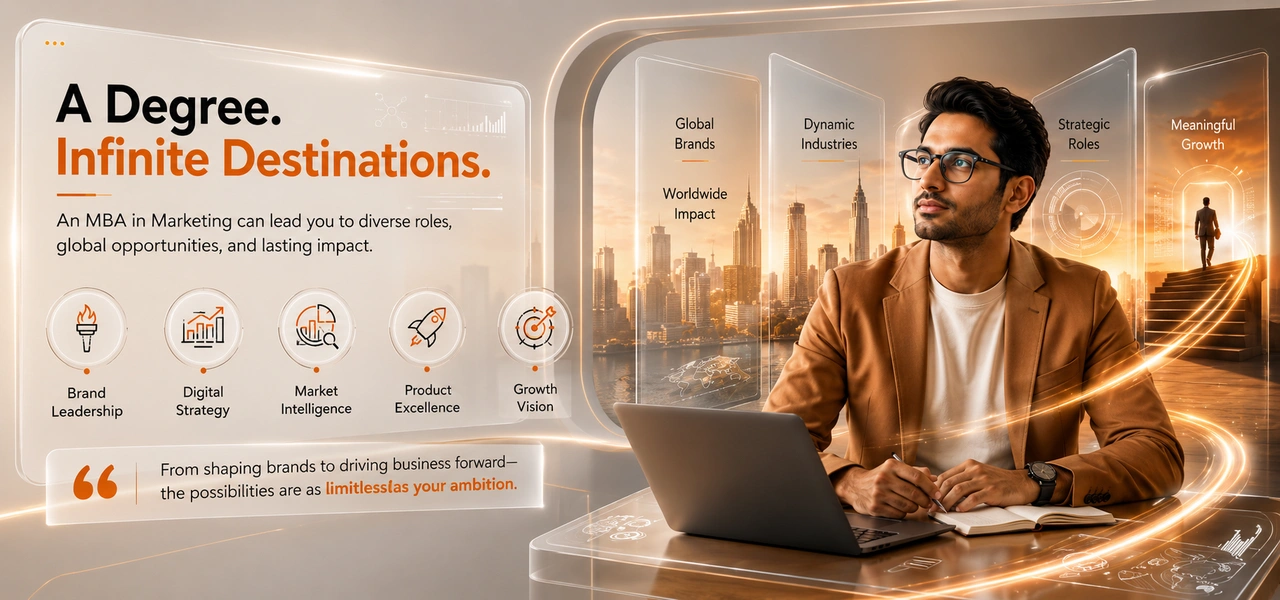
Brand Manager: Shape how a product is perceived in the market, enhance visibility and ensure consistent customer experience. From launching new products to maintaining the trust behind established names, you’ll guide how the world sees and feels about a brand.
Digital Marketing Strategist: As a Digital Marketing Strategist, you’ll design campaigns that attract, engage, and convert audiences through SEO, content strategy, social media, and analytics.
Market Research Analyst: This role is for those who love to decode what drives human behaviour. Market Research Analysts gather and interpret data to uncover patterns, preferences, and opportunities.
Product Manager: Lead innovations and new launches of products, ensuring they align with both market demand and brand strategy.
Chief Marketing Officer: Craft the brand story for the entire corporation. Think of Indra Nooyi, who began her journey in marketing and went on to become the CEO of PepsiCo. That’s the power of combining marketing insight with business leadership, exactly what an MBA cultivates.
The Smartest Leap: Why LPU Online
At the end of the day, ambition needs direction, and direction needs the right platform.
If you’re ready to transform your career, Lovely Professional University (LPU) Online offers a globally recognised MBA in Marketing program designed for professionals who want flexibility, innovation, and impact.
With a curriculum built for the digital era, mentorship from experienced faculty, and exposure to real-world projects, LPU Online empowers you to study anytime, anywhere, without pausing your career.
You’ll learn to think like a strategist, act like a leader, and make decisions that move markets. Because great marketers don’t wait for trends. They create them. Final Thought
Ask yourself: Do you want to keep following trends or start creating them?
An MBA in marketing course isn’t just a degree. It’s your passport to becoming the kind of professional who doesn’t just sell products, but builds legacies.
And your legacy? It starts with a single decision.
Make it count with LPU Online’s MBA in Marketing, where ambition meets opportunity, and learning meets leadership.