

The Morning of the Automated Analyst
It’s 8:45 AM, and a mid-level analyst logs in, preparing for the day ahead: messy supply chain data, endless spreadsheets, and a dashboard that would normally take hours to build. But today is different. A notification blinks: “All tasks completed. Dashboards optimized and anomalies flagged for review.”
Overnight, the AI hasn’t just run scripts; it untangled chaos, reorganized pipelines, highlighted the metrics that matter, and even suggested a layout executives will actually notice. The tedious work that once defined the day? Gone.
The twist isn’t that AI did the job. Is that what used to mark expertise, SQL joins, manual tuning, painstaking spreadsheets, is now baseline? The real edge lies in asking the right questions, spotting what the machine misses, and turning raw predictions into decisions that matter.
Data Science careers aren’t about speed anymore; they’re about foresight, about staying a step ahead of the algorithm. In 2026, success belongs to those who can operate in the gray space between AI and human judgment, where intuition meets intelligence.
The Manual Era: When Data Science was a “Hands-On Craft”
Before the Great Compression, the traditional data science workflow was a slow, deliberate craft. This was the era of “static BI,” where data scientists functioned as stewards of statistical methods, deriving insights from structured spreadsheets through significant manual effort. Feature engineering was often treated as a specialized craft, relying heavily on trial and error and consuming weeks of a professional’s time.
In this early phase from 2020 to 2022, data scientists were often protected by the perceived complexity of their tools. Even though nearly 80% of their time was spent on repetitive data preparation and cleaning, the challenges of manual feature engineering and extended hyperparameter tuning were widely accepted as inherent to the discipline. It was a period of “hand-built” visualization workflows, where practitioners frequently referred to statistical formulas and methods in notebooks to solve problems that were primarily technical in nature rather than strategic.
The Great Compression (2023–2026)
The discipline underwent a significant transformation between 2023 and 2026, often described as a period of rapid acceleration in workflow efficiency. The iteration cycle shortened considerably as AutoML and Generative AI enabled professionals to prototype multiple approaches in the time it previously took to build a single baseline model. This shift reflected a broader transition from “Model-Centric AI” to “Data-Centric AI.” By 2024, McKinsey reported that 72% of companies had integrated AI into business operations.
By 2025, as predicted by Gartner, roughly 80% of routine data science tasks, including boilerplate report generation and hyperparameter grid searches, were fully automated. Success in 2026 is driven by high-quality, reliable data frameworks rather than the complexity of the algorithm itself. AutoML platforms have reduced model training timelines by up to 40%, forcing a transition where the professional’s focus is on the data quality framework, the foundation that makes the AI smarter and the results more reliable.
Also read: Real-World Jobs Created by Generative AI in 2026
AI vs. Data Science: A Modern Lens for 2026
The distinction between AI and Data Science has sharpened, as the "Science" has moved from manual coding to what is essentially a "point-and-click" intelligent adventure. While both fields utilize Python and share a foundation in mathematics, they serve different masters in 2026.
|
Category |
Artificial Intelligence (AI) |
Data Science (DS) |
|
Primary Focus |
Mimicking human intelligence and action |
Extracting and interpreting insights |
|
Core Objective |
Building systems that act autonomously |
Uncovering patterns for decision-making |
|
Tech Stack |
Java, Prolog, TensorFlow, PyTorch, C++ |
SQL, R, Python, Pandas, Tableau, Hadoop |
|
Human Role |
System Architect / Orchestrator |
Interpreter / Strategic Framer |
|
Key Outcome |
AI Acts: Smart machines that adapt |
DS Interprets: Actionable business stories |
A student deciding between an AI certification and a Data Science degree today faces a choice in complexity. AI roles often demand hardware integration and robotics, while Data Science has moved toward Natural Language Processing (NLP) and automated pipelines. With platforms like H2O.ai and DataRobot, the modern data scientist uses AI as a co-pilot to transform raw data into a narrative so compelling it might make George RR Martin blush.
Career Evolution: The Rise of the Specialized Hybrid
The "junior data scientist" role of 2022 is largely extinct. Entry-level compression has eliminated the "dashboard-only analyst" and the "copy-paste notebook scientist" who relied on surface-level library usage. In the market for data science vs AI careers, the premium has shifted toward AI data scientist roles that require a specialised blend of technical fluency and industry intuition.
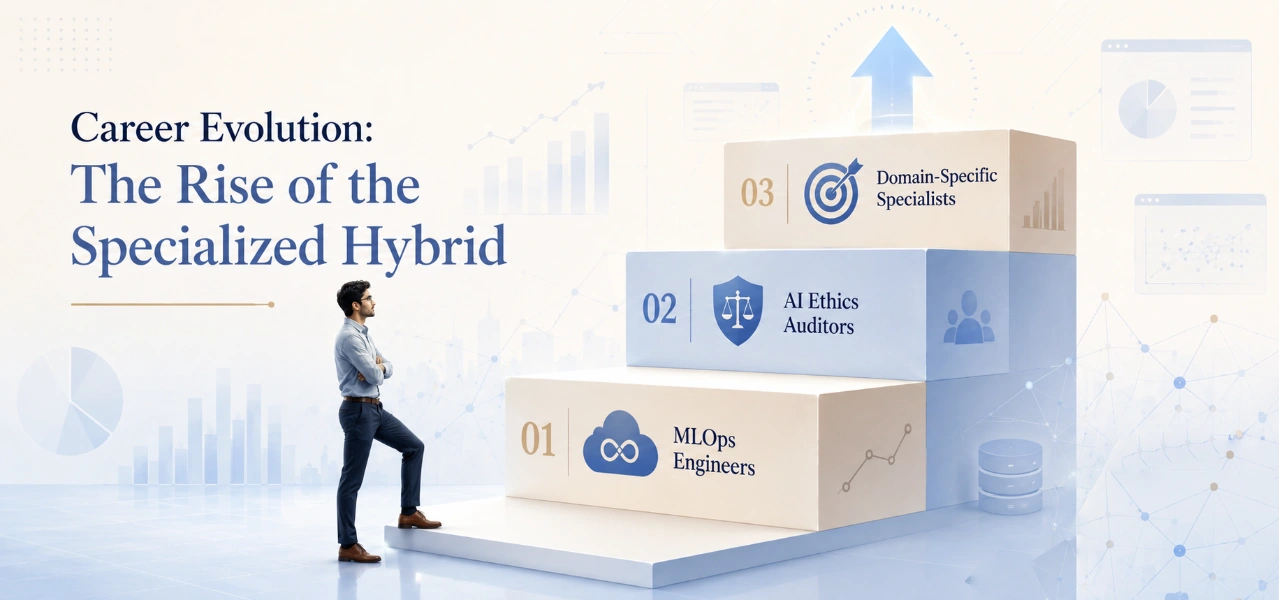
High-value roles in 2026 include:
- MLOps Engineers: Managing the deployment and lifecycle of models.
- AI Ethics Auditors: Navigating the "Judgment Layer" to ensure transparency.
- Domain-Specific Specialists: Professionals who apply data science to niche fields like healthcare analytics or financial risk modelling.
The demand for those who can “frame the business problem” is growing. In 2026, proficiency in visualization tools or libraries is increasingly common across skill levels, but the ability to define meaningful business questions and translate them into analytical problems remains a key differentiator among professionals.
The "Judgment Layer": Why Analytics is Not a Binary
The debate of "analytics vs AI" is a false choice. As automation handles the "how" of the syntax, the coding, and the tuning, the human professional must own the "why." AI makes naked predictions based on patterns; causality, however, remains a matter of human interpretation.
Data scientists now act as "morally upright statisticians." Their value lies in detecting statistical bias that AI might miss and navigating the ethical trade-offs inherent in high-stakes fields like credit scoring or medical diagnostics. While AI can flag a fairness violation, it cannot navigate the human nuances of policy. An analyst may realize their traditional reporting is automated, but this forces a pivot toward explaining implications to stakeholders. The job is no longer to present the data, but to act as a "translator" who defines the strategic "what next."
An Actionable Roadmap for 2026 and Beyond
To survive the future of data science, one must move beyond writing code and toward orchestrating systems.
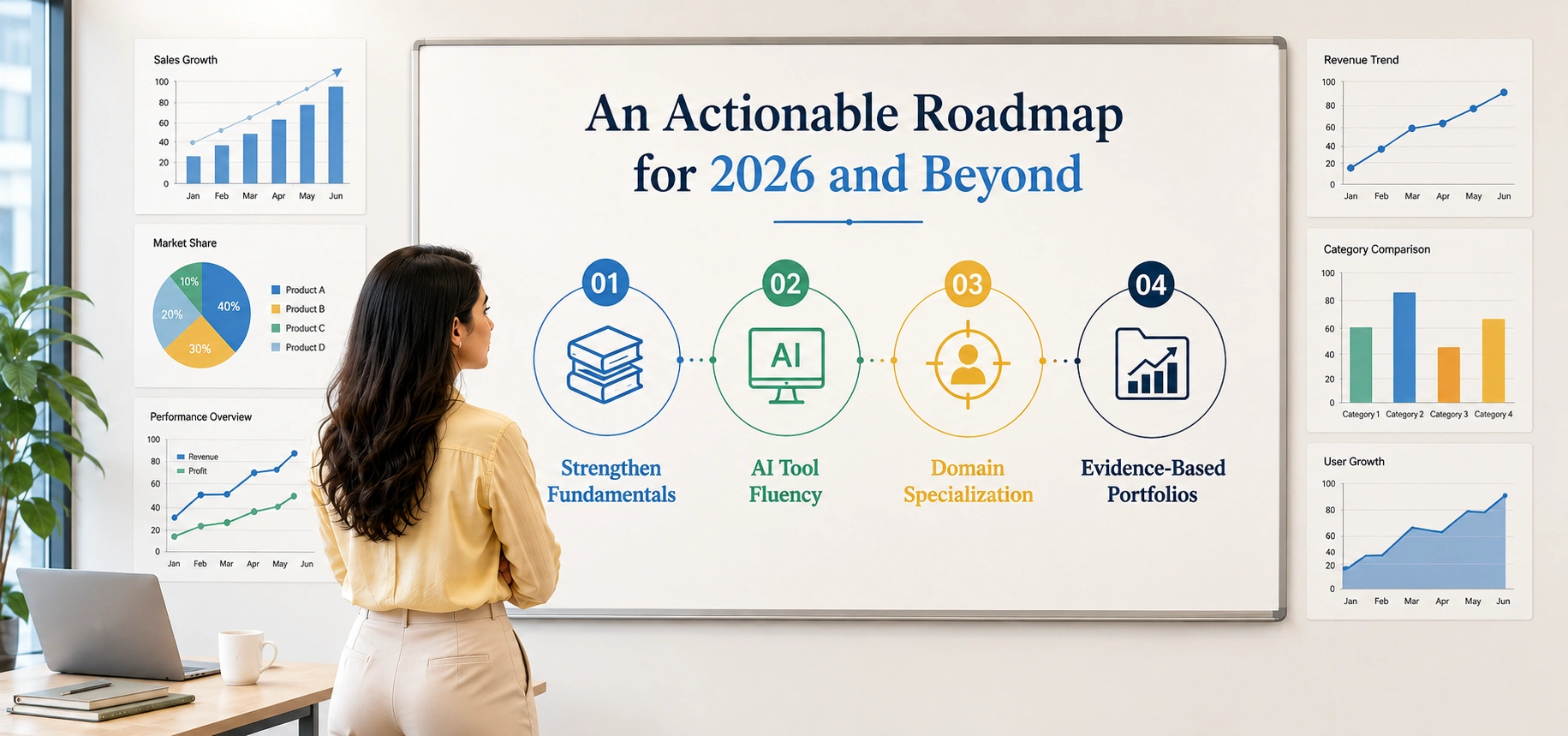
- Strengthen Fundamentals: Move beyond surface-level libraries. Mastery of statistics, probability, and specifically causal inference is the ultimate job security. Machines predict; humans interpret uncertainty.
- AI Tool Fluency: Transition from "writing code" to "orchestrating systems." Learn to use generative code assistants and AutoML to accelerate the iteration loop.
- Domain Specialization: Knowing the industry retail behavior versus clinical data is irreplaceable. Domain knowledge is the biggest separator between a replaceable operator and a strategic asset.
- Evidence-Based Portfolios: Build case studies that demonstrate how AI was used to solve a messy business problem. Proof of outcome beats a list of programming languages every time.
Conclusion
AI doesn’t replace the analyst. It rewrites the rules, doing the work we once measured skill by cleaning, predicting, and reporting, while leaving the messy, meaningful decisions to humans. In 2026, the power isn’t in who codes fastest. Built in who can translate intelligence into insight, and insight into action.
The future belongs to those who treat AI not as a competitor, but as the plumbing beneath their craft. It moves the data, runs the numbers, spins the models, while humans focus on the architecture: the questions, the judgment, the context, the story no machine can tell. Survival isn’t about algorithms anymore; it’s about the edge only humans can give them.