


Table of Contents
- Why Do We Trust Some Brands Without Thinking Twice?
- What Does a Brand Manager Actually Do?
- Why 2026 Could Be the Right Time to Build a Brand Management Career
- Brand Management Is Not Just for Fashion Anymore
- What Skills Help You Build a Successful Brand Management Career?
- Career Opportunities in Brand Management
- Conclusion
Before we explore what a brand management career really involves, let's begin with something interesting.
Read these two lines.
"Daag Achhe Hain."
"2-Minute Noodles."
That's all. If brand names immediately appeared in your mind, you've already seen the power of branding in action.
What's even more fascinating is that no logos were shown, no products were displayed and no company names were mentioned. Yet, just a few words were enough to remind you of brands you've probably known for years.
That kind of recall doesn't happen overnight.
It is built through consistent experiences, memorable campaigns, products that deliver on their promise and stories that stay with people long after an advertisement is over. Over time, those moments become much bigger than a marketing campaign. They become trust. And once a brand earns that trust, it often becomes the first choice even before customers begin comparing alternatives.
Behind every brand that achieves this is a team making hundreds of thoughtful decisions about what the brand should stand for, how it should communicate, how customers should experience it and how it should stay relevant in an increasingly competitive market. That is what brand management is all about.
So, what does a brand management career actually involve? What skills do you need to succeed? And more importantly, could it be the right career path for you in 2026? Let's find out.
Why Do We Trust Some Brands Without Thinking Twice?
Think about the last time you bought a phone, booked a hotel, ordered food or chose a pair of shoes.
Did you evaluate every single option available in the market? Probably not. You most likely started with brands you already knew. That is not because they are always the cheapest or technically the best. It is because they have earned a place in your mind long before you reached the checkout page.
A single positive experience becomes another reason to trust them. A memorable advertisement makes them easier to recall. Consistent quality is what keeps people coming back. Over time, these moments build familiarity and familiarity often becomes preference.
That is exactly why companies invest so heavily in branding today. A strong brand does not just attract customers it creates loyalty, encourages recommendations and gives businesses a competitive advantage that is difficult to copy. Building that kind of reputation does not happen by chance.It requires professionals who understand both business strategy and customer psychology. That is where a brand management career begins.
What Does a Brand Manager Actually Do?
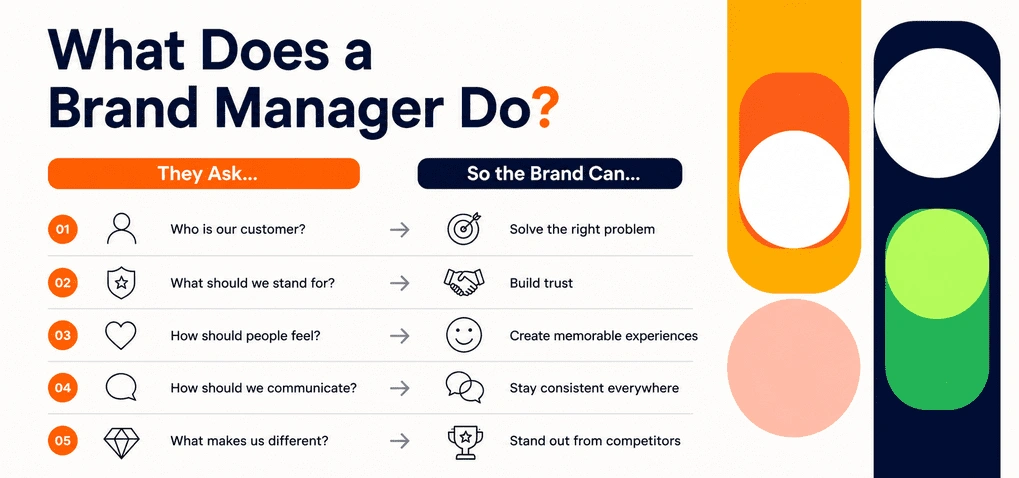
One of the biggest misconceptions students have is that brand managers simply create advertisements or approve social media posts. In reality, that is only a small part of the job.
Imagine a company preparing to launch a new smartwatch. Months before customers even see the product, dozens of important decisions have already been made.
- Who is the product being built for?
- What problem is it solving?
- Is there a need for this product?
- Or do we need to create one?
- How should it be priced?
- What message should the launch campaign communicate?
- How should the packaging feel when someone opens the box?
Even after the launch, the work does not stop.
Brand managers study customer feedback, monitor competitors, analyse market trends and work closely with teams across marketing, sales, product development, design and customer support.Their responsibility is not simply to increase sales. It is to ensure that every interaction people have with the company reflects the same identity, values and promise.
In simple words, they do not just build campaigns. They build confidence in a brand.
Why 2026 Could Be the Right Time to Build a Brand Management Career
A decade ago, having a great product was often enough. Today, that is rarely the case.
Customers have more choices than ever before. New brands enter the market almost every day and comparing products takes only a few seconds online. That means businesses can no longer compete on features alone. They compete on experience, trust and on the stories people remember.
At the same time, India's premium and luxury market is growing rapidly, digital-first businesses are expanding and homegrown brands are beginning to compete on a global stage.
Whether it is fashion, technology, healthcare, education, hospitality or finance, organizations are investing more than ever in building brands that people recognise and remember.
That is creating exciting opportunities for students who want careers that combine creativity with business strategy. A brand management career is not just about managing logos or advertising campaigns anymore. It is about influencing how people perceive a business and helping that business grow because of it.
Brand Management Is Not Just for Fashion Anymore
When students hear the words brand management, they often picture luxury fashion brands, designer labels or high end advertisements.
But branding exists wherever people make choices. The smartphone you buy, the hospital you trust, the university you apply to, the food delivery app you open after a long day and even the bank where you keep your savings. Every one of them is a brand.
And every one of them needs professionals who can shape how customers think, feel and connect with it. That is why brand managers today work across industries like technology, FMCG, healthcare, hospitality, automobiles, education, e-commerce, real estate, sports, finance and luxury retail.
The opportunities are no longer limited to one industry. They are growing wherever businesses want to build stronger customer relationships.
What Skills Help You Build a Successful Brand Management Career?
One of the biggest myths about brand management is that it is only for creative people.
Creativity certainly matters. But so do analytical thinking, communication, business understanding and problem solving.A successful brand manager learns how to balance both logic and creativity.
Some of the most valuable skills include:
- Understanding consumer behaviour
- Strategic thinking and decision making
- Communication and storytelling
- Market research and competitor analysis
- Digital marketing fundamentals
- Data interpretation
- Collaboration and leadership
The role is not just about mastering every business function instead it is about connecting them. Because a strong brand is rarely built by one department alone. It is built when marketing, product, sales, finance, customer support and leadership all work towards the same promise.
Career Opportunities in Brand Management
For students looking for a career that combines creativity, business, psychology and strategy, brand management offers an exciting path.
As businesses continue investing in stronger customer experiences and long term brand value, the demand for professionals who understand branding is steadily increasing.
Career opportunities today include roles such as:
|
Career Goal |
Typical Role |
|
Consumer Brands |
Brand Executive, Assistant Brand Manager |
|
FMCG |
Brand Manager |
|
Technology |
Product Brand Manager |
|
Luxury & Retail |
Luxury Brand Manager |
|
Hospitality |
Brand Experience Manager |
|
E-commerce |
Growth Brand Manager |
|
Healthcare |
Healthcare Brand Manager |
With experience, professionals can move into leadership positions such as Marketing Manager, Category Head, Marketing Director, Vice President of Marketing or even Chief Brand Officer.
Salary depends on the organization, industry, city and experience.
However, professionals with specialised knowledge and strong business understanding often progress much faster because organizations increasingly recognize branding as a long term business investment rather than just a marketing function.
For students entering the workforce in 2026, this creates a career path with both stability and growth.
Also Read: Design a Recognisable Professional Identity with an Online MBA
Conclusion
Let us go back to the question we started with.
Why do we instinctively trust some brands before we have even looked at the product? The answer was never just advertising. It was the experience, the consistency, the emotions and the countless small decisions that shaped our perception over time.
That is exactly what brand managers help create. They do not simply promote products. They build identities that people remember, trust and choose.
If you are someone who is curious about why people buy what they buy, enjoys understanding consumer behaviour and wants to combine creativity with business strategy, a brand management career could be one of the most rewarding paths to explore in 2026.
Because in the coming years, companies will not just compete to build better products. They will compete to build better brands.And behind every successful brand will be someone responsible for shaping the story people choose to believe.