

AI can diagnose diseases, write legal briefs, generate financial models, and code entire applications. What it cannot do is be held accountable, earn trust, navigate ambiguity, or exercise genuine judgement. That distinction between what AI can produce and what humans must own is the fault line along which every career in 2026 will either hold firm or fracture.
The scale of this shift is real. A Gartner survey of over 700 CIOs found that by 2030, no IT work will be done without AI involvement. Yet the same research makes clear that human oversight, critical evaluation, and strategic direction remain indispensable. The question facing students and professionals today is not whether AI will affect their careers, because it already has. The question is whether they are building the capabilities that sit beyond the reach of automation.
This blog is structured around three objectives: identifying which roles are genuinely resilient to automation, understanding the human capabilities that make them so, and mapping the high-growth industries in India where those roles are expanding. The goal is not to predict the future of work, but the goal is to help you make informed, forward-looking decisions about where to invest your time, education, and ambition.
Why AI Anxiety Feels So Real Today
What makes this moment genuinely difficult is not that AI is replacing humans, but that it is replacing the entry points through which most professionals once built their careers. The concern is legitimate, but losing entry-level roles to automation does not mean losing the career itself. Every period of technological transformation has restructured where careers begin, not whether they exist.
What AI is specifically targeting in today's job market:
- Repetitive, rule-based tasks: data entry, basic reporting, template-driven writing, and standard customer queries
- Predictable process work: routine compliance checks, formulaic financial modelling, and scripted support roles
- Entry-level pattern recognition: basic image classification, document sorting, and structured data analysis
What AI cannot structurally replace:
- Contextual judgement: decisions that require reading a situation beyond the data that is available
- Accountability: roles where a human must own the outcome and its consequences
- Relationship-driven work: trust, negotiation, mentorship, and stakeholder management
- Ethical reasoning: navigating ambiguity where no algorithm can determine what is right
The shift is real. But the professionals who understand precisely where that boundary lies are the ones best positioned to build careers on the right side of it.
The Biggest Myth: Tasks vs. Careers
It has often been said that: "AI doesn't take careers; it takes tasks." This is a crucial distinction.
- A Task is a single unit of work, repetitive, predictable, and rule-based.
- A Career is a complex collection of responsibilities requiring judgment, empathy, and strategy.
Think back to the history of banking in India. When the first ATMs arrived in the 1990s, everyone predicted the end of the "bank clerk." What actually happened? The "task" of counting and dispensing cash was automated. However, the career of the banker evolved. They became relationship managers and financial advisors. They moved from being "cash counters" to "trust builders."
AI is currently coming for the "counting cash" tasks in your job. Your goal is to move toward the "advisor" side of your industry.
The "At-Risk" Zone: What AI Replaces Easily
Before identifying where careers are safe, it is worth being precise about where they are not. The following roles do not face disruption because AI is particularly intelligent, but they face it because the work itself requires very little of what makes human intelligence distinctive.
- Administrative and Clerical Work: Manual data entry roles face an automation risk of 95%, with AI systems now processing thousands of documents per hour at significantly lower error rates than humans.
- Routine Customer Support: Customer service roles rank among the most exposed, with AI assistants and chatbots increasingly handling standard queries at scale.
- Retail and Checkout Operations: Retail cashiers face a 65% automation risk as self-checkout and computer vision systems become standard across modern retail.
- Junior Finance and Analysis: Business and financial operations roles carry the highest share of high-risk automation exposure across all sectors, at 19.9%.
- Routine Media and Content Tasks: Recent research (McKinsey research) categorises 86% of data entry and templated content tasks as technically automatable today.
The common thread across all these categories is the absence of contextual judgment, ethical accountability, and complex human interaction, the capabilities that remain beyond the reach of current AI systems.
The Human Advantage: What Makes a Career AI-Resistant?
Across every major automation study, the roles that survive technological disruption share a common architecture built on capabilities that cannot be reduced to data, replicated by pattern recognition, or optimised by an algorithm. These capabilities fall into four distinct pillars:
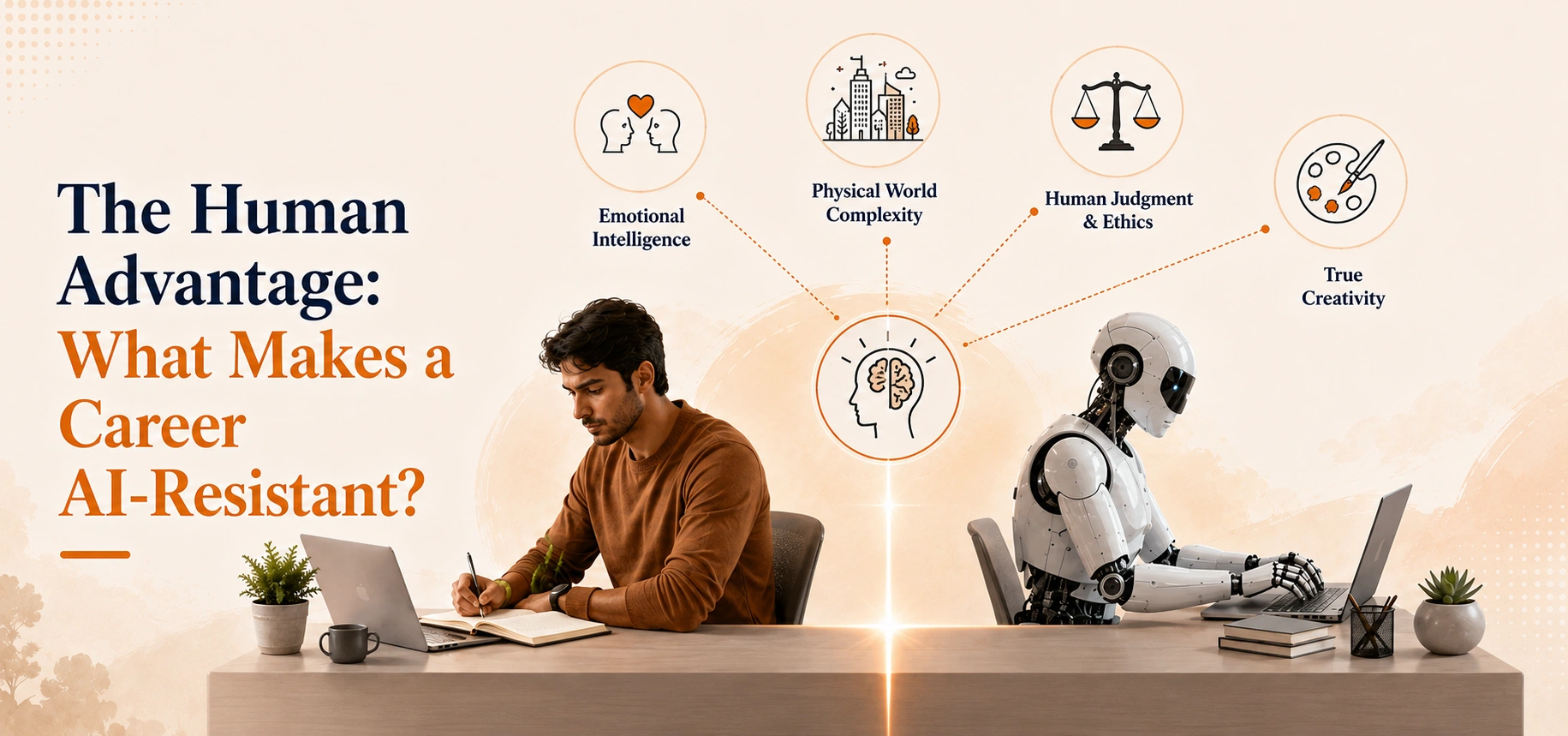
- Emotional Intelligence: AI can analyse the words in a conversation, but it cannot read the hesitation behind them. Managing tension, interpreting unspoken signals, and responding to human emotion in real time remains beyond the reach of any current model.
- Physical World Complexity: Controlled environments can be automated. The real world cannot. Surgical procedures involving unexpected variables, field engineering in unpredictable conditions, and hands-on construction work demand physical adaptability that robotics cannot yet reliably replicate.
- Ethical Judgement and Accountability: Many consequential professional decisions do not have an objectively correct answer; they have a human one, shaped by context, culture, and competing values. Crucially, AI cannot be held accountable for outcomes. Humans can.
- Original Creativity: AI can produce work that resembles the output of great thinkers. It cannot originate the perspective, lived experience, or cultural intention behind it. Conceptual originality remains a distinctly human capability.
Top Careers That Will Thrive in the AI Era
Several careers have always been defined by the presence of human touch in them. The trust and reliance one can put into humans might never be replaced through any technological or AI Automation.
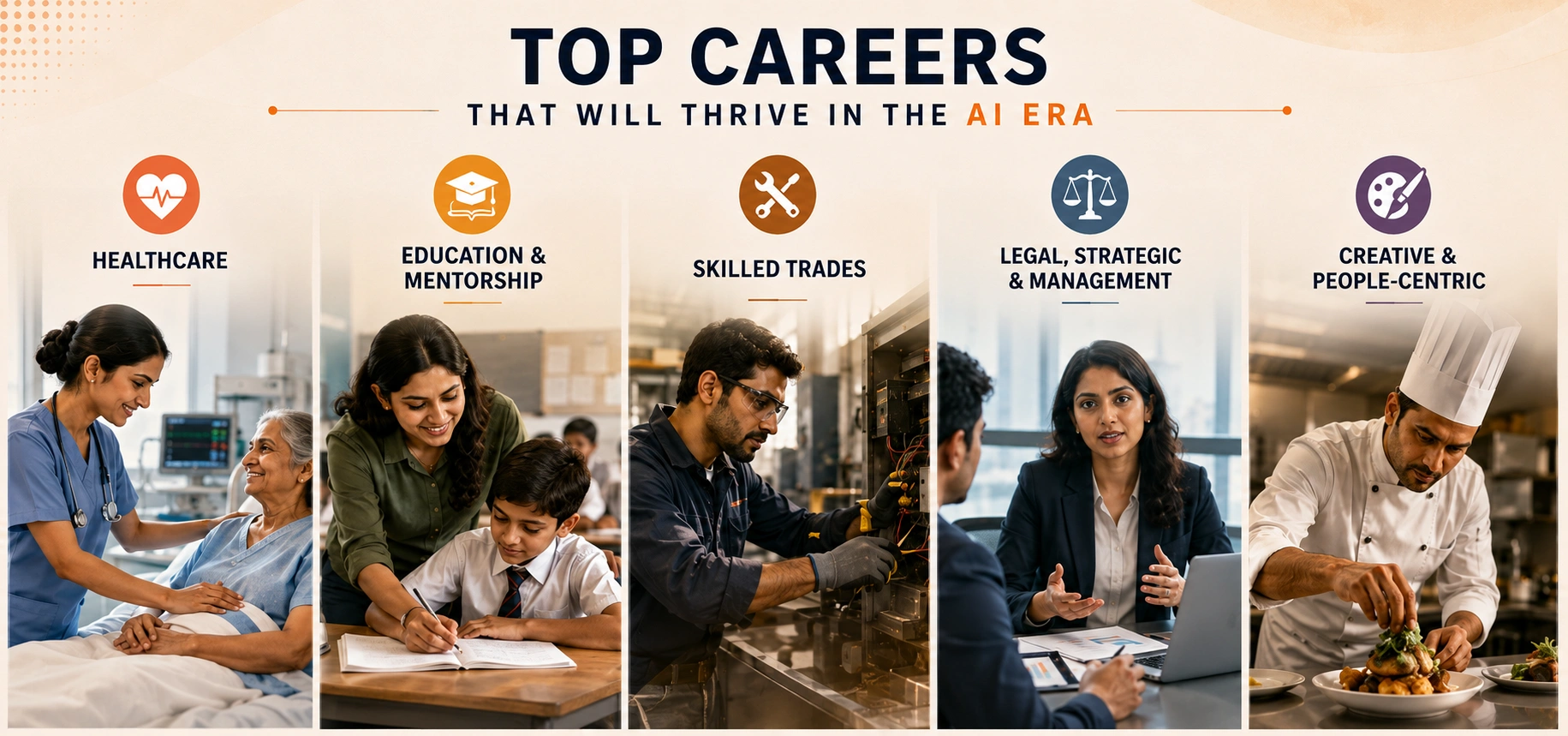
Healthcare: The Power of the Human Touch
Healthcare is the ultimate AI-proof sector because it combines Emotional Quotient and Physical World Complexity.
- Nurse Practitioners (40.1% Growth): This is the fastest-growing healthcare occupation through 2034, according to the BLS (Bureau of Labour Statistics). AI monitors data; clinical judgement and patient communication remain human. Bureau of Labor Statistics
- Physician Assistants (28% Growth): This is among the highest growth rates for any occupation that requires complex clinical decisions in unpredictable environments.
- Mental Health Counsellors (19% Growth): This role is growing at nearly triple the average rate for all occupations. The deep therapeutic trust required in clinical mental health practice cannot be algorithmically replicated.
- Physical Therapists (22% Growth): Hands-on assessment, real-time adaptation to patient pain response, and tactile clinical judgement make this among the most automation-resistant roles in the healthcare sector, per BLS.
Education & Mentorship: More Than Just Information
Teaching is moving from "information transfer" (which AI does well) to "inspiration and mentorship."
- Special Education Teachers: Highly personalised and adaptive teaching methods require human attentiveness to developmental and emotional cues that no algorithm can reliably decode.
- Elementary Teachers: Managing emotions, social dynamics, and individual learning development simultaneously places this role firmly beyond information-delivery automation.
- Coaches and Mentors: Understanding individual psychology, motivation, and potential requires strategic human judgement rooted in interpersonal insight that AI cannot replicate.
Skilled Trades: The Heroes of the Physical World
In India, we often look down on "working with your hands." Stop. In the AI era, Master Technicians are the new elite. They face Physical World Complexity every day.
- Master Electricians & Plumbers: Every building in India is a unique puzzle. Troubleshooting a short circuit in a 1970s bungalow requires problem-solving that a robot cannot mimic. These roles are seeing 8-15% salary growth because of the scarcity of human expertise.
- HVAC & Smart Home Technicians: As India’s luxury real estate market booms, the demand for specialists who can integrate AI-driven climate systems into complex physical structures is skyrocketing. These experts earn premium rates, with global median salaries reaching ₹95 Lakhs.
- Specialised Auto Mechanics (EV focus): As we shift to Electric Vehicles (Tata, Mahindra), the need for mechanics who can diagnose complex hybrid systems using sensory perception (hearing a rattle, feeling a temperature shift) is becoming a high-tech-resistant superpower.
Legal, Strategic & Management Roles
Roles that require Human Judgment & Ethics are exceptionally safe.
- Lawyers: Persuading a court, interpreting human intent behind contracts, and navigating moral grey areas demands deeply contextual judgment that no algorithm can reliably substitute.
- HR Managers: Resolving workplace conflict, developing organisational culture, and leading workforce transitions requires human sensitivity and relational intelligence that AI cannot replicate.
- Operations and Project Managers: Navigating uncertainty, aligning stakeholder expectations, and sustaining team motivation across complex environments demands the kind of adaptive, accountable leadership that remains distinctly human.
Creative & People-Centric Careers
Creativity informed by culture and emotion – True Creativity – remains a human stronghold.
- Choreographers: Cultural emotion and lived human experience are the foundation of movement and expression, qualities AI can imitate but never originate.
- UX Directors: Designing experiences that authentically bridge human psychology and technology demands creative and empathetic intelligence that AI cannot generate independently.
- Executive Chefs: At the intersection of leadership, sensory creativity, and cultural curation under high-pressure conditions lies a role that is fundamentally and irreducibly human.
Jobs That Will Evolve, Not Disappear: The Human-AI Partner
The future of work is not defined by humans versus AI; it is defined by humans working alongside it. GitHub Copilot now writes nearly half of a developer's code on average, according to GitHub's own usage data. This does not signal the end of software development as a profession. It signals the end of one type of contribution within it. The developer who writes routine scripts in isolation is being displaced. The Solution Architect, the professional who understands a client's business problem and directs AI to build the right solution, is becoming more valuable than ever.
New Roles on the Horizon:
- AI Ethics Officers: Ensuring AI systems do not inherit or amplify human bias requires deep philosophical, legal, and organisational judgement, capabilities no algorithm can self-apply.
- Human-AI Interaction Designers: Specialists who design the interfaces and workflows that make AI tools intuitive, accessible, and trustworthy for human users across industries.
Conclusion: From Fear to Confidence
The AI revolution is not about the end of work; it is about the end of monotony. The roles disappearing are often those that treated professionals like machines, repetitive, soul-crushing, and data-heavy.
The roles thriving are those that require professionals to be at their most human. Competing with a machine on speed or scale is not a viable strategy; the more sustainable path is becoming the irreplaceable partner who provides the vision, the ethics, and the empathy that technology fundamentally lacks.
For students and professionals navigating this transition, a worthwhile starting point is identifying one task in current work that AI could perform and one human skill that it could not. The distance between those two answers is where deliberate, future-proof career development begins.
References: Certain insights presented in this article are informed by research and industry analysis published by Gartner, specifically the article titled “Gartner Survey Finds All IT Work Will Involve AI by 2030; Organizations Must Navigate AI Readiness and Human Readiness to Find, Capture and Sustain Value,” available through the Gartner Newsroom. The referenced findings have been used to provide context on the increasing integration of artificial intelligence across IT functions, workforce readiness considerations, and the organisational capabilities required to achieve sustainable value from AI adoption.