

Do you remember the last time Netflix suggested a show that felt oddly perfect for your mood? Or when a food delivery app showed you a simple chart of how much you spent last month. Both use data, but the work happening behind the scenes is very different.
This is where the confusion between Data Science and Data Analytics usually begins.
Many people hear these terms together and assume they are interchangeable. But, they are not. Understanding the difference between Data Science and Data Analytics is important if you are planning a career in a data-related domain or trying to decide which skills to invest time in. This blog breaks down the differences using simple examples so you can clearly see which path suits you better.
What Is Data Science?
Imagine an e-commerce company wants to know which customers are likely to stop buying from them in the next three months. There is no direct answer in a spreadsheet. Someone has to build a system that can learn from past behaviour and predict future actions. That is Data Science.
Data Science focuses on solving future-oriented problems. A data scientist works with large volumes of data, writes code, builds models, and trains algorithms to make predictions or automate decisions.
For example:
- Assessing customer retention risk
- Recommending products based on user behaviour
- Detecting fraud in online transactions
- Forecasting demand for the next season
To do this, data scientists use programming, statistics, and machine learning. The work is experimental and often involves trial and error. You build a model, test it, improve it, and repeat.
In simple terms, data science answers questions like:
- What is likely to happen next?
- How can we automate this decision?
- Can we predict outcomes before they occur?
What Is Data Analytics?
Consider a college canteen that witnesses a noticeable decline in lunch sales on weekdays compared to the previous month. To understand the reason behind this change, the canteen owner reviews the information already available to him.
The data in this situation includes daily sales records, item-wise sales numbers, pricing details, and sales volume across different days and time slots. This data represents raw facts collected through regular operations.
The owner then begins the analytics process by examining this data. He compares sales across days, identifies which food items sell the most, reviews price variations, and studies the time periods when sales tend to drop.
Through this analysis, he identifies clear patterns:
- Sales decline on days when a popular menu item is unavailable
- Students prefer value-based combo meals rather than individual items
- The highest sales occur within a specific time window
These insights help him make informed decisions about inventory planning, pricing strategies, and promotional offers.
This entire process is Data Analytics.
Data analytics involves analysing existing data to uncover patterns, trends, and reasons behind outcomes. The data already exists; the value lies in how it is examined and interpreted to support better decision-making.
In practical terms, data analytics answers questions such as:
- What has changed compared to earlier periods?
- Why did performance increase or decline?
- What actions can be taken to improve future results?
Data Science vs Data Analytics: The Core Difference
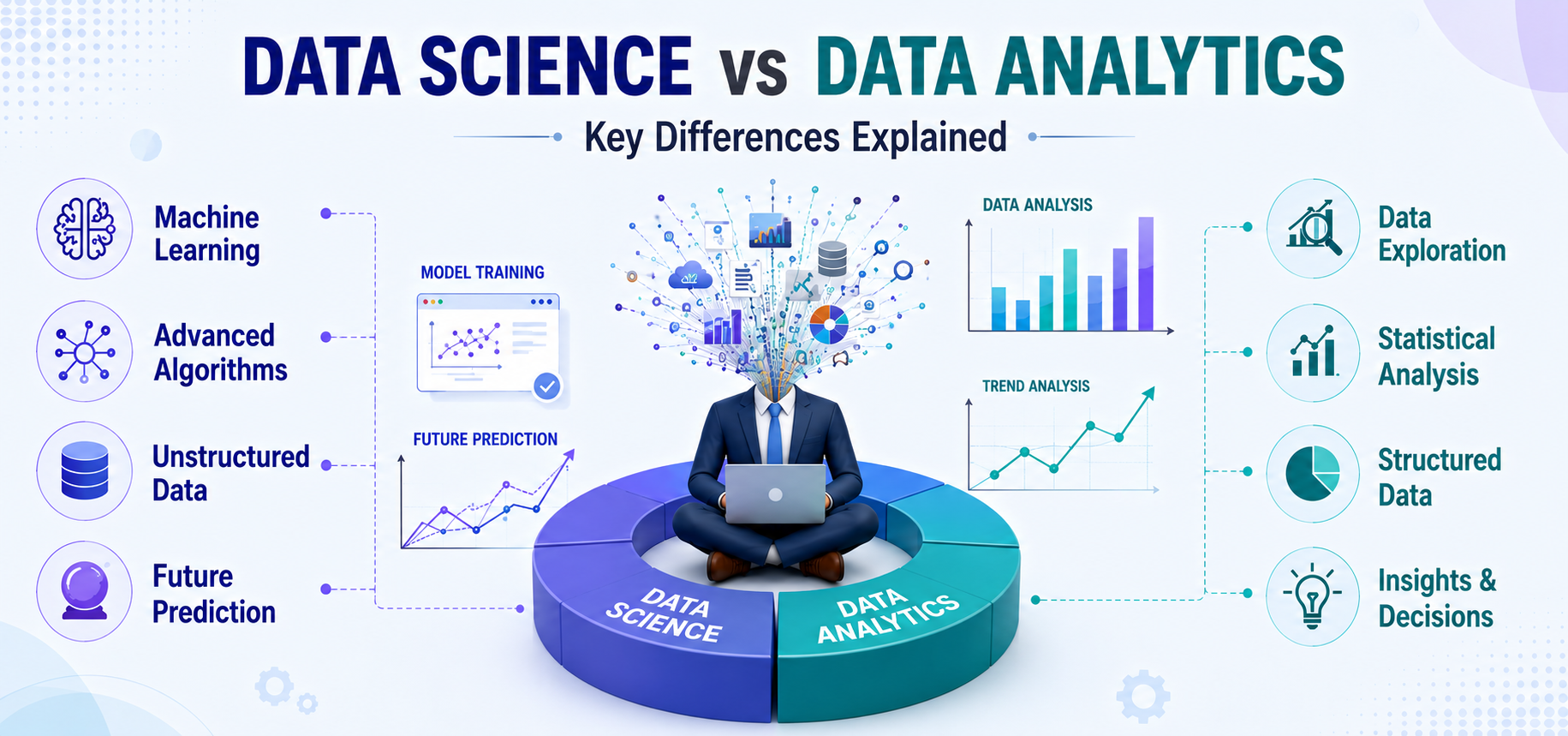
The easiest way to understand Data Science vs Data Analytics is to think about time. Data analytics looks at the past and present, while Data science looks at the future. Analytics helps businesses make informed decisions today. Data science helps businesses prepare for tomorrow. Let’s make it clearer from the table given below:
Comparison Table: Data Science vs Data Analytics
|
Aspect |
Data Science |
Data Analytics |
|
Primary Focus |
Prediction and automation |
Insights and decision support |
|
Type of Questions |
What will happen next? |
What happened and why? |
|
Data Type |
Structured and unstructured |
Mostly structured |
|
Skills Required |
Programming, ML, statistics |
SQL, Excel, visualisation |
|
Tools Used |
Python, R, ML libraries, big data tools |
SQL, Excel, Power BI, Tableau |
|
Output |
Predictive models, algorithms |
Reports, dashboards, insights |
|
Complexity |
High |
Moderate |
|
Entry Barrier |
Higher |
Lower |
Tools and Day-to-Day Work
A typical day also looks different in Data Science vs Data Analytics roles.
A data scientist may spend the day:
- Writing Python code
- Testing machine learning models
- Cleaning large datasets
- Discussing model performance with engineers
A data analyst may spend the day:
- Pulling data using SQL
- Creating charts and dashboards
- Reviewing reports with stakeholders
- Answering business questions
Both roles work with data, but the nature of the work and the expectations are different.
Career Scope and Growth
From a career perspective, both paths offer strong demand and long-term relevance.
Data analytics roles exist in almost every industry. Finance, healthcare, education, marketing, and operations all rely heavily on analysts. This makes data analytics a good entry point for beginners and career switchers.
Data science roles are more specialised and usually found in technology-driven organisations. These roles often require deeper technical expertise and continuous learning.
When comparing Data Science vs Data Analytics as a career choice, think about how comfortable you are with:
- Coding and mathematics
- Ambiguous problems with no fixed answers
- Long experimentation cycles
If that excites you, data science may be a good fit. If you prefer structured analysis and business impact, data analytics may suit you better.
Salary Perspective
Salary potential is an important consideration when comparing data science and data analytics. While both fields offer strong earning potential, compensation varies with role complexity, technical depth, and experience.
Data Science Salary Range
Data science roles generally pay more due to advanced technical requirements and greater responsibility.
- Entry-level (0–2 years): ₹6–10 LPA
- Mid-level (3–6 years): ₹12–25 LPA
- Senior / Specialised roles: ₹30 LPA and above
Common roles include Data Scientist, Machine Learning Engineer, and AI Specialist, particularly in product-based and technology-driven organisations.
Data Analytics Salary Range
Data analytics roles provide competitive compensation with steady growth as professionals develop domain expertise.
- Entry-level (0–2 years): ₹4–8 LPA
- Mid-level (3–6 years): ₹10–18 LPA
- Senior / Lead Analyst roles: ₹20 LPA and above
These roles are widely available across industries such as finance, marketing, healthcare, and operations.
In general, Data science roles often begin at a higher salary band, while data analytics offers quicker entry and consistent progression. More importantly, salary growth in both fields depends on skills, problem-solving ability, and real-world impact, not just the job title.
Which One Is Right for You?
Choosing between Data Science vs Data Analytics is less about trends and more about alignment.
Many professionals start with data analytics and later transition into data science. Both paths are valid and often interconnected.
If you are still unsure where to begin, starting with a guided learning path can make the decision easier. LPU Online provides flexible programs designed to help you build a strong foundation in data science.
Conclusion
Data science and data analytics are often viewed as competing fields, but in practice, they complement each other. Data analytics helps us understand what has already happened and what is happening now, while data science builds on those insights to anticipate future outcomes.
When you clearly understand Data Science vs Data Analytics, you make career decisions based on clarity and self-assessment rather than surface-level trends. With the right mindset and continuous skill development, both paths can lead to a stable and rewarding career in today’s data-driven world.
FAQs
- What are the best tools used in data analytics compared to data science?
Data analytics commonly uses tools like Excel, SQL, Power BI, Tableau, and Google Analytics to analyse historical data and create reports or dashboards.
Data science relies more on Python, R, machine learning libraries, big data frameworks, and cloud platforms to build predictive models and automate decisions. - How do job roles in data analytics differ from those in data science at top tech firms?
At top tech companies, data analysts focus on reporting, performance tracking, and business insights that support decision-making.
Data scientists work on advanced problems such as predictive modelling, algorithm development, and building data-driven systems used in products and services. - Is data analytics easier to start with than data science?
Yes. Data analytics has a lower entry barrier and is often recommended for beginners. It requires less advanced mathematics and programming compared to data science. - Which has better career growth: data science or data analytics?
Both fields offer strong career growth. Data analytics provides quicker entry and steady progression, while data science offers deeper technical roles and higher growth potential with experience. - Do I need coding skills for data analytics?
Basic coding, mainly SQL and some Python, is helpful but not always mandatory at the entry level. Data science roles require strong programming skills. - Can a data analyst move into data science later?
Yes. Many professionals start in data analytics and gradually transition into data science by learning programming, statistics, and machine learning. - Which field is better for freshers?
Data analytics is generally better suited for freshers due to its practical approach and easier learning curve. Data science is ideal for those with strong technical backgrounds or higher qualifications. - Are data science and data analytics roles in demand?
Yes. Both roles are in high demand across industries such as technology, finance, healthcare, e-commerce, and consulting, driven by the growing reliance on data-driven decisions.