

Table of Content
Introduction
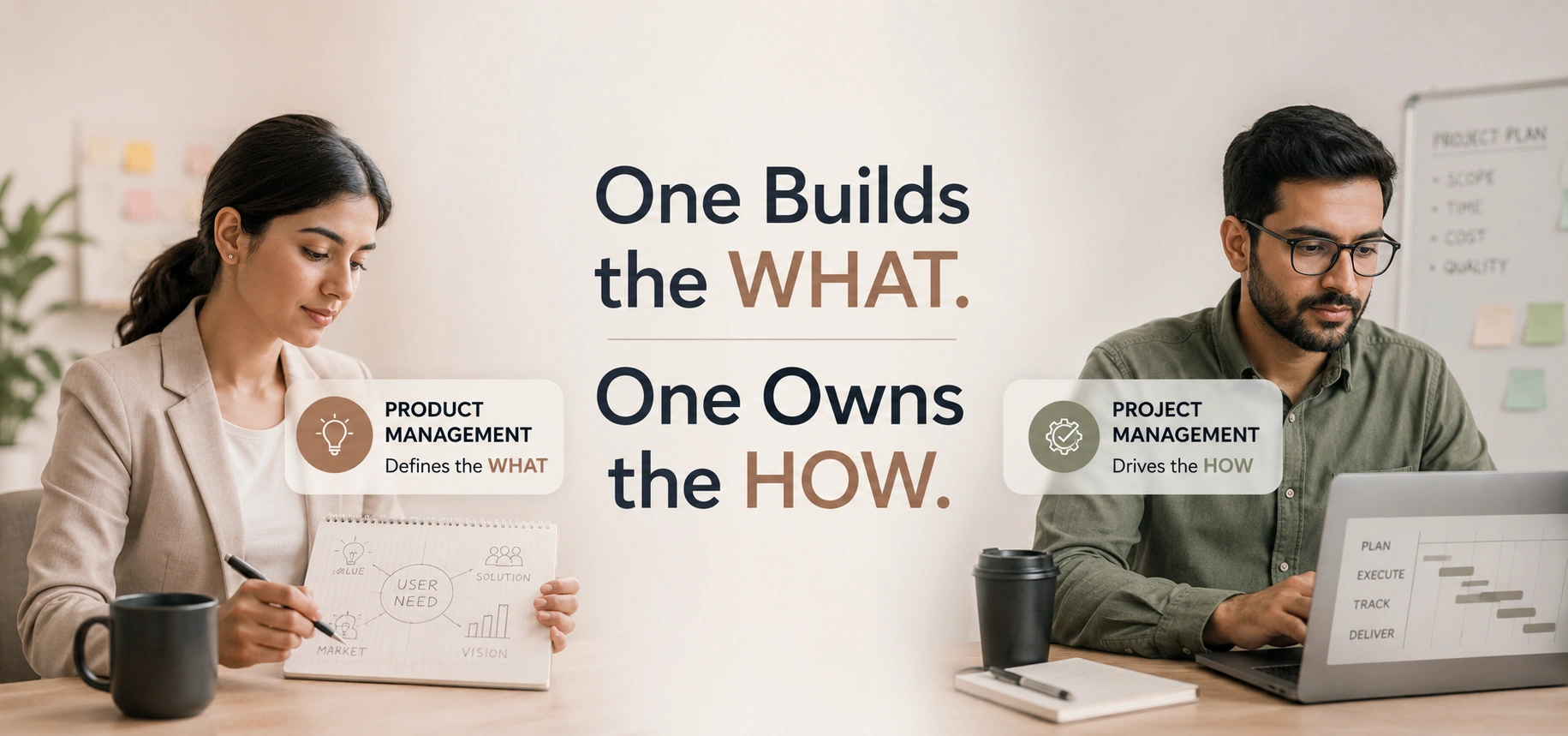
Picture two professionals walking into the same company on the same day. The first one sits down with the design team, pulls out a whiteboard, and starts asking, "What problem are we actually solving for our users and why does it matter?" The second opens a project tracker, maps out timelines, assigns tasks, and asks, "How do we deliver this, and by when?"
Same company. Same product launch. Completely different roles, responsibilities, and career trajectories.
Yet, every year, thousands of students and working professionals use the terms Product Manager and Project Manager interchangeably, and it silently costs them interviews, promotions, and salary negotiations. Whether you are a fresh graduate, a mid-career switcher, or someone seriously considering an MBA in Product Management, understanding this distinction is not just academic; it is career-defining. Let us break it down, once and for all.
What Is Product Management?
Product Management is a strategic, innovation-driven discipline focused on defining what a product should be, who it should serve, and why it deserves to exist in the market. A Product Manager (PM) is often described as the "CEO of the product", someone who owns the product vision from inception to launch and beyond, without necessarily managing anyone directly.
Product Managers work at the crossroads of business strategy, user experience, and technology. They spend their days conducting user research, analysing market data, writing product requirement documents, and aligning engineering, design, marketing, and sales teams around a unified product roadmap. It is a role built on influence, insight, and the relentless pursuit of product-market fit.
The role has exploded in demand over the last decade, driven by the rise of SaaS companies, digital-first businesses, and consumer apps. Companies like Google, Amazon, Swiggy, Razorpay, and CRED have entire product organisations where PMs are among the highest-paid and most strategically critical professionals. A Product Manager does not manage people — they manage decisions, priorities, and outcomes.
Key areas a Product Manager owns: vision and strategy, user research, product roadmapping, OKRs and KPIs, feature prioritisation, and stakeholder alignment.
What Is Project Management?
Project Management is the discipline of planning, organising, and executing a specific project within defined constraints, usually time, budget, and scope. A Project Manager (PjM) is the engine behind execution. They are the professionals who ensure that what was envisioned actually gets built, delivered, and signed off on schedule and within the approved budget.
Unlike Product Management, which is ongoing and iterative, Project Management is temporary by nature. Every project has a defined beginning, a set of milestones, and a clear end. Once the project is delivered, the project manager moves on to the next one. This makes the role highly transferable across industries from IT and construction to healthcare, finance, and government.
Project Managers are experts in frameworks like Agile, Scrum, PMP (Project Management Professional), and PRINCE2. They manage risk registers, resource plans, status reports, and stakeholder communications with precision. Their value lies not in what they build, but in how reliably and efficiently they deliver it. In a world where time and budget overruns can sink entire organisations, a skilled Project Manager is invaluable.
Key areas a Project Manager owns: timelines and milestones, budget control, resource planning, risk management, and delivery coordination.
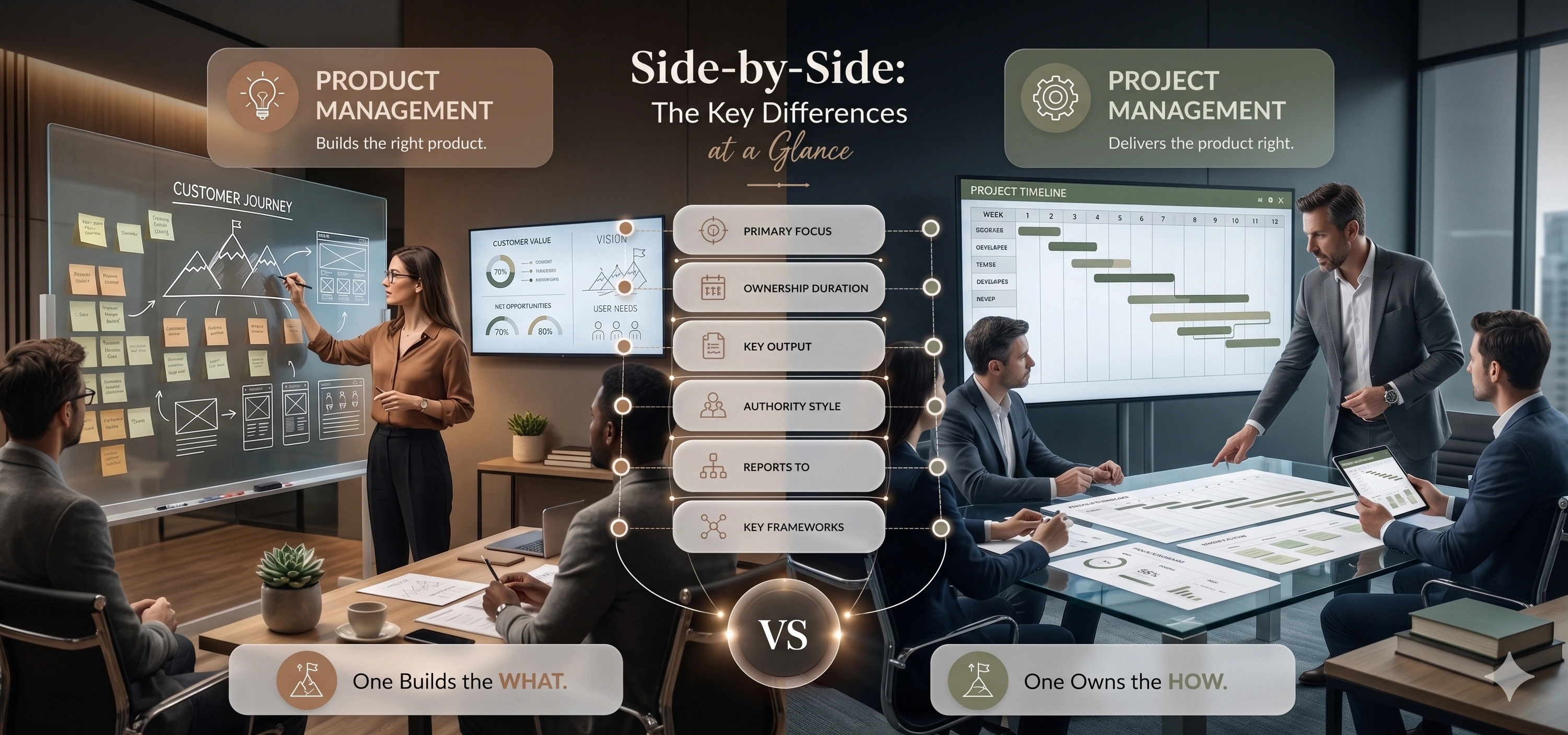
Side-by-Side: The Key Differences at a Glance
|
Dimension |
Product Manager |
Project Manager |
|
Primary Focus |
What and Why: Vision and Strategy |
How and When: Execution and Delivery |
|
Ownership Duration |
Ongoing entire product lifecycle |
Temporary project - start to close |
|
Key Output |
Product roadmap, features, and user value |
Delivered project within scope and budget |
|
Authority Style |
Influence without direct authority |
Direct coordination of teams and tasks |
|
Reports To |
CPO / VP of Product |
PMO Director / COO |
|
Key Frameworks |
OKRs, Jobs-to-be-Done, Design Thinking |
Agile, Scrum, PMP, PRINCE2, Gantt |
|
Tools Used |
Jira, Mixpanel, Figma, ProductBoard |
MS Project, Asana, Trello, Monday.com |
|
Average Salary (India) |
₹15 – 40 LPA (Senior PM) |
₹10 – 25 LPA (Senior PjM) |
|
Career Destination |
CPO, CEO, Startup Founder |
PMO Head, VP Operations, Programme Director |
|
Ideal Qualification |
MBA in Product Management / CS + MBA |
MBA + PMP / PRINCE2 Certification |
Where Do the Two Roles Actually Overlap?
While fundamentally different, both roles demand strong communication, cross-functional collaboration, and the ability to manage competing priorities without losing sight of the bigger picture. In fast-growing startups where teams are lean, and every professional wears multiple hats, one person may handle both product strategy and project execution simultaneously.
In large enterprises and tech companies, however, these roles are clearly separated. Product Managers focus on the "what" and "why," while Technical Program Managers or Project Managers own the "how" and "when." Understanding which side of this spectrum energises you is the first and most important step in choosing the right career path.
Skills that both roles share include stakeholder management, Agile fluency, data-driven decision making, clear communication, influence without authority, and the ability to identify and mitigate risk before it becomes a crisis.
Why an MBA in Product Management Is the Smartest Move Right Now
The demand for skilled Product Managers across India's booming tech ecosystem has never been higher. From Bengaluru's startup belt to Gurugram's fintech hubs and Mumbai's enterprise corridors, companies are actively hunting for professionals who can bridge business strategy with user-centric product thinking. Yet, the supply remains critically short because most graduates simply are not trained for it.
This is precisely why an MBA in Product Management has become one of the most sought-after postgraduate qualifications among ambitious professionals today. Unlike a generic MBA, an MBA in Product Management is hyper-focused, combining the business fundamentals of a traditional MBA with specialised training in product strategy, UX thinking, data analytics, go-to-market planning, and technology literacy.
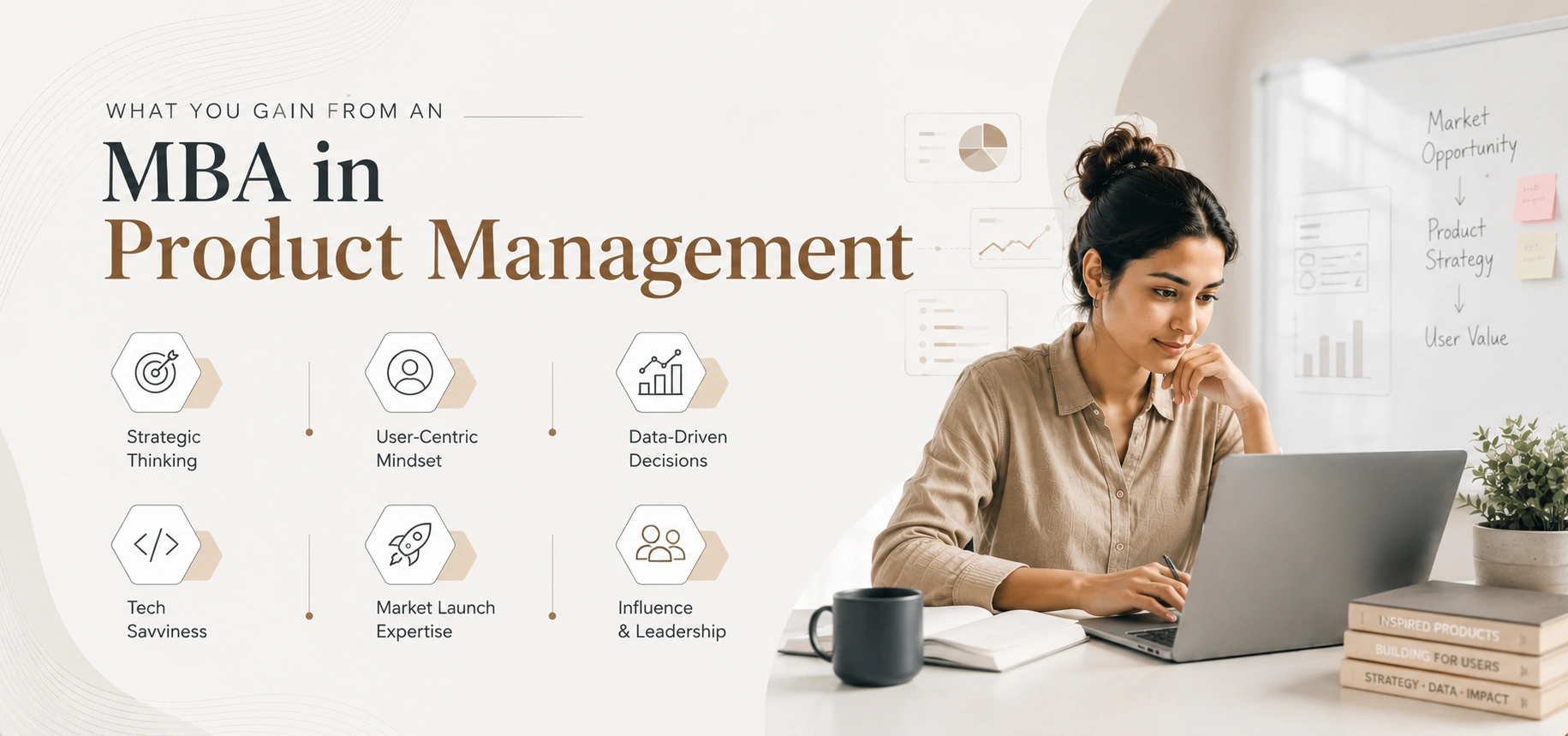
Here is what you gain from a well-structured MBA in Product Management programme:
- Product Strategy and Roadmapping: Frameworks like Jobs-to-be-Done, Opportunity Scoring, and OKR-setting to define direction with precision and purpose.
- User Research and Design Thinking: Conducting interviews, building personas, mapping user journeys, and validating hypotheses before writing a single line of code.
- Data Analytics and Product Metrics: Reading funnels, running A/B tests, interpreting cohort data, and setting the right KPIs for each stage of growth.
- Technology Fluency for Non-Engineers: Understanding APIs, databases, system architecture, and Agile development cycles well enough to collaborate seamlessly with engineering teams.
- Go-to-Market Strategy: Positioning, pricing, launch planning, and competitive differentiation for new features and products.
- Leadership Without Authority: Influence, negotiation, storytelling, and alignment — the soft skills that separate great PMs from average ones.
Graduates of an MBA in Product Management programme are equipped to step into Associate PM roles at top tech companies, transition from engineering or marketing backgrounds into product functions, or launch their own product-led ventures with greater confidence and clarity than any self-taught path can offer.
Which Path Is Right for You?
Both Product Management and Project Management are exceptional careers; the question is which one aligns with how you naturally think and what energises you professionally.
Choose Product Management if you are obsessed with user problems, love working under ambiguity, enjoy thinking about strategy and market dynamics, and want to own a product's entire journey from idea to impact.
Choose Project Management if you thrive on structure, love coordinating diverse teams toward a shared deadline, take pride in flawless execution, and want a career that travels well across industries and geographies.
If you are leaning toward product, the clearest and most credible path forward is an MBA in Product Management, especially one delivered online, allowing you to learn while you work and apply every concept to real challenges in real time.
Conclusion: Your Launchpad Is Here - LPU Online
The difference between a Product Manager and a Project Manager is not just a matter of job title; it is a matter of mindset, methodology, and career vision. One defines what gets built; the other ensures it gets delivered. Both are indispensable to any organisation that wants to survive and scale in today's competitive landscape.
If the world of product strategy, user obsession, and market-defining decisions excites you, there has never been a better time to formalise that ambition. At LPU Online, Lovely Professional University's industry-leading digital learning platform, our MBA in Product Management programme is designed for exactly this moment. Built in collaboration with seasoned product leaders, startup founders, and hiring companies, it combines a globally recognised LPU degree with real-world curriculum, live mentorship, and a strong placement network.
Whether you are a fresher charting your first career move, an engineer ready to pivot into product, or a working professional aiming for that senior PM role, LPU Online gives you the knowledge, credentials, and community to get there. The best product decisions begin with the best education, and your decision starts here.