


Table of Content
- The Foundation of Modern Business: Understanding Traditional Finance
- What a Finance MBA Prepares You For
- How Technology Is Reshaping Financial Services
- What a FinTech MBA Focuses On
- Career Opportunities After a FinTech MBA
- Industry Demand and Hiring Trends Across Financial Roles
- Skills That Differentiate Finance and FinTech Professionals
- Salary Outlook and Long-Term Career Growth
- Choosing the Right Specialisation Based on Your Career Goals
- Career Mobility and Hybrid Roles in the Financial Sector
- How MBA Programs Are Adapting to Industry Changes
- Conclusion: Aligning Your MBA Choice with the Future of Finance
Your salary gets credited in seconds. You pay rent with one tap. You invest while scrolling through your phone. Yet behind every “successful” transaction is a choice, made by people who understand money and by people who know how technology can move that money faster and at scale. This shift is not just visible on our phones; it is visible in how the industry itself is growing.
Unexpectedly, fintech accounts for merely 2-5% of worldwide financial revenue, yet it is growing at 15-21% annually, significantly faster than traditional finance, which increases at a rate of 6%. The increase in growth accounts for the rapid changes in roles today, which is why finance careers increasingly operate at the junction of technology and numbers. Nevertheless, before grasping how technology propels finance, it’s crucial to comprehend how finance operates, as every digital advancement is fundamentally based on the same essential financial principles.
The Foundation of Modern Business: Understanding Traditional Finance
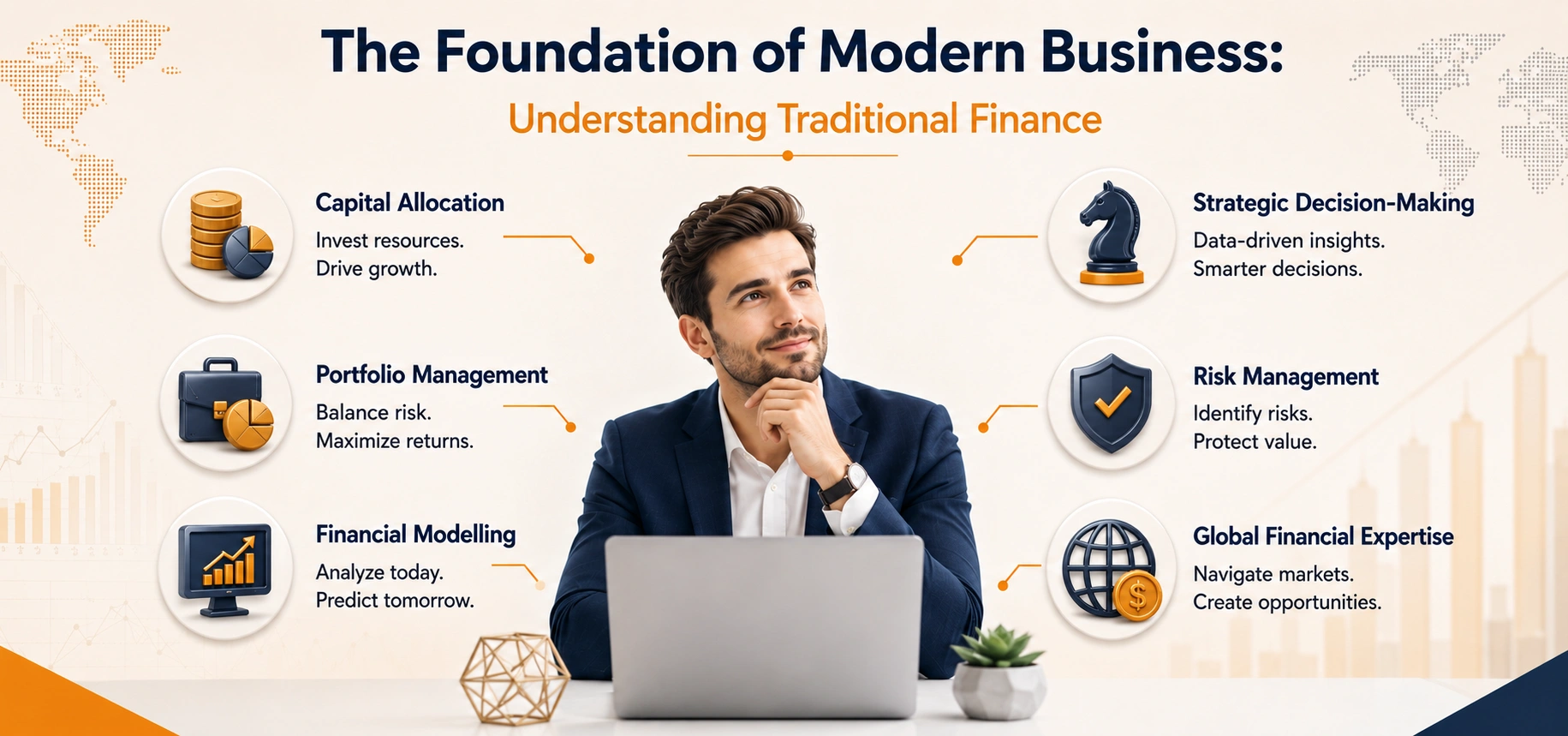
Traditional finance forms the backbone of global commerce. It encompasses everything from corporate financial planning and investment banking to risk management and wealth management advisory services. These aren't outdated practices; they're the foundation upon which modern economies function.
Core pillars of traditional finance include:
- Capital Allocation: Determining where and how to invest organisational resources
- Portfolio Management: Building and maintaining investment portfolios that balance risk and return
- Financial Modelling: Creating quantitative representations of business operations and market scenarios
- Strategic Decision-Making: Using financial data to guide corporate strategy and growth initiatives
- Risk Management: Identifying, assessing, and mitigating financial uncertainties
Finance professionals analyse market trends, assess investment opportunities, and ensure organisations maintain financial health. This domain requires deep analytical thinking, understanding of regulatory frameworks, and the ability to interpret complex economic data. Despite technological advances, core finance principles remain essential. Companies still need experts who can evaluate mergers and acquisitions, manage capital structures, forecast cash flows, and navigate international financial markets.
What a Finance MBA Prepares You For
A Finance MBA builds comprehensive expertise in financial theory, quantitative methods, and strategic management. The curriculum typically covers corporate finance, investment analysis, financial markets, risk management, derivatives, and portfolio theory.
Students develop advanced skills in financial modelling, valuation techniques, and economic forecasting. They learn to interpret financial statements, assess credit risk, and make data-driven investment recommendations. The program emphasises both technical proficiency and strategic thinking necessary for leadership roles.
Beyond technical knowledge, Finance MBA programs cultivate professional networks through case studies, industry projects, and connections with financial institutions. This traditional pathway has proven its worth across decades of economic cycles.
Career Opportunities After a Finance MBA
Finance MBA graduates enter diverse roles across established institutions. Here's what the career landscape looks like:
|
Role |
Average Salary range |
Primary Focus |
|
Investment Banking Analyst |
₹12,00,000 – ₹25,00,000 (total comp can go higher with bonuses) |
M&A advisory, capital raising, structured finance |
|
Portfolio Manager |
₹10,00,000 – ₹22,00,000 |
Investment strategy and asset allocation |
|
Investment Analyst |
₹8,00,000 – ₹18,00,000 |
Market research and investment recommendations |
|
Financial Controller |
₹18,00,000 – ₹35,00,000 |
Financial reporting and compliance |
|
Corporate Finance Consultant |
₹15,00,000 – ₹30,00,000 |
Strategic financial advisory |
|
Chief Financial Officer (CFO) |
₹50,00,000+ (can go into crores in large firms) |
Executive financial leadership |
These roles exist within commercial banks, investment firms, insurance companies, multinational corporations, and consulting agencies. The structured career progression offers stability and clear advancement paths with well-defined benchmarks for promotion and compensation increases.
How Technology Is Reshaping Financial Services
Technology hasn't replaced finance; it's just been amplified. The transformation is visible across every dimension of financial services:
Key Technological Shifts:
- Artificial Intelligence: Analyses millions of data points in milliseconds for better decision-making
- Blockchain: Creates transparent, immutable transaction records and enables smart contracts
- Machine Learning: Detects fraud patterns and anomalies that human analysts might miss
- Digital Platforms: Democratize access to financial services previously available only to the wealthy
- Cloud Computing: Enables scalable infrastructure without massive capital investment
This transformation extends beyond consumer banking. Algorithmic trading executes millions of transactions per second. Robo-advisors provide personalised investment guidance at scale. RegTech solutions automate compliance monitoring across global operations. The financial industry is experiencing its most significant technological disruption since the introduction of electronic trading.
Surprisingly, despite this massive shift, fintech has contributed approximately 2-5% of global revenue within the vast financial ecosystem. Yet projections show fintech could exceed USD 1.1 trillion by 2032, growing at roughly 16% annually.
The Rise of FinTech as a Career Domain
FinTech represents where innovation meets opportunity. The numbers tell a compelling story:
Global FinTech Landscape:
|
Metric |
Traditional Finance |
FinTech |
|
Annual Revenue Growth |
~6% |
15-21% |
|
Current Market Value |
Part of ~$12.5T global finance |
$340B+ (rising toward $1T+) |
|
Adoption Rate (India) |
Standard banking |
87% (vs 64% global average) |
|
Revenue Contribution |
~95-97% of the finance industry |
~2-5% (but rapidly expanding) |
India leads globally with an 87% fintech adoption rate. The sector's market value stands at $340 billion today, projected to approach $1 trillion soon. India's fintech sector alone is expected to reach USD 421.48 billion by 2029.
The growth differential tells the story: traditional finance grows at approximately 6% annually, while fintech expands at 15-21% year-over-year. This isn't a passing trend; it's a fundamental restructuring of how financial services operate. Career opportunities in fintech blend technical expertise with financial acumen. Professionals in this space don't just understand money, they engineer systems that move it, secure it, and democratize access to it.
What a FinTech MBA Focuses On
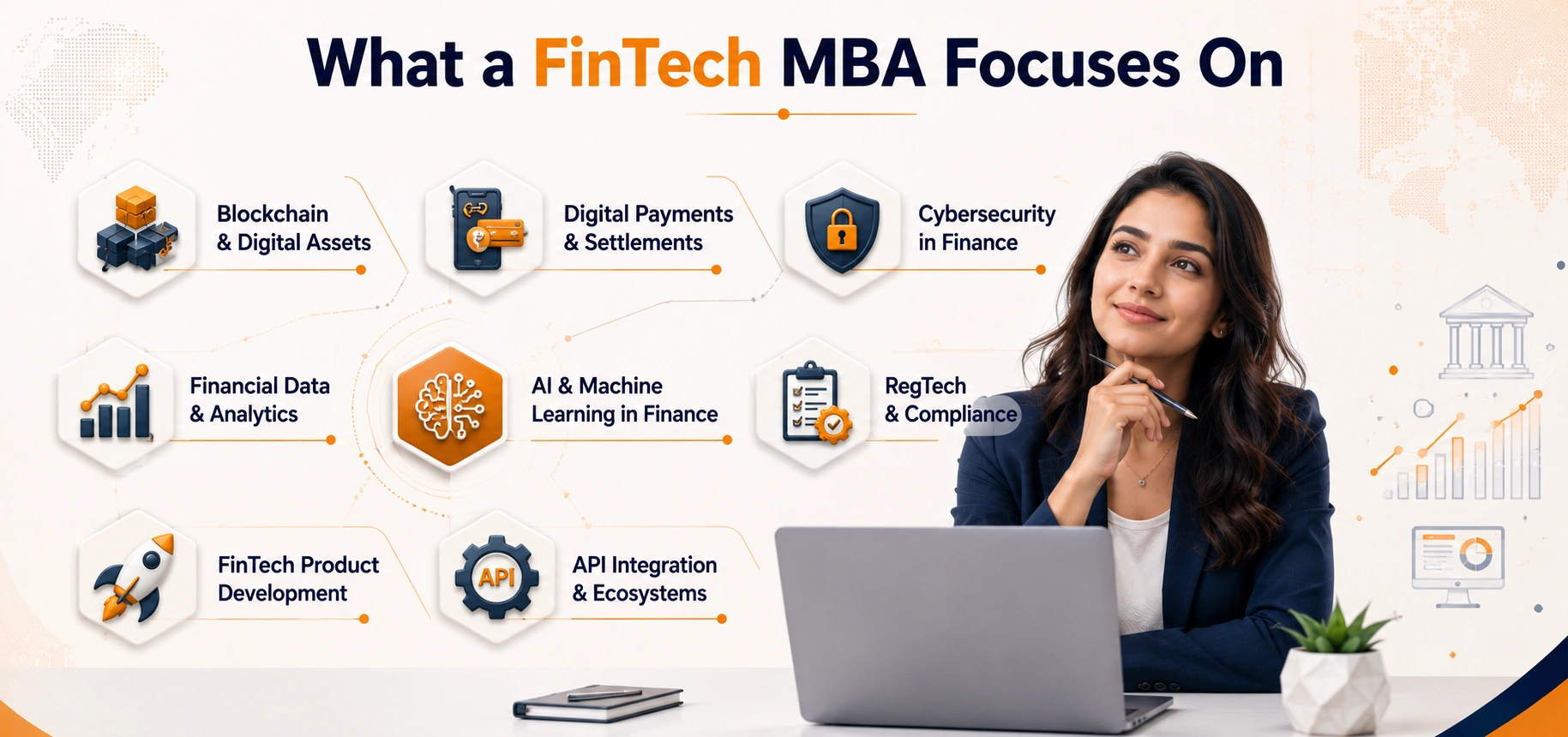
FinTech MBA programs integrate finance fundamentals with technological innovation. The curriculum is designed to create professionals who can operate at the intersection of both worlds.
Core Curriculum Components:
- Blockchain Architecture: Understanding distributed ledger technology and cryptocurrency ecosystems
- Digital Payment Systems: Mobile wallets, cross-border payments, and instant settlement mechanisms
- Financial Data Analytics: Big data processing, predictive modelling, and data visualisation
- AI in Finance: Machine learning applications for credit scoring, fraud detection, and algorithmic trading
- Cybersecurity: Protecting financial infrastructure from digital threats
- Regulatory Technology (RegTech): Automating compliance and navigating digital finance regulations
- Product Development: Agile methodologies for building fintech solutions
- API Integration: Connecting financial systems and creating seamless user experiences
Students learn to develop fintech products, analyse big data for financial insights, implement machine learning models for risk assessment, and navigate the complex regulatory landscape of digital finance. The curriculum emphasises hands-on projects, startup methodologies, and rapid innovation cycles.
These programs prepare professionals to bridge two worlds, translating complex technical capabilities into business value while maintaining the rigorous financial standards the industry demands.
Career Opportunities After a FinTech MBA
FinTech MBA graduates enter rapidly expanding roles with competitive compensation packages:
|
Role |
Average Salary Range |
Key Responsibilities |
|
FinTech Product Manager |
₹25,00,000 – ₹45,00,000 |
Product strategy, user experience, market positioning |
|
Blockchain Consultant |
₹12,00,000 – ₹28,00,000 |
Distributed ledger implementation, crypto strategy |
|
Digital Banking Strategist |
₹15,00,000 – ₹30,00,000 |
Digital transformation, customer experience design |
|
Financial Systems Manager |
₹25,00,000 – ₹45,00,000 |
Technology infrastructure oversight |
|
RegTech Compliance Specialist |
₹14,00,000 – ₹30,00,000 |
Automated compliance solutions |
|
Financial Data Scientist |
₹12,00,000 – ₹35,00,000+ |
Machine learning models, predictive analytics |
|
FinTech Software Developer |
₹8,00,000 – ₹30,00,000+ |
Building payment systems, mobile apps, APIs |
These roles exist within fintech startups, traditional banks undergoing digital transformation, technology giants entering financial services, and consultancies helping organisations navigate technological change. The variety of opportunities allows professionals to choose environments that match their risk tolerance and career goals.
Industry Demand and Hiring Trends Across Financial Roles
The talent landscape reveals interesting patterns across both domains:
Current Market Dynamics:
|
Indicator |
Traditional Finance |
FinTech |
|
Unemployment Rate |
~2% (well below 3.7% national avg) |
Even lower in specialised roles |
|
Quarterly Workforce Growth |
Steady, predictable |
~13% in mid-sized firms |
|
Hiring Priority |
Degrees + experience |
50% prioritize skills over degrees |
|
Most In-Demand Skills |
ESG knowledge, compliance |
AI/ML, blockchain, data science |
|
Geographic Concentration |
Major financial hubs |
Increasingly distributed/remote |
The talent war is fierce. Approximately 50% of fintech firms now prioritise technical skills over traditional degrees, opening doors for diverse backgrounds. Mid-sized fintech companies increased their workforce by nearly 13% in a single quarter, while other industries experienced slower growth.
Traditional finance faces its own talent shortage. With unemployment rates around 2% among finance professionals in the U.S., well below the national average of 3.7%, competition for qualified candidates intensifies. Companies increasingly seek professionals who combine compliance, ESG knowledge, or fintech skills.
Emerging Trend: Hybrid roles are becoming the norm, requiring professionals to have both traditional finance expertise and technological fluency. Organisations value candidates who can operate across both domains, creating premium opportunities for those who develop cross-functional capabilities.
Skills That Differentiate Finance and FinTech Professionals
Understanding the skill differences helps you identify which path aligns with your strengths and interests:
Finance MBA Core Skills:
- Financial modelling and valuation analysis
- Regulatory compliance and risk assessment
- Market research and economic forecasting
- Strategic financial planning
- Accounting principles and GAAP/IFRS knowledge
- Investment theory and portfolio management
- Mergers & acquisitions expertise
- Stakeholder communication and presentation
FinTech MBA Core Skills:
- Programming languages (Python, JavaScript, SQL)
- Data science and machine learning
- Blockchain and distributed systems
- API development and integration
- User experience (UX) design thinking
- Agile project management
- Cloud infrastructure knowledge
- Cybersecurity fundamentals
The Convergence Advantage:
The most valuable professionals master both domains. They understand financial principles deeply enough to identify opportunities for technological innovation while possessing the technical skills to implement solutions. This convergence creates competitive advantages in today's market, often translating to 20-30% higher compensation compared to single-domain specialists.
Salary Outlook and Long-Term Career Growth
Entry-level salaries favour traditional finance at prestigious institutions, but fintech offers compelling equity opportunities. Traditional finance provides structured progression with predictable compensation increases. FinTech careers offer higher variance, while at early-stage companies may pay less initially but provide significant upside through equity.
Professionals who combine domains command premium compensation. Those who understand both traditional financial principles and emerging technologies can earn 20-30% more than specialists in only one area. As AI, blockchain, and quantum computing mature, early adopters of these skills can expect substantial compensation premiums.
Long-term wealth creation differs between paths. Traditional finance offers stability and consistent growth. FinTech presents a higher risk but potentially transformative wealth through successful ventures or equity positions at rapidly growing companies.
Choosing the Right Specialisation Based on Your Career Goals
Your choice should reflect your interests, strengths, and vision for your career. Here's a framework to help you decide:
Choose a Finance MBA if you:
- Value structured environments with established processes
- Enjoy deep analytical work with financial models and data
- Prefer working with proven frameworks and methodologies
- Seek stability and clear career progression paths
- Are drawn to prestigious traditional institutions (Goldman Sachs, JP Morgan, McKinsey)
- Want to specialise in areas like private equity, hedge funds, or investment banking
- Prefer face-to-face client relationships and advisory roles
Choose a FinTech MBA if you:
- Thrive in fast-paced, constantly evolving environments
- Enjoy solving problems through technological innovation
- Want to build products that reach millions of users
- Are comfortable with ambiguity and rapid change
- Want to shape the future of financial services
- Are interested in entrepreneurship or startup culture
- Prefer working at the intersection of multiple disciplines
Consider a Hybrid Approach if you:
- Want maximum flexibility in career options
- Enjoy both analytical thinking and creative problem-solving
- See yourself leading digital transformation initiatives
- Want to command premium compensation in emerging roles
Many professionals start in one domain and transition to another. Finance professionals can add technical skills through certifications and practice. Technology professionals can deepen financial knowledge through specialised courses and on-the-job learning.
Career Mobility and Hybrid Roles in the Financial Sector
The boundaries between finance and fintech are blurring. Investment banks now employ significant technology teams. Fintech startups recruit experienced finance professionals for credibility and regulatory expertise. This creates mobility opportunities for those willing to adapt.
Hybrid roles like "Head of Digital Transformation at a Bank" or "Finance Lead at a FinTech Startup" require understanding both worlds. These positions often offer the most compelling compensation packages and the fastest career advancement.
Remote work has expanded geographic opportunities. While major hubs like New York, London, and Singapore offer the highest salaries, remote positions allow professionals to access premium opportunities while optimising the cost of living.
How MBA Programs Are Adapting to Industry Changes
Leading business schools recognise the convergence happening. Programs now offer specialised fintech intensives, cross-disciplinary projects combining finance and computer science, partnerships with industry leaders, and flexible curricula that allow students to customise their learning paths.
Online MBA programs have democratized access to quality education. Professionals can now pursue advanced degrees while maintaining careers, learning at their own pace, and accessing global faculty expertise. These programs increasingly incorporate real-world projects, industry mentorships, and practical applications alongside theoretical foundations.
The best programs don't just teach finance or technology; they teach how these domains intersect and how professionals can create value at that intersection.
Conclusion: Aligning Your MBA Choice with the Future of Finance
The financial world needs both traditional experts and technological innovators. It needs people who understand centuries of financial wisdom and those who can reimagine how that wisdom applies in a digital age. Most importantly, it needs professionals who can bridge both worlds.
Your MBA choice isn't about picking the "better" option; it's about aligning your education with your unique strengths and career aspirations. Whether you pursue a Finance MBA, a FinTech MBA, or combine elements of both, you're preparing for an industry that's simultaneously timeless and transforming.
The education you choose today will shape not just where you start, but how far you can go. Consider what excites you, what challenges you want to solve, and what kind of impact you want to make. Then explore programs that align with that vision.
Ready to take the next step? Explore how LPU's online MBA in Finance programs can equip you with the skills, knowledge, and network to excel in this dynamic field. The future of finance is being written now. Make sure you're part of the story.
Also Read: MBA in Finance: A Career Trend on the Rise
Statistics and industry insights referenced in this article have been sourced from The Winds of Change: India FinTech Report 2022 (EY India), Seven Key Trends Shaping the Future of FinTech Industry (EY India), At 87%, India Has the Highest FinTech Adoption Rate in the World Against the Global Average of 64% (Press Information Bureau, Government of India), Indian FinTech Industry Projected to Reach $420 Billion by 2029 (ASSOCHAM), and Indian Fintech Sector To Reach $420 Billion By 2029: Digital Payments Body (Digital India).