

Amid expanding business activity and the steady rise of start-ups, money management has become a very crucial topic among individuals. From a shop owner calculating daily profits to corporate leaders making massive investment calls, or young professionals tracking their SIPs and crypto wallets.
These changes are visible through the stats showing that 56.1% of individuals now consider themselves disciplined in managing money, with 25.8% attributing their financial confidence to consistent savings habits[1], while small enterprises continue to report stronger performances after adopting disciplined financial practices. The message is simple: informed financial decisions create stable and sustainable growth.
This growing awareness about personal and organisational finance management increases the demand for deeper financial expertise. Here, an MBA in Finance fits perfectly by providing you with the ability to make financial judgments, analytical thinking, and equipping you to navigate complex market dynamics with confidence. For anyone considering an online MBA, this specialisation becomes a direct pathway to stronger career prospects and meaningful professional impact.
Understanding Online MBA in Finance
You meet your friends, and somehow, within minutes, the conversation shifts to investments, side incomes, market trends, and career moves in finance. Everyone seems to have an opinion. You might be wondering why an MBA in Finance is the topic of discussion at every table in town. But before that, let's take a pause and understand why that is.
Every time people hear “Finance,” many imagine complex spreadsheets, complicated ratios, intimidating stock tickers racing across a screen. But in reality, finance isn’t just about numbers; it’s about the story behind them.

Beneath the surface, at its heart, an Online MBA in Finance is about understanding how money whispers, moves, and grows. It teaches you how businesses turn numerical data into financial decisions that don’t just survive the market but define it.
What Does an Online MBA in Finance Really Teach You?
Here you learn to manage budgets, evaluate investments, and plan strategically to drive growth. It’s about translating complex numbers into clear and actionable insights. This is the “LANGUAGE OF BUSINESS” you will be mastering.
Key Domains: Investment, Banking, Corporate Finance, & Risk
-
Wealth Management & Investments: From your salaries to your business profits, wealth management is all about investment and returns. You will learn how money works for people and drive businesses via understanding the concepts behind mutual funds, stocks, and alternative assets.
-
Banking & Financial Services: From Retailing Transaction systems and Industrial lending loans to digital Banking facilities, this field helps you understand how modern money systems keep economies running.
-
Corporate Finance: Here’s where strategy meets structure. You’ll learn how companies decide on budgets, investments, and long-term plans that affect their market position; these skills often pave the path to CFO (Chief Financial Officer) roles.
-
Risk Management and Analysis: Focuses on identifying, assessing, and reducing financial risks through structured, data-driven decision-making.
Together, these domains open multiple career paths. Whether you dream of analysing markets at a global investment firm, optimising financial decisions in a start-up, or managing budgets at a multinational, an MBA in Finance equips you to do it all.
We’ve entered an era where technical algorithms used in the trading of stocks, AI predicting market movements, and blockchain technology make transactions transparent. That’s why a modern MBA in Finance doesn’t just teach you traditional finance; it teaches you finance with tech.
Students get hands-on experience with:
-
AI and data analytics tools that forecast market trends, analyse data for decision making, and detect fraud.
-
FinTech platforms; to understand digital banking systems, lending models, and how technology is transforming financial services.
-
Blockchain and cryptocurrency ecosystems; to explore how digital assets work, how transactions are secured, and how these technologies are shaping modern investment strategies.
-
Visualisation tools like Power BI, Tableau, and Python dashboards that turn data into strategy and relieve you from running between multiple handwritten pages, making visuals of your data appealing.
This is where finance stops being just about numbers and starts working alongside innovation. The professionals who understand both aren’t just relevant, they’re leading the way into modern business.
So if you ever thought finance was old-school, think again; it’s now one of the most tech-driven, future-proof careers out there.
Why Online MBA in Finance is a Career Trend on the Rise
What’s driving this rise is a shift you can’t ignore; finance is no longer working behind the scenes; it’s leading the decisions that define modern business.
An MBA in Finance is emerging as one of the most valuable qualifications of this decade. Here is some information that will clear your “WHY” about the trend driving the rise of MBA in Finance :
|
Key Trend |
Redefining the Finance Landscape |
How do you get prepared? |
|
Integration of AI, Blockchain, and Machine Learning |
Over 52% of financial operations now use AI and automation (PwC Global FinTech Report 2023). AI predicts markets, blockchain builds trust, and ML automates decision-making |
Develops hybrid expertise in financial analytics, fintech, and data-driven decision-making, which is vital for the digital finance era. |
|
Global Expansion of Digital Banking & Investments |
Digital banking usage has grown 250% in the past decade (World Bank 2024). Borders are blurring with fintech, crypto, and global trading apps. |
Develops capability in international finance, digital assets, and cross-border market strategy. |
|
Financial Risk and Cyber Security |
Rising financial fraud and data threats make risk management and compliance top career domains. |
Provides in-depth training in risk modelling, compliance frameworks (Basel III, AML, GDPR), and exposure to RegTech and fraud analytics. |
Top Career Opportunities After an Online MBA in Finance
One person is evaluating multi-crore investment decisions. Another is advising businesses on financial strategy. Behind every major business decision is a financial expert evaluating risk, return, and long-term impact. That’s the space an MBA in Finance prepares you for.
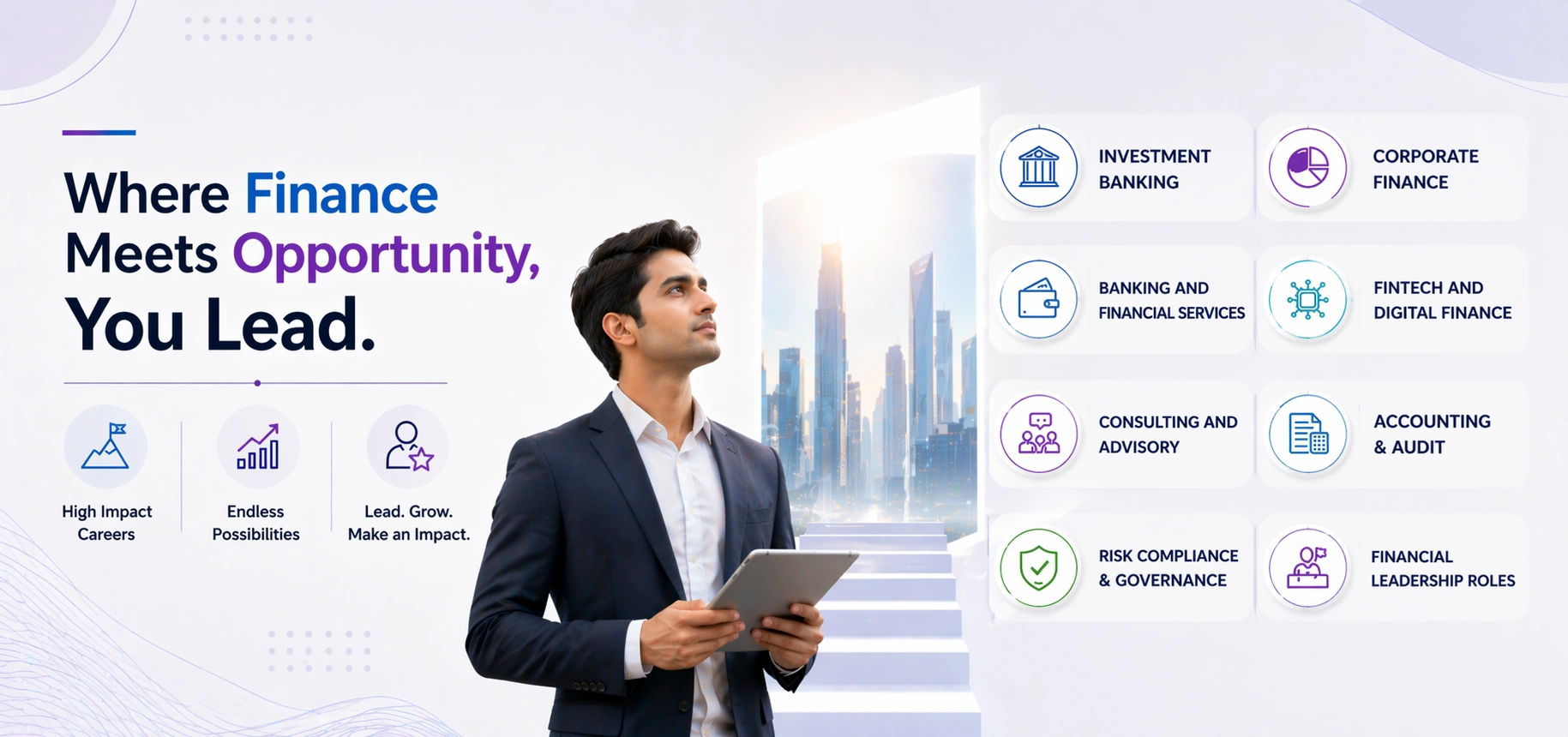
An MBA in Finance opens a door to enormous opportunities from high-stakes investment banking to strategic financial leadership. The table below shows some of the most promising career paths, their core roles, and essential skills needed to excel.
|
Segment |
Roles & Opportunities |
Skills required |
|
Investment Banking |
Investment Banker, M&A Specialist, Equity Analyst |
Financial Modelling, Valuation, Mergers & Acquisitions, Excel, Analytical Thinking, Deal Structuring |
|
Corporate Finance |
Finance Manager, Budget Analyst, etc. |
Cost control, Strategic planning, Cash Flow Management |
|
Banking and Financial Services |
Relationship Manager, Credit or Loan Manager |
Lending & Credit, Banking Operations, Customer communication, Financial Documentation |
|
FinTech and Digital Finance |
FinTech strategist, Product manager, Business Analyst |
Ai in Finance, Digital payments, Product development, Blockchain, AI in Finance |
|
Consulting and Advisory |
Financial consultant, Management consultant, Business advisor |
Problem Solving, Business Valuation, Market Research, Strategic Communication |
|
Accounting & Audit |
Auditor, Compliance Officer, Financial Accountant |
Understanding Accounting Standards, Taxation, Audit procedures, and Attention to detail |
|
Risk Compliance & Governance |
Risk Officer, Compliance Analyst, Internal Auditor |
Regulatory knowledge, Fraud detection, Ethics, Risk mitigation Strategies |
|
Financial Leadership Roles |
Chief Financial Officer (CFO), VP- Finance, Head of Strategy |
Corporate Governance, Financial Forecasting, Strategic vision, People Management, etc. |
The Future Outlook: Why an Online MBA in Finance Will Remain Relevant
Looking at the context of the present economy, where nearly every transaction and business decision is shaped by data, the need for professionals who truly understand finance remains stronger than ever. India’s digital economy already contributes a significant share to national output and employment, with digital platforms accounting for a notable portion of GDP and supporting millions of workers, and digital transactions continuing to grow at scale. This expansion means organisations are dealing with more financial information than ever before, but not all of them can translate that information into sound financial direction.
An MBA in Finance prepares professionals to contribute in ways that automated systems cannot. It trains professionals to evaluate financial information with context, weigh risk against opportunity, and take responsibility for decisions that affect long-term outcomes. Whether it involves managing complex investment environments, supporting business expansion, or navigating technology-led financial systems, finance professionals remain central to sustainable growth. And as finance continues to evolve alongside digital innovation, the real question is no longer whether these skills will be needed, but where one should learn to lead this change.
Why Choose LPU Online for MBA in Finance?
If the future of business depends on Finances, then the future of finance depends on how well you learn it. And LPU Online ensures you learn it right.
Online MBA in Finance at LPU Online combines academic excellence with real-world exposure, preparing professionals for the financial challenges of a digital-first world. The program focuses on building three pillars of Financial expertise, i.e., Analytical Thinking, Technological Adaptability, and Leadership.
Conclusion
Finance has moved far beyond textbooks and balance sheets. Today, effective money management plays a key role in decisions that determine growth, risk exposure, and overall business direction. An MBA in Finance trains professionals to read situations as much as numbers, especially in a world where technology keeps changing the rules.
It’s more than an online degree; it’s the toolkit for tomorrow’s business leaders.
And that is exactly what LPU Online delivers: Industry-aligned curriculum, flexible learning, and global recognition. It’s where ambition meets opportunity, and where you prepare not just for a job, but for a future that runs on Financial Intelligence.
Become a future-ready finance leader with LPU Online MBA in Finance.
This blog incorporates insights and information referenced from The Times of India’s article on financial habits and money management trends in India in 2025.