


“Twinkle, twinkle, little star, how I wonder what you are…” is a line most of us remembered relatively than learning it consciously, and it stayed with us long before we thought about who wrote it or why it mattered. Written by Jane Taylor, it seemed simple then, but quietly sparked a lasting curiosity for words and meaning.
For some, that curiosity never fades. It turns into revisited pages, marked lines, and a quiet pull toward literature that feels personal. Somewhere along the way, it begins to take a more defined shape, seeking not just expression, but direction.
Today, learning no longer demands stepping away from life to move forward. It adapts and fits into your routine. Even something like an Online MA in English can become a natural extension of this journey, allowing you to go deeper into literature without putting everything else on hold.
What follows is not just about pursuing literature, but understanding where it stands today and where it can take you next.
MA in English - Still Relevant in Today’s World?
Pursuing an MA in English today goes beyond studying literature. It develops the ability to understand how language shapes thought, how narratives influence society, and how meaning is constructed and conveyed in a content-driven world. This is not a generic skill set. It comes from consistently engaging with texts, contexts, and perspectives in a way that few disciplines demand.
From analysing public discourse to interpreting cultural shifts and creating meaningful content, this training builds a depth of understanding that extends beyond surface-level communication. Its relevance lies not just in career pathways, but in how effectively you can read, respond to, and influence the world around you.
As this engagement with literature continues to evolve with changing mediums, it naturally leads to a deeper question of how literature and technology intersect today.
Bridging Literature and Technology
Literature has always encouraged us to pause, question, and reflect, but the world around us moves faster than ever. Today’s learners no longer rely solely on quiet libraries or stacks of printed journals; they navigate e-books, audio lectures, digital archives, and virtual classrooms with equal ease.
Online English Literature Courses emerge as a powerful blend of tradition and technology. They bring together the richness of literary study and the flexibility of the digital world. With well-designed modules, vibrant peer discussions, and access to vast online libraries, students can dive deep into English literature without sacrificing academic rigour or their daily routines.
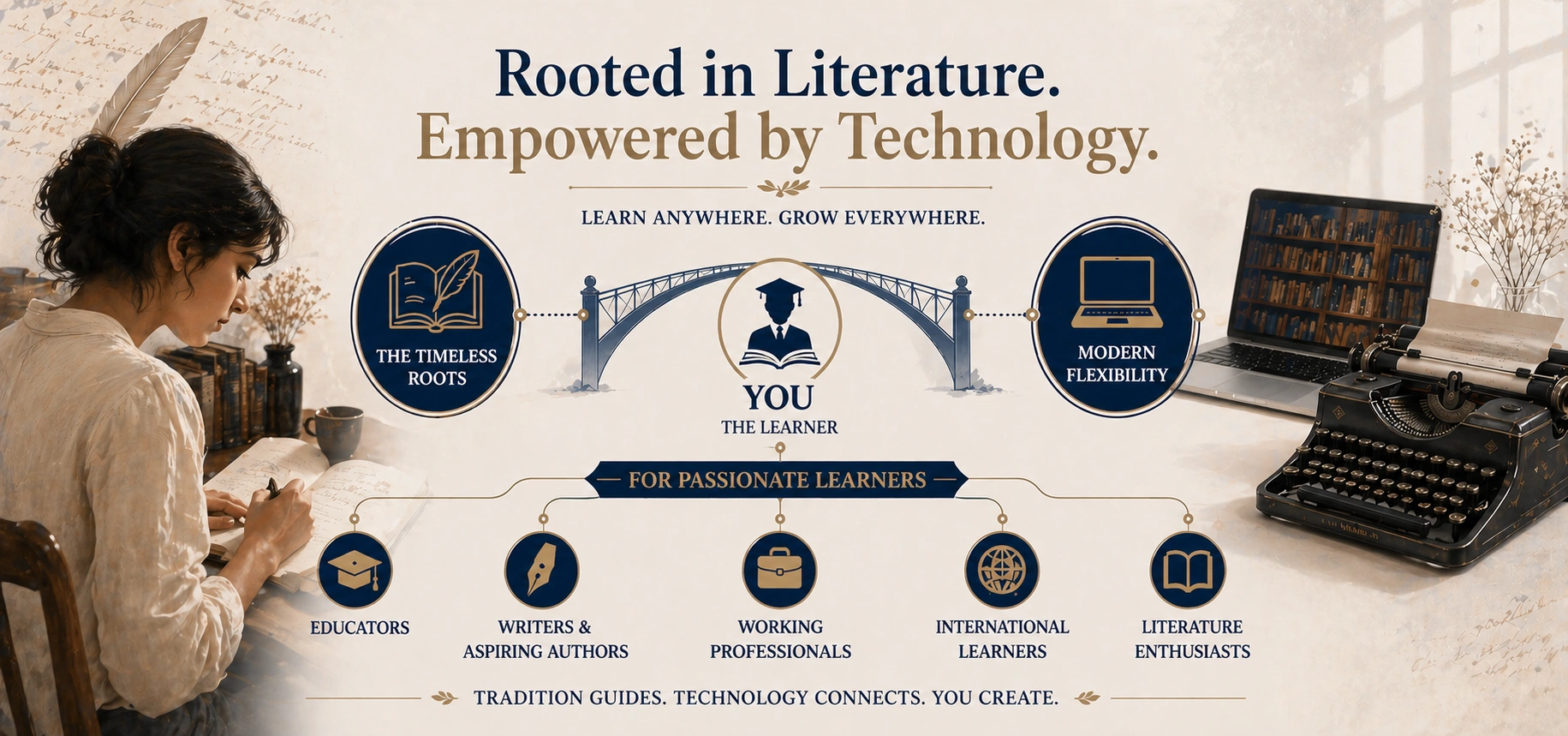
Who Chooses an MA in English and Why?
An Online MA in English doesn’t belong to one kind of learner; it attracts people whose journeys, passions, and motivations are wonderfully different, like:
- Educators
Teachers who want to strengthen their understanding of literature, improve their teaching approach, and prepare for academic or leadership roles in education. - Writers and Aspiring Authors
Storytellers seeking stronger narrative techniques, exposure to global literature, and the confidence to develop a distinct creative voice. - Working Professionals
Individuals manage careers and personal commitments while remaining committed to professional growth. For them, flexibility is not optional; it makes continued learning possible. - International Learners
Students who want a recognised degree but are unable to relocate can choose online education as a borderless classroom that fits their lifestyle and responsibilities. - Literature Enthusiasts
Readers who have spent years exploring books, marking passages, and following favourite authors, and now want a structured way to study literature in greater depth.
What unites these learners is their shared love for language, literature, and critical inquiry. They seek not only personal enrichment but also professional leverage. The flexibility of online programs ensures that motivation is not hindered by geographical constraints, work obligations, or other life commitments.
Moreover, the rise of online learning platforms has democratized access, making it easier for individuals from varied backgrounds to pursue higher education in English literature. The online environment fosters collaboration, discussion, and mentorship among peers and faculty from different regions, enriching the learning experience.
Inside the MA in English Classroom: What You’ll Study?
Online MA programs in English open doors to a vast and layered world of literary study, one that stretches from centuries-old classics to the most current voices shaping modern discourse. Instead of limiting you to a single genre or period, these programs blend tradition with innovation.
Students dive into contemporary writings, critical theories, and the cultural forces that shape them. Along the way, they learn to read deeply, question rigorously, and interpret from multiple lenses.
Typically, the curriculum unfolds through modules such as:
- Literary Theory & Criticism
Classical to contemporary literary approaches that help students analyse texts using diverse critical frameworks. - British & American Literature
Study of canonical authors and major literary works to understand historical, social, and cultural contexts. - Postcolonial & World Literature
Exploration of global literary perspectives that encourages appreciation of diversity in literature and culture. - Creative Writing & Composition
Writing workshops and practical exercises focused on developing personal voice, creativity, and writing style. - Research Methodology
Training in thesis writing, academic papers, and scholarly research to build critical thinking and analytical skills. - Electives
Flexible subject choices, such as digital humanities and linguistics, allowing learners to tailor studies according to their interests.
Students also explore the works of renowned authors, understanding not just the texts but the socio-cultural conditions that shaped them. Assignments, discussions, and research projects provide hands-on learning, while creative writing components nurture the personal voice of each learner.
The online format ensures an interactive experience. Discussion boards, virtual classrooms, and collaborative projects simulate the engagement of traditional programs, while giving students the freedom to learn at their own pace. This combination of structured and flexible learning allows deeper engagement with literature and critical analysis skills.
Skills You Build Without Realising
An MA in English shapes you in ways that go far beyond reading and writing. As you move through texts, discussions, and research, you quietly start developing skills that stay with you for life. Here are some of the strongest ones:
- Critical Thinking & Analysis:
You learn to break down complex ideas, compare interpretations, and form arguments that are sharp, balanced, and well-reasoned. - Clear & Confident Communication:
From essays to presentations, you begin expressing thoughts with clarity, precision, and impact. These are the skills every profession values. - Creative Expression:
Whether it’s fiction, poetry, or reflective writing, you learn to articulate ideas with originality and emotional depth. - Research Mindset:
Thesis work and academic projects train you to investigate deeply, question meaningfully, and present insights in a structured, scholarly way. - Interdisciplinary Awareness:
You start connecting literature with media, culture, society, and communication, making your understanding broader and more relevant.
And beyond all these, something subtle yet powerful happens, i.e., you gain confidence in your ideas, empathy in your interpretations, and a more thoughtful way of seeing the world. These are the skills that make MA English graduates adaptable, insightful, and valued across industries.
Career Horizons After MA English
Graduates of an Online MA in English enter a wide range of career opportunities that value analytical thinking, strong communication skills, and cultural understanding. The degree extends beyond academic study and provides a practical and professional foundation. It equips learners with skills that are relevant across industries.
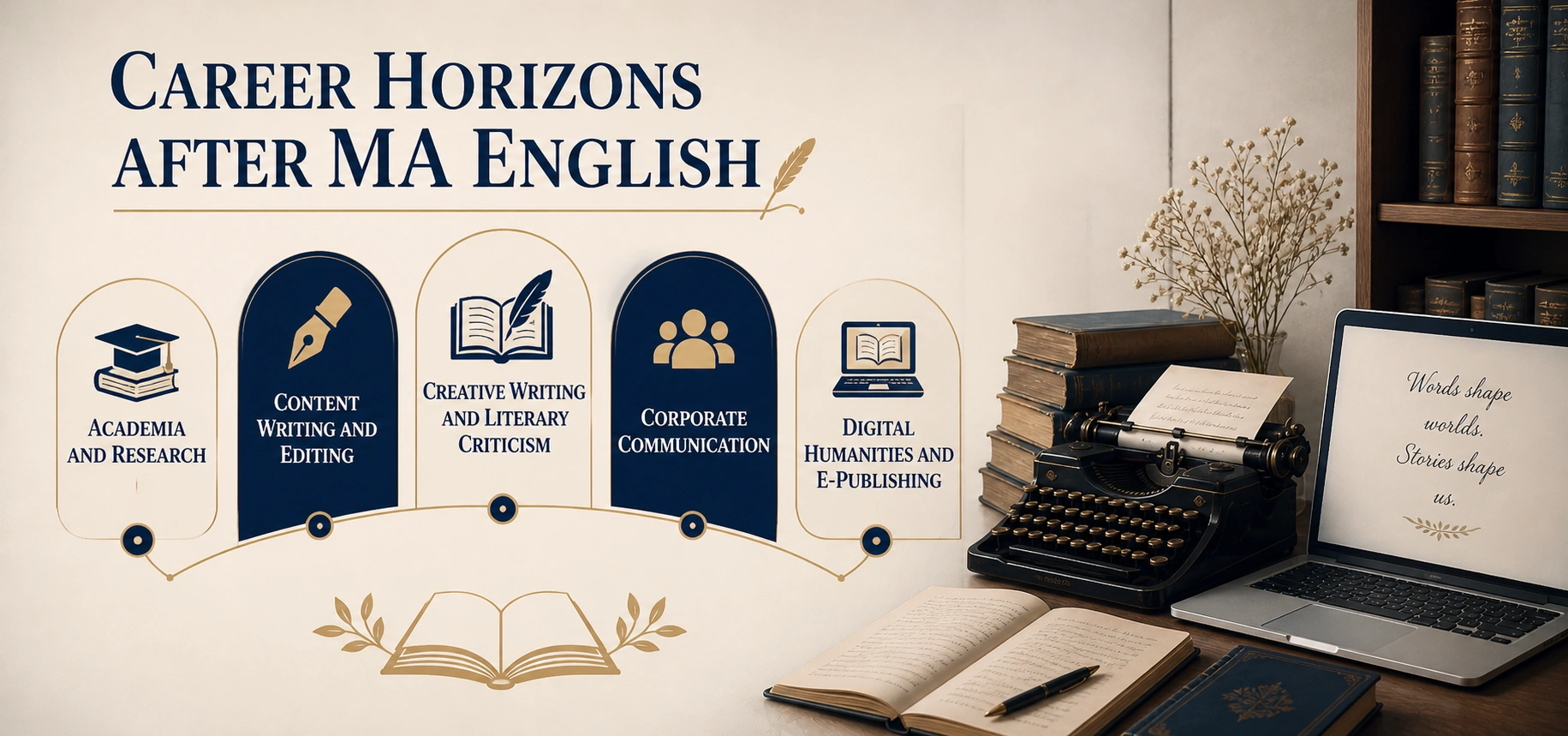
Some promising career paths include:
- Academia and Research
Careers in academia offer opportunities to teach at colleges and universities, contribute to curriculum design, and mentor students in their academic journey. For those inclined toward advanced scholarship, pursuing a PhD can open doors to in-depth research, publications, and long-term academic leadership roles
. - Content Writing and Editing
Content professionals are in demand across publishing houses, digital media platforms, advertising agencies, and corporate content teams. These roles focus on creating, editing, and refining content where clarity, creativity, accuracy, and audience understanding are essential. - Creative Writing and Literary Criticism
This path suits individuals interested in freelance writing, storytelling, or critical analysis. Opportunities include writing short stories, poetry, book reviews, and contributing articles or critiques to literary magazines, journals, and online publications. - Corporate Communication
Corporate communication roles span public relations, branding, marketing communication, and internal communications. Professionals in this field shape organisational narratives, manage brand voice, support reputation management, and craft messages for diverse stakeholders. - Digital Humanities and E-Publishing
This emerging field blends literary expertise with digital tools. Career options include working with online archives, digital content platforms, editorial software, and e-publishing projects, applying traditional humanities knowledge to modern digital formats.
Beyond these structured paths, many graduates move into interdisciplinary roles like journalism, cultural studies, film and media analysis, scriptwriting, and digital content creation.
The blend of literary depth and modern digital literacy prepares them not just for today’s careers but for the evolving opportunities of tomorrow.
The Power of Literature Today
Literature has always served as a mirror to society, shaping our understanding of cultures, emotions, histories, and the human condition. Its relevance hasn’t dimmed; if anything, it matters even more in a world that’s constantly changing.
What has changed is the way we access it. Online programs have brought literature out of the traditional classroom and placed it into a global, digital commons. With virtual libraries, interactive forums, and real-time conversations with peers and faculty, learners can explore texts more deeply and from multiple perspectives.
This blend of literature and technology creates a richer and more dynamic learning experience. Students aren’t just reading; they’re discussing, interpreting, questioning, and sharing ideas across borders.
Once confined to physical books and lecture halls, literature now thrives in connected and collaborative digital spaces, retaining its timeless power while evolving to meet the needs of modern learners.
Final Thoughts: Your Journey from Books to Broadband
The pursuit of literature is timeless, but the methods of learning have evolved. Through English Literature Courses Online, aspiring scholars, writers, and educators can continue their literary journey without compromise.
These programs provide flexibility, global perspectives, and professional pathways, transforming passion into opportunity. The transition from books to broadband is not just about technology; it’s about preserving the depth of literary study while embracing the possibilities of the digital age.
For those who have felt the quiet thrill of reading poetry under lamplight, the excitement of exploring a novel, or the reflective calm of literary analysis, an MA in English online provides a connection between tradition and innovation, passion and profession, words and the world.