

Table of Content
- What Exactly Is Generative AI?
- Generative AI vs Normal AI: 3 Everyday Examples
- Why Businesses Are Investing in Generative AI Now?
- Core Generative AI Skills Professionals Should Build in 2026
- Popular Generative AI Tools Used in the Workplace
- Career Paths Linked to Generative AI Skills in India
- Notes on the salary context:
- How Professionals Can Start Building Generative AI Skills
- Conclusion: What This Shift Means for Students and Early-Career Professionals
These days, AI shows up everywhere. Not in a dramatic way, but in small things we barely think about - photo filters, caption suggestions, email drafts, and presentation templates. We use them without stopping to ask where they came from.
Now think about your own workplace. In almost every team, there is that one person who finishes tasks faster and still looks relaxed by the end of the day. Meanwhile, others stay late, work harder, and still feel behind. I have seen this happen more times than I can count. Hard work is not the problem. The problem is when effort is not supported by the right tools and methods. That is where the real gap starts showing.
Recent data shows that about 16.3% of the world’s population is using AI tools, knowingly or unknowingly. At the same time, more than 90% organisations have already adopted AI technology to drive growth and efficiency (Microsoft). So clearly, AI is already inside workplaces. Systems are upgraded, tools are smarter, and platforms are more automated than before.
Despite all this talk about AI adoption, there is one area where we are still lagging, and that is our limited understanding of AI that stops us from harnessing its true potential. Are we really part of these numbers, or are we just using very basic features that do not give much advantage anymore? Do we even know what kind of AI we are working with, and whether that AI is still relevant in today’s job market? These questions may sound a little confusing, and even a bit uncomfortable, but they are very important.
Because not every AI works the same way, and not every AI skill helps in career growth. So, before we move into skills, tools, and job roles, let us first understand this clearly - what is Generative AI, and how is it different from the AI systems we have already been using for years?
What Exactly Is Generative AI?
Let us not get ahead of ourselves and start defining what we understand very little about. Let us start with how technology actually shows up in our lives.
You see this daily. You open YouTube, and it shows you videos that match what you usually watch. Or you open Amazon, and it suggests products based on your past orders. That is also AI. It looks at your old behaviour and guesses what you might like next. It is not creating anything new for you. It is only selecting and suggesting from what already exists.
Now think of another situation.
You open a tool and ask, “Write a birthday message for my friend who loves cricket,” and within seconds, you get a fresh message that was not written anywhere before. Or you say, “Make a short presentation on digital marketing,” and it gives you points, structure, and even slide ideas. This is generative AI.
The simple difference is that normal AI helps in choosing and predicting, while Generative AI helps in creating and drafting.
That’s why people are suddenly talking about AI helping with writing, designing, coding, and even planning. Now the machine is not just giving suggestions; it is helping you build the first version of your work. And this is where many people get confused.
They think, “I was already using AI before, so what is new now?”
The truth is, earlier AI was mostly working quietly inside apps. Now, generative AI is sitting directly in front of you, waiting for your instructions.
Generative AI vs Normal AI: 3 Everyday Examples
Let us make this even clearer with very basic workplace examples.
Example 1: Writing an Email
Earlier, AI in email apps helped by correcting spelling or suggesting short replies like “Okay” or “Noted.” That is helpful, but you still had to think and write the full email.
With generative AI, you can say, “Write a polite follow-up email to a client who has not replied for a week,” and you get a full draft. You only edit it and send it. The thinking and drafting both get faster.
Example 2: Making a Presentation
Before, software could help you with templates and design layouts. But the content, points, and structure had to come from you.
Now, you can ask for an outline, talking points, and even examples for your topic. You are not starting from zero anymore. You are starting from something that is already prepared for you.
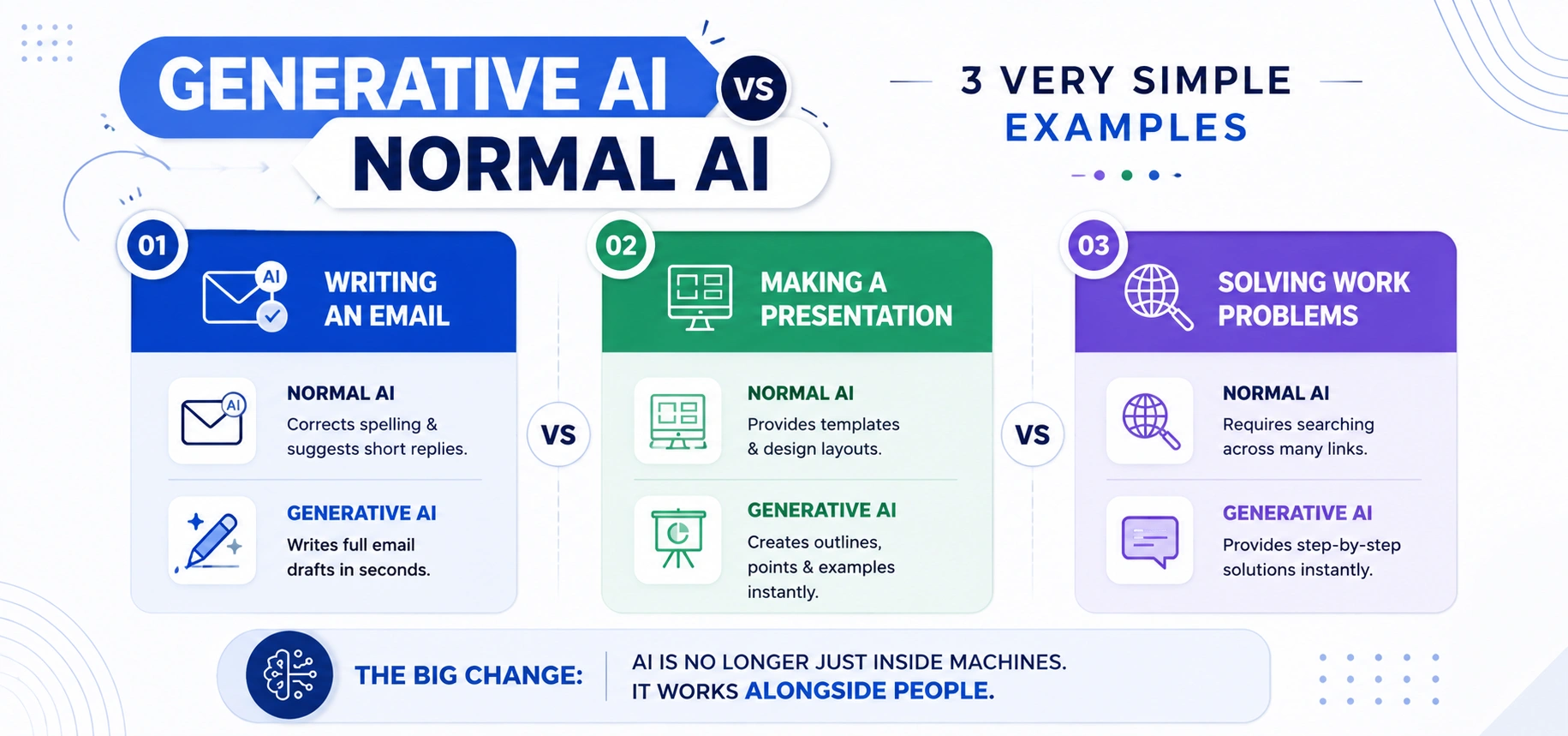
Example 3: Solving Work Problems
Earlier, if you were stuck with a task, you searched on Google, opened many links, and slowly figured things out. With generative AI, you can describe your problem in simple words and get a step-by-step suggestion instantly. It feels like asking a senior colleague for help, instead of searching through ten websites.
So the big change is not that AI entered offices. The big change is that AI started working alongside people, not just inside machines. And once that happens, the kind of skills professionals need also starts changing. Earlier, knowing software was enough. Now, knowing how to work with intelligent tools is becoming just as important.
This is exactly why generative AI skills are getting so much attention in 2026.
Why Businesses Are Investing in Generative AI Now?
Interestingly, the demand and investment in generative AI have reached record levels in a very short time. What started as small trials has now turned into proper business adoption. Today, companies are using generative AI in customer service, marketing, product development, operations, and even in internal reporting and planning. In fact, worldwide spending on AI technologies, including generative AI systems and infrastructure, is expected to reach around $2.52 trillion in 2026 (Gartner). This clearly shows that organisations are not just testing AI anymore; they are building long-term business strategies around it.
Another important point is that this push is not limited to global companies alone. India is also being recognised among the leading countries in AI readiness and competitiveness, which means the ecosystem here is also moving fast in terms of policy, industry adoption, and digital infrastructure (PIB, Government of India). So this shift is very much relevant for Indian professionals as well.
The main reasons why companies are putting so much focus on generative AI are quite practical:
- Increased productivity: Generative AI helps people complete routine work faster, whether it is writing, reporting, coding, or planning, which improves daily output without increasing work pressure.
- Cost control: Automating repetitive tasks helps companies manage growing workloads without adding the same level of manpower.
- Faster decisions: AI can quickly summarise large amounts of information, helping managers and teams take quicker and more informed decisions.
- Easy scaling: Businesses can handle more customers, more data, and more projects without expanding teams at the same speed.
- Staying competitive: Companies that adopt AI early can move faster, personalise services better, and respond quickly to market changes.
Because of all these reasons, generative AI is no longer seen as an extra tool or optional upgrade. It is slowly becoming part of how modern workplaces function. And when the way of working changes, the kind of skills people need also starts changing.
That is exactly why the focus is now shifting towards generative AI skills and how professionals can build them for the future.
Core Generative AI Skills Professionals Should Build in 2026
Using generative AI at work is not just about knowing a few tools. It is about building certain skills that help professionals use these tools effectively, responsibly, and in ways that actually improve performance. These skills are useful across industries, whether someone works in business, technology, design, operations, or communication roles.
The following table explains the key generative AI skills that are expected to matter most in 2026:
|
Skill Area |
What It Means in Simple Words |
Why It Matters at Work |
|
Prompt Writing and Task Framing |
Knowing how to clearly explain what you want from an AI tool so that it gives useful output instead of random results. |
Better prompts save time and improve the quality of drafts, reports, designs, and code generated by AI. |
|
Editing and Validation |
Checking AI output for accuracy, relevance, and tone before using it in real work. |
AI can make mistakes, so professionals must ensure content is correct and suitable for business use. |
|
Understanding AI Limitations |
Knowing where AI performs well and where human judgment is still required. |
Helps avoid over-dependence on tools and reduces the risk of wrong decisions based on faulty outputs. |
|
Workflow Integration |
Using AI as part of daily tasks like reporting, planning, research, and communication. |
Makes AI a productivity partner instead of an occasional tool, improving overall efficiency. |
|
Data Awareness and Privacy |
Knowing what information is safe to share with AI tools and what should remain confidential. |
Protects company data and ensures compliance with privacy and security policies. |
|
Domain + AI Combination |
Applying AI tools within your own field, such as marketing, finance, HR, or operations. |
The real value comes when AI supports job-specific tasks, not just general usage. |
Popular Generative AI Tools Used in the Workplace
Generative AI tools are now part of regular business workflows. They are not limited to tech teams anymore and are being used across departments for everyday tasks. Instead of focusing only on tool names, it is more useful to understand them by the type of work they support.
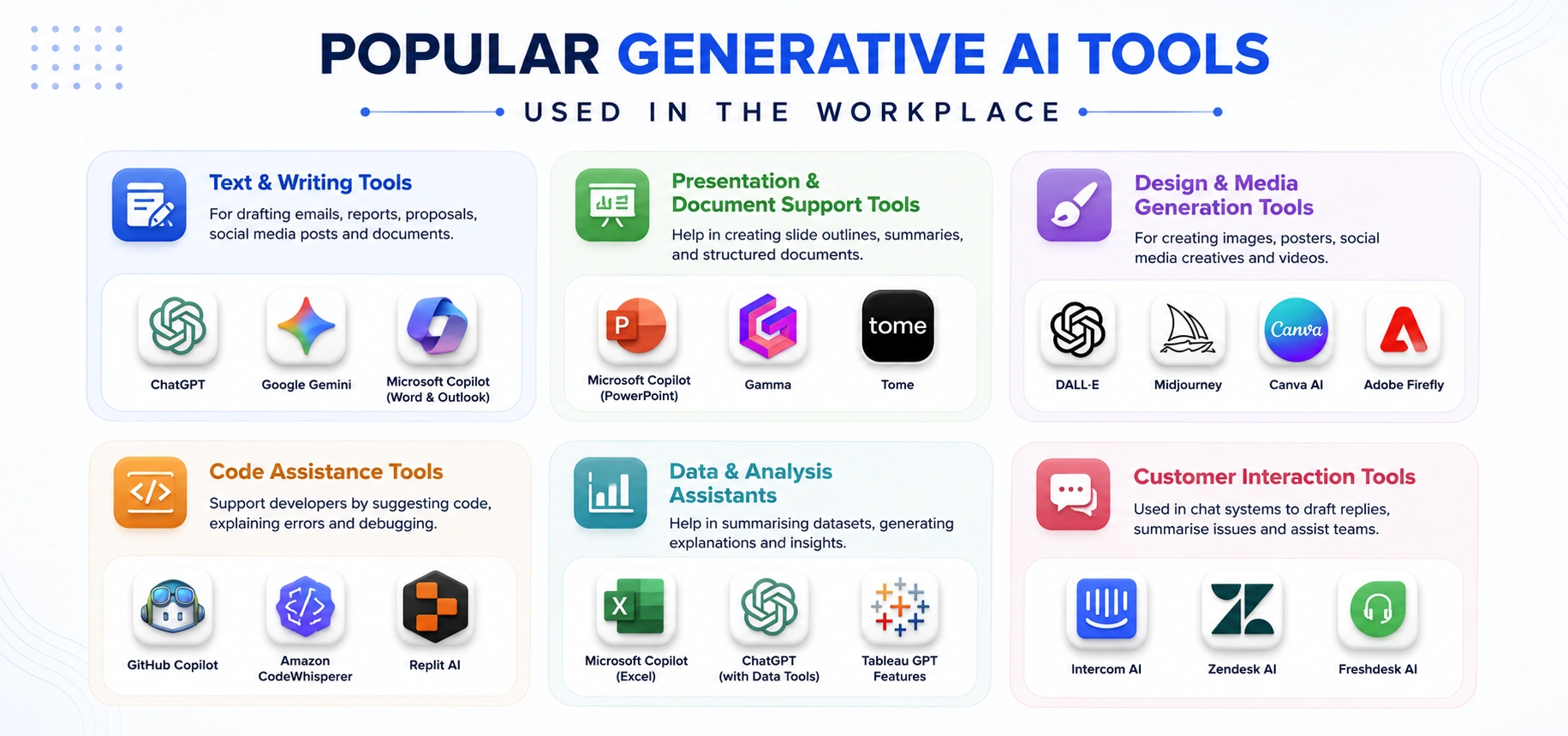
Here are the main categories of generative AI tools used in workplaces today, along with common examples:
- Text and Writing Tools
Used for drafting emails, reports, proposals, social media posts, and internal documents.
Examples: ChatGPT, Google Gemini, Microsoft Copilot (Word and Outlook) - Presentation and Document Support Tools
Help in creating slide outlines, summaries, and structured documents from rough notes.
Examples: Microsoft Copilot for PowerPoint, Gamma, Tome - Design and Media Generation Tools
Used to create images, posters, social media creatives, and basic videos.
Examples: DALL·E, Midjourney, Canva AI, Adobe Firefly - Code Assistance Tools
Support developers by suggesting code, explaining errors, and helping with debugging.
Examples: GitHub Copilot, Amazon CodeWhisperer, Replit AI - Data and Analysis Assistants
Help in summarising datasets, generating explanations, and creating insights from reports.
Examples: Microsoft Copilot for Excel, ChatGPT with data tools, Tableau GPT features - Customer Interaction Tools
Used in chat systems to draft replies, summarise issues, and assist support teams.
Examples: Intercom AI, Zendesk AI, Freshdesk AI
What is important to understand is that these tools are not replacing entire jobs. They are changing how tasks inside those jobs are done. This is why companies now look for people who can work comfortably with such tools instead of avoiding them.
And once tools become part of daily work, the next question naturally comes up.
What kind of job roles are actually growing because of generative AI?
Career Paths Linked to Generative AI Skills in India
As generative AI transforms industries, it is also creating new job opportunities around the world. According to the World Economic Forum’s Future of Jobs Report, AI and related technologies are expected to create around 170 million new jobs globally by 2030 (World Economic Forum). This means professionals who build the right skills now are likely to see strong growth in opportunities over the next few years.
The table below shows key career paths connected to generative AI skills, along with typical average salary packages in India (in INR), based on current market trends and industry data:
|
Career Path |
Typical Average Salary (INR per year) |
|
Generative AI Engineer |
₹10,00,000 - ₹22,00,000 |
|
AI/ML Engineer |
₹6,00,000 - ₹15,00,000 |
|
Data Scientist |
₹5,00,000 - ₹12,00,000 |
|
NLP / Language Model Specialist |
₹6,00,000 - ₹15,00,000 |
|
AI Product Manager |
₹18,00,000 - ₹40,00,000 |
|
Business Analyst with an AI focus |
₹7,00,000 - ₹18,00,000 |
Notes on the salary context:
- Entry-level roles start at the lower end of the range, and salaries rise quickly with experience, demonstrated project work, and industry demand.
- Roles that combine domain knowledge (like business functions or product strategy) with generative AI skills tend to command higher packages.
- India’s market is maturing fast, and salaries in these areas continue to trend upward as demand outpaces the supply of skilled professionals.
How Professionals Can Start Building Generative AI Skills
Interestingly, if you ask any generative AI tool how to learn generative AI, it will immediately suggest practising with tools, building workflows, and applying AI to real tasks. In many ways, the learning path is already clear. Skill development starts with active usage, not passive reading.
For working professionals, the most effective approach is practical and focused:
- Integrate AI into daily work, such as drafting, reporting, analysis, and planning, instead of using it only for trials.
- Improve task instructions to get accurate and relevant output, which directly impacts productivity.
- Apply AI within your job function rather than learning generic use cases that may not add workplace value.
- Create simple task automations using AI with documents, spreadsheets, and workflow tools.
- Follow responsible usage practices, especially around data privacy and decision-making.
- Track business use cases, not just new tool launches.
In short, generative AI skills are built by working with AI consistently and purposefully, not by treating it as a separate technical subject.
Conclusion: What This Shift Means for Students and Early-Career Professionals
The larger shift driven by generative AI is not limited to faster tools or smarter software. It is changing how organisations design roles, evaluate productivity, and allocate work. As routine tasks become easier to automate or accelerate, professional value will increasingly come from how effectively individuals can frame problems, guide intelligent systems, and translate outputs into business outcomes.
For students and early-career professionals, this means career readiness will depend less on familiarity with isolated tools and more on the ability to integrate generative AI into core work processes. Those who develop this capability early will be better positioned for roles that demand adaptability, cross-functional thinking, and continuous learning, where generative AI skills function as a foundational workplace competency rather than a specialised add-on. For learners looking to build this depth in a structured way, programs like the LPU Online MCA in Artificial Intelligence and Machine Learning are designed to combine computing fundamentals with applied AI skills, helping students move beyond tool usage and into real-world problem solving with intelligent systems.