

Introduction
While pursuing my BCA, I dreamed of joining a top MNC right after graduation. One of my friends had a different goal. He wanted to secure an internship by the fourth semester itself. Every Monday morning, we would start our day searching for opportunities, applying for jobs, and hoping that this would finally be the week things changed.
A few placement drives and internship interviews later, we found ourselves sitting on a college bench asking the same question. We had studied well, maintained decent grades, worked on projects, and carried ourselves professionally. Then why were we struggling to prove our potential when recruiters asked us a simple question: "Can you show us your work?"
The answer was disappointing. All we had was a resume. A plain document written in Calibri font, listing skills like Java, Python, communication, teamwork, and a few academic projects. It told recruiters what we knew, but it never showed what we had actually built, solved, or achieved.
That was when we realised the problem wasn't our degree, our grades, or even the competition. The problem was visibility. Our work existed, but nobody could see it. And that's exactly where an online portfolio becomes a BCA student's career turning point.
Building a Strong Online BCA Portfolio: Why Visibility Matters More Than Ever
Once we realised that our work lacked visibility, the next question naturally followed: how do we make recruiters see what we are capable of? The answer is surprisingly simple, i.e., through an online portfolio.
An online portfolio is a digital representation of your professional journey. It is a place where you showcase your projects, technical skills, certifications, achievements, internships, and experiences in a way that allows others to evaluate your capabilities. Unlike a resume, which only summarises your qualifications, a portfolio demonstrates them. It provides evidence of your learning and proves that you can apply your knowledge to solve real-world problems.
For BCA students, this distinction is extremely important. Most students graduate with similar coursework, similar subjects, and often similar grades. Recruiters know what a BCA curriculum covers. What they want to understand is how you have used that knowledge. Have you built applications? Have you worked on databases? Have you explored web development? Have you contributed to open-source projects? These are the questions a portfolio answers.
In today's hiring environment, recruiters often search for candidates online before scheduling interviews. If they find a professional portfolio, GitHub profile, LinkedIn presence, and project documentation, they immediately gain confidence in the candidate. In many cases, your portfolio starts speaking on your behalf before you even enter the interview room.
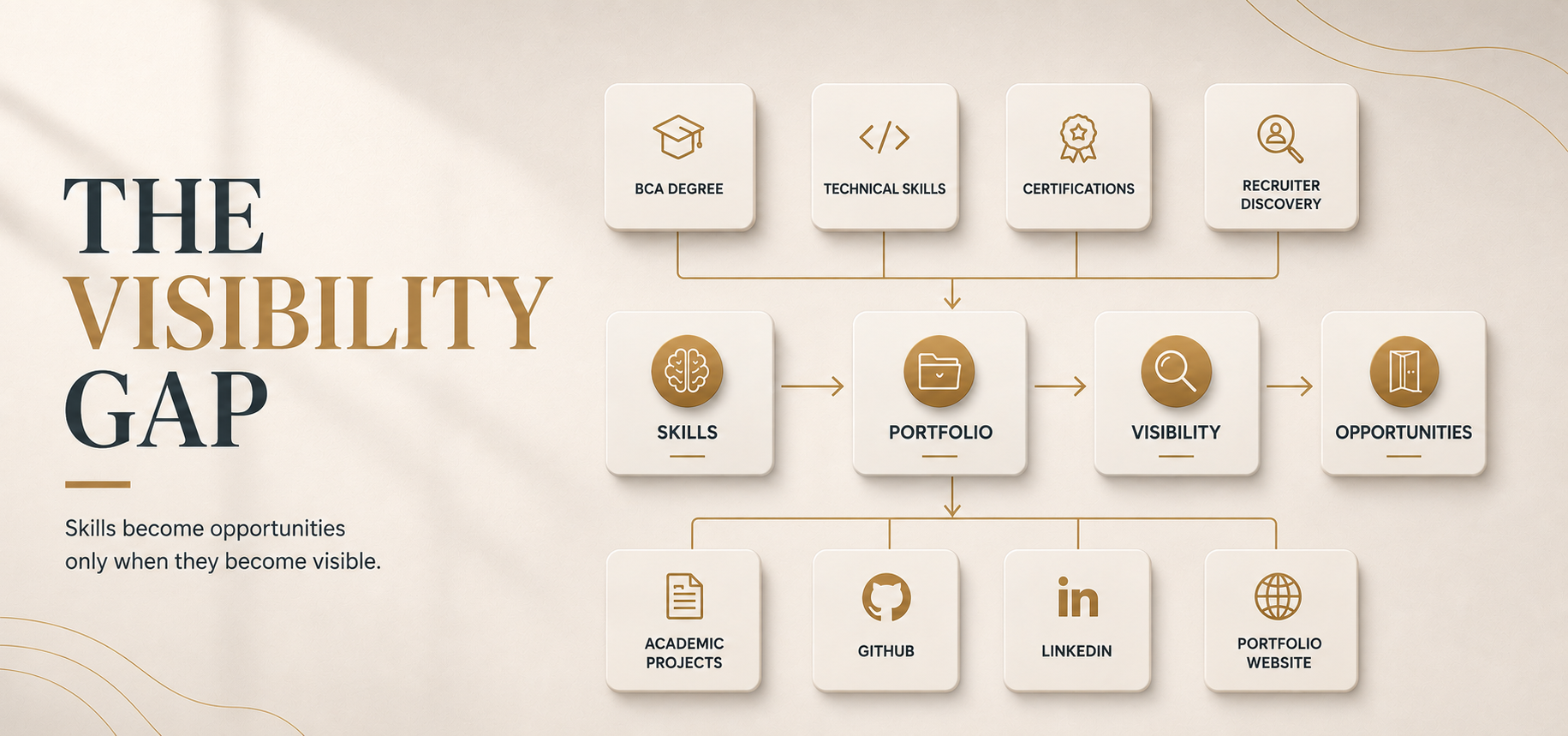
A BCA degree provides the knowledge and foundation needed to build a career in technology. However, in today's competitive job market, recruiters often look beyond qualifications and grades. They want to see how you have applied your learning in real projects and practical situations.
Consider two students with similar academic records and technical skills. If one of them can showcase projects, GitHub repositories, certifications, and technical work through an online portfolio, they immediately become more visible and credible to recruiters. A portfolio turns your skills from claims on a resume into proof of your capabilities.
Some key benefits of building an online portfolio during your BCA include:
- Demonstrates your practical skills through real projects.
- Improves your chances of securing internships and jobs.
- Builds a strong professional identity online.
- Increases credibility by showcasing achievements and certifications.
- Creates networking and collaboration opportunities.
- Helps track your learning and growth over time.
In simple terms, your degree tells recruiters what you have studied, while your portfolio shows them what you can actually do.
Essential Elements Every BCA Student Portfolio Should Include
A strong portfolio is not simply a collection of files. It should be structured strategically to present your professional profile effectively.
The first section should be a professional introduction. Briefly explain who you are, what you are studying, your interests, and your career goals. Keep it concise but meaningful.
Next comes your technical skills section. Organise your skills into categories such as programming languages, frameworks, databases, development tools, and technologies. This makes it easier for recruiters to evaluate your expertise.
Projects form the heart of any portfolio. Each project should include:
- Project title
- Objective
- Technologies used
- Screenshots or demonstrations
- GitHub repository link
- Key challenges solved
- Outcomes achieved
You should also include certifications from recognized platforms and organizations. These validate your commitment to continuous learning.
An updated resume should be available for download. Recruiters often appreciate having quick access to a formal summary of your qualifications.
Achievements such as hackathons, coding competitions, scholarships, leadership roles, and academic recognitions deserve their own section as well.
Finally, ensure that your contact information is clearly visible. Include your email address, LinkedIn profile, GitHub account, and any other professional networking platforms you actively use.
Step-by-Step Guide to Building a Strong Online Portfolio
Creating a portfolio may seem overwhelming initially, but the process becomes manageable when approached systematically.
- Define Your Career Direction
- Identify your area of interest, such as Software Development, Web Development, Cybersecurity, Data Analytics, Cloud Computing, or UI/UX Design.
- Understanding your career goals helps you decide which projects, skills, and achievements should be highlighted.
- Gather Your Best Projects
- Focus on quality rather than quantity.
- Include projects that demonstrate problem-solving, technical skills, and practical application of your knowledge.
- Three well-documented projects often create a stronger impression than ten incomplete ones.
- Create a Professional GitHub Profile
- Upload your projects with proper documentation and clean code.
- Add meaningful README files explaining the project's purpose and functionality.
- Recruiters often review GitHub repositories to evaluate coding practices and project organisation.
- Build a Portfolio Website
- Create a central place where recruiters can access all your work.
- Use platforms such as GitHub Pages, WordPress, Wix, Notion, or a custom website.
- Keep the design simple, professional, and easy to navigate.
- Write Project Case Studies
- Explain the problem you aimed to solve.
- Describe your approach and the technologies used.
- Highlight the outcomes, challenges faced, and lessons learned.
- This demonstrates your problem-solving ability beyond technical implementation.
- Add Certifications and Achievements
- Include relevant certifications, hackathons, coding competitions, workshops, and awards.
- Showcase accomplishments that strengthen your credibility and learning journey.
- Optimise Your LinkedIn Profile
- Keep your profile updated with skills, projects, certifications, and achievements.
- Add links to your portfolio website and GitHub profile.
- Build connections with professionals, recruiters, and industry peers.
- Update Your Portfolio Regularly
- Add new projects, certifications, and experiences as you grow.
- Remove outdated content and improve existing project descriptions.
- Treat your portfolio as a living document that evolves with your career.
Best Platforms to Create Your Online Portfolio
Different platforms serve different needs. The right choice depends on your technical comfort level and customisation requirements.
|
Platform |
Ease of Use |
Cost |
Best For |
|
GitHub Pages |
Moderate |
Free |
Developers and coders |
|
WordPress |
Easy |
Free/Paid |
Blogs and portfolios |
|
Wix |
Very Easy |
Free/Paid |
Beginners |
|
Notion |
Easy |
Free |
Simple portfolios |
|
Canva Portfolio |
Very Easy |
Free |
Design-focused portfolios |
|
Personal Domain Website |
Moderate |
Paid |
Professional branding |
For most BCA students, GitHub Pages combined with a custom domain offers an excellent balance between professionalism and affordability.
Common Portfolio Mistakes BCA Students Should Avoid
Many students unintentionally weaken their portfolios through avoidable mistakes. Like:
- One common mistake is adding every project ever created. Recruiters prefer quality over quantity. Showcase only your strongest work.
- Another mistake is writing generic project descriptions. Instead of saying, "Built a website using HTML and CSS," explain the problem solved, features implemented, and outcomes achieved.
- Ignoring mobile responsiveness can also create a poor impression. Many recruiters review portfolios on mobile devices.
- Broken links, outdated content, and incomplete GitHub repositories reduce credibility instantly. Regular maintenance is essential.
- Students should also avoid copying portfolio templates without personalization. Your portfolio should reflect your unique journey and interests.
- Finally, do not rely solely on certificates. Certifications demonstrate learning, but projects demonstrate capability. Both should complement each other.
Sample Portfolio Structure for a BCA Student
A simple and effective portfolio structure may look like this:
Home | About Me | Skills | Projects | Certifications | Resume | Achievements | Contact
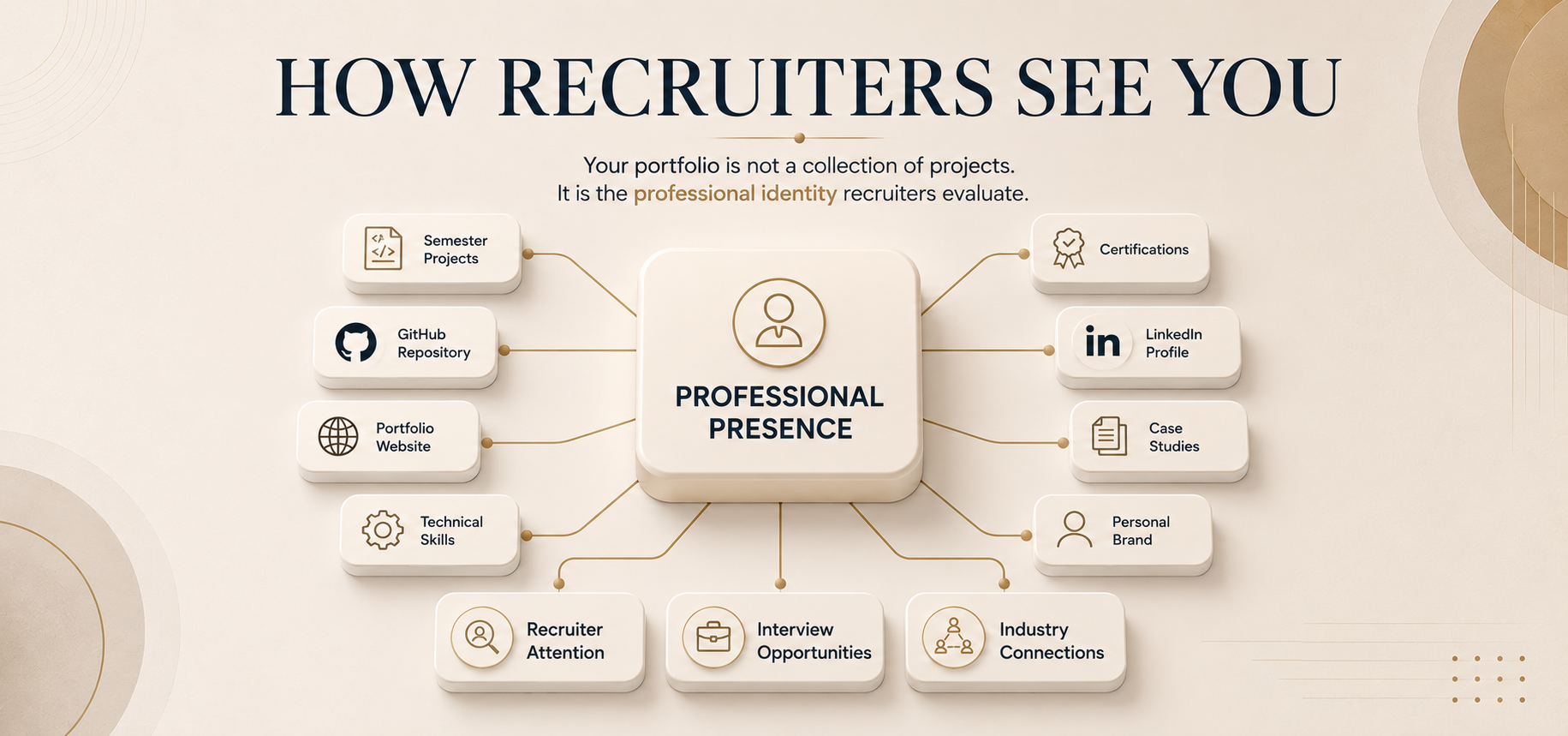
This structure ensures that recruiters can quickly find the information they need without unnecessary complexity.
How an Online Portfolio Can Help You Secure Internships and Jobs
To understand the value of a portfolio, it helps to think like a recruiter.
Recruiters face hundreds of applications for a single role. Their objective is to identify candidates who can contribute effectively with minimal risk. A portfolio reduces uncertainty because it provides evidence.
When recruiters review your projects, they gain insights into your technical skills, problem-solving abilities, communication style, and attention to detail. They can verify claims made on your resume and assess whether your experience aligns with the role.
Many organisations now conduct portfolio screening before interviews. Candidates with visible work often receive more attention because recruiters can evaluate them beyond academic qualifications.
A portfolio also improves trust. Instead of asking employers to believe that you know Python, Java, SQL, or React, you show them applications built using those technologies. This shift from claims to proof significantly strengthens your profile.
Ultimately, portfolios help transform students into professionals. They demonstrate initiative, consistency, and practical competence, and the qualities every employer values.
Final Thoughts
A BCA degree opens doors, but a portfolio helps people notice you at those doors.
The reality is that opportunities rarely go to the most qualified person on paper. They often go to the person whose skills are most visible. An online portfolio bridges the gap between learning and opportunity by allowing recruiters to see your work, understand your capabilities, and evaluate your potential.
Whether you are in your first semester or approaching graduation, there is no perfect time to start building a portfolio. The best time is now. Every project you complete, every certification you earn, and every skill you develop can become part of a professional identity that works for you even when you are not actively applying for opportunities.
Your portfolio is not just a website. It is your proof of work.
FAQs
- Do BCA students really need an online portfolio?
Yes. A portfolio helps showcase practical skills, projects, and achievements that cannot be fully represented through a resume alone.
- What should I include in my first portfolio?
Start with your introduction, technical skills, academic projects, certifications, GitHub profile, resume, and contact information.
- Can I create a portfolio without internship experience?
Absolutely. Academic projects, personal projects, hackathons, and certifications are enough to build a strong beginner portfolio.
- Is GitHub enough to serve as a portfolio?
GitHub is valuable, but combining it with a dedicated portfolio website creates a more professional presentation.
- Should I buy a custom domain name?
While not mandatory, a custom domain improves professionalism and personal branding.
- How often should I update my portfolio?
Ideally, update it whenever you complete a significant project, certification, internship, or achievement.
- Can an online portfolio help me get freelance projects?
Yes. Many freelancers secure clients by showcasing their work through portfolios and project case studies.
- What is the difference between a resume and a portfolio?
A resume summarizes your qualifications, while a portfolio demonstrates them through actual projects, achievements, and evidence of your skills.