


Introduction
If you ask ten people what a product manager actually does, there is a very high chance that you will get ten different answers.
Some describe product managers as strategists, others as project coordinators, and some assume they simply manage timelines and meetings.
The reality is far more complex than what we know.
Product management is a combination of business strategy, technology, and user experience. It involves understanding problems from multiple perspectives and making decisions that shape how people interact with products and services.
Because of this complexity, very few professionals begin their careers with a complete understanding of what product management truly involves. The role often becomes clearer through practical exposure, collaboration with cross-functional teams, and participation in real product decisions.
For anyone considering this career path, understanding the challenges, lessons, and skills involved can provide valuable direction. This Blog explores what product management is, the obstacles professionals commonly encounter, and the capabilities that contribute to long-term success in the field.
What is Product Management?
Before pursuing a career in product management, it is important to understand what the role actually involves.
Product management is the process of identifying problems, understanding user needs, and developing solutions that create value for both customers and businesses.
In simple terms, product managers are responsible for guiding the direction of a product. They help determine:
- What should be built
- Why it should be built
- Who it is being built for
- When it should be released
- How success will be measured
This requires balancing user expectations, business objectives, and technical feasibility.
The role often involves:
- Conducting user research and gathering feedback
- Identifying customer pain points
- Converting insights into product opportunities
- Prioritising features and improvements
- Collaborating with designers and developers
- Measuring outcomes and refining solutions
Rather than focusing solely on execution, product management is a continuous process of learning, prioritising, and decision-making.
Also Read: Difference between Product management and Project management
Challenges: The Phase Nobody Talks About

Building a career in product management is rarely straightforward.
For many aspiring product managers, the workplace can feel overwhelming at first. Technical discussions introduce unfamiliar concepts, and product decisions often involve difficult trade-offs with no perfect answer. There are moments when professionals question whether they are asking the right questions, making the right decisions, or even moving in the right direction. But these moments of uncertainty are often where the most meaningful learning happens.
Product management requires people to navigate complex situations where there are no perfect answers, stay curious, and continuously improve their understanding of users, products, and business priorities.
Progress rarely comes from knowing everything from the start. More often, it comes from learning a little every day, reflecting on mistakes, and gradually building the confidence to navigate increasingly complex challenges.
Lesson 1: Real Experience Creates Career Clarity
Many students spend considerable time researching careers, industries, and emerging job roles. While this exploration is valuable, product management is one of those professions that becomes easier to understand through practical exposure.
Real projects provide insights that theory alone cannot offer.
Observing how teams make product decisions reveals an important reality: discussions are rarely about abstract ideas. They focus on real users, real constraints, and real business objectives.
Practical experience helps aspiring product managers understand:
- How customers actually use products
- Why certain features succeed while others fail
- How teams balance competing priorities
- What influences product decisions
Three important lessons often emerge from this exposure:
- No book can fully teach empathy for users
- No lecture can replace real decision-making
- No theory can completely explain user behaviour
Career clarity often develops through action rather than endless planning. Internships, live projects, and hands-on learning experiences frequently provide the strongest foundation for future growth.
Lesson 2: Communication Is Just as Important as Decision-Making
One of the most overlooked aspects of product management is communication.
Product managers work with developers, designers, marketing professionals, business leaders, and customers. Each group views problems differently and often prioritises different outcomes.
Success depends on the ability to bring these perspectives together.
Clear communication helps:
- Prevent misunderstandings
- Align teams around shared goals
- Clarify expectations and priorities
- Build trust across departments
- Ensure everyone understands the reasoning behind decisions
Effective product managers are not simply people with the best ideas. They are often the individuals who help teams achieve clarity and alignment.
Lesson 3: Not Every Idea Will Work
One of the most important realities of product management is that not every idea succeeds.
Features that appear promising during planning may receive little engagement after launch. Improvements that seem useful may fail to solve the intended problem. Assumptions about users may prove inaccurate.
While these outcomes can be disappointing, they are a natural part of product development.
Every result provides valuable information.
Unsuccessful initiatives often reveal:
- Incorrect assumptions about users
- Gaps in product research
- Unclear problem definitions
- Overlooked usability concerns
The ability to analyse outcomes, learn from mistakes, and adapt quickly becomes a critical advantage for product professionals.
Lesson 4: Skills Matter More Than Titles
Early in a career, it is easy to focus heavily on job titles and designations. However, long-term success in product management is driven far more by skills than by titles.
Several capabilities consistently contribute to effective product leadership:
- Analytical thinking
- User research and customer understanding
- Strategic decision-making
- Problem-solving ability
- Communication and stakeholder management
- Data interpretation
- Prioritisation and planning
Developing these skills creates a stronger foundation for growth than simply pursuing higher designations.
Over time, these capabilities become increasingly valuable across industries and product environments.
Why Product Management Is a High-Growth Career
The demand for product managers continues to grow because organisations increasingly rely on digital products to engage customers, solve problems, and drive business growth.
Whether it is a banking application, an online learning platform, an e-commerce marketplace, or a software solution for businesses, successful products require professionals who can connect customer needs with business goals.
As digital transformation accelerates, opportunities continue expanding across industries such as:
- Technology
- Fintech
- Edtech
- E-commerce
- SaaS
- Healthcare technology
- Startups
This makes product management one of the most dynamic and future-focused career paths for professionals who enjoy solving problems, collaborating with teams, and creating meaningful business impact.
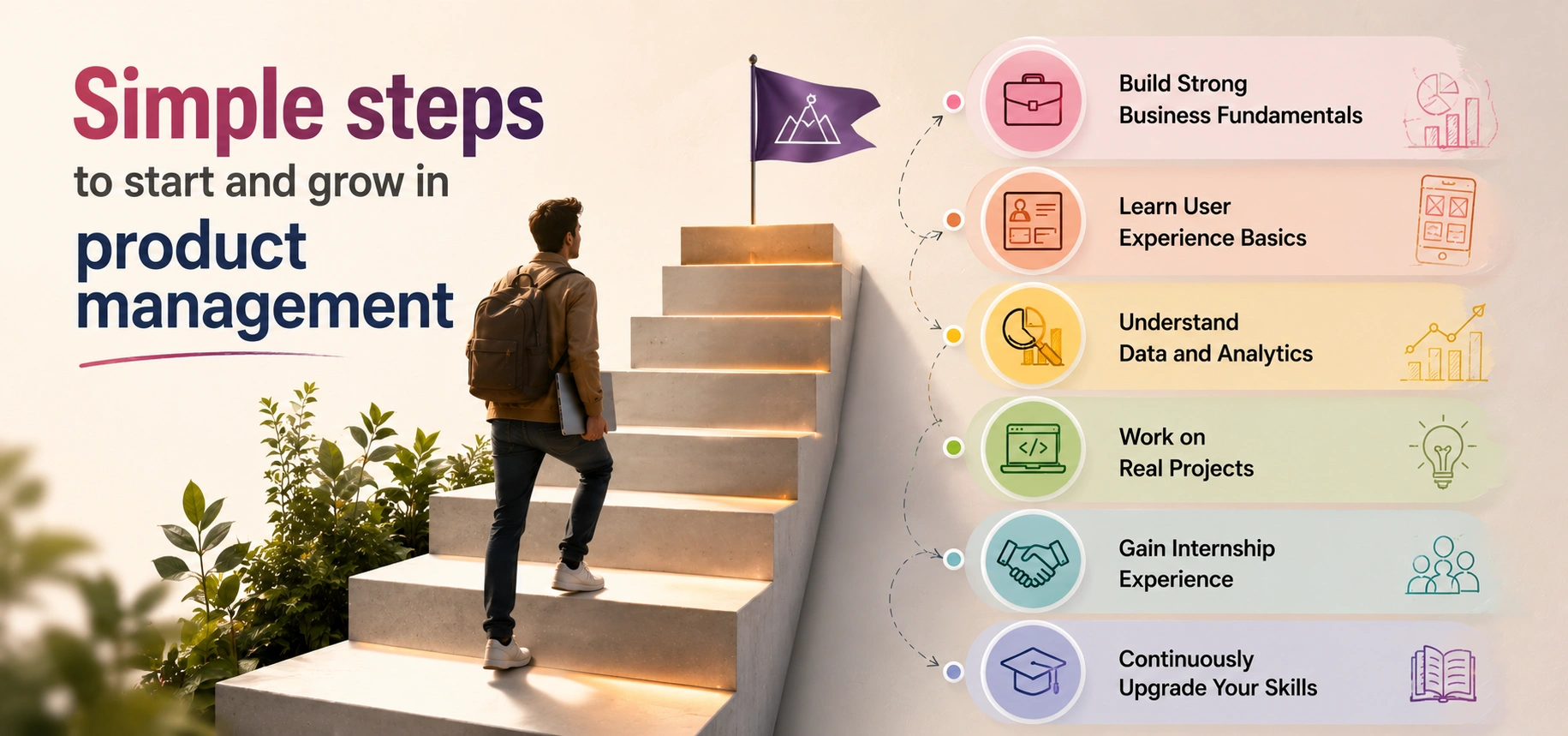
A Practical Career Roadmap
For aspiring product managers, the journey often begins with building foundational knowledge.
A practical roadmap may include:
- Understanding product management fundamentals
- Developing analytical and communication skills
- Participating in internships and live projects
- Learning user research techniques
- Understanding product metrics and data analysis
- Building familiarity with product development processes
- Creating a portfolio of practical work and case studies
Progress may seem gradual at first, but consistent learning and practical exposure create long-term momentum.
Conclusion
Building a career in product management is not about following a single predetermined path.
It is about developing the ability to understand users, solve meaningful problems, collaborate effectively, and make informed decisions in uncertain situations.
The journey will involve challenges, setbacks, and continuous learning. However, each experience contributes to professional growth and helps build the skills that define successful product managers.
For students and aspiring professionals, the focus should not be on finding the perfect career path immediately. Instead, it should be on gaining practical experience, developing relevant skills, and remaining open to continuous learning.
With the right combination of education, exposure, and persistence, product management can become a rewarding and future-ready career choice.