

If you’re studying marketing right now, chances are your feed feels louder than ever.
One minute you’re watching a “day in the life” of a social media manager working from a cafe with perfect lighting. Next, you’re saving a thread about algorithm hacks. Then someone says Instagram is dead. Then someone else says LinkedIn is the future. It never stops.
It’s easy to think this career is just trending audio, aesthetic workspaces, and clever captions. But once you look past the surface, you realise something quickly: social media marketing in 2026 is less about vibes and more about understanding people.
And that’s where most students get stuck.
The Shift: Why the Social Landscape is Rebranding Itself
Something quietly broke around 2024.
Nobody announced it. There was no press release, no viral moment marking the exact second it happened. But somewhere between the fifteenth sponsored post and the third “authentic” brand voice that sounded identical to every other authentic brand voice, people just got tired. Not tired of the internet, but tired of being managed by it.
Nowhere is this reshuffling more visible than in where marketers are actually putting their energy. Instagram, the platform that essentially defined the visual brand identity playbook for a decade, has quietly lost its throne. It didn't collapse. It just stopped being first in the conversation.
The clearest winner in that reshuffle? YouTube: which, depending on your age, either surprises you or makes complete sense. Extending YouTube shorts to three minutes wasn't a technical tweak, but it was a bridge. One end connects to the fast, creator-driven culture of short-form videos. The other end reaches the lean-back prime-time attention that used to belong exclusively to broadcast TV. YouTube is now the only platform standing comfortably in both worlds, and brands that understand that are already moving accordingly.
Defining the Vibe: Key Social Media Marketing Trends for 2026
Imagine it's 2 am, and somewhere out there, a 19-year-old with a ring light and a half-eaten bag of chips is editing a 28-second video that will be seen by three million people before this editor wakes up. No agency. No budget. Just instinct, timing, and an understanding of what people actually want to feel when they scroll.
That’s the world you’re stepping into. And before you open a single scheduling tool or write a single caption, you need to understand what’s driving it.
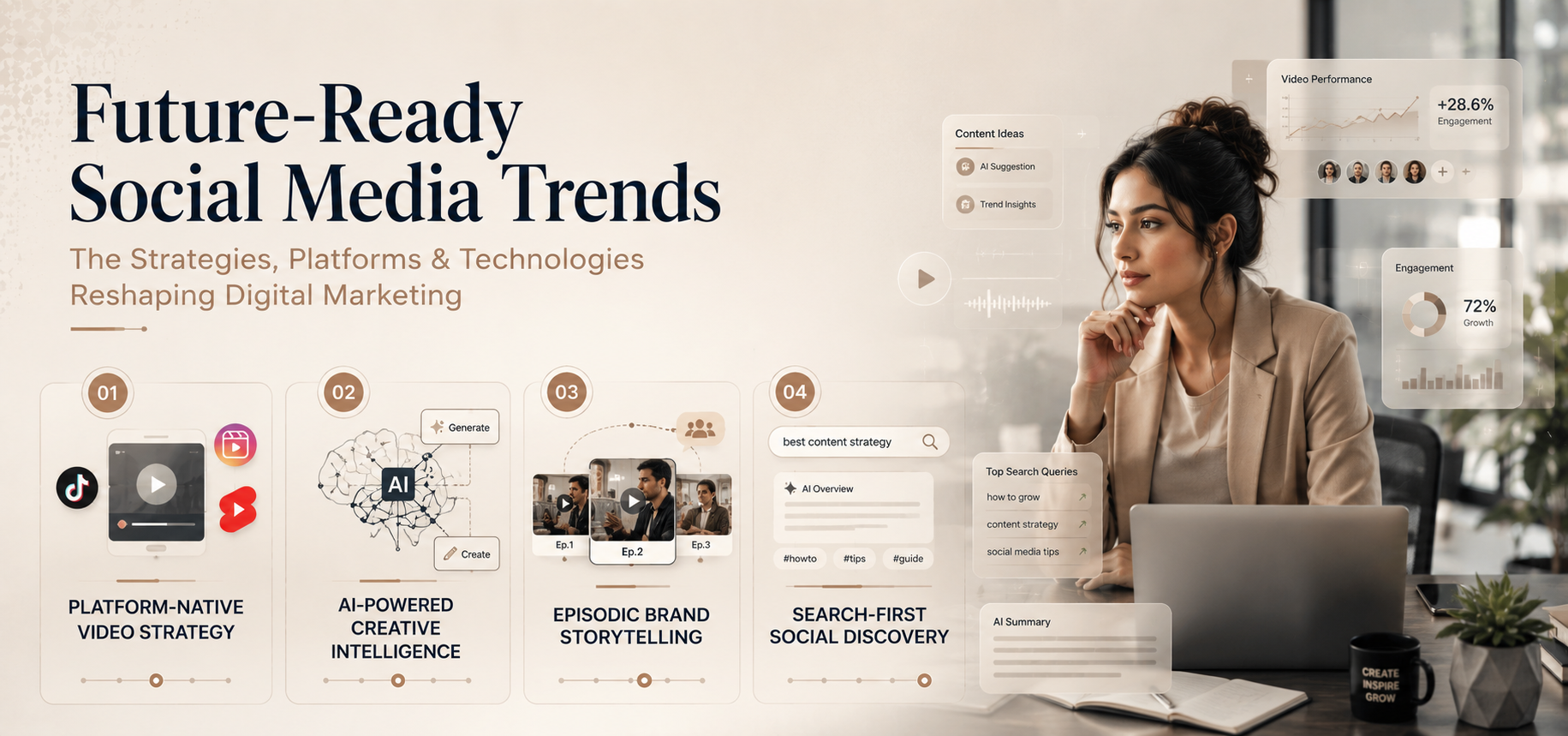
Video Everywhere, But Not All Videos Are Equal: The Age of Platform Fluency
Let's get something straight: video didn't "win." It graduated.
TikTok, Reels, YouTube Shorts, they've stopped competing and started coexisting, each with its own personality and unwritten rules. The brands that are thriving right now aren't the ones posting the same clip everywhere and hoping for the best. They're the ones who get each platform the way you get the different versions of yourself, the one at a job interview versus the one at Sunday brunch.
GoPro figured this out in an almost poetic way. On one hand, they're dropping Chris Finck out of a plane for a BASE jumping reel that makes your palms sweat. On the other hand, they handed a HERO13 Black to food creator Susi Vidal and let her make dinner. Same camera. Completely different universe. And both felt right because GoPro didn't try to turn a cooking video into an extreme sports ad; they just let each world be itself.
For you, as someone building your career, this means learning the rhythm of each platform. TikTok wants to be grabbed by the throat. YouTube wants a story arc. Master both, and you're not just a content creator; you're fluent in multiple dialects of the same language.
Mainstream AI Integration
AI has moved from an experimental novelty to a standard tool for ideation and quality assurance. Heinz demonstrated this with its AI Ketchup campaign, using bots to generate images that reinforced brand recognition. However, marketers must remain ethical; 52% of users are concerned about undisclosed AI-generated content.
Students should use AI as a creative partner for brainstorming rather than a replacement for human thought. The student-level impact involves learning to prompt AI for research while ensuring the final output feels human. Storytelling and relatability remain the primary differentiators that AI cannot currently replicate with authenticity.
Serialized Content
Consumers are increasingly drawn to original content series that feature recurring characters and evolving stories. Shameless Media’s "The Shoffice" and its spinoff "Out of Shoffice" use an Office-style format to show workplace culture. These unpolished peeks into brand life resonate with audiences who crave behind-the-scenes access and familiar faces.
Students should practice creating "brand lore" by developing recurring themes or characters in their portfolios. Consistency in personality helps an audience feel like they are watching a binge-worthy show rather than an advertisement. Serialisation encourages repeat viewership, which is often more valuable for a brand than a single viral hit.
Social Search and AEO
Social search is now the primary discovery method for over 50% of Gen Z consumers. Marketers must master Answer Engine Optimisation (AEO) to ensure content appears in AI-driven platform summaries. This involves writing captions that provide direct, scannable answers to common user queries like "how-to" guides.
Students should practice writing captions that are both conversational and rich with relevant keywords. Optimising profiles for searchability ensures that a brand remains visible as traditional Google searches decline. This shift makes technical SEO knowledge a high-value asset for anyone entering the future of social media marketing.
The Essential Student Toolkit: Categorised for Clarity
Navigating social media marketing tools in 2026 requires a balance between functionality and cost. Tool overwhelm can paralyse a strategy, so selecting a specialised stack is essential for efficiency. The following tools are categorised based on their primary value for a beginner.
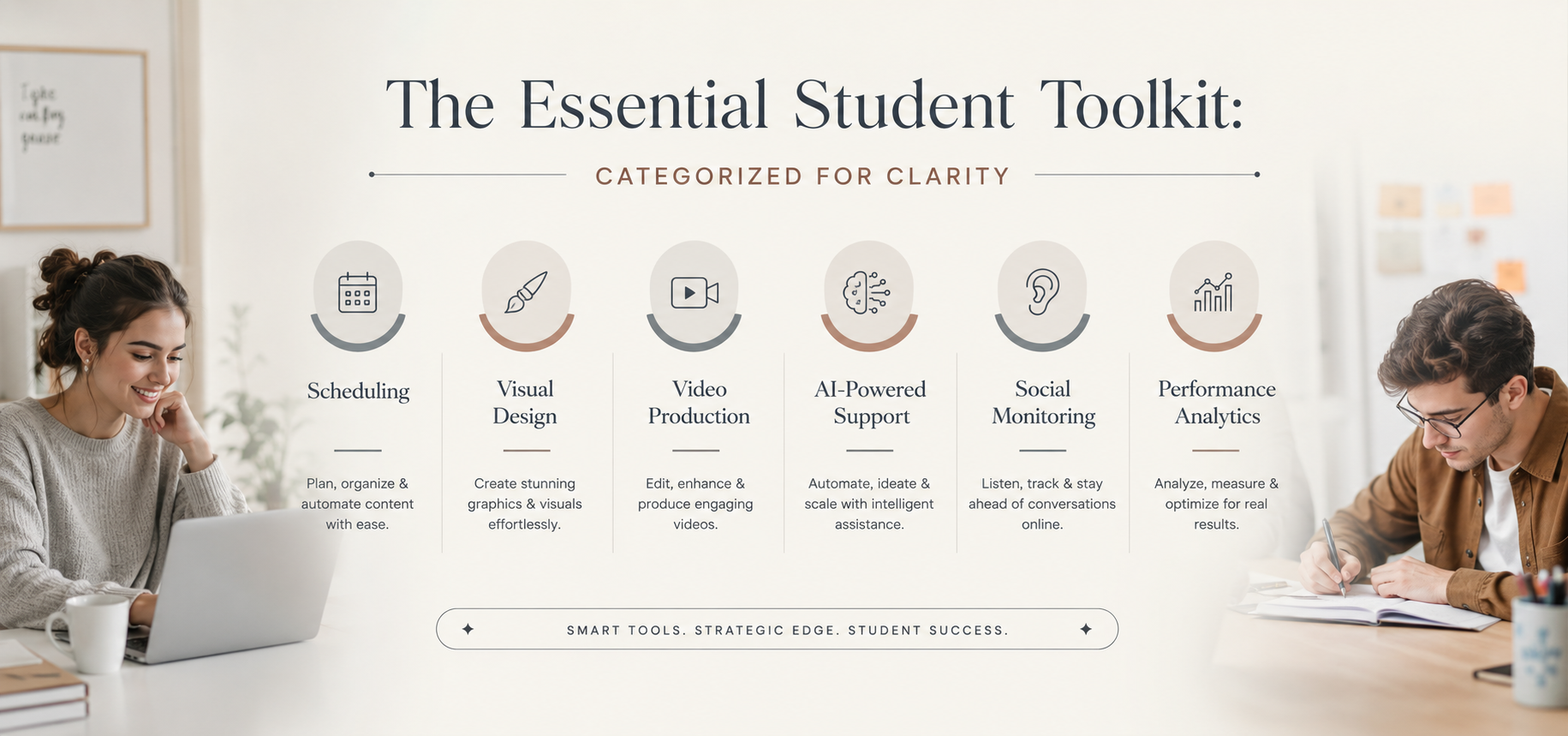
Scheduling
- Buffer: This is ideal for students due to a free plan for three channels and habit-building "streaks" features. It helps beginners move from sporadic posting to a consistent professional rhythm.
- Hootsuite: A robust all-in-one dashboard best for those who need to manage complex team workflows and social listening.
Design
- Canva: A non-negotiable tool for non-designers, offering brand kits and thousands of templates for quick creation.
- Adobe Lightroom: Necessary for photo-heavy brands that require signature presets to maintain a consistent colour aesthetic.
Video Editing
- CapCut: The current industry standard for TikTok and Reels, offering mobile-friendly transitions and AI-powered effects.
- Movavi: A user-friendly option for students who want to create professional video content without learning complex software.
AI Assistance
- Manychat: Essential for DM automation, allowing students to build workflows that "warm up" potential customers 24/7.
- Supermeme.ai: A specialised tool that turns text into memes, helping brands stay culturally relevant with minimal effort.
Social Listening vs. Analytics
- Mention: Used for social listening to monitor brand sentiment and track what people are saying across the web.
- Socialinsider: A dedicated analytics tool that helps students understand which specific content pillars are driving the most growth.
The Decision Framework: How to Choose a Tool Without Going Broke
A student's budget is limited, making every subscription choice a critical financial decision. High-quality social media tools should drive measurable results rather than just adding another monthly expense. Use this checklist to evaluate any software before committing to a paid plan.
- Does it save time? A tool should remove repetitive manual labour. Saving 30 minutes a day results in 10 hours of gained strategy time per month.
- Is it intuitive? If the learning curve takes weeks, the tool is a chore, not an asset for your workflow.
- Is it affordable and supported? Look for tools with transparent pricing and reliable customer support to handle technical glitches.
- Does it prove ROI? The best tools link social activity to business outcomes like lead generation or website traffic.
Realistic Reality Checks: Common Mistakes Students Make
Avoid the common pitfalls that separate amateurs from seasoned marketing professionals. Many beginners rely too heavily on "set it and forget it" systems, neglecting the need for daily presence. True results come from active participation in the community, not just automated scheduling.
One major error is treating AI as a total replacement for the human touch in creative work. Using AI for ads or art without adding a human storytelling element can alienate a skeptical audience. Transparency is essential; failing to disclose AI use can damage the trust a brand has worked to build.
Another mistake is over-relying on "trending audio" while neglecting the development of original brand lore. Trends are useful tools, but they cannot serve as the entirety of a long-term marketing strategy. The most successful marketers build recognisable worlds that their audience can inhabit, regardless of the latest trend.
Looking Ahead: SMM Beyond 2026
The social landscape will continue to integrate advanced AI, but the human element will remain the differentiator. As polished, generated content becomes the norm, the demand for "real experience" and "imperfection" will rise. Audiences can instinctively feel when a piece of content lacks a real person's perspective or voice.
Social Search and Answer Engine Optimisation will represent the next major frontier for new marketers. The ability to satisfy E-E-A-T criteria in every post is a skill that will only grow in demand. Marketers must focus on building authority and trust to succeed as discovery systems become more automated.
Conclusion: The Slow Build
A career in social media marketing is not defined by a single viral moment or a lucky post. Virality is fleeting, but a career is built on the steady acquisition of professional, technical skills. Students should avoid the urge to "solve" the entire digital landscape in a single week.
The most effective path forward is to pick one tool and one skill to master every seven days. Start with a simple scheduling tool like Buffer to build a habit, then move toward mastering strategic planning. Mastering these foundations ensures a student is prepared for an industry that never stops changing.