

Table of Content
- Introduction: HR Data Analytics
- Top HR Analytics Tools Every Organization Uses
- Skills You Will Gain From Learning HR Analytics
- Career Opportunities After Learning HR Data Analytics
- Conclusion
Three high-performing employees resign within a month!
The HR team gathers to understand what went wrong. Was it the manager? Salary package? Workload? Better opportunities elsewhere? Everyone has a reason, but no one else has context for that reasoning. In such situations, all assumptions are more speculative rather than backed by facts or data.
This is not an uncommon situation. Every organization experiences questions that cannot be resolved through intuition alone. Why are employees leaving? Which hiring source brings the best talent? What drives high performance? The answers are in the data already gathered, but only if someone knows how to read the patterns behind it.
That’s where HR data analytics comes into play.
It’s not an independent HR function. It’s a skill that enables HR professionals to blend human understanding with insights that come from data. HR data analytics can help organizations predict trends, make informed decisions and build a stronger, more engaging workplace. In other words, be solution oriented rather than reacting to challenges.
Through this blog, we delve deeper into this function, peel the layers and try to replace opinions with evidence.
Introduction: HR Data Analytics
The easiest way to understand HR analytics is to understand the two concepts that form it.
1. Understanding the meaning of HR: Beyond hiring
Ask someone what HR (Human Resources) does and they will immediately say ‘hiring people’.While hiring is one aspect of HR.
HR is the department that manages the entire journey of any employee - right from the point of finding the right candidate with the right skills for the right roles. Also, it is not just about finding befitting talent but also retaining the current talent in the organization for a longer period of time.
Hence, it is all about understanding the employees, finding solutions to the challenges that they might be facing and building a positive work environment for them to work effectively. As a result, both the candidate and the organization will excel together.
2. Understanding the Concept of Data Analytics
There is a regular retrieval and compilation of data by the organizations at every stage of the employee’s journey: from hiring to onboarding, attendance records, performance reports and exit interviews. The question worth asking is: are organizations using them effectively? And the answer lies in data analytics.
The process of collecting, organising and analysing the data is known as data analytics. It helps to know the businesses such as what is actually going on, and why it is going on, what can happen next in the organization and most importantly - what will be the next step. It’s all about taking evidence-based actions rather than leaving everything to mere guesswork.
3. The Intersection of Human Resources and Data Analytics
So far, we have explored HR and data analytics as two separate concepts. An understanding of both is equally important. Now we will understand the working of both concepts. When HR and data analytics work together, the organization becomes very powerful, as they stop relying on instincts and focus on factual data that serves as evidence.
Eventually, the questions that relied on assumptions are now answered, all thanks to data:
-
Why are top performers leaving?
-
Which hiring source consistently delivers the best employees?
-
Which teams are at the highest risk of burnout?
-
What skills will the business need next year?
That’s the real value of HR data analytics. It helps HR professionals to think beyond instinct to insights which will lead them to smarter hiring, stronger employee experiences and better business outcomes.
Top HR Analytics Tools Every Organization Uses
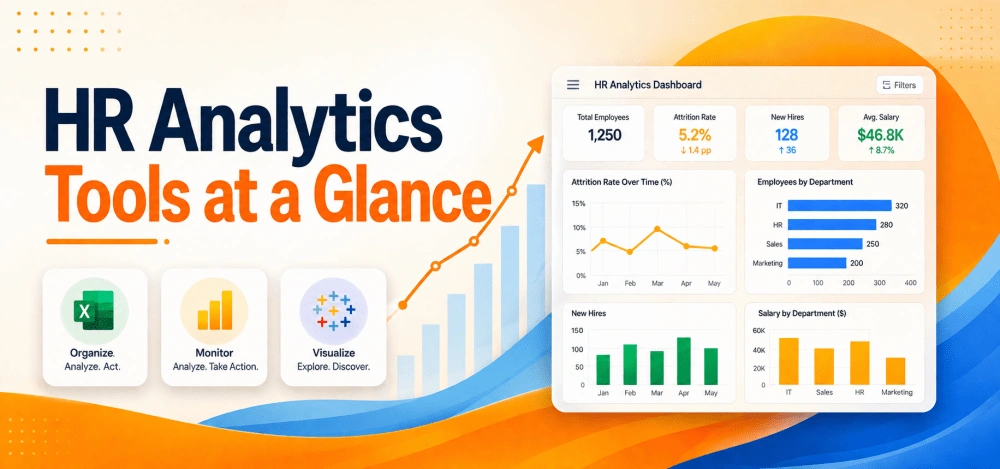
Great HR decisions don't happen by chance; they're powered by the right tools. Following are the most popular HR data analytics tools that are used across organizations to turn data into meaningful insights.
Microsoft Excel
Many employees and college students have already used or are using Excel for recording and reorganising data. But for HR, those spreadsheets help track daily activities like recruitment, metrics, employee data and generating reports, which helps the management for better decision making. The best thing? For anyone exploring HR data analytics, Excel is the best place to start. Most learners can get comfortable with Excel in 2-4 weeks.
Microsoft Power BI
If we talk about HR leaders, they can easily present hundreds of employee records in a dashboard, which is easy to understand. That’s where the role of Microsoft Power BI comes in, as it turns the raw data into attractive visuals which help the HR teams to analyse the hiring trends, the turnover and performance of the employees in one place. With consistent practice, beginners can easily learn the basics of Power BI in 4 - 6 weeks.
Tableau
Everyone can easily understand a good visual, but to read a spreadsheet - it takes a certain keen eye for detail and processing complex human data into result-bearing actions.
Tableau turns the same complex data into simple charts and dashboards which helps HR professionals and the organizations to make the business decisions. To learn the basics of Tableau, it will take around 3-5 weeks.
SQL
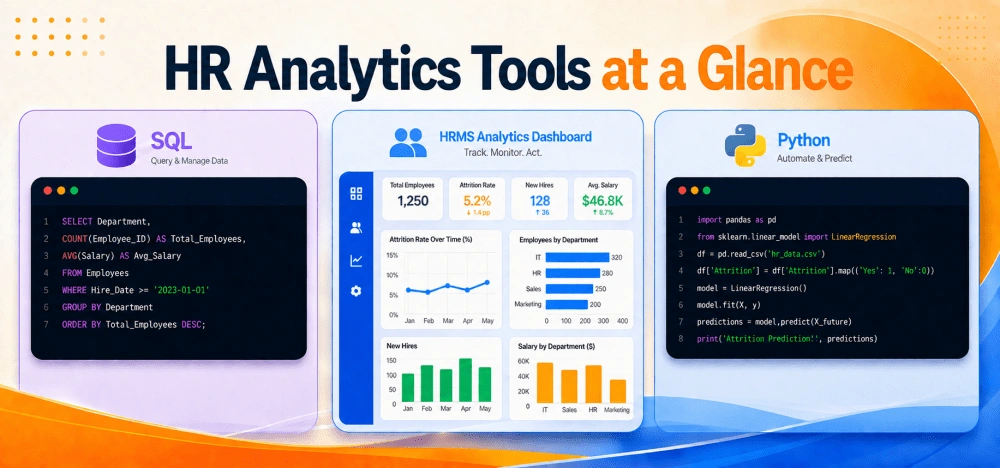
Every HR dashboard you see is driven by a database which has thousands of employee records. SQL gives all professionals exactly the data they want without shifting through endless spreadsheets. SQL helps the organizations, especially which are handling large volumes of data. On an average, it takes around 1-2 weeks to learn the basics of SQL.
Python
Python will take HR analytics a step further by helping organizations analyse large volumes of data and patterns that are uncovered and are difficult to spot manually. It allows HR teams to move beyond reporting towards forecasting, automate analysis, identify trends and support predictive HR analytics. Most beginners become comfortable with the fundamentals in 2 to 3 months.
HRMS Analytics Dashboards
HRMS stands for Human Resource Management System. Most HR teams have access to analytics - they just don't know it. Modern HRMS platforms like Workday, SAP SuccessFactors, Oracle HCM, and Darwinbox are built-in dashboards that give you instant insights into hiring, attendance, payroll, performance, and employee engagement, without making reports from scratch. A lot of the analysis is already in the software, so you can normally learn the basics in 2 to 4 weeks.
Skills You Will Gain From Learning HR Analytics:
Many people think learning HR analytics is about mastering Excel, Power BI, SQL or Python. But not really, these tools are essential but the value lies in the practical skills that you develop and which helps the organization and HR professionals make better decisions.
Here are some of the primary skills you will build as you learn HR analytics:
1. Collection and Cleaning Of Data
Before any analysis even begins, data needs to be efficient for it to have any effect. You'll learn how to collect HR data from different sources, identify missing or duplicate records, correct inconsistencies, and prepare datasets for analysis. Clean data is the foundation of reliable insights.
2. KPI (Key Performance Indicators) Analysis and HR Metrics
You will eventually understand how to measure the effectiveness of HR key metrics such as employee turnover, absenteeism, time-to-hire, cost-per-hire, employee retention, diversity ratios and training effectiveness. More importantly, you will learn how to interpret these metrics to support business decisions.
3. Visualization of Data and Creation of Dashboards
The skill that can be added to your portfolio is the ability to transform HR data into interactive dashboards and visual reports, as numbers alone rarely tell a compelling story. This will help the managers and the leaders to quickly understand the trends and make informed decisions.
4. Decision Making Driven by Data
One of the most valuable skills you'll gain is learning to replace intuitions with data and evidence. Instead of relying on assumptions, you can use data, which will help to identify problems and generate solutions that will be backed by facts.
5. Predictive Analytics
As your HR analytics skills grow, you will be able to identify patterns that help in the forecasting of future trends. It will include predicting employee attrition, identifying high-potential employees, and forecasting the hiring requirements. With these insights, organizations can take proactive steps instead of reacting to the problems after they arise.
6. HR Reporting and Business Communication
The only part of the job is not only analyzing the data but you will also learn to communicate your findings to the business leaders in a way they can understand. This will include presenting insights, explaining trends and translating data into HR recommendations.
7. Problem Solving with Data
The vital skill you will be developing is not only the ability to answer business questions, but importantly the answers backed by evidence. HR analytics will help you uncover and understand why employees leave, the effectiveness of recruitment, employee engagement measurement and assessing learning outcomes.
Also Read: Is a Master’s in Business Analytics Worth It in 2026? Here’s the Truth
Career Opportunities After Learning HR Data Analytics
HR data analytics skills can open doors to a variety of HR and people analytics roles, which include:
|
Career Role |
What They Do |
|
HR Data Analyst |
Helps to analyse HR data to identify trends, generate insights and support decisions backed by data. |
|
People Analytics Specialist |
Use employee data to solve workplace issues and help the leaders to make better decisions. |
|
HR Business Partner (HRBP) |
Identify high-performing employees, coach managers how to lead a team by combining HR expertise with analytics. |
|
Talent Acquisition Analyst |
Improve recruitment strategies using hiring data, sourcing metrics and candidate insights. |
|
Planning Analyst |
Predict hiring needs, analyse trends and identify future skill gaps. |
|
Learning & Development Analyst |
Measure training effectiveness and evaluate employee learning and development outcomes. |
|
HR Analytics Consultant |
Help organisations implement HR analytics solutions and develop strategies. |
Conclusion
Do you still remember those three employees who resigned from the organization at the beginning of this blog? There were no clear answers for those questions; the three resignations were not mysteries. They were hidden in the data. That's exactly where HR analytics makes the difference, instead of just relying on guesswork and assumptions. Now there were no vague answers; it was backed by data and facts with proper evidence.
A successful modern HR professional doesn't just understand people; they also understand the data that shapes people's decisions. HR analytics is not just a skill, it is a capability that empowers every HR to lead with confidence, strategy and impact.