

Table of Content
- What Is HR Data Analytics and Why Does It Matter Now?
- Why Do Companies Suddenly Care So Much About HR Data Analytics?
- Who Actually Needs to Learn HR Data Analytics?
- When Should Students Start Building This Skill?
- Where Is HR Data Analytics Actually Used Inside a Company?
- How Can Students Start Learning HR Data Analytics Today?
- Conclusion
Resume updated for the fifth time this month. Strong CGPA, two solid internships, a clear grasp of recruitment and labour laws, everything a textbook mentions an HR aspirant should have. Yet every offer feels like food in a restaurant coming your way, only to land on another table.
It wasn't until a placement mentor reviewed the interview feedback that the real issue surfaced: every rejected candidate had one thing in common; they couldn't understand a simple dashboard or interpret what the numbers meant for the business.
In 2026, this is a common sighting. Students are technically "HR-ready" but not "data-ready” and recruiters have started to acknowledge that gap. Bad news?
Not really.This is exactly where HR data analytics comes in, not as an optional add-on skill but as the deciding factor between a shortlisted resume and the one that never saw the light of day. If you want to understand why this one skill is reshaping HR hiring in 2026, and how you can build it before it costs you an offer, this blog is for you.
What Is HR Data Analytics and Why Does It Matter Now?
For decades, HR ran on instinct. A manager "felt" that morale was low, or "sensed" a department was overstaffed. HR data analytics replaces that guesswork with evidence. It is the practice of collecting employee data from attendance and performance to engagement surveys and exit interviews and converting it into patterns that predict behaviour before it becomes a crisis.
Traditional HR asks, "What happened?" HR data analytics asks, "Why did it happen and what happens if we don't act on it?" That shift from reactive to predictive is exactly why analytics has moved from an optional certification line on a resume to a core hiring requirement across every industry from IT to manufacturing to retail. Recruiters aren't just testing textbook knowledge anymore; they're testing whether a candidate can think in numbers.
Why Do Companies Suddenly Care So Much About HR Data Analytics?
The honest answer? Because losing employees has become expensive. Replacing a trained employee can cost the company several months' worth of salary paid - once hiring, onboarding, and lost productivity are factored in. And one should also know that paying salary is not the only cost any company bears when they hire someone.
HR data analytics helps organisations catch warning signs early: a dip in engagement scores, a spike in overtime, a pattern in resignation timing, long before an employee hands in their notice.
It also changes how HR is perceived inside a company. An HR professional who can walk into a leadership meeting with a dashboard showing exactly where hiring costs are bleeding or which team has the highest burnout risk, is no longer seen as "support staff." They become a strategic voice at the table. That is the shift 2026 has firmly cemented: data-educated HR professionals sit closer to decision-making than ever before, and companies are actively hiring for that capability.
Who Actually Needs to Learn HR Data Analytics?
This is where most students get it wrong. HR data analytics isn't reserved for senior managers or people with "Analyst" in their job title. It's for:
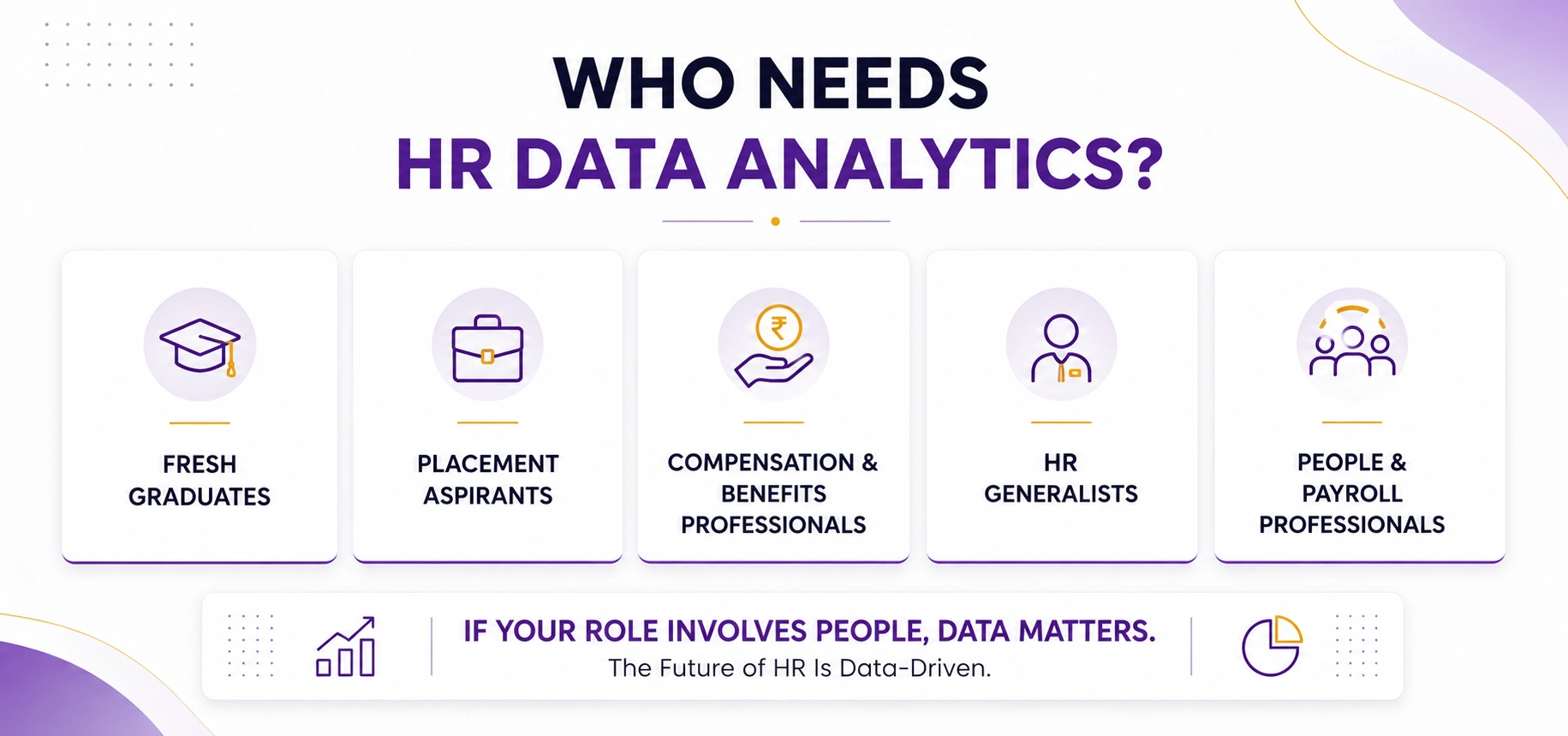
- Fresh graduates entering recruitment roles, who now need to justify hiring decisions with data instead of gut feeling.
- Placement candidates, who are increasingly tested on basic analytics tools during interviews, not just HR theory.
- Professionals in compensation and benefits, who use analytics to benchmark salaries fairly and prevent attrition caused by pay gaps.
- HR generalists, who are expected to read and interpret a dashboard even if they'll never build one from scratch.
If a role touches people, performance, or payroll in any way, HR data analytics will eventually land on that desk. The only real question is whether the person sitting there is ready for it.
When Should Students Start Building This Skill?
Never a better time than right now. Recruiters evaluate analytics readiness during internships and placement interviews, not after someone is hired. Waiting until the first job to "pick it up on the go" means starting from zero while peers who built the skill earlier are already contributing from day one.
The ideal window is the final academic year, when HR coursework is already underway and analytics concepts can be applied directly to live case studies, internships, or class projects. This is also the easiest time to learn foundational tools, since there's structured guidance, mentorship, and no production-level pressure riding on the very first dashboard someone builds.
Where Is HR Data Analytics Actually Used Inside a Company?
Analytics isn't confined to one department; it runs through the entire employee lifecycle.
In recruitment: It identifies which sourcing channels bring in employees who stay long-term.
In onboarding: It tracks how quickly new hires reach full productivity.
In performance management: It spots skill gaps across teams before appraisal season causes panic.
In retention: It flags flight-risk employees using patterns in leave, engagement, and workload data.
In workforce planning: It ensures hiring and promotion decisions are measurable and fair, not assumed.
Understanding where analytics fits into daily HR operations helps connect classroom theory to real business problems, which is precisely what interview panels are testing for when they ask scenario-based questions.
How Can Students Start Learning HR Data Analytics Today?
Nobody needs to become a data scientist. What's needed is working fluency, the ability to read, interpret, and act on HR data with confidence. A practical starting point looks like this:
Get comfortable with spreadsheets first. Most HR analytics still runs on well-structured data before it ever touches advanced software.
Learn to read dashboards, not just build them. Understanding what an attrition or retention dashboard is communicating is often more valuable in interviews than knowing every formula behind it.Practice with real HR case studies. Look at hiring funnel data, engagement survey results, or resignation trends, and ask what decision follows from what's visible.Build one small project. Even a simple analysis, like identifying which factors most influence resignation, shows recruiters the ability to apply theory to reality.
Also Read: Is Human Resource Management a Good Career Choice for You?
This is exactly the gap that structured, industry-aligned programs are built to close, connecting HR theory with the practical, tool-based skills today's job market genuinely demands.
Conclusion
HR data analytics is no longer a specialisation to add later; it's the lens through which modern HR decisions are made. Students who build this skill early don't just perform better in interviews; they walk into their first HR role already thinking like decision-makers instead of order-takers. For anyone serious about future-proofing an HR career, this is the moment to start, and with the right guided learning environment, as the one LPU Online offers, that shift from theory to real workplace analytics becomes a lot less overwhelming and a lot more achievable.