


We have often come across statements like, “HR hi to hai! Hiring-firing, leave approvals, festival planning, ya fir employees ke liye ek cosy chair settle kar dena; that’s all they do, right?” If this is what you’ve always thought, well, you’re definitely not the only one. For years, HR professionals in India have carried this stereotype of being the office event managers, leave masters, or placement coordinators.
But jokes apart, the reality is far deeper. It needs strategy, creativity, empathy, and authority to manage people and organisation, the most unpredictable yet most valuable asset of any company. And this is exactly where Human Resource Management (HRM) comes into the picture.
What exactly is HRM?
Every organisation runs on many moving parts like technology, systems, and deadlines, but none of them works without the right people. Studies even show that nearly 80% of business performance depends on how well people are managed.
And when people drive performance, Human Resource Management becomes essential. HR looks beyond hiring or paperwork by understanding employees' needs, building systems that support growth, and keeping the workplace aligned and productive. When the resources are managed well, the whole organisation moves with clarity and purpose.
Here are a few core responsibilities that define how HRM operates in any modern workplace:
- Bridging the gap between management and employees.
- Recruitment & hiring, training & development, performance management, compensation & benefits, employee relations, compliance, etc.
- HRM drives culture, employee engagement, and growth.
- Placing the right people in the right roles is how they contribute to long-term business success.
- Balancing the interests of both employees and organisation by understanding people's emotions and aspirations, while continuously adapting to new workforce trends and technologies.
But it doesn’t stop here. From administrative responsibility to talent acquisition, building culture to technology adoption. They exist as a change-maker, or, in other words, as a business partner. If these responsibilities and management tasks excite you. Believe that you are ready to build your career in HRM. If still the doubt exists, why choose HRM as a career? Here is the solution.
Why consider HRM as a Career, and is it right for you?
We are all now familiar with the workings of HRM. But if we want to choose this as a career, our “WHY” must be clear.
Whether you are a college student or a working professional, or if you like to engage socially and actively participate in small events, take the authority of your roles and responsibilities, along with taking care of your environment. You are rooted in this domain. Let’s clear this up with some pointers.
Here are some questions to help you reflect on whether it’s the right path for you:
- Do you enjoy working with people and helping them succeed?
Imagine seeing someone’s journey from onboarding to induction to grow to higher posts. They will be thankful to you for your kind consideration and guidance. - Are you good at communication, empathy, and conflict resolution?
If you are empathetic enough to understand your employees’ issues and can come up with solutions, and if you have strong communication skills to resolve conflicts, then say yes to this role. - Are you interested in psychology, business, or workplace behaviour?
If you want to understand and learn business psychology and manage workplace decorum, then again, say yes to this role. - Do you want a career where you can influence people’s lives and organisational success?
If you want to be someone who positively influences people’s lives and contributes to the organisation’s growth and success stories, then once again, say yes to this career choice. - Are you curious about blending people skills with technology and strategy?
If your creativity sparks when blending the latest trends and technology with people skills, and if you aim to bring ease and a better work culture to businesses, then again, it’s a big yes, and this is the right choice for you.
Skills you need to shine in HR
Succeeding in Human Resource Management isn’t just about knowing policies or handling payroll. It involves navigating diverse workplace challenges and balancing people’s needs with business goals. To truly shine in HR, you need a blend of professional expertise and strong interpersonal abilities.
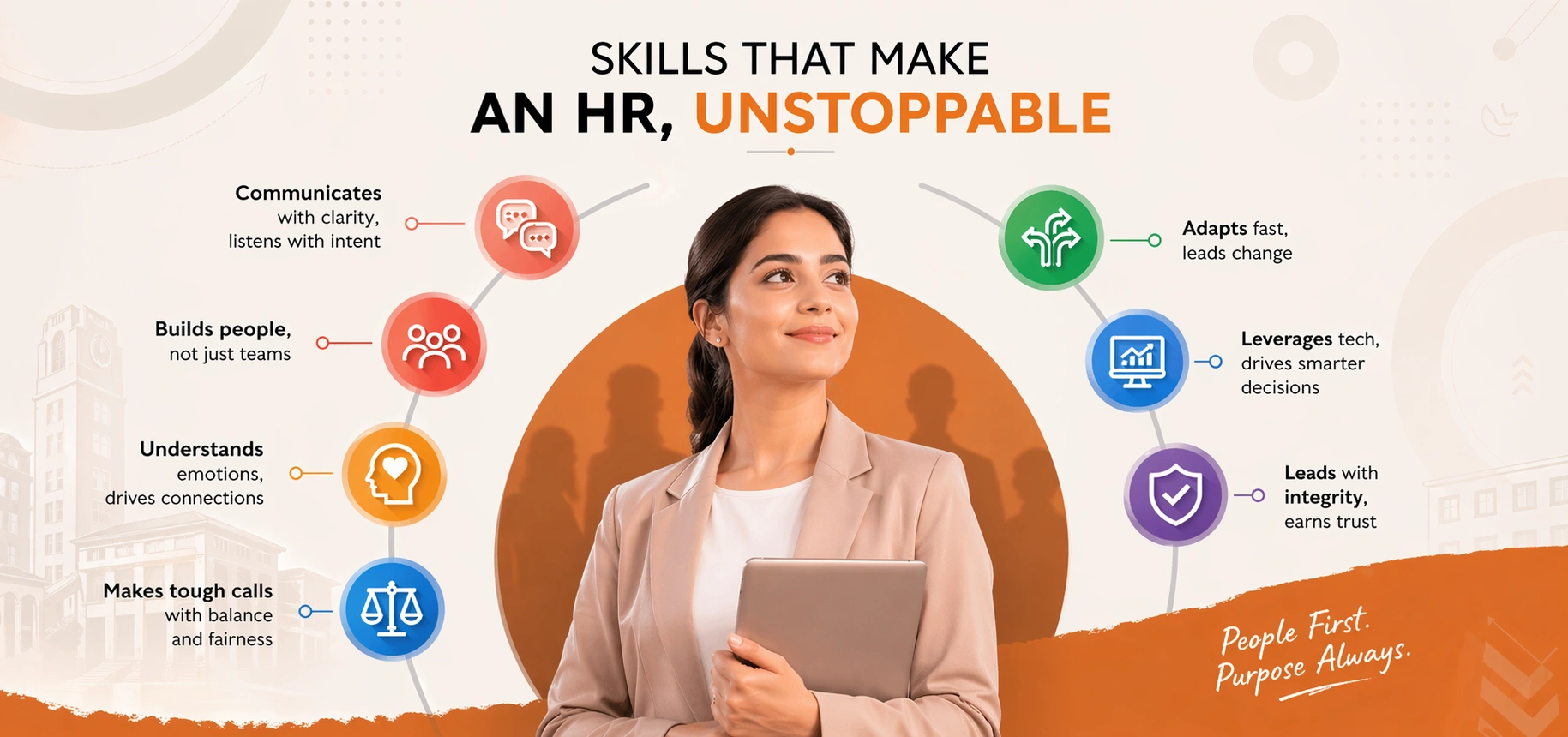
Key skills every HR professional should master
- Communication skills: Having good communication skills is crucial with a clear, empathetic, and persuasive approach.
- People management: Having fair management skills in order to build trust, influence people, and resolve conflicts is also a part of it.
- Emotional Intelligence: Understanding people’s emotions and responding empathetically.
- Decision-making: HR often requires taking tough but balanced decisions that consider both organisational priorities and employee needs.
- Adaptability: Flexible to the changing workplace, culture, and technology.
- Technically handy: One must have an advantage if they know HR management software, analytics, and digital tools to drive smarter decisions.
- Ethics and Integrity: Maintaining confidentiality and ensuring fairness in all practices.
Career Pathways in HRM
A career in Human Resource Management is not confined to a single role. As organisations grow and workplace dynamics evolve with time and new generations, the HR function has expanded into multiple specialised and leadership tracks. This gives aspiring HR professionals the freedom to choose paths that match their strengths and interests, whether it’s working directly with people, designing policies, or shaping business strategies.
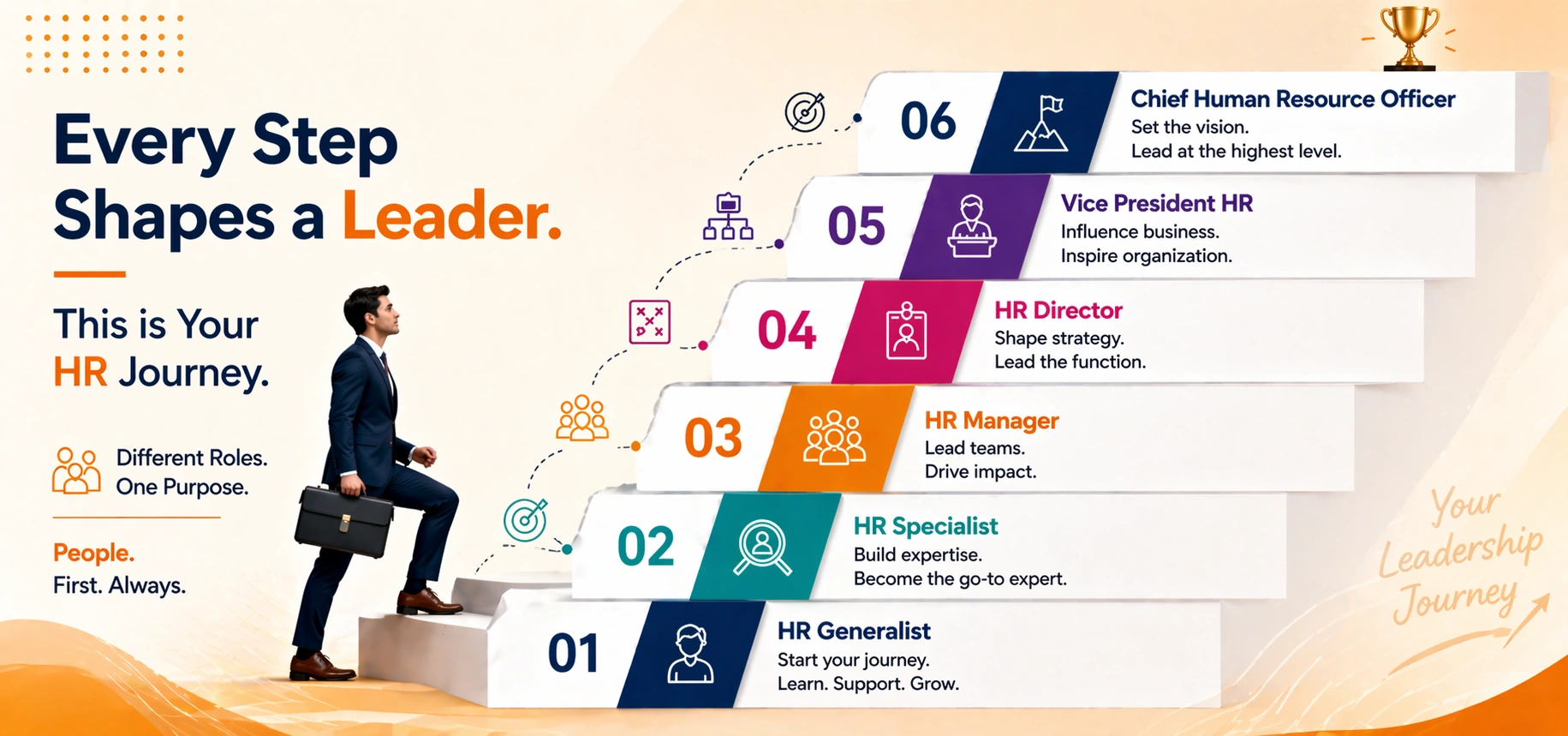
There are different levels of this career path. Let’s take note of the roles according to the levels from entry to chief:
HR Career Path
1. HR Generalist (Entry-Level)
Common roles that are available globally:
- HR Assistant
- HR Coordinator
- Junior HR Generalist
- Payroll & Benefits Assistant
Focus: Handling day-to-day HR operations like onboarding, leave management, payroll, and employee support.
2. HR Specialist (Domain-Focused)
Roles commonly available globally:
- Talent Acquisition Specialist
- Learning & Development (L&D) Coordinator
- Compensation & Benefits Analyst
- Employee Relations Specialist
- Diversity & Inclusion (D&I) Specialist
Focus: Specialising in one function such as recruitment, training, performance management, or employee relations.
3. HR Manager (Mid-Level Leadership)
Roles commonly available globally:
- HR Manager
- Talent Development Manager
- Employee Engagement Manager
- Compensation & Benefits Manager
- Training & Development Manager
Focus: Leading HR teams, managing policies, and aligning HR practices with organisational goals.
4. HR Director (Senior Leadership)
Roles commonly available globally:
- Director of Human Resources
- Global HR Director
- Director of Talent Strategy
- Director of People & Culture
Focus: Driving HR strategy across business units or regions, focusing on culture, leadership development, and organisational growth.
5. Vice President HR (Executive Leadership)
Roles commonly available globally:
- Vice President of Human Resources
- VP of People & Culture
- VP of Talent & Organisational Development
- Global Head of HR
Focus: Leading enterprise-wide HR strategy, advising top executives, and ensuring HR supports long-term business vision.
6. Chief Human Resource Officer (CHRO) (C-Suite Leadership)
Roles commonly available globally:
- Chief Human Resource Officer (CHRO)
- Chief People Officer (CPO)
- Head of Global People Strategy
Focus: Serving as a part of the executive leadership team, shaping overall business strategy through people, culture, and talent development.
Perks and Challenges of an HR Career
Working as a Human Resources manager comes with some perks and challenges, too. Which is crucial to understand before you enrol in the course, i.e., MBA in Human Resource Management, be it an Offline or Online MBA course.
Perks:
Job Security and Stability: HR professionals are essential to every organisation, making this field stable and consistently in demand.
Professional Networking Opportunities: HR roles provide opportunities to interact with professionals across departments and locations, helping build strong professional relationships and networks.
Continuous Learning: The HR domain keeps evolving with new technologies, workplace policies, and industry practices, encouraging constant learning and growth.
Diverse Career Opportunities: HR offers multiple specialisations such as recruitment, training & development, HR analytics, employee engagement, and leadership roles.
Impact on People’s Lives: HR professionals contribute to shaping careers, resolving workplace challenges, and creating a positive work culture where employees feel valued.
Work-Life Balance: HR careers often provide a stable and balanced professional lifestyle.
High Salary Potential: HR professionals can earn competitive salaries, with average packages ranging from 5 LPA to 20 LPA, depending on experience and role.
Challenges:
This rewarding opportunity comes with its own set of challenges. These challenges will test your professional expertise and emotional intelligence as well. Here are some of the most significant challenges faced by HRMs.
Job Security and Stability: HR professionals are essential to every organisation, making this field stable and consistently in demand.
Balancing Employee and Management Needs: HR professionals must maintain a balance between employee expectations and organisational goals.
Adapting to Changing Work Trends: Modern workplaces with hybrid models, diverse teams, and evolving technologies require HR to continuously adapt.
Handling Sensitive Issues: HR professionals often deal with emotionally and legally sensitive situations such as workplace conflicts, employee grievances, and layoffs.
Setting the Right Foundation for Your Career in HRM
Growth in HR doesn’t plateau because of a lack of effort. It slows down when experience isn’t supported in the right direction.
Over time, the question shifts from “what am I doing?” to “what am I working towards?”
This is where choosing the right learning path starts to make a difference:
- Work-Integrated Learning
An Online MBA in HRM from LPU Online allows you to upskill without stepping away from your current role. - Business-Aligned HR Perspective
You don’t just learn HR functions, but how they connect with finance, operations, and overall business strategy. - Application-Focused Approach
The program emphasises practical exposure through real-world scenarios, not just theoretical understanding. - Recognised Academic Credibility
You earn a qualification that is widely accepted and valued across industries, ensuring it supports your long-term career plans. - Career-Oriented Skill Development
It prepares you for roles that require decision-making, leadership, and strategic thinking in HR.
Ultimately, building a strong foundation in HRM is about making a choice that aligns with both your present role and future ambitions. And when that choice supports your growth without holding you back, you know you’re on the right path.
Final Thoughts
Apart from the context that HRs are the favourite punchline in corporate jokes and memes. The truth is that HRs juggle challenges so smoothly that most of us don’t even notice, all while standing strong for both the company and the employees. One day, they’re the strict guide setting rules, and the very next day, they’re the helping buddy - solving your issues. It’s a tough balance, but they make it work.
And we can’t deny the fact that it’s a career with real rewards. In India, HR managers often earn around ₹6–20 LPA (approx), while senior roles abroad earn more than our expectations. Plus, with the rising demand for tech-savvy HR professionals, the scope is only getting bigger. That’s why more people are turning to an Online MBA in HRM, and pursuing it virtually with a trusted institution like LPU Online, which makes the journey flexible and future-proof.
This blog incorporates insights and conceptual references from the article “Leadership” published by McKinsey & Company, supplemented with additional research, analysis, and editorial contextualisation.