

Not too long ago, Artificial Intelligence felt like something that belonged in a sci-fi novel or a locked R&D lab. It was a "someday" problem, definitely not something that would derail your Monday morning meeting. But that wall has come down. We are watching a quiet but massive shift where machine learning isn’t just an experiment anymore, it’s actually running the show.
You can see it in everyday things, like how Netflix somehow knows what you want to watch before you do, or in heavy industry, where plants are fixing machines days before they even break. AI has become the invisible engine behind pretty much every major sector. For anyone in leadership or just trying to build a career, ignoring this isn’t an option anymore. The gap between the companies using this stuff and the ones sticking to the "old ways" is getting wider by the day. This study digs into how that transition is happening and what it really means for the rest of us and our jobs.
Beyond Automation: The Rise of Decision Intelligence
The first wave of AI was mostly about "doing"; handing off the boring, repetitive stuff to machines just to save time. We were stuck in the age of Descriptive Analytics, looking at dashboards that basically just told us what had already happened. But we’re moving past that now into the era of Decision Intelligence. It’s a fundamental change; we aren’t just automating tasks anymore, we’re using AI for complex, real-time problem solving.
The questions have changed, too. Instead of asking "What went wrong?", companies are asking "What’s going to happen?" and "How do we handle it?" This is the difference between reacting to a crisis and getting ahead of it. You stop analysing why the supply chain broke last month and start running simulations to stop it from breaking next week.
As The AI Frontier notes, AI is quickly moving from being an optional tool to a default support system. It won’t be viewed as a separate tech initiative for much longer; instead, it will be the core layer running through everything from finance to marketing. This pretty much signals the end of making decisions based solely on intuition. Human experience is still vital, sure, but there is simply too much data now for any human mind to process alone. The businesses that come out on top will be the ones that stop relying on gut feelings and start treating AI as a genuine partner in the decision-making process.
The Productivity Multiplier Across Sectors
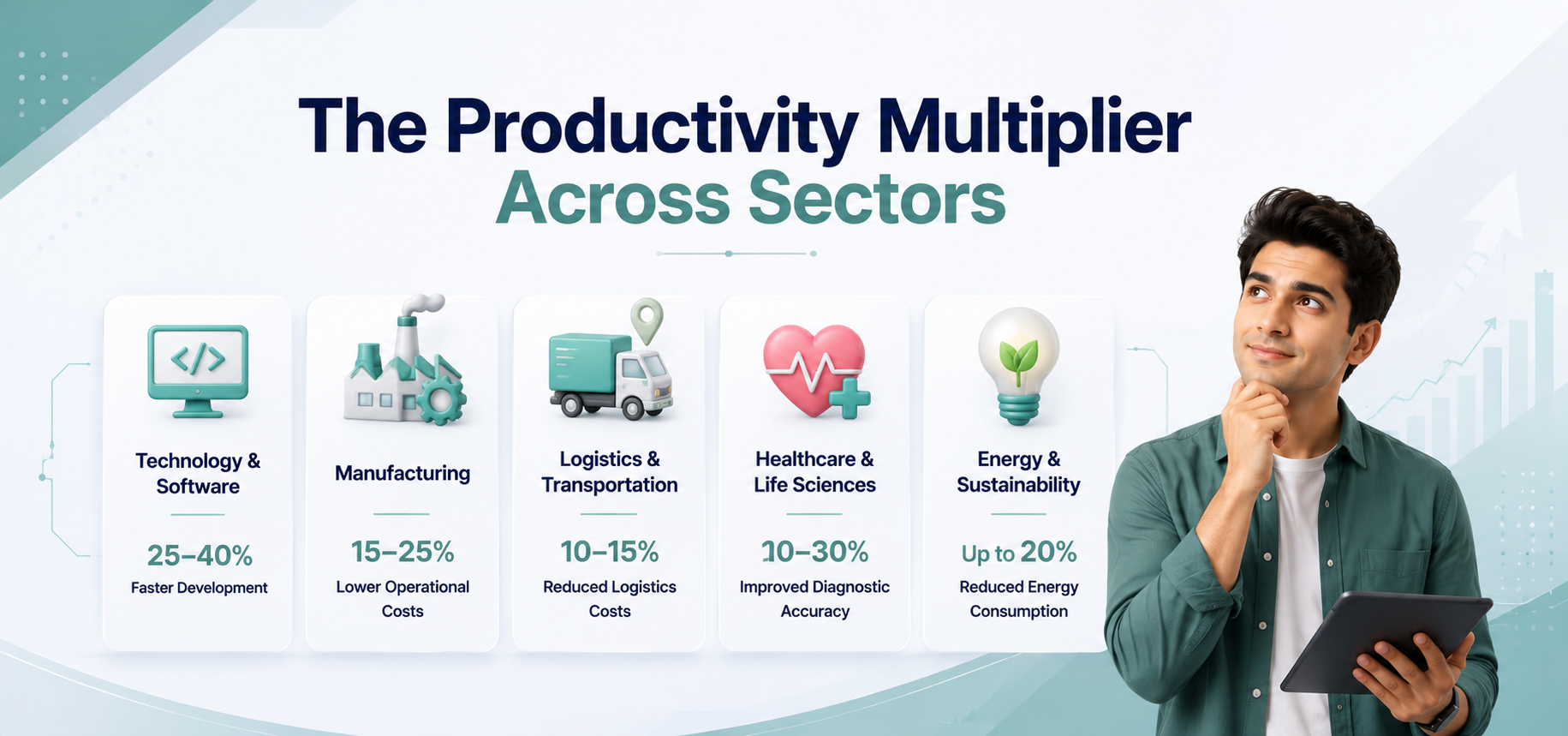
The impact of AI is best measured by its role as a productivity multiplier. According to the PwC Global AI Study, AI-driven organisations are seeing productivity gains of 20-30% compared to those sticking to traditional operational models [PwC]. This efficiency is not localised to one area but is spread across diverse sectors:
- Technology and Software: AI has significantly accelerated the pace of innovation. By automating code generation and testing, development cycles are becoming much leaner, with AI reducing software development time by 25-40% [Gartner, Accenture].
- Manufacturing: The focus here is on precision and time. Through predictive maintenance and quality inspection using computer vision, AI helps cut operational costs by 15-25% [BCG, World Economic Forum].
- Logistics and Transportation: Efficiency in movement is the goal of logistics and transportation. AI-driven route optimisation and demand prediction have led to a 10-15% reduction in logistics costs [PwC, Capgemini].
- Healthcare and Life Sciences: AI is revolutionising the frontline of medicine through predictive patient risk analysis and medical imaging. AI-driven diagnostics have been shown to improve accuracy by 20-30% [World Health Organisation, Nature Digital Medicine].
- Energy and Sustainability: By forecasting consumption patterns and optimising smart grids, AI is helping the sector meet sustainability goals, reducing energy consumption by up to 20% [International Energy Agency, World Economic Forum].
An analysis of these trends reveals a significant shift in the organisational structure. Traditionally, a company’s output was directly tied to its human capital footprint, i.e., more growth required more people. However, "lean teams" supported by robust AI systems consistently outperform larger organisations. AI lowers the barrier to entry by replacing massive manual execution with scalable algorithms, allowing small and agile teams to handle volumes of work that previously required entire departments.
Rewiring Internal Business Functions
While high-level industry shifts are impressive, the most profound changes are occurring within the functional departments of everyday companies. AI is effectively rewiring the "internal organs" of businesses:
Marketing: Earlier, marketing was largely assumption-driven, with campaigns targeting broad audiences and insights arriving too late to be actionable. AI now segments customers based on real-time behaviour and personalises messaging instantly. This shift toward performance-optimised marketing allows brands to optimise ad spending in real time, leading to an improved return on marketing investment (ROI) of up to 30% [HubSpot, Salesforce].
Finance and Risk Management. Previously, finance teams were slowed down by static reports and backwards-looking analyses. Today, AI supports real-time scenario modelling and better capital allocation. This is particularly evident in fraud prevention and risk assessment.
"AI-based fraud detection improves accuracy by up to 50%." [Deloitte, IBM]
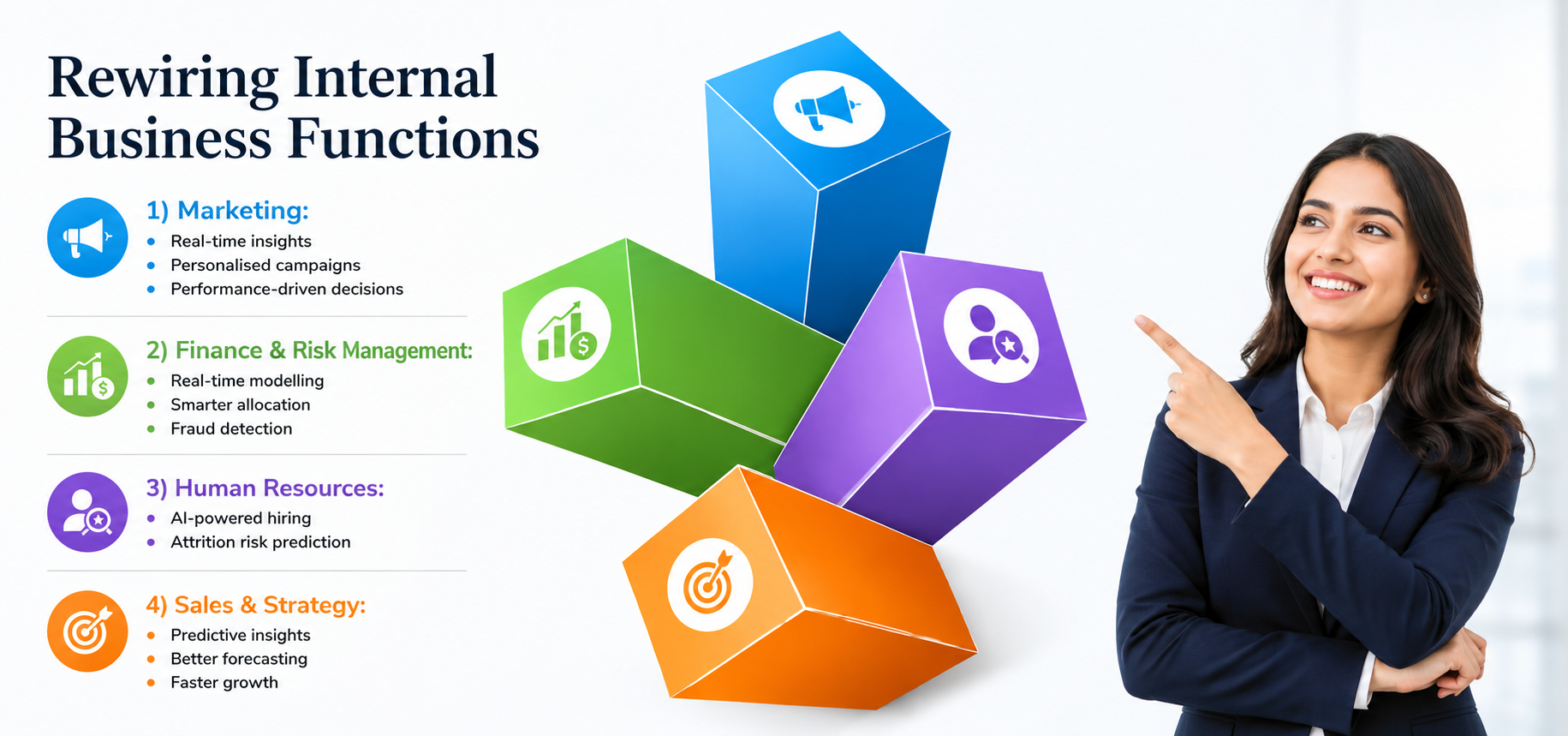
Human Resources (HR) hiring was once a manual, subjective process prone to bias and delays. AI-powered systems screen resumes and match candidates to roles with high precision, while also predicting attrition risk before an employee even resigns.
Sales and Strategy The "guesswork" of sales, qualifying leads, and following static pipelines has been replaced by predictive lead scoring and revenue forecasting.
- Shorter sales cycles and higher win rates are also expected.
- Better revenue predictability.
- Reduced strategic risk through data-backed scenario planning.
- Improved workforce productivity through better talent-role fit.
The Hyper-Personalisation of Customer Experience
We’ve reached a point where generic experiences just don't cut it anymore. People expect systems to understand exactly what they need in real-time, and AI is driving that shift through hyper-personalisation.
Just look at how we consume media. Recommendation engines aren't just a nice feature; they’re the main event, driving over 35% of what people actually watch on big streaming platforms. That’s the difference between keeping a subscriber and losing them to churn. Retailers are chasing the same dynamic. By using AI to adjust prices and tailor product suggestions to individual behaviour, they’re seeing sales jump by 10-15%.
It’s even reshaping education. We're seeing tools that adapt to a student's specific pacespeeding up or slowing down as needed, which boosts engagement by a solid 20–25%. Across every sector, the rule is the same: if you aren't tailoring the experience, you're falling behind.
Future Outlook: AI as the Default Business Layer
As we look toward 2026 and beyond, AI will cease to be a "special project" and will become the default business layer. We are moving away from generic, one-size-fits-all AI tools toward industry-tailored systems. These systems will be pretrained on specific data, such as healthcare records, supply chain logistics, or financial transactions, making them more accurate and relevant than ever before.
The risk for companies in the coming years is no longer simply "not adopting" AI. The real risk is "not integrating effectively." As AI-driven efficiency benchmarks rise, companies that fail to embed these systems into their core operations will find it nearly impossible to compete in terms of cost, speed, or quality.
Career Resilience: The Rise of the Hybrid Professional
A common concern is whether AI will eliminate jobs in the future. However, the reality is more nuanced: AI is redesigning roles rather than simply eliminating them. While routine and rule-based work is being automated, the demand for decision-oriented and creative responsibilities has increased. This has led to the rise of the "Hybrid Professional,” someone who combines deep domain expertise with AI fluency.
Four high-demand skill categories have emerged:
- Data Literacy: The ability to read, interpret, and question data outputs rather than accepting them at face value.
- AI Tool Fluency: Knowing how to use AI for research, forecasting, and analysis to outperform manual methods.
- Business Problem Framing: The critical ability to translate a complex business challenge into a specific question that an AI system can answer.
- Critical Thinking: Evaluating AI recommendations and applying human judgment to ethical and strategic decisions.
This shift is creating new roles, such as AI-enabled Product Managers, Marketing and Growth Analysts, and Strategy and Planning Analysts. In each of these roles, human judgment remains essential for high-stakes decisions that AI cannot independently handle.
Lead the Future with LPU Online
As industries continue to evolve, the demand for professionals who can lead AI initiatives is at an all-time high. To position yourself at the forefront of this shift, consider furthering your expertise with LPU Online’s MCA in Artificial Intelligence and Machine Learning (Online). This program is designed for modern professionals, offering a flexible, industry-relevant curriculum that focuses on real-world applications of AI. Acquire the skills required to transcend traditional boundaries and emerge as a leader in the new age of decision intelligence.
Conclusion: The New Standard
AI isn’t just a shiny toy for the tech crowd anymore. It’s basically the price of admission for doing business today. It doesn't matter if you're manufacturing products or treating patients; if you want to survive in this market, you need that predictive edge just to keep up.
Here’s the reality check: the future isn't about replacing humans. It’s about mixing your experience with AI skills. People who can look at a messy business problem and figure out how to use AI to solve it? They aren't just going to keep their jobs; they’re going to be the ones running the show.
FAQs
Which industries are seeing the biggest changes?
Tech, finance, manufacturing, and healthcare are definitely feeling it the most. It's massive for efficiency; we're talking about cutting coding time by nearly 40% and making medical diagnoses about 30% more accurate.
Does using AI mean companies will hire fewer people?
No, not necessarily. It’s mostly taking over the repetitive, busy work so people can focus on the bigger picture. We aren't just seeing job cuts; we're seeing "hybrid" roles where a small team uses AI to do the work that used to take an army.
How does AI actually make customers happier?
It comes down to speed and getting personal. Think about how streaming services know what you want to watch before you do. That kind of anticipation is huge; it’s helping retail brands bump their sales by 10-15%.
What skills should I be focusing on?
You need data literacy, sure, but the real money skill right now is "Business Problem Framing." It’s basically just the ability to take a messy real-world problem and turn it into the kind of specific question an AI can actually answer.