


The Moment Everyone Started Questioning Coding
The arrival of ChatGPT triggered one of the biggest debates the technology industry has seen in years. People who had never written a line of code were suddenly creating websites, mobile app prototypes and software scripts with text prompts. Social media was filled with demonstrations of AI building products in minutes, making it seem like programming was no longer needed. As a result, people started asking: Is learning to code worth it after ChatGPT?
At first, it seems like a valid concern. If an AI can generate hundreds of lines of code in seconds, why spend months or years learning programming concepts? Why invest in a skill that seems to be automated?
The answer is not that simple. We need to understand what coding is really about. The discussion usually assumes that coding is about writing a few lines of broken words known as code. However, the reality is more complex. To understand whether coding is still worth learning, we need to separate the act of typing code from the discipline of software development.
Coding Was Never About Writing Code
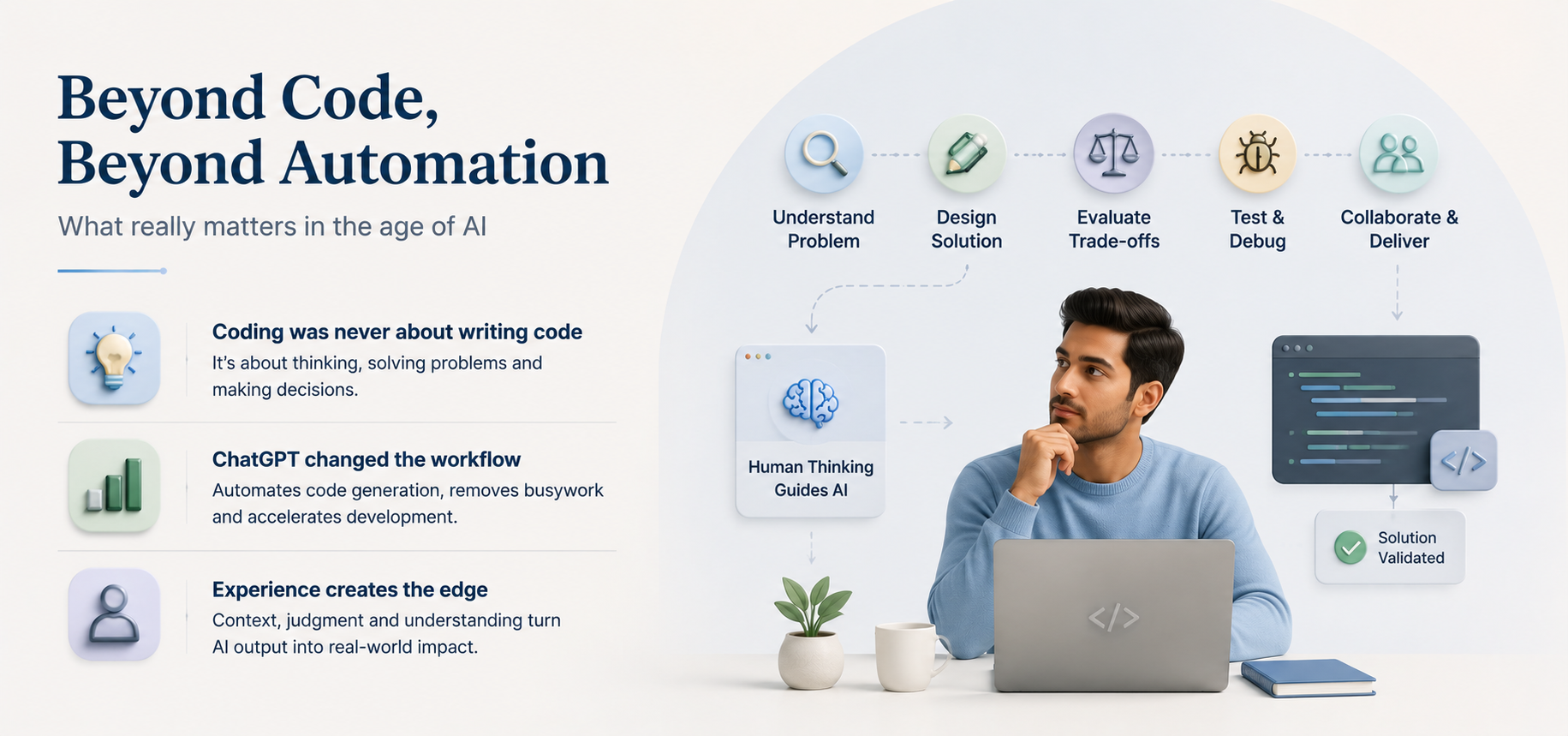
One of the biggest misconceptions about programming is that developers spend their entire day producing code. In reality, coding is one part of a much larger process. Professional developers spend a lot of time understanding problems, designing solutions, evaluating trade-offs, testing assumptions, fixing bugs and collaborating with teams. The code itself is often the output of a series of decisions.
This distinction matters because ChatGPT primarily automates code generation, not problem-solving. It can suggest solutions, generate templates and accelerate implementation. It still relies on human direction. Someone must define the problem, evaluate the output and determine whether the solution is appropriate.
Programming has always been about thinking rather than typing.
Once this becomes clear, the conversation shifts from whether AI can write code to whether AI can replace the thinking that makes software useful.
What ChatGPT Actually Changed In A Developer’s Workflow
Eliminating programmers has never been the intent of developing AI tools like GPT. Rather, AI has changed the way they work. Tasks that consumed hours can now be completed in minutes. Developers use AI to generate code, explain unfamiliar concepts, create documentation and identify potential errors.
According to GitHub's developer surveys and studies around AI-assisted coding tools, many developers report productivity improvements when using AI during development. The benefit is not necessarily that AI creates software independently. Instead, it removes tasks and allows developers to focus on higher-value work.
This shift resembles technological transformations throughout history. Calculators did not eliminate mathematicians. Spreadsheets did not eliminate accountants. Design software did not eliminate engineers. Instead, these tools changed where professionals spent their time and effort.
Coding is experiencing a transformation. As routine implementation becomes faster, the importance of judgment, architecture and decision-making continues to increase.
Why Experienced Developers Are Benefiting More Than Beginners
An interesting pattern has emerged since AI coding tools became widely available. Many experienced developers are seeing productivity gains over complete beginners. At first, this seems counterintuitive. One might assume that AI would level the playing field completely. However, experienced developers possess something AI cannot provide on its own: context.
When ChatGPT generates code, a senior developer can quickly identify performance concerns, security vulnerabilities, scalability limitations and architectural weaknesses. They understand where the code fits within a system and can evaluate whether the solution aligns with business requirements.
Beginners often face a challenge. They may receive functioning code. Struggle to understand why it works, how to modify it or how to fix it when something breaks.
AI rewards understanding more than it rewards dependency.
This explains why coding knowledge continues to matter. The value is no longer limited to writing code. The value lies in understanding what the code is doing. Whether it should exist in the first place.
The Growing Gap Between Generating Code And Creating Software
The ability to generate code and the ability to create software are increasingly becoming two things.
Software development involves more than producing functional output. Modern applications must be secure, reliable, scalable, maintainable and capable of supporting users over long periods of time. These considerations require thinking and technical judgment.
For example, an AI can generate a login system. Determining how user authentication should integrate with security policies requires human expertise. An AI can create database queries. Designing a database that supports future growth requires planning and experience.
As organisations continue adopting AI-assisted development, this distinction becomes more important. Businesses are not simply purchasing code. They are investing in solutions that solve problems, support operations, and create value.
The ability to generate code may become increasingly common. The ability to create meaningful software remains highly valuable.
The Skills That Are Becoming More Valuable in the AI Era
As AI changes the mechanics of programming, it is also changing which skills deserve the most attention. Developers no longer gain a significant advantage simply by memorising syntax because AI can generate much of it on demand. What remains difficult to automate is the ability to think through problems, make decisions, and understand how software systems work. As a result, several skills are becoming even more valuable in the age of AI.
1. Problem-Solving
At its core, programming is about solving problems. AI can suggest solutions, but it still depends on humans to define the problem correctly. Developers who can break complex challenges into manageable parts and identify practical solutions will remain in demand, regardless of how advanced AI becomes.
2. Debugging and Error Analysis
Generating code is easy. Fixing code is often much harder. AI-generated code can contain bugs, unexpected behaviours, or implementation issues that only become visible during testing. Developers who can identify the root cause of problems and systematically troubleshoot them bring value that AI alone cannot guarantee.
3. Software Architecture and System Design
Building a feature and building a scalable product are two very different things. Software architecture involves deciding how different components interact, how applications scale, and how systems remain reliable over time. These decisions require experience, planning, and business understanding that extend far beyond code generation.
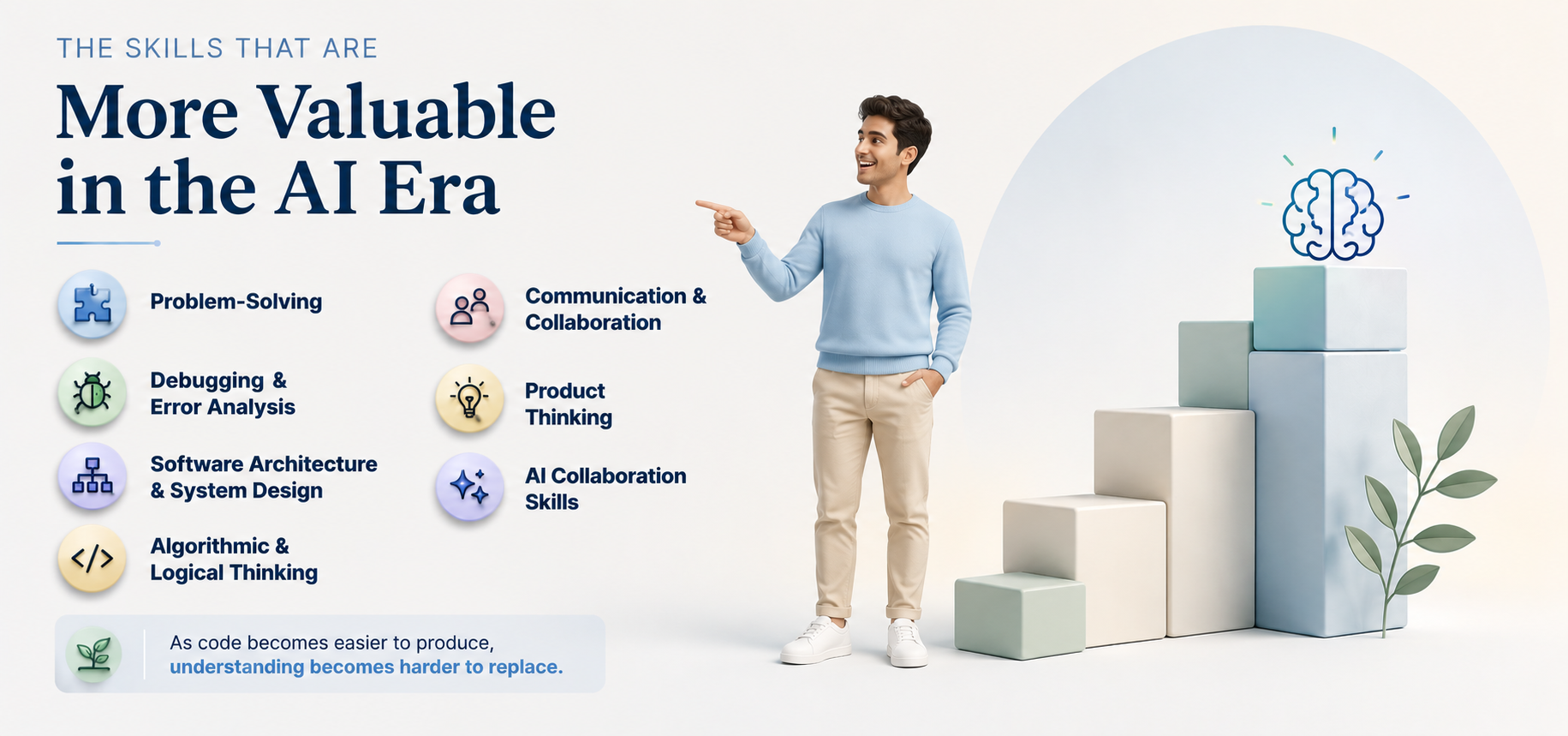
4. Algorithmic and Logical Thinking
AI can write algorithms, but developers still need to determine which approach is most suitable for a particular situation. Understanding efficiency, data structures, and computational logic helps developers evaluate AI-generated solutions instead of accepting them blindly.
5. Communication and Collaboration
Modern software development is rarely a solo activity. Developers work with designers, product managers, business teams, and stakeholders. The ability to explain technical concepts, gather requirements, and align solutions with business objectives remains a critical skill that technology cannot easily replace.
6. Product Thinking
The best developers do more than build features. They understand why those features matter. Product thinking helps developers connect technical decisions to user needs, business goals, and customer experiences. As AI handles more implementation work, this broader perspective becomes increasingly valuable.
7. AI Collaboration Skills
A new skill category is also emerging: the ability to work effectively with AI tools. Developers who know how to write clear prompts, evaluate AI-generated outputs, and integrate AI into their workflow can achieve significantly higher productivity than those who treat AI as either a threat or a complete replacement.
As code becomes easier to produce, understanding becomes harder to replace.
Rather than viewing this shift as a threat, developers can see it as an opportunity. The focus is moving away from memorising syntax and towards mastering the greater skills that have always powered great software. Those who strengthen these foundations are likely to remain relevant and valuable, no matter how advanced AI becomes.
Who Benefits Most From Learning Coding in the AI Era?
The biggest winners in the age of AI are unlikely to be those who ignore technology or those who depend on it completely. Instead, the advantage will belong to people who understand enough about technology to work effectively alongside AI.
Whether someone is an aspiring developer, a business professional, a healthcare student, or a legal expert, foundational coding knowledge offers benefits that extend far beyond writing software.
Some of the most valuable advantages include:
- A better approach to addressing the problems is through structured and logical thinking.
- Improved decision-making when evaluating AI-generated outputs instead of accepting them at face value.
- Greater independence in using, modifying, and adapting AI-powered tools.
- Stronger digital literacy in a world where software increasingly influences every profession.
- Enhanced career adaptability as AI becomes embedded across industries.
For developers, coding knowledge helps them direct AI effectively and build better software. For non-technical students, it helps them understand the systems that are increasingly shaping their professions.
The future does not belong to people who compete with AI. It belongs to people who know how to collaborate with it while bringing their own judgment, expertise, and critical thinking to the table.
How to Learn Coding Smartly After ChatGPT
In an era where AI can generate functional code within seconds, the question is no longer whether to learn coding but how to learn it in a way that builds genuine capability rather than dependency.
First, prioritize Fundamentals over Syntax. Learn the "why" before you learn the "how." Understand variables, loops, and logic before you touch an AI prompt. You need the mental model of how a computer "thinks" before you can collaborate with one.
Second, embrace Human-AI Collaboration. Don't fight the tool, but don't let it think for you. Practice using AI to explain complex concepts or to help you debug a specific error, but force yourself to explain back why the fix worked.
Third, use Personalized Learning Paths. Use AI-powered platforms to tailor the curriculum to your goals, whether that’s healthcare tech or fintech, but maintain your autonomy. If the AI gives you an answer, treat it as a hypothesis to be tested, not a divine truth.
Common Mistakes Learners Make Because of AI
AI tools enhance the learning experience, but they also enable a set of common mistakes that can compromise long-term competence.
The Blind Dependence Trap
- Starting with AI instead of thinking independently becomes a habit quickly
- Code gets written, but understanding never catches up
- Avoiding the discomfort of a blank screen blocks real learning
- The result is surface-level skill with weak fundamentals
The Brittle Code Trap
- AI-generated code works until real-world complexity breaks it
- Edge cases are often missed in unreviewed output
- Hidden security flaws can go unnoticed
- Code that fails under real users is not truly complete
The Identity Trap
- Relying on AI creates gaps during interviews and real-world problem-solving
- Credentials without understanding do not last in professional settings
The core truth is simple: AI is a powerful assistant, not a replacement for a thinking engineer.
Conclusion
Coding is not disappearing; it is evolving
The question of whether coding is worth learning after ChatGPT emerges from a misunderstanding of what coding has always been. Programming was never simply about writing syntax. It was about solving problems, building systems and creating technology that delivers value.
ChatGPT has undoubtedly transformed software development. It has made code generation faster, more accessible, and more efficient. However, it has not removed the need for understanding, judgment or creativity.
If anything, the rise of AI has highlighted the importance of these qualities. As technology automates tasks, the skills that remain uniquely human become even more valuable.
Learning to code today is still worth the investment. The difference is that success no longer depends on how much syntax you can memorise. It depends on how you can think, analyze, design and solve problems.
The future of programming is not about competing with AI. It is about learning how to build alongside it. Those who embrace that reality may discover that coding is not becoming less valuable in the age of AI. It is becoming more powerful than before.
References: Insights in this article are based on “This Chart Shows Just How Bad Things Have Gotten for Software Engineers” (Business Insider) and “Is Software Eating the World? — An Introduction” (Cutter Consortium).