


When you first heard "MBA after BCA," did it feel like a choice you made? Or did it slowly take shape the way many important decisions do - through a passing comment at a family dinner, a suggestion from a senior who seemed to have everything figured out, or simply by following the familiar path that everyone around you appeared to be taking?
"Beta, MBA kar le. Scope bahut hai."
"Tech plus management? You'll be unstoppable."
"My cousin did it. He's in Bangalore now. Great package."
And somewhere between the third person who said it and the fourteenth LinkedIn post you scrolled past at midnight, it quietly began to feel like your idea. That's just how it works sometimes. Good advice, heard often enough, starts to feel like personal clarity.
But here's what makes a BCA graduate genuinely different from everyone else walking into an MBA program: you're not starting from zero. You already think in systems. You already understand how the digital world is wired. An MBA doesn't replace that; it amplifies it. It hands you a new vocabulary of markets, people, strategy, and leadership and suddenly the technical world you already know starts making a different, more expansive kind of sense.
So yes, maybe someone planted this idea. But that doesn't make it wrong for you.
This blog will simply help you figure out if it's right.
First, Let's Talk About What Nobody Else Will
Every other article about "MBA after BCA" is going to give you the same thing: a list of eligible colleges, CAT exam dates, average salary packages, and job roles with titles that sound impressive but tell you nothing real.
What they won't tell you is this:
An MBA doesn't automatically make you valuable. This combination does.
There's a subtle but important difference. Thousands of people get MBAs every year. The ones who genuinely stand apart after a BCA aren't the ones who simply added a management degree; they're the ones who understood why their technical background was secretly their greatest weapon walking into a business classroom.
Think about it. When your MBA professor puts a supply chain disruption case study on the board, your classmates from commerce or arts are thinking in flow charts and cost equations. You're thinking in systems dependencies, failure points, and data flows. That's not a small advantage. That's a completely different lens, and businesses in 2026 are hungry for people who can wear both pairs of glasses at once.
The World You're Walking Into in 2026
Here's something worth understanding before you make any decision: the job market you're graduating into is fundamentally different from the one your seniors described to you.
In 2026, artificial intelligence has quietly eaten through entire layers of entry-level technical work. Routine coding tasks, basic data processing, and standard IT support are increasingly automated or outsourced. The "just learn to code, and you'll be fine" advice that worked five years ago has a shorter shelf life today.

What hasn't been automated and what AI, ironically, has made more valuable is the ability to make decisions. To manage people who are managing machines. To sit across from a client who doesn't understand their own problem yet and translate confusion into a roadmap.
That's a management skill. And it's one that a BCA graduate with an MBA is uniquely positioned to develop, because you understand both sides of the table.
Companies now prioritise what experts call "T-shaped" professionals, people who possess great technical skills alongside broad management perspectives. A BCA graduate pursuing an MBA isn't just collecting degrees; they're quite literally building the shape of a professional that 2026's market is actively looking for.
What Actually Changes After an MBA, Honestly
Let's not romanticise this. An MBA changes specific things, and it's worth knowing exactly what those things are before you commit two years and a significant amount of money.
What changes:
Your language changes first. You stop describing problems in technical terms and start framing them in business outcomes, cost, revenue, risk, and growth. This sounds small. It isn't. It's the difference between being heard in a boardroom and being sent back to your desk.
Your network changes. This one is underrated almost everywhere. The people you sit next to in an MBA classroom, your batchmates, your professors, and the guest speakers who come through, become the professional web that carries your career forward for decades. A BCA alone, no matter how brilliant, rarely builds this web.
Your ceiling changes. Employers are willing to pay 20 to 30 per cent higher salaries to candidates who combine technology knowledge with business strategy skills. More importantly, the kinds of roles that open up shift entirely - from executor to decision-maker, from team member to team leader.
What doesn't change:
Your imposter syndrome, at least for a while. Walking into a room full of commerce graduates and finance professionals as a tech person can feel disorienting. You'll spend the first semester wondering if you belong. You do. But nobody warns you about that feeling, and it's worth knowing it's coming.
The Specialisation Question: This Is Where Most BCA Graduates Get It Wrong
Most articles will hand you a generic list of MBA specialisations: Marketing, Finance, HR, Operations, and leave you to figure it out yourself. Let's be more specific, because your BCA background makes certain specialisations not just suitable, but exceptional choices.
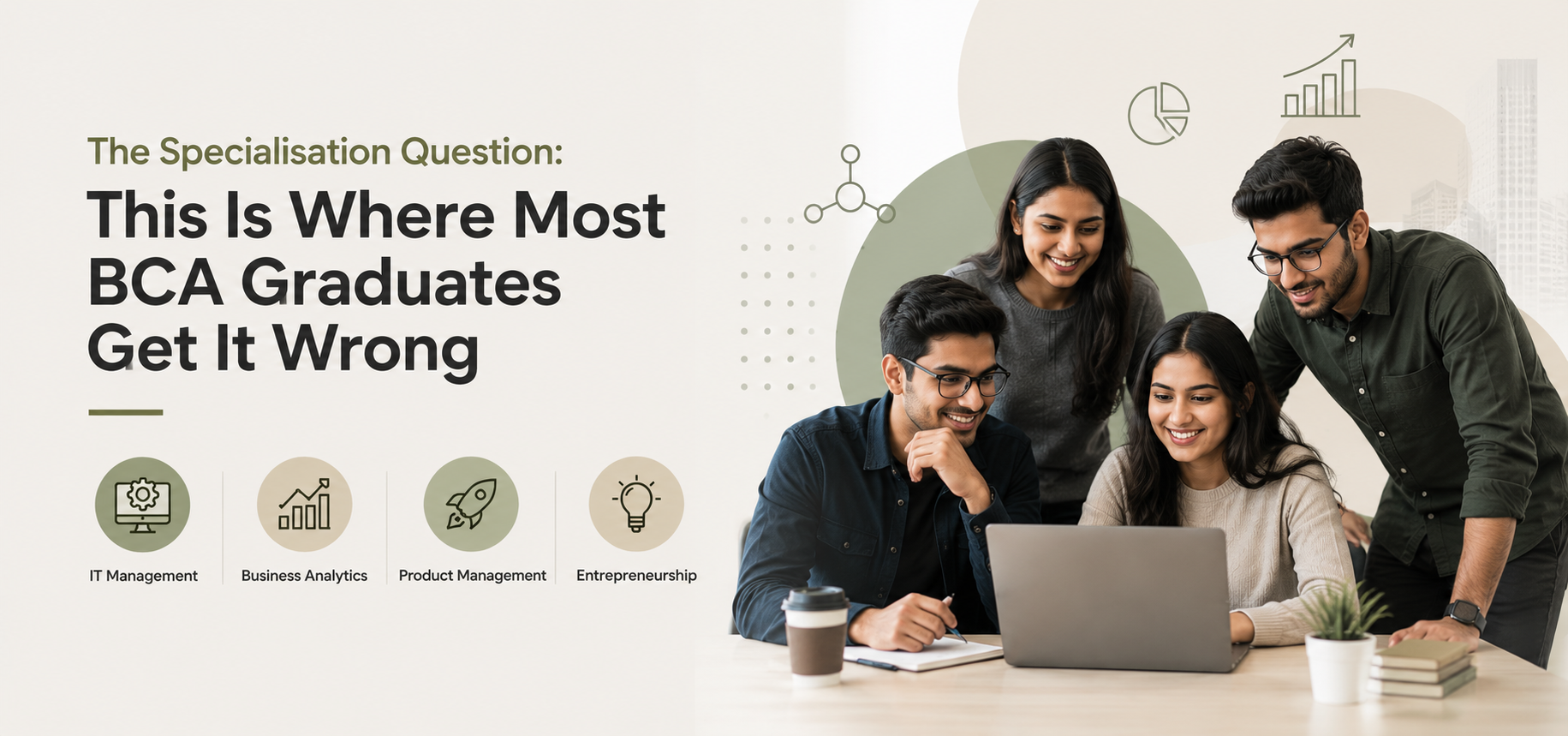
MBA in IT Management or Systems Management is the obvious one, and it's obvious for a reason: it works. Your technical foundation, combined with managerial training, makes you one of the most complete profiles in this space.
MBA in Business Analytics is arguably the most exciting choice for 2026. Data is the new infrastructure of every industry, and someone who understands both the pipeline that generates the data and the boardroom decisions that should follow from it is genuinely rare.
MBA in Product Management is the hidden gem that most BCA graduates don't consider. Product managers are the people who live between the engineering team and the business - translating user needs into technical requirements and technical realities into business strategy. A BCA graduate is built for this role. An MBA makes them credible for it.
MBA in Entrepreneurship deserves a mention too - if you've ever had an idea you couldn't stop thinking about, this path gives you the frameworks, the networks, and occasionally the funding connections to actually build something.
Should You Pursue an MBA Right After BCA or Work First?
This is the question that genuinely depends on who you are, and anyone giving you a universal answer is guessing.
Here's a more honest framework:
Get into an MBA right after BCA if you have a clear specialisation in mind, you're targeting top-tier institutes where a fresher profile is actually competitive, and you have the financial support to do it without the burden reshaping your decisions afterwards.
Gain Work Experience for 1-2 years first if you're not sure what kind of manager or leader you want to become yet. Experience gives you stories of real problems you solved, real decisions you made, and MBA classrooms and interviewers reward those stories enormously. You'll also understand which parts of business actually interest you once you've been inside one.
The gap year or two isn't a delay. For many, it's the difference between an MBA that transforms them and one that they simply pass through.
The Part About Money Real Numbers, Not Just Ranges
Let's be straightforward about this because vague promises help no one.
Freshers with an MBA after BCA typically earn between ₹6 to ₹8 lakhs annually in India, and candidates with project management skills and IT domain expertise can reach ₹10 to ₹12 lakhs within three to four years of experience.
Compare that to a BCA graduate entering directly into the workforce - entry-level pay for fresh BCA graduates often sits around ₹2-4 LPA, though role, skills, and location can double or triple that within a few years.
The financial gap widens meaningfully in the mid-career stage, which is where the MBA's real return on investment shows up. It's not just the starting salary - it's the trajectory. A Business Analyst or IT Manager with an MBA background at year five of their career is in a fundamentally different conversation than a developer who plateaued at a technical role.
That said, be honest about the cost too. A good MBA from a reputed institute costs money, time, and opportunity. Calculate your ROI with your specific numbers, not someone else's LinkedIn success story.
When is an MBA After BCA NOT the Right Move
This is the section most blogs tend to skip - not because it isn't important, but because it doesn't neatly support the narrative they're trying to build. As a result, students are often left without the full context they need to make an informed decision.
This blog takes a different approach. Instead of focusing only on the advantages, we'll explore the complete picture - benefits, limitations, trade-offs, and considerations - so you can evaluate whether an MBA after BCA is genuinely the right choice for your goals, interests, and career aspirations.
An MBA after BCA is probably not the right move if:
- You're doing it purely to escape the pressure of job hunting right now. An MBA isn't simply a way to postpone difficult career decisions; it's a significant investment of time, effort, and money. And like any investment, its value depends largely on the clarity and conviction behind the decision.
- You haven't figured out what kind of work actually excites you. Two years and significant money spent deepening skills in a direction you're not sure about is a risk that compounds over time.
- You're a deeply technical person who genuinely loves building things and has no interest in managing people or navigating business strategy. In that case, an MCA or specialised certifications in AI, cloud computing, or cybersecurity might serve you far better and faster.
- There's no shame in any of these realisations. The shame would be in ignoring them.
So, is an MBA after BCA Really the Right Move for YOU?
Here's the honest answer: an MBA after BCA is one of the most powerful academic combinations available to an Indian graduate in 2026 if it aligns with what you actually want to do with your working life.
It's not a magic door that opens automatically. It's a tool - a sophisticated, expensive, time-intensive tool that works brilliantly in the right hands for the right purpose.
Ask yourself three questions before you decide:
- One, do I want to eventually lead people, influence strategy, or build something of my own? If yes, the MBA accelerates every one of those paths.
- Two, am I choosing a specialisation that genuinely excites me, or just the one that sounds most impressive at family gatherings?
- Three, am I doing this because I've thought it through, or because everyone around me seems to be doing it?
If your answers to those questions are clear and honest, the decision, one way or another, will be too.
Because at the end of the day, the most powerful career move isn't the most popular one. It's the one you make with your eyes open.
Still figuring it out? That's not indecision - that's due diligence. Keep asking the right questions.
Note: All statistical data, salary benchmarks, and market trends cited within this publication have been formally cross-referenced with validated industry disclosures from PWMedharthi, MCSGOC, and ISMT. The insights presented accurately reflect current market indices as of 2026. This content is intended strictly for exploratory professional guidance, and the baseline figures serve as highly accurate macroeconomic indicators of contemporary return on investment (ROI) within the IT and management sectors.