

Table of Content
- The 2026 Curriculum: Beyond the Table Stakes
- The Hiring Market: Why 90% of Recruiters are Still Calling
- What happens to the 10% of businesses that aren't hiring these graduates?
- Salary Economics: Decoding the ₹8L to ₹31L Spread
- The Growth Hubs: Where the Jobs Actually Are
- The Strategic Fit: Is This Degree for You?
- Conclusion: The Balanced Verdict
For decades, the life of an operations manager was defined by a spreadsheet and a gut feeling. Inventory levels were maintained based on historical averages and human intuition. Simply put, a "spreadsheet and a guess" approach to supply chain health. You’ve seen this play out a thousand times: a founder or a senior manager in a WhatsApp group at 11 PM, personally approving a stock transfer between warehouses because the "system" failed to predict a spike in demand. This is the hallmark of a scaling business that has outgrown its manual processes but hasn't yet professionalised its logic.
That era is long gone. Today, forecasting models have largely replaced human guesswork, and they are usually closer to the truth than the most experienced manager. These predictive systems process variables, weather patterns, local traffic disruptions, and geopolitical shifts that a human brain simply cannot synthesize in real-time. This shift is not just a technological upgrade; it is a fundamental change in the nature of management.
The industry is experiencing a quiet but total transformation. While many academic discussions still focus on manual calculation and traditional management theories, the reality on the ground is that the primary driver of modern operations is the ability to manage the machine, not to be the machine.
If you are considering an MBA in Operations Management in 2026, you must understand that the degree is no longer about learning how to perform calculations. It is about developing the domain judgment required to decide what to do with the output the AI provides. The chaos of stockouts on bestsellers and overstock on dead SKUs is rarely a "warehouse problem", it is a forecasting problem in the disguise of a warehouse costume.
The 2026 Curriculum: Beyond the Table Stakes
When evaluating this degree, it is critical to distinguish between foundational management requirements and the specialised technical expertise that truly drives higher market value. Most high-tier programs are structured as two-year postgraduate journeys, but the significant value is typically delivered in the late stages of the curriculum.
The Standard Core (Year One). The first year is about "table stakes", the general management core that every business leader requires to function in a boardroom.
- Finance: Understanding capital allocation and the impact of inventory carrying costs on the balance sheet.
- Marketing: Aligning production capabilities with volatile market demand cycles.
- Human Resources: Managing the specialised labour force required for modern logistics.
- Decision Sciences: The mathematical and statistical foundations that underpin business logic.
The Operations Track (Year Two). This is where the specialization takes shape, narrowing into the mechanics of the "Modern Supply Chain."
- Production Planning: The logistics of manufacturing and the shift toward just-in-time (JIT) 2.0.
- Supply Chain Design: Building the architecture of how goods move from a global origin to a hyperlocal consumer.
- Quality Systems: Implementing frameworks like Six Sigma and Lean to eliminate waste in high-burn environments.
- Procurement: Navigating vendor relationships and the complexities of global sourcing.
The bridge between these two years is where most students fail. They treat the core as a hurdle to be cleared rather than the language they will need to justify their operational budgets to a CFO later in their careers.
The Hiring Market: Why 90% of Recruiters are Still Calling
The demand for MBA graduates remains remarkably high, but the motivations for hiring have undergone a radical shift. According to the 2026 Graduate Management Admission Council (GMAC) survey, conducted in partnership with EFMD, approximately 90% of corporate recruiters plan to hire MBA graduates over those with only bachelor's degrees or external hires.
However, there is a paradox in the data. While hiring intent is high, the criteria for selection have narrowed. Recruiting patterns indicate that domain knowledge in operations, once the primary requirement, is now treated as "necessary but not sufficient."
Key Shift: AI tool proficiency is now ranked by recruiters as almost equal to strategic thinking. In functions like operations, where decisions regarding routing, inventory, and forecasting are increasingly automated, employers are looking for "systems architects" rather than "task managers."
What happens to the 10% of businesses that aren't hiring these graduates?
They are often the legacy firms stuck in the "spreadsheet and a guess" phase, struggling with high churn and inefficient overhead. Conversely, the 90% who are hiring are looking for managers who can oversee the AI systems that do the heavy lifting. The hiring market in 2026 does not want a manager who can manually calculate a reorder point; it wants a manager who can audit the algorithm that calculated it and identify why it might be hallucinating during a supply chain disruption.
Salary Economics: Decoding the ₹8L to ₹31L Spread
The financial return on an MBA in Operations Management varies significantly based on your specific "tool-stack" rather than just the prestige of the degree. Data from March 2026 illustrates a massive gap between entry-level outcomes and high-value professional compensation.
Salary Reality vs. Skill Stack
|
Professional Category |
Annual Salary Range (LPA) |
Primary Drivers |
|
Entry-Level / Standard Degree |
₹4L – ₹7L |
Basic academic credentials; limited exposure to industry-standard software. |
|
Average Professional |
Up to ₹17.97L |
Domain knowledge paired with 3-5 years of industry experience and basic ERP literacy. |
|
High-Value Professional |
Up to ₹31.27L |
MBA combined with advanced tool mastery, AI fluency, and niche certifications. |
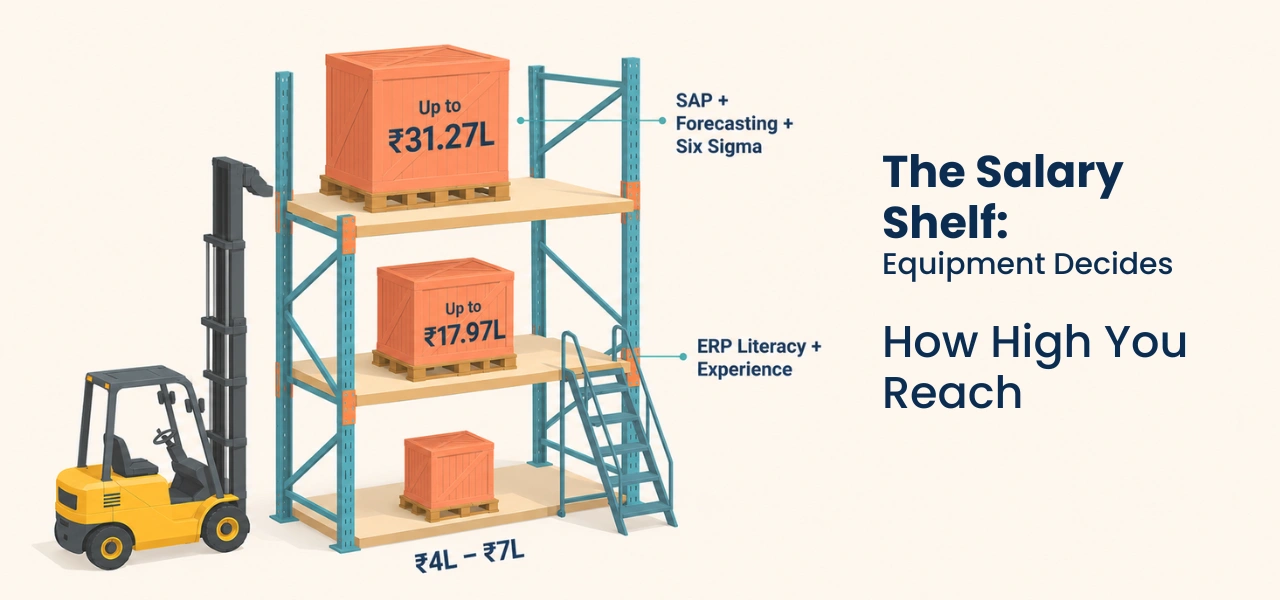
It is a common misconception that the average salary of ₹17.97 LPA is a guaranteed outcome of the degree. The data shows that the professionals sitting at the top of the ₹31L bracket are distinguished by "Salary Accelerators."
- SAP S/4HANA Mastery: This isn't just about data entry; it’s about understanding the centralised logic of a global enterprise. Professionals who can navigate modern ERP systems are essentially the "pilots" of the corporate machine.
- Demand-Forecasting Tools: Fluency in predictive analytics software allows a manager to move from being reactive to being proactive. This skill alone can be the difference between a ₹10L and a ₹20L offer.
- Six Sigma and Lean Certification: In the high-burn world of Indian e-commerce, where margins are thin, the ability to shave 2% off operational waste is worth millions. This is why these certifications provide a 3x multiplier on salary potential.
The degree opens the door, but your technical proficiency determines how far you can walk through it.
The Growth Hubs: Where the Jobs Actually Are
The demand for operations professionals is being driven by specific, high-growth sectors that have fundamentally rewritten the rules of logistics. While legacy operations, focused on traditional factory-floor management, are still present, they are growing much slower than digitally native supply chains.
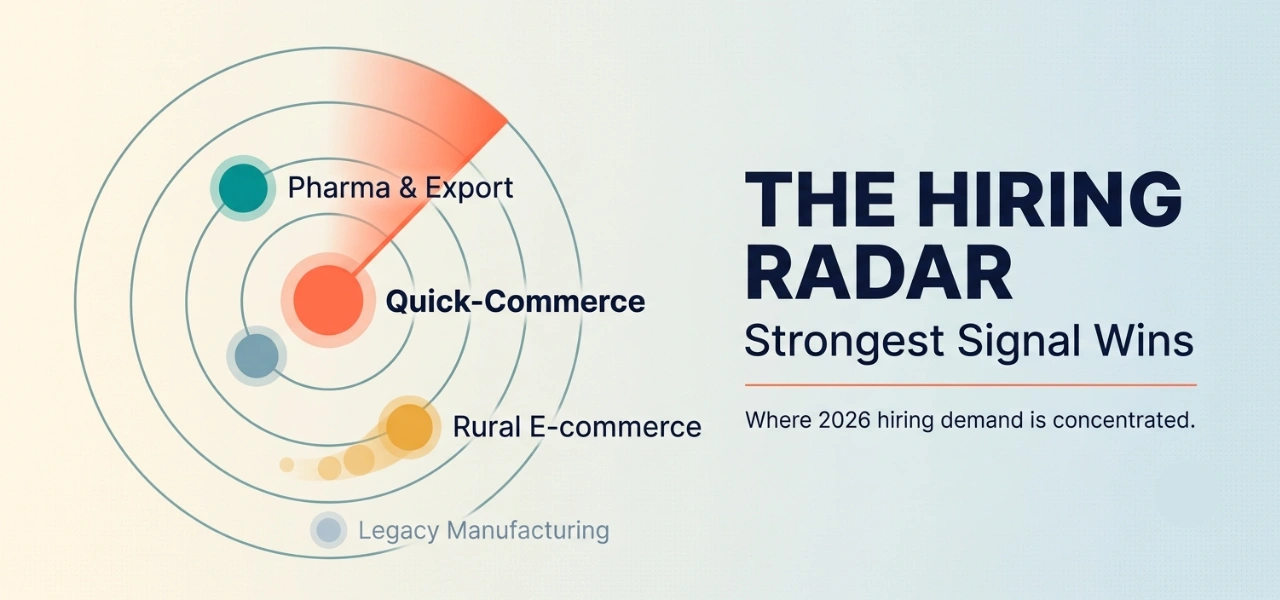
Modern Operations Hubs:
- Quick-Commerce: Entities like Zepto, Blinkit, and Swiggy Instamart have created a "logistics nightmare" that only high-level strategic thinkers can solve. Delivering a grocery order in 10 minutes isn't a delivery problem; it’s a hyperlocal dark-store optimisation problem. These roles require intense data management and real-time oversight that traditional factory training doesn't cover.
- Pharma and Export: As India solidifies its position as a global manufacturing hub, the need for professionals who understand cold-chain logistics and global procurement is skyrocketing. These are high-stakes roles where a single temperature deviation can result in millions of dollars in losses.
- E-commerce Expansion: Beyond the Tier-1 cities, the expansion of online retail into rural India requires a total redesign of last-mile delivery systems.
If a curriculum is still solely focused on 20th-century manufacturing theories, it is missing the sector where the hiring volume is actually rising. You are looking for a program that treats "Quick-Commerce" not as a trend, but as a discipline.
The Strategic Fit: Is This Degree for You?
The MBA in Operations Management is a specific tool for specific career paths. It is not a one-size-fits-all solution, and being "brutally honest" about your starting point is essential for ROI.
- The Engineer or BBA Graduate: You likely have the technical foundation but are finding yourself "boxed in." You can build a perfect production line, but you can't explain to a CFO why the inventory holding cost is killing the company's margin. This degree provides the "language of the boardroom," allowing you to transition from a technical expert to a strategic leader.
- The Promotion Seeker: You are already in the trenches of logistics or production. You know the "how," but your upward mobility is capped because you lack the "why" (and the formal credentials required for VP-level roles). For you, the MBA is a defensive move as much as an offensive one, it prevents you from being bypassed by younger, more "digitally-literate" hires.
- The Career Switcher: You are targeting the high-growth sectors mentioned above but lack domain authority. You need the degree to provide a structured transition. However, you are at the highest risk if you don't pursue tool fluency. A career switcher with a degree but no SAP or Power BI skills is often viewed as a "theoretical" hire, which the 2026 market rarely tolerates.
If you expect a ₹17 LPA salary based on the certificate alone without mastering the analytics layer, you will be disappointed. The market pays for the ability to bridge the gap between "data" and "decisions."
Conclusion: The Balanced Verdict
The value proposition of an MBA in Operations Management in 2026 is robust, provided you view the degree as a "door opener" rather than a "finished product." The GMAC data proves that recruiters still want the MBA credential, but the "accelerator" for your career is the continuous pursuit of technical skills.
The degree provides the management framework, but your willingness to close the "syllabus-to-market" gap determines your salary. If you choose a program that prioritizes tool-heavy learning and focus your career on the data-heavy sectors of the economy, the investment remains one of the most stable and rewarding paths in modern business. The era of the spreadsheet is dead; the era of the operations strategist has just begun.
References:
This article is based on insights, industry reports, and publicly available research from leading organizations and publications, including EFMD Global, GMAC (via Yahoo Finance), EICTA Consortium (IIT Kanpur), Supply Chain India Jobs, and upGrad. These sources were used to inform the market trends, hiring insights, salary data, and industry perspectives discussed in this article. All analyses, interpretations, and conclusions presented here have been independently written for this blog.