

Table of Content
Imagine you are standing in a grocery aisle, staring at two different brands of coffee. You are weighing the price of a premium roast against a store-brand option, checking your weekly budget, and perhaps considering a "buy one, get one free" coupon. This small, everyday decision is a perfect example of economics in action at the personal level. It is about how you, an individual, allocate your limited resources to satisfy your needs.
Now, imagine the news playing on the store’s overhead speakers. The news anchor mentions that the nationwide cost of living has jumped by 7% this year, or that the central bank has just raised interest rates to cool down an overheating economy. While your coffee choice was a private matter, these news items involve massive forces that affect every person in the country simultaneously.
These two scenarios represent the two primary branches of economic study: microeconomics and macroeconomics. While beginners often use these terms interchangeably, distinguishing between them is the essential first step toward true financial literacy. To understand why this matters to your wallet, we have to look at how the "small" decisions and the "big" trends work in tandem.
In this guide, we will break down the fundamental definitions, explore the Scope of Microeconomics and macroeconomics, analyse real-world career paths, and explain the fascinating synergy that keeps the global economy moving.
The Foundation: What Is Economics?
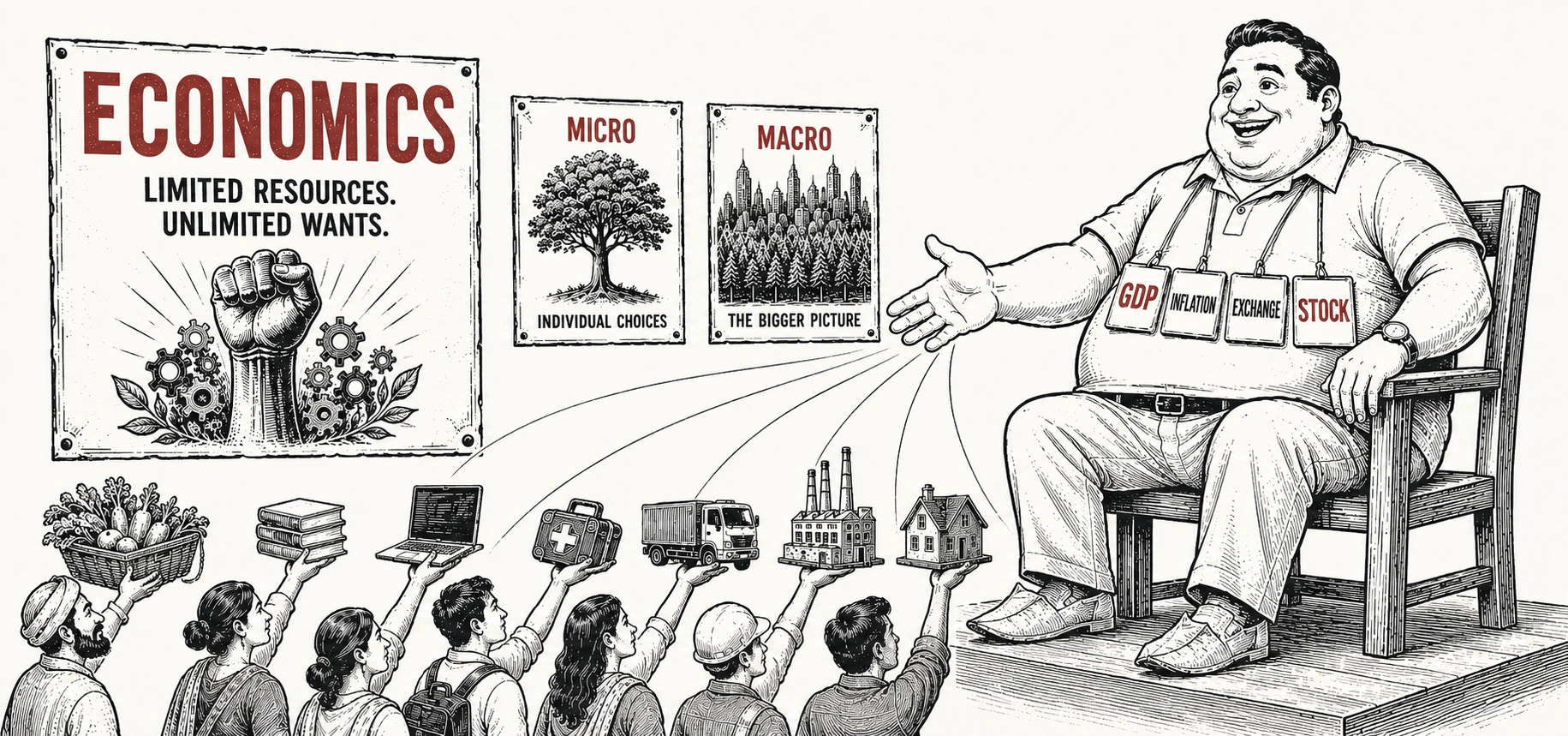
Before separating “micro” from “macro,” understand what they have in common. Economics, at its root, is the study of scarcity: how individuals, businesses, and governments divide limited resources like time, money, and raw materials against wants that never run out.
Because nobody can have everything, every economic decision is a trade-off in some form. Economists split this enormous subject into two lenses to keep it workable:
- Microeconomics: This lens looks at the "trees." It focuses on the behavior of individual units, such as a single household or a specific company.
- Macroeconomics: This lens looks at the "forest." It steps back to view the entire nation or the global landscape, focusing on total output, stability, and growth.
What Is Microeconomics?
Microeconomics is the branch of economics that adopts a "Bottom-Up Approach." It starts with the smallest building blocks of an economy, individuals and firms, and analyses how their specific choices impact the allocation of resources and the pricing of goods.
Microeconomics is the study of individual economic units, such as households, firms, and industries. It uses a bottom-up approach to analyse how these entities make decisions regarding resource allocation, price changes, and market interactions to achieve efficiency in specific segments of the nation's economy.
When we talk about the Scope of Microeconomics, we are looking at the specific variables that influence individual market segments. To understand the "why" behind your local store's prices, we must explore these key elements:
- Demand and Supply: The core mechanism of this field. It determines how the interaction between consumer desire and producer availability leads to Price Determination for a specific product. When a new phone launches and demand outpaces the units on shelves, the price climbs until buyers and sellers settle on a number both sides will accept.
- Consumer Behaviour: This area analyses how you make choices based on budget constraints. Because your income is finite, you must choose products that provide the most "utility" or satisfaction. This explains why a price hike in one area might lead you to switch to a cheaper substitute.
- Production and Costs: It mainly focuses on the "firm" side. It studies how businesses manufacture goods efficiently by managing the factors of production: labour, capital, land, etc. A bakery weighing the price of flour against the wages of its bakers is managing production costs, and that balance decides its margin, not its popularity.
- Market Structures: Microeconomics examines the environment where trade happens. In "perfect competition," many sellers keep prices low. In a "monopoly," a single seller has the power to restrict output and raise prices, directly impacting the consumer’s pocketbook.
- Labour Economics: This looks at specific labour markets, evaluating how the demand for certain skills dictates the wage of an employee and, ultimately, the final price of a product.
Real-Life Example: Consider a local boutique owner. If the cost of silk rises, the owner must decide whether to raise the price of dresses or accept lower profits. This decision is based on local demand and the boutique’s internal costs. This is microeconomics in action.
What Is Macroeconomics?
While microeconomics starts with the individual, macroeconomics takes a "Top-Down Approach." It ignores the individual boutique and instead looks at the total production of all businesses across an entire country. It is the study of national and global phenomena.
Macroeconomics is the branch of economics that studies the behaviour and performance of an economy as a whole. It focuses on aggregate indicators such as National Income, GDP, inflation, and unemployment to develop strategies and policies that promote national growth and long-term economic stability.
Macroeconomics deals with broad variables that impact the collective well-being of every citizen. To understand how a nation stays healthy, we look at these core elements:
- National Output (GDP): This measures the total growth of a nation by tracking the value of all goods and services produced over a specific period. It is the primary yardstick for a country's economic health.
- The Price Level Triad (Inflation, Deflation, and Reflation): Macroeconomics studies why general price levels rise (inflation) or fall (deflation). It also looks at reflation, which is a deliberate attempt to increase output and spark inflation to combat a recession. These fluctuations determine the purchasing power of your savings.
- Unemployment: This tracks the health of the national labour market. High unemployment suggests the economy is not utilising its resources efficiently, which can lead to lower National Income and increased social issues like poverty.
- Fiscal and Monetary Policy: This involves the tools used to stabilise a nation. Fiscal policy refers to government spending and taxation, while monetary policy involves central banks adjusting interest rates to control the money supply.
- International Trade: This explores how the exchange of goods across borders affects a nation’s stability and its relationship with the rest of the world.
Real-Life Example: If a nation’s central bank raises interest rates to combat inflation, it isn’t just targeting one person. This move makes borrowing more expensive for everyone, from someone buying a car to a corporation building a factory. This "top-down" policy is a classic macroeconomic strategy to slow down the entire economy.
Microeconomics Vs. Macroeconomics
To help you see the whole picture, let’s compare these two fields across their most vital parameters.
|
Parameter |
Microeconomics |
Macroeconomics |
|
Meaning |
Studies individual, household, and company behaviour in decision-making. |
Studies the behaviour and performance of the economy as a whole. |
|
Focus/Focus Area |
Individual actions and specific market segments. |
General concepts like GDP growth and unemployment rates. |
|
Scope |
Small portions of the economy (individuals or firms). |
National and global issues, including aggregate trends. |
|
Decision Makers |
Individuals, households, and businesses. |
Governments and Central Banks. |
|
Variables |
Individual variables (specific demand/supply). |
Aggregate variables (National Income, general price levels). |
|
Applications |
Used to solve internal issues like pricing and output. |
Used to solve external/environmental issues like stability. |
|
Significance |
Controls product prices and factors of production. |
Maintains consistency in price levels; addresses poverty. |
|
Limitations |
Based on unfeasible assumptions (e.g., assuming 100% employment). |
Fallacy of Composition (what works for one may not work for all). |
Why Both Branches Matter
As an economics educator, I often tell my students that you cannot have a healthy forest without healthy trees. Both branches are essential for different stakeholders:
- For Students: These concepts form the absolute backbone of advanced business degrees like an MBA or BBA. Mastering the interplay between individual markets and national trends is required for any professional in finance or management.
- For Businesses: Microeconomics helps a manager set the right price for a product to ensure it sells. Macroeconomics, however, informs the "big" moves, like whether the national economy is stable enough to justify expansion into a new country.
- For Governments: Fixing poverty needs macroeconomics, growing national income at scale. But it also needs microeconomics, a subsidy sized correctly for one category of farmer, or a regulator watching one monopoly closely enough to stop it from squeezing consumers.
Opportunities In The Field
Irrespective of the preferences, both branches of economics offer distinct and rewarding opportunities.
Microeconomics Career Paths:
- Corporate Advisor: These specialists help companies analyse the supply and demand of their products. Tech giants like Microsoft recruit corporate advisors to evaluate how specific IT services impact the market and to understand the market scope of their offerings.
- Policy Adviser: This role involves creating regulations for specific industries. A policy adviser might work on international trade rules for the automotive sector or localised employment laws to ensure fair competition.
Macroeconomics Career Paths:
- Research Assistant: These professionals conduct deep dives into the aggregate factors that impact the global economy. They help organizations understand how world events, like a change in global oil prices, will influence national markets.
- Economist: Macroeconomists assess national development and use analytical tools for risk detection. They are the "doctors" of the economy, diagnosing issues like high inflation and suggesting interest rate changes to keep the nation stable.
How They Work Together
While we study them separately, microeconomics and macroeconomics are two sides of the same coin. They exist in a constant feedback loop.
The Interconnection: According to the International Monetary Fund (IMF), individual consumption patterns (a microeconomic factor) collectively influence "aggregate demand." If millions of individuals decide to save money rather than spend it on coffee and clothes (micro), that collective behaviour causes the national GDP to drop (macro).
The Feedback Loop: Conversely, government macro policies directly change individual lives. If the government raises taxes (a macro policy) to pay down national debt, you suddenly have less money in your wallet for that premium coffee (a micro change). You cannot truly understand the "forest" without observing the "trees," and you cannot understand why a "tree" is struggling without looking at the climate of the "forest."
Conclusion
Microeconomics and macroeconomics aren't competing theories. They're two different resolutions of the same image. One zooms into a household's grocery bill or a firm's pricing sheet. The other pulls back to a nation's growth rate and its policy levers. Both are needed to make sense of a single week's headlines, let alone a career built on top of them.
None of this stays confined to a textbook. It shows up in a household budget, in a shop owner's next price change, in how a graduate reads the business section of the news five years into a career. A business or economics programme that treats both branches as tools to use, rather than chapters to memorise, is what turns this into something worth more than an exam score.