


You revised every chapter. You made the notes, watched the lectures twice, and even color-coded your flashcards. And somehow, someone who seemed less prepared walked out with a better score.
That feeling is frustrating. But it also points to something worth paying attention to.
Online exams are not just moved online versions of traditional tests. They are built differently, scored differently, and they quietly favor a very specific kind of thinker. Not the one who memorized the most, but the one who understood how the system works.
In 2026, the gap between an average score and a great one often has nothing to do with the syllabus. It has everything to do with preparation style. This guide is about closing that gap, starting right now.
12 Smart Strategies to Succeed in Online Exams in 2026
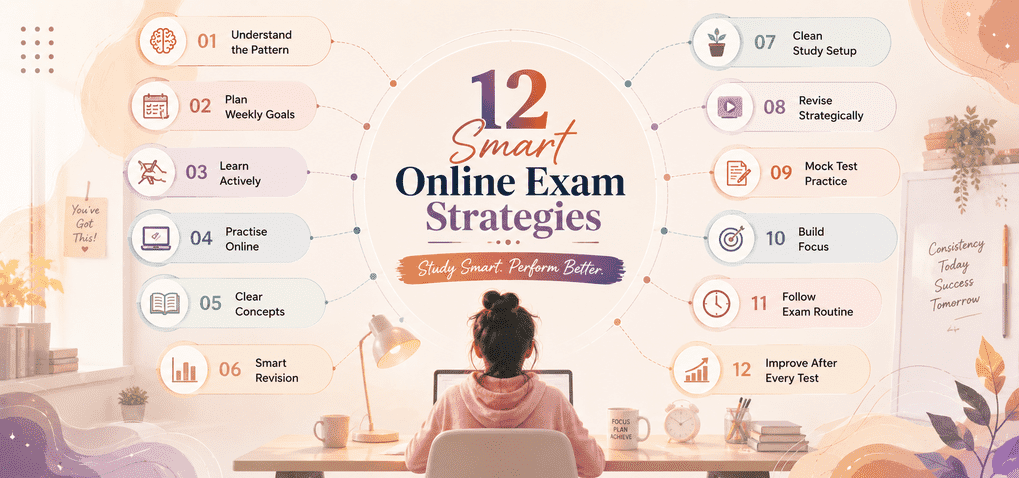
Online exams in 2026 do not just test what you know. They test how well you have prepared for the specific environment you are being assessed in. The twelve strategies ahead cover everything from how you plan your week to what you do in the ten minutes after an exam ends. Each one builds on the last. Together, they give you a complete preparation system, not just a list of tips.
1. Understand the Digital Pattern, Not Just the Syllabus
Most students walk into online exams asking the wrong question. Instead of "what chapters are important," the better question is "how does this platform actually test me?"
That shift in thinking changes everything.
In 2026, online exams commonly include:
- Application-based MCQs that test how you think, not just what you remember
- Time-tracked problem solving that rewards speed and clarity together
- Scenario and case-based questions built around real-world contexts
- AI-proctored accuracy checks that monitor consistency
- Limited-time long answers typed digitally under pressure
Once you understand the pattern, your preparation stops being scattered and starts being surgical. You no longer study. You study exactly what matters.
2. Build a Weekly Micro-Plan Instead of One Big Study Schedule
Big study plans look great on paper and fall apart by Tuesday. The problem is not your discipline. The problem is the plan itself.
Toppers think in weekly cycles, not month-long timelines. Here is a rhythm that actually works:
- Day 1 to 3: Learn and absorb new concepts
- Day 4 to 5: Revise and self-test what you covered
- Day 6: Attempt practice quizzes under timed conditions
- Day 7: Sit with your mistakes and understand them properly
This works because digital exams reward the student who shows up consistently, not the one who crammed for twelve hours the night before. Small, repeated effort beats one exhausting sprint every single time.
3. Use Active Learning Instead of Passive Notes
There is a very specific feeling that passive reading creates. It feels like progress. You finish a chapter, you feel informed, and you move on. But when the exam question arrives, the information is nowhere to be found.
That is because reading is not the same as learning.
Successful online learners use techniques that force the brain to work:
- Flashcards for rapid recall practice
- Concept maps to connect ideas visually
- The teach-back technique, where you explain a topic out loud as if you are the teacher
- Chapter-end quizzes to test yourself immediately after studying
- Summary sheets written in your own words, not copied from the textbook
These methods train your brain to retrieve information quickly under pressure, which is exactly the skill digital exams measure.
4. Practise on the Same Medium You Will Be Tested On
This is one of the most quietly damaging mistakes students make, and almost nobody talks about it.
They study on paper. They take their handwritten notes everywhere. They revise with a pen in hand. And then they sit in front of a screen on exam day and wonder why everything feels slightly off.
The transition from paper to screen affects your speed, your reading focus, and your ability to think clearly under a timer. Your brain is not used to the format, and it shows in your score.
Fix this by mirroring your exam environment during practice:
- Attempt quizzes online, not in a notebook
- Type out long answers digitally so your fingers and your thoughts learn to work together
- Solve MCQs on screen with a timer running
- Simulate the actual exam window whenever possible
Your brain is highly adaptive. Train it inside the system you want to perform in.
5. Prioritise Understanding Over Memorisation
Online exams in 2026 use intelligent question mixing, which means two students sitting the same exam often never see identical question sequences. Topics appear in new combinations. Familiar concepts show up in unfamiliar contexts.
Memorising past papers used to be a shortcut. Now it is barely a starting point.
What actually holds up under these conditions is genuine understanding. Ask yourself:
- Why does this concept work the way it does?
- Where would it apply in a real situation?
- How does it connect to the other topics in this module?
When your understanding is solid, even a question you have never seen before feels approachable. You stop guessing and start reasoning. That is the real difference between a student who memorises and one who actually knows the material.
6. Replace “Revision” With “Data-Driven Revision.”
Revising everything sounds thorough. In practice, it is exhausting, inefficient, and often a way of avoiding the topics that actually need attention.
Toppers revise differently. They let their performance data tell them what to focus on.
The loop looks like this:
- Take a short mock test
- Identify which topics cost you the most marks
- Revise only those specific areas
- Retest to confirm the gap has closed
That is it. No colour-coded revision timetables covering every chapter. No re-reading topics you already understand. This approach cuts revision time significantly and improves retention because every session has a clear, targeted purpose.
7. Create a Minimalist Digital Study Setup
Your environment is doing a lot more work than you realise. A cluttered desk, a phone buzzing every few minutes, a slow internet connection, and background noise from another room; these things are not minor inconveniences. They are consistent drains on your focus, and over a two-hour study session, they add up.
A topper's digital setup tends to be genuinely simple:
- A clean, clutter-free desk with only what you need in front of you
- A stable internet connection, especially if your course platform is involved
- A quiet space where interruptions are rare
- Your device is set to Do Not Disturb during study hours
- One notebook nearby for jotting quick summaries or formulas
- A fixed routine that simulates exam conditions regularly
The goal is to remove friction before it removes your focus.
8. Attend Live Classes and Revisit Recordings Strategically
Not every recorded lecture deserves a rewatch. Sitting through hours of video content you already understood is not revision. It is procrastination wearing a productive disguise.
Toppers apply a simple filter before revisiting any class recording:
- Is the concept new or something I am still unclear on?
- Did the instructor solve high-value or commonly tested questions?
- Did I score low on a quiz related to this topic?
If none of those are true, skip it and use the time elsewhere. If even one applies, it is worth watching again, this time with your notes open and your full attention on what you missed the first time.
9. Use the “Two-Layer Practice Method.”
Most students practice in only one way, and it is usually the wrong one for where they are in their preparation.
The two-layer method separates practice into two distinct phases:
- Layer 1 is concept practice. This is where you work to understand the idea itself. You are not timing yourself. You are not simulating an exam. You are making sure the concept is genuinely clear in your mind.
- Layer 2 is exam-style practice. This is where you take that understanding and train it under real exam conditions: timed, structured, and formatted the way the actual test will be.
Skipping Layer 1 means you are practising questions you do not fully understand yet. Skipping Layer 2 means you understand the content but never learned to perform under pressure. Both layers are necessary. Most students only do one.
10. Strengthen Mental Endurance
Knowledge alone does not get you through a two-hour online exam. Stamina does.
If your concentration begins to slip at the forty-five-minute mark, it does not matter how well you revised. The second half of the exam will cost you marks that had nothing to do with what you knew.
Build mental endurance the same way you would build physical endurance: gradually and consistently.
- Attempt at least one full-length mock exam every week
- Practice under real-time pressure, not a relaxed, open-book version of it
- Use the Pomodoro method during long study sessions to build focused work in intervals
- Try short concentration drills of five to ten minutes, where you block everything out completely
As your mind becomes less fatigued by the exam environment, your accuracy in the final sections improves noticeably. That is where a lot of marks are quietly waiting.
11. On the Exam Day: Stick to a Clear Flow
Exam day has a way of making even well-prepared students second-guess themselves. The best thing you can do is walk in with a repeatable sequence and follow it without overthinking.
- Begin with the questions that feel straightforward and build early momentum
- Mark the difficult ones and move past them without losing time
- Maintain a steady pace throughout, keeping an eye on the clock without obsessing over it
- Never dwell on a single question for too long; a difficult one is not worth losing three easy ones
- Only review your answers if time genuinely permits at the end
This sequence does one important thing: it keeps panic from setting in. When you have a clear process to follow, the brain stays calm and focused rather than spiralling on the hard question in section two.
12. After the Exam: The Most Ignored Step
Most students finish an exam, close the tab, and try to forget about it as quickly as possible. That is understandable. But it is also why they keep making the same mistakes in the next one.
High-performing students treat every exam as data.
After each test, sit with these questions for just ten to fifteen minutes:
- Which topics consumed more time than they should have?
- Which question formats felt unfamiliar or caught me off guard?
- Did I perform better or worse than my mock scores predicted?
- What is the one thing I would change about my preparation before the next exam?
You do not need a long debrief. You need an honest one. A single exam, reflected on properly, teaches you more about how to prepare than a week of revision without direction.
Beyond Preparation - The Skills That Actually Make You Score Higher
Preparation gets you to the starting line. But what carries you through the exam itself is a completely different set of skills. Most students pour everything into studying the content and leave nothing for the actual performance.
The truth is, two students can walk in with the same level of preparation and walk out with very different scores, simply because one knew how to think clearly under pressure, manage their time without panic, and stay consistent from the first question to the last.
These are learnable skills. And they make a bigger difference than most people expect.
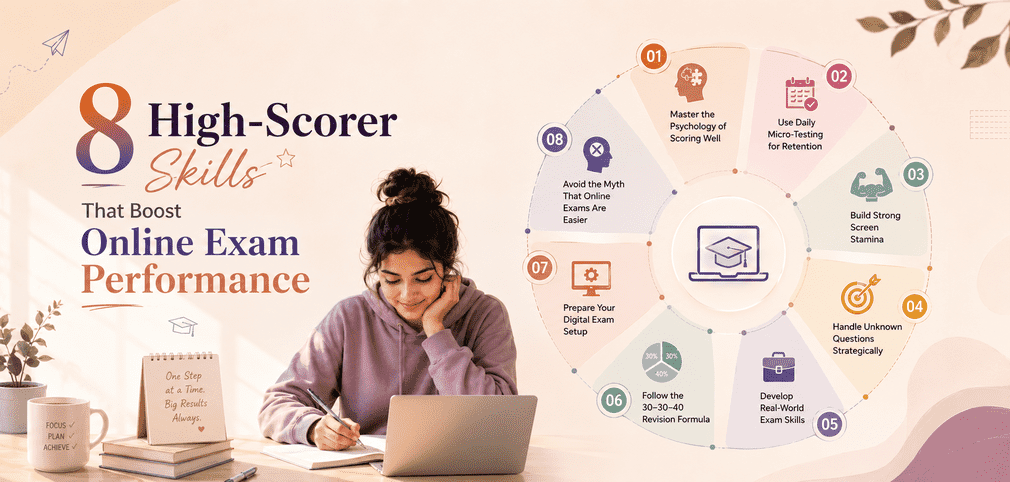
1. The Psychology of Scoring Well in Online Exams
Most students blame difficult questions or limited time when their scores fall short. But toppers know the real factor sits much closer to home. It is mental positioning, and it is far more trainable than most people realise.
Online exams reward four psychological strengths that no syllabus will ever teach you:
Cognitive Switching Control: The ability to move between MCQs, problem-solving, and typed answers without losing your rhythm or focus along the way.
Low-Noise Thinking: A focused mind will always outperform a brilliant one surrounded by distractions. Train your attention, not just your memory.
Calm Recall Under Pressure: The concepts are still there when the timer is running. Panic is what pushes them into the background, not difficulty.
Digital Confidence: Knowing your exam interface well enough to stop hesitating. That comfort alone can save you fifteen to twenty percent of wasted time during an exam.
When you train your mind alongside your memory, your scores rise in a way that extra revision hours simply cannot match.
2. The Role of Micro-Testing: 5 Minutes That Change Everything
Here’s something toppers do that average learners ignore: tiny, frequent tests.
Not full-length mocks.
Not 1-hour quizzes.
Just 5-minute micro-tests:
- 5 questions after finishing a topic
- 2 quick case scenarios
- One short numeric problem
- One conceptual “why does this work” question
These micro-tests act like mental checkpoints.
They prevent overconfidence, reveal weak spots instantly, and force your brain to store data more efficiently.
5 minutes of micro-testing equals 30 minutes of passive revision.
3. How to Build Exam Stamina Without Burning Out
Academic fatigue hits differently in online exams. It is not just mental tiredness. It is the specific kind of exhaustion that comes from staring at a screen for hours, where your eyes, your attention, and your thinking all wear down at the same time.
The good news is that stamina is buildable. You just have to train it the right way:
Visual Endurance Training: Spend fifteen to twenty minutes every day solving questions on screen. Not on paper. Your eyes need to get comfortable with the format before exam day arrives.
Timed Focus Blocks: Set a twenty-five-minute timer and solve continuously without touching your phone. No pauses, no quick checks. This trains your brain to stay locked in for the exact kind of stretch an exam demands.
Cognitive Cooldowns: After every study session, sit back and close your eyes for three minutes. It sounds too simple to matter. It is not. Your brain processes and resets faster than you think.
Digital Detox Windows: Keep the hour before sleep completely screen-free. Research suggests this improves memory consolidation by up to thirty per cent, meaning what you studied that day actually sticks.
Stamina is not about studying longer. It is about sustaining clarity all the way to the last question.
4. What to Do When You Don’t Know an Answer
Toppers are not toppers because they know everything. They are toppers because they know exactly what to do when they do not.
Freezing on a difficult question is not a knowledge problem. It is a strategy problem. And it is completely fixable.
Step 1: Rule out the obviously wrong options. You do not need to know the right answer to improve your odds. Eliminating even one option shifts the probability in your favour immediately.
Step 2: Look for pattern cues. Online exams often use concept-linked distractors, meaning the wrong options are usually built around the same topic. That alone can point you in the right direction.
Step 3: Do not get emotionally attached to a hard question. If it feels unfamiliar, mark it and move on. Sitting with one difficult question costs you the easy marks waiting for the three questions ahead.
Step 4: Return with a calm mind. A question that felt impossible on the first read will often feel surprisingly approachable the second time around, once the pressure of the moment has settled.
This single skill, used consistently across an exam, can improve your overall score by ten to fifteen percent without any additional studying.
5. How Digital Exams Reward Real-World Employability
There’s a reason companies trust online assessments: they test skills that matter in actual workplaces.
Online exams strengthen:
- Decision-making under time pressure
- Quick comprehension
- Digital navigation
- Self-managed productivity
- Logical reasoning
- Written communication (through typed answers)
You don’t just pass your exam- you prepare for your career.
6. The 30- 30- 40 Revision Formula
Most students revise everything equally and end up feeling prepared for nothing specifically. High scorers do it differently. They divide their revision intentionally, and the results speak for themselves.
The formula is straightforward:
30% on your strongest topics. Do not ignore what you already know well. Revisiting strong areas builds confidence and locks in the marks that should always be yours.
30% on moderately strong topics. These are the ones sitting just below your comfort zone. A little focused attention here is usually what separates a decent score from a genuinely strong one.
40% on your weak areas. This is where most of the damage happens in online exams. Weak topics do not just cost you those specific marks; they create a ripple of mistakes across connected questions, too.
This formula works because it stops you from over-preparing what you already know and under-preparing what actually needs the work. Your revision stays structured, your time stays purposeful, and you walk into the exam with a clear picture of exactly where you stand.
7. The “Exam Tech Checklist” Students Forget Until It’s Too Late
Before your exam day, confirm:
- Laptop fully charged
- Charger connected
- Internet backup (hotspot/second router)
- Browser updated
- Webcam & microphone functioning
- Notifications turned OFF
- Unnecessary tabs closed
- Keyboard cleaned (typing clarity matters)
- Login credentials noted beforehand
Technical readiness removes almost 70% of exam anxiety.
8. The Biggest Myth About Online Exams - “It’s Easier.”
A lot of students walk into their first online exam with a quiet assumption that the digital format somehow makes things simpler. Open book, flexible, forgiving. That assumption tends to cost them.
Online exams are not easier. They are simply more structured, more logical, and in many ways, more revealing of how you actually think.
What they test is exactly what modern employers look for in a candidate:
- Accuracy: Getting it right, not just getting it done.
- Efficiency: Performing well within a fixed window of time without wasting a second.
- Interpretation: Understanding what a question is actually asking before jumping to an answer.
- Conceptual Clarity: Knowing the why behind an answer, not just the what.
- Digital Competence: Navigating a structured exam environment with confidence and zero hesitation.
Students who prepare smartly do not score higher because the exam was easy. They score higher because they understood what the format was actually rewarding and built their preparation around that. That is the real advantage, and it is available to anyone willing to prepare with intention.
Conclusion
Online exams in 2026 are not harder. They are just different, and different responds very well to the right preparation.
The students who consistently score at the top are not working twice as hard as everyone else. They have simply aligned their habits with what digital assessments actually reward: structured thinking, conceptual clarity, consistent practice, and the ability to perform under pressure without falling apart.
Everything covered in this guide points to one shift. Moving from studying more to studying with intention. When your preparation matches the mechanics of the format you are being tested in, high scores stop feeling like a lucky outcome and start feeling like a natural result.
You already have the syllabus. You already have the time. What this guide gives you is the direction. Now all that is left is to use it.