


Table of Content
- What is the difference between the two MBAs?
- What is an Online MBA?
- What is an Executive MBA?
- Online MBA vs Executive MBA: A Side-by-Side Comparison
- What Are The Career Opportunities After Both Degrees?
- Which MBA Offers Better ROI?
- How to Decide Which MBA is Right for You?
- Why Choose an Online MBA from LPU Online?
- Conclusion
“Which MBA is better for someone having a few years of experience?”
“Which MBA is better for me?”
You have probably searched some version of these questions more than once. Not because you are unsure about pursuing an MBA, that’s actually the only settled and clear part. But it’s because the choice between an Online MBA and an Executive MBA keeps circling back, unanswered, no matter how many articles you skim.
At first glance, the two degrees can look remarkably similar. Both are designed to offer business management and administration principles. Both appear in the same search results, LinkedIn articles, colleagues' conversations and the same recurring MBA degree comparison lists.
But they are not the same. One degree is designed to launch a career from the ground up. The other is built to accelerate a career that is already gathering momentum.
Here’s where the confusion stops, and the right choice finally becomes clear.
What is the difference between the two MBAs?
Imagine this. A 5th-grade student knows the mathematics formulas of a 10th-grade curriculum. To even have this kind of expectation is weird. Right? Similarly, both MBA degrees teach business. The difference is that neither of them teaches the same way. One meets someone at the starting line. The other meets someone already mid-race, looking to close the gap to the finish line.
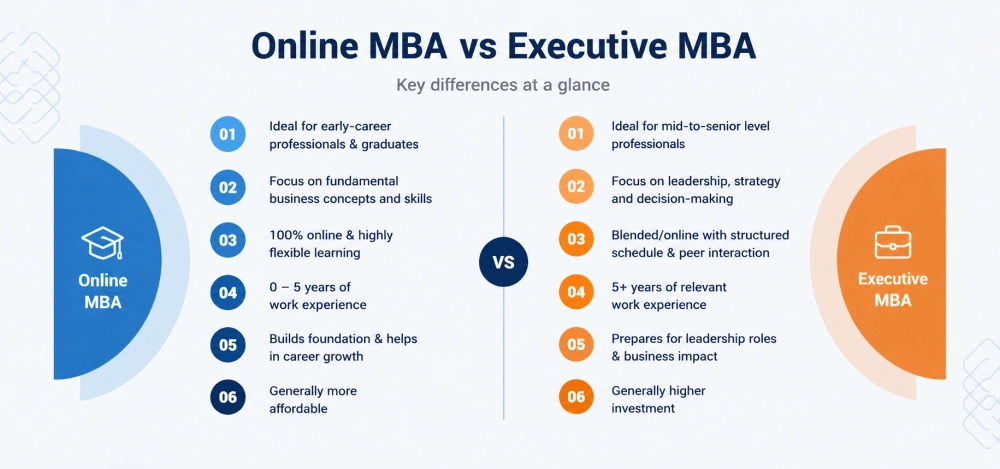
The motive of an Online MBA is to start with the management principles and business fundamentals from scratch. For an Executive MBA, the person is expected to have a solid foundation in the basics, and the curriculum is built upon more advanced concepts.
What is an Online MBA?
“I want to get an MBA degree”, you said out loud, maybe to your boss or just to yourself, but that did not let you escape reality. Work emails flooded your inbox, per usual. Client meetings that felt longer, project deadlines, family responsibilities, and hundreds of little ad hoc things that quietly end up taking up whatever little time is left in the day.
That's the gap an Online MBA was created to fill.
The curriculum of an Online MBA introduces:
- Basic business concepts.
- Understanding how organisations actually work.
- Financial decisions are made on the basis of data and analytics.
- Concepts of leadership, marketing, strategy, economics, human resources and more
What is an Executive MBA?
Working for more than 3 years makes you proudly say that experience has been a great teacher all these years. But now the strategies that once solved problems begin to feel incompetent at doing so. The decisions become more complex. Every decision you make now impacts the whole team, budgets, customers and sometimes an entire organisation.
That's the point where an Executive MBA starts making sense.
The curriculum of an Executive MBA introduces:
- Advanced business strategy and organisational leadership.
- Solving complex business challenges
- High-impact financial, operational and strategic decision-making
- Developing an executive mindset for organisation-wide leadership.
Online MBA vs Executive MBA: A Side-by-Side Comparison
Selecting the right program requires a detailed look at how each degree functions in a professional context. It is important to understand the fundamental difference between Online MBA and Executive MBA structures before committing your time and capital. The following table provides a direct comparison of the two MBA degrees:
|
Dimension |
Online MBA |
Executive MBA |
|
Eligibility |
Undergraduate degree |
Undergraduate degree and senior profile |
|
Work Experience |
Varies: Highly accessible for those with 0 to 3 years |
Often, 7 or more years of experience |
|
Target Audience |
Early career and tech professionals |
Mid to senior-level managers |
|
Learning Format |
Mostly digital and asynchronous |
Hybrid or interactive formats |
|
Flexibility |
Very high: self-paced options |
Moderate: structured for executives |
|
Duration |
Typically 2 years |
Typically 1.5 to 2 years |
|
Curriculum |
Management foundations and technical skills |
Leadership and strategic decision making |
|
Cost |
Generally more affordable |
Higher investment in executive services |
|
Networking |
Digital peer-to-peer interaction |
High-level executive networking |
|
Career Outcomes |
Skill upgrading and career entry |
C-suite, CEO, or executive roles |
|
Admission Process |
Academic records and entrance exams |
Executive MBA eligibility: Resume and leadership track |
According to Signalling Theory, employers view a degree as a signal of a candidate’s potential productivity and motivation. While a credibility gap once existed for digital degrees which is now narrowing through the use of experiential learning. Programs that incorporate live case studies and virtual residencies help close this gap by proving the student has mastered communication and leadership.

What Are The Career Opportunities After Both Degrees?
The real question is not which degree gets the better job, but the question is which degree prepares you for the career you are trying to build?
Both degrees create opportunities, but they don’t always open the same doors. Here's how they differ:
After an Online MBA
- Step into diverse industries such as technology, healthcare, banking, retail, manufacturing, consulting, startups, and e-commerce.
- Explore management-focused roles in marketing, finance, human resources, operations, business analytics, product management, and project management.
- Switch industries without starting over, as the curriculum builds transferable business skills that apply across sectors.
- Grow alongside your career, making it an ideal choice for fresh graduates and early to mid-career professionals.
After an Executive MBA
- Move from managing work to shaping business strategy through senior leadership and executive roles.
- Lead organisational transformation, innovation, and business growth rather than simply executing plans.
- Take on greater decision-making responsibilities involving teams, budgets, stakeholders, and long-term business goals.
- Strengthen your leadership credibility while continuing to build on years of professional experience.
Which MBA Offers Better ROI?
Cheaper isn’t the same as better, just like how more expensive isn’t the same as smarter. ROI or return on investment is a subjective measure that depends on your personal financial goals and current salary bracket.
According to the 2025 GMAC Prospective Students Survey, 56% of Online MBA candidates and 45% of Executive MBA (EMBA) candidates said that earning a raise or salary increase is one of their top career goals.
Here's how both degrees compare:
- In general, an online MBA allows you to continue working full-time while requiring less financial commitment. The opportunity cost is also low because you don't have to put your career on hold.
- An Executive MBA is intended for experienced professionals looking for top leadership roles; it usually has a higher tuition cost. Stronger executive networks, strategic leadership abilities, and long-term career advancement rather than quick savings provide the return for many.
Ultimately, the better ROI isn't determined by the degree itself. It's determined by how well the degree aligns with your career stage, professional goals, and the value you expect it to create over the years that follow.
How to Decide Which MBA is Right for You?
Choosing between these paths requires an honest assessment of your current status and future needs. Do not rush this decision, as the right choice will serve as the foundation for the rest of your career. Review these non-negotiable questions to help guide your final decision.
- Do I currently have more than seven years of significant professional work experience?
- Is my primary goal to upgrade specific technical skills or to obtain a C-suite or CEO position?
- Do I prefer a self-paced, asynchronous style or synchronous, live interaction with my peers?
- Is the program I am considering accredited by a recognised body?
- Am I motivated by the 28 per cent recession trigger or by the 50 per cent executive-level goal?
Why Choose an Online MBA from LPU Online?
If you have made it this far, chances are you are not just looking for an MBA. You're looking for one that fits your career, your schedule and your long-term goals. That's where choosing the right university becomes just as important as choosing the right degree.
At LPU Online, the Online MBA course is designed for professionals who want the flexibility of online learning without compromising on academic quality or industry relevance. The programme combines structured weekend LIVE classes with self-paced learning, allowing students to balance work, personal commitments, and higher education more effectively.
Here's what makes the programme stand out:
- UGC Entitled degree from a university accredited with NAAC A++, offering a qualification that's recognised and valued across industries.
- Weekend LIVE classes that encourage real-time interaction with faculty and peers while fitting comfortably around a working professional's schedule.
- Industry-oriented curriculum with multiple specialisations, helping learners build expertise aligned with their career aspirations.
- Experienced faculty and learner support, ensuring guidance throughout the academic journey rather than just at the beginning.
- Career and placement support is designed to help students translate their learning into meaningful professional opportunities.
Conclusion
There is no universal "better" degree when comparing the Online MBA and the Executive MBA. The best option is the one that fits both your present career level and the particular objectives you have set for yourself. Both approaches provide a respectable path to progress, regardless of whether you require the adaptability of digital learning or the strategic emphasis of executive leadership.
Education is a lifetime process that necessitates making decisions based on your particular situation and the state of the economy. You can choose the curriculum that will best support your development by concentrating on certification, institutional repute, and your own career triggers. Your leadership trajectory will be shaped by the choice you make now for years to come.
References:
This article incorporates insights from the Graduate Management Admission Council's (GMAC) 2025 Prospective Students Survey Summary Report to provide context on global trends in graduate management education, candidate preferences, career aspirations, and evolving industry expectations. The report was referenced solely for informational purposes to support discussions on market trends and student behavior.
All content, analyses, interpretations, and conclusions presented in this article are original and have been independently developed for this blog.