


Let me ask you a question:
How often do you hear words like deadlines, targets, delays, missed deliverables, budget overruns, and constant follow-ups in workplaces, classrooms, or meetings? More times than we can recall, right?
You see people juggling between spreadsheets, project updates, review calls, and status reports. Everyone seems preoccupied, and everyone understands that they are accountable. Yet somehow, things still don’t go as planned. Have you ever thought about who is actually dealing with all of this and why these conversations exist in the first place? Never is the only correct answer. After all, it’s all a part of the project(s) being handled, right?
Well, the answer matters, but not as much as the pattern behind these situations. Before we talk about tools, handlers of the project, or careers, it’s important to understand where most projects start losing their direction.
If you observe closely, you will notice that many projects follow a familiar path.
Where Most Projects Begin and Quietly Start Falling Apart
Every project begins with confidence.
The idea feels solid.
The team feels capable.
Timelines look achievable.
There is always that early belief: “We’ll cross that bridge when we get there”
Then, gradually, things start to slip through cracks, one thing leads to another, and the bridges we were meant to cross are now deep under the water.
Requirements begin to change midway.
Deadlines start shifting.
Meetings increase, but clarity and actions decrease.
Everyone is busy, yet progress is nowhere near.
This does not happen because people lack skills or motivation; it happens because projects rarely fail due to underprepared management and haphazard execution. This is exactly where project management becomes crucial.
At its core, project management exists to answer one fundamental question: how do we move from an idea to a completed outcome without losing control, direction, or momentum along the way?
Understanding this is not about memorising definitions or frameworks. It is about recognising how work actually unfolds in real environments, under pressure, constraints, and change.
Let’s understand why project management insights matter while practising.
What Project Management Really Looks Like in Practice
In theory, project management is described as the application of tools, techniques, and skills to achieve defined objectives, while in practice, it is about making the right decisions early, before small issues turn into costly failures.
Project management determines:
- What work needs to be done
- In what order should it be executed
- Who is responsible for each outcome
- How time, cost, and quality are balanced
Without project management, work still happens. But it happens in fragments, driven by urgency rather than priorities. With project management in place, work moves with structure, visibility, and purpose. Teams know what matters, progress is measurable, and outcomes stay aligned with expectations.
To understand project management properly, it helps to see it in action rather than as a definition.
At its core, a project is a temporary effort created to achieve a specific outcome. It has a clear beginning, a defined end, and fixed constraints such as scope, time, and budget. This is what separates a project from daily operations, which are ongoing and repetitive.
To make this practical, let’s take a simple but realistic example.
The Situation: Digitising Customer Onboarding
Imagine a company that still handles customer onboarding manually. Forms are filled out on paper, approvals take time, and customers often complain about delays. Leadership decides that this process needs to be digitised through an online onboarding system.
At this point, nothing has been built yet. There is only a problem and an idea. This is where project initiation begins.
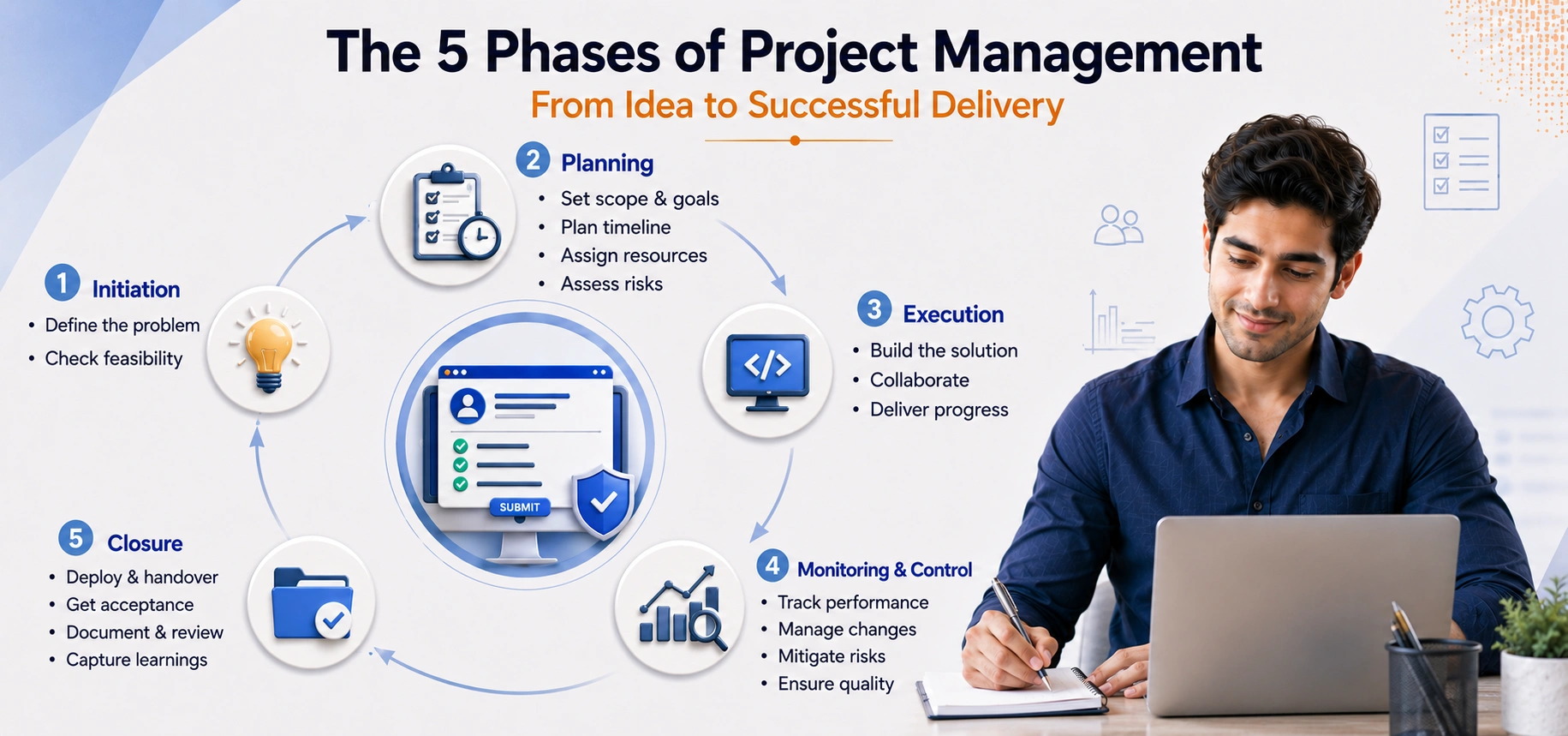
1. Initiation: Defining the Problem and Feasibility
During initiation, the focus is not on solutions, but on clarity.
The company asks key questions:
- What problem are we trying to solve?
- Who will use this system?
- Is it technically and financially feasible?
- Does this initiative align with business goals?
Once these questions are answered and the project is approved, it officially moves forward. Without this step, teams often start working on ideas that were never fully thought through.
2. Planning: Turning the Idea into a Roadmap
After initiation, the project enters the planning stage. This is where most successful projects are actually decided.
In our onboarding example, planning involves:
- Defining the scope, such as user registration, document upload, and approval workflows
- Deciding timelines and milestones
- Assigning teams and responsibilities
- Identifying risks like data security or integration issues
- Estimating cost and resource requirements
At this stage, the idea of “digitisation” transitions from being vague to being a structured plan that teams can follow.
3. Execution: Where Work Begins
Once the plan is in place, execution starts.
Developers begin building the system, designers create interfaces, and testers prepare validation scenarios. The role of project management here is not to do the work, but to ensure that work is happening as planned, dependencies are managed, and teams remain aligned.
Without planning, execution often turns into confusion. With planning, it becomes coordinated progress.
4. Monitoring and Control: Keeping the Project on Track
As execution continues, monitoring and control run alongside it.
In our example, this means:
- Tracking whether development is on schedule
- Managing changes requested by stakeholders
- Identifying risks early, such as delays or performance issues
- Ensuring quality standards are met
This stage prevents small deviations from turning into major setbacks.
5. Closure: Completing the Project Properly
Finally, once the onboarding system is ready and approved, the project moves into closure.
This includes:
- Final deployment
- Stakeholder acceptance
- Documentation
- Reviewing what worked and what didn’t
Many teams skip this step, but proper closure ensures that lessons are carried forward into future projects.
Why This Structure Matters
Without a structured approach, projects rely heavily on assumptions and guesswork. With project management, each decision is deliberate, each phase has a purpose, and outcomes are predictable. This structured flow is what turns ideas into delivered results, and it forms the foundation of effective project management across industries.
Key Project Management Skills That Create Real Impact
Successful Project Managers (The handler of the project) are not defined by the tools they use alone. They are defined by the way they think, communicate, and respond to challenges.
Communication
Project managers act as a bridge between technical and non-technical stakeholders, ensuring that information is clear, accurate, and timely.
Example: Explaining a project delay to leadership without damaging trust or confidence.
Planning and Prioritization
Breaking complex objectives into actionable tasks helps teams stay focused and ensures that work progresses in a structured manner.
Risk Management
Identifying potential issues early prevents small problems from escalating into major failures.
Example: Preparing alternative solutions for supplier delays or technology-related risks.
Leadership Without Authority
Project managers often guide and influence teams that do not report to them directly, relying on trust, clarity, and collaboration rather than hierarchy.
Problem-Solving Under Pressure
Projects rarely follow the plan exactly. Effective project managers make timely, balanced decisions even in high-pressure situations.
While these skills define how a project manager thinks and responds, they still need a structured way to organize and deliver work. That structure comes from project management methodologies, which shape how projects are planned and executed.
Project Management Methodologies: How Work Gets Done
Whether you're racing deadlines, wrangling teams, or navigating the beautiful chaos of a product launch, the methodology you choose isn't just process; it's the invisible architecture shaping every decision you make.
Waterfall Methodology
A sequential approach where each phase is completed before the next begins.
Used in:
- Construction
- Manufacturing
- Compliance-heavy environments
Value: Predictability and documentation
Limitation: Low flexibility once execution begins
Agile Methodology
An iterative approach focused on adaptability and continuous feedback.
Used in:
- Software development
- Digital products
- Innovation-driven teams
Value: Faster delivery and responsiveness
Scrum Framework
A structured Agile framework using short cycles called sprints.
Key elements:
- Sprint planning
- Daily stand-ups
- Reviews and retrospectives
Value: Transparency, accountability, and team alignment
Most modern organizations now follow hybrid models, combining structure with flexibility.
Tools and Technologies Used in Modern Project Management
Modern project management runs on something far more than spreadsheets and sticky notes; the tools your team reaches for every morning quietly shape how problems get spotted, decisions get made, and work gets shipped.
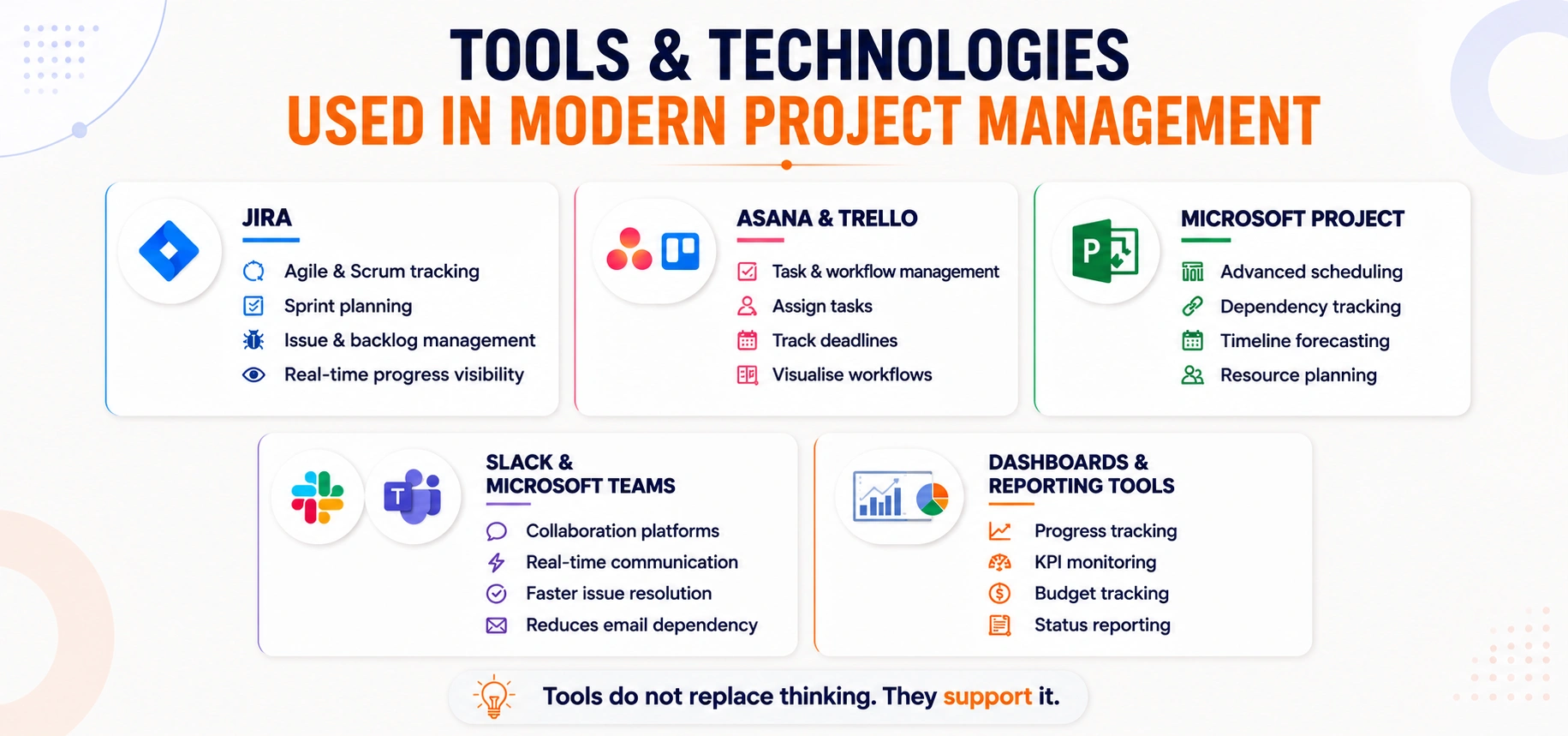
Jira
Used for Agile and Scrum project tracking.
Purpose: Sprint planning, issue tracking, and backlog management
Value: Real-time progress visibility
Asana and Trello
Task and workflow management tools.
Purpose: Assigning tasks, tracking deadlines, and visualising workflows
Value: Easy adoption across teams
Microsoft Project
Advanced scheduling and dependency tracking tool.
Purpose: Timeline forecasting, resource planning
Value: Suitable for large, structured projects
Slack and Microsoft Teams
Collaboration platforms.
Purpose: Real-time communication, faster issue resolution
Value: Reduces delays caused by email dependency
Dashboards and Reporting Tools
Used for progress tracking and decision-making.
Purpose: KPI monitoring, budget tracking, status reporting
Value: Data-driven project decisions
Tools do not replace thinking. They support it.
Common Project Management Challenges and How They Are Handled
Even with proper planning and execution, projects face challenges. Understanding these common issues and how they are handled is key to keeping work on track and outcomes aligned.
Scope Creep
Scope creep occurs when new requirements are added without adjusting timelines or budgets.
Example: A client requests additional features midway through development, assuming they can be delivered within the original deadline.
Handled by: Clearly defining the scope upfront and following formal approval processes for changes.
Stakeholder Misalignment
Different stakeholders may have conflicting expectations, leading to confusion and rework.
Example: Business teams expect rapid delivery while technical teams require more time for quality testing.
Handled by: Regular communication, documented decisions, and aligned expectations.
Resource Constraints
Projects often face limitations in time, budget, or available personnel.
Example: A key team member leaves during a critical project phase.
Handled by: Prioritizing essential tasks and planning realistically with available resources.
Team Burnout
Continuous pressure and unrealistic timelines can reduce productivity and morale.
Example: Teams working extended hours for long periods start missing deadlines despite effort.
Handled by: Balancing workloads, setting realistic timelines, and monitoring team well-being.
Experienced professionals gain strong project management insights by managing expectations just as carefully as execution.
Real Project Management Insights from Practice
Projects rarely fail because of tools. They fail due to unclear ownership and delayed decisions. When responsibilities are not clearly defined, tasks move slowly, and accountability becomes blurred.
Case example:
A mid-sized IT company was developing an internal CRM system. Multiple teams were involved, but no single owner was responsible for the final decisions. Feature approvals were delayed, changes kept coming in, and timelines slipped. Once a dedicated project manager was assigned with clear decision authority, priorities were fixed, approvals became faster, and the project moved back on track.
Another important insight from real projects is that flexibility matters. Rigid plans often break when faced with changing requirements, technical challenges, or stakeholder feedback. Projects succeed when plans adapt without losing control.
Finally, consistent documentation and follow-ups prevent misunderstandings and rework.
In the same project, clear meeting notes, documented decisions, and regular follow-ups reduced repeated discussions and saved significant time during later phases.
These practical lessons highlight that successful project management is less about tools and more about ownership, adaptability, and clarity.
Project Management as a Career: Roles and Growth
Project management is a structured career path with clear growth opportunities. As professionals gain experience, they move from execution support to leadership roles with greater ownership and strategic responsibility.
This progression is typically reflected across three stages of project management roles, each defined by its scope of responsibility and level of impact.
Entry-Level Roles
- Project Coordinator
- Associate Project Manager
Focus: Supporting project execution, tracking tasks, coordinating teams, and assisting senior managers.
Mid-Level Roles
- Project Manager
- Program Manager
Focus: End-to-end project delivery, stakeholder management, risk handling, and managing multiple workstreams.
Senior-Level Roles
- Portfolio Manager
- PMO Head
- Delivery Director
Focus: Overseeing multiple projects, aligning initiatives with business strategy, managing budgets, and driving organizational outcomes.
Career Advancement
- Certifications such as PMP (Project Management Professional), PRINCE2 (Projects IN Controlled Environments), and Agile credentials enhance credibility, improve leadership readiness, and open global career opportunities.
Market Demand: Why Project Managers Often Earn More Than Coders
Project management demand is often underestimated, yet it plays a critical role in organizational success. While coders and engineers focus on executing specific tasks, project managers are accountable for overall outcomes.
Why Demand for Project Managers Is High
- Abundant technical talent: Skilled developers and engineers are widely available in the market.
- Scarcity of management capability: Professionals who can manage people, budgets, timelines, and stakeholders effectively are far fewer.
- High cost of project failure: Failed or delayed projects result in financial losses, missed opportunities, and reputational damage.
Why Senior Project Managers Earn More
- Budget ownership: Senior project managers oversee large, often multi-million-dollar budgets.
- Risk reduction: They identify and mitigate risks before they escalate into costly failures.
- Business alignment: They ensure technical work supports business objectives and priorities.
- Leadership influence: Their decisions directly impact strategy, delivery timelines, and organizational performance.
As organizations scale, the ability to coordinate teams, manage complexity, and maintain accountability becomes more valuable than individual technical output.
Industry Trends in Project Management
Project management is changing as the way we work and do business continues to evolve.
- Hybrid Work Models: Project managers now handle teams that work from different locations or remotely. This means clear communication, regular check-ins, and better coordination are more important than ever.
- Data-Driven Project Management: Instead of guessing, project managers use dashboards and reports to see progress, spot delays early, and make informed decisions.
- Outcome-Focused Delivery: Success is no longer measured by completing tasks alone. The real focus is on whether the project delivers meaningful results for the business.
- Cross-Functional Leadership: Project managers work with teams from different departments, such as technology, marketing, and operations, to keep everyone aligned toward the same goal.
These trends reinforce why project management skills continue to remain relevant and future-ready across industries.
Conclusion
Project management is not about controlling people or processes. It is about creating clarity, aligning efforts, and ensuring that work moves in the right direction. In a professional environment filled with deadlines, changing priorities, and limited resources, strong project management brings structure where there would otherwise be confusion.
The insights discussed show that successful projects depend on more than tools or technical skills. They rely on thoughtful planning, clear communication, informed decision-making, and the ability to adapt when conditions change. As organizations grow and projects become more complex, the role of a project manager becomes even more critical.
Whether you are a student exploring career options or a working professional aiming to grow into leadership roles, developing project management skills can significantly strengthen your career. In a world full of capable talent, the ability to manage outcomes, not just tasks, is what truly sets professionals apart.
Also Read: Difference between Product management and Project management