

Table of Content
You might have seen those tiny checkboxes that sit quietly at the bottom of a signup form. Without even glancing at what that text says, you quickly check in these boxes and click on ‘continue’. Two seconds, that’s all it takes to accept a privacy policy most of the people have never read in their lifetime.
There is an assurance inside which states that “will read it later”, but no one takes the time to read that long document with several pointers. And in all of this, you have just handed over permissions that were never fully understood and that too to the systems which can’t be fully seen.
Here comes the twist. On the other side of that checkbox isn’t just a company taking a record of your email address. It’s often several algorithms, bots and AI-driven systems working to protect your data which others are trying to steal.
So, welcome to the invisible battlefield of the internet where artificial intelligence has become both the guard and the threat. Further, you will read about how AI is rewriting the rules of cybersecurity and what its roles are.
What Is Cybersecurity?
Imagine this: somewhere right now, a hacker is trying to get into the system of a bank, a hospital or even your personal laptop. And standing between that hacker and chaos is something most people never think about: Cybersecurity.
When the internet was discovered, it was never built to be safe but it was built to connect people easily and efficiently. Nobody thought about hackers when they were busy inventing email. And that one blind spot created an entire industry of criminals who exploit it every single day.
So what exactly is this invisible shield protecting? Pretty much everything you touch online:
-
Your devices, laptops, phones, tablets, and smart gadgets that quietly collect and store your data
-
Your networks, the invisible highways your information travels through every single day
-
Your accounts, emails, banking apps, social media, and anything guarded by a password
-
Your identity, the personal details that, once stolen, are almost impossible to fully take back
-
Business systems, the servers and databases that companies trust to keep customer data safe
Each password you create, every firewall you deploy, and every "confirm your identity" notification that frustrates you, that’s cybersecurity discreetly performing its function behind the scenes.
Cybersecurity is not a one-and-done arrangement that you can overlook. It’s an ongoing battle, waged silently, behind each screen you utilize.
What is AI in Cybersecurity?
The cybersecurity shield which has been protecting you now has an upgrade. It not only stops any data from landing in the laps of hackers, but it is now learning from every attack, spotting a threat and reacting faster than any human possibly could.
That's AI in cybersecurity.
It's not just software anymore, it's intelligence. And this intelligence works in ways traditional security never could:
-
Identifying patterns, detecting the subtle, unique signals within vast quantities of data that a human could easily overlook.
-
Immediate threat identification, noticing unusual actions as they occur, rather than hours or days afterwards.
-
Predictive defence involves analyzing previous attacks to anticipate potential future attempts by hackers.
-
Automated reply, neutralizing a danger in seconds, without needing a human to notice at all.
-
Self-learning systems become increasingly intelligent and precise with each attack they face.
Algorithms process billions of data points within seconds and systems advance more quickly than any manual update possibly could. The same AI that protects your data is also being used by hackers to compromise it, such as more intelligent malware, frauds and automated threats.
This signifies that the future of cybersecurity is no longer about humans competing with hackers. It is artificial intelligence against itself. Understanding this shift is exactly what programs like LPU's Online MCA in Cybersecurity are built to teach.
What Are The Key Roles Of AI In Cybersecurity?
The term ‘shield’ likely brings an image of a soldier guarding the palace entrance with a sword drawn ready, vigilant for threats. It is the typical picture but the incorrect one.
Artificial Intelligence in Cybersecurity is not a barrier to waiting for attacks. It is already within the walls, monitoring every discussion, observing every login and foreseeing the assault before the attacker has even completed their planning.
The real question is not if AI safeguards you. It is the numerous ways it’s accomplishing that simultaneously many of which you likely haven’t even considered.
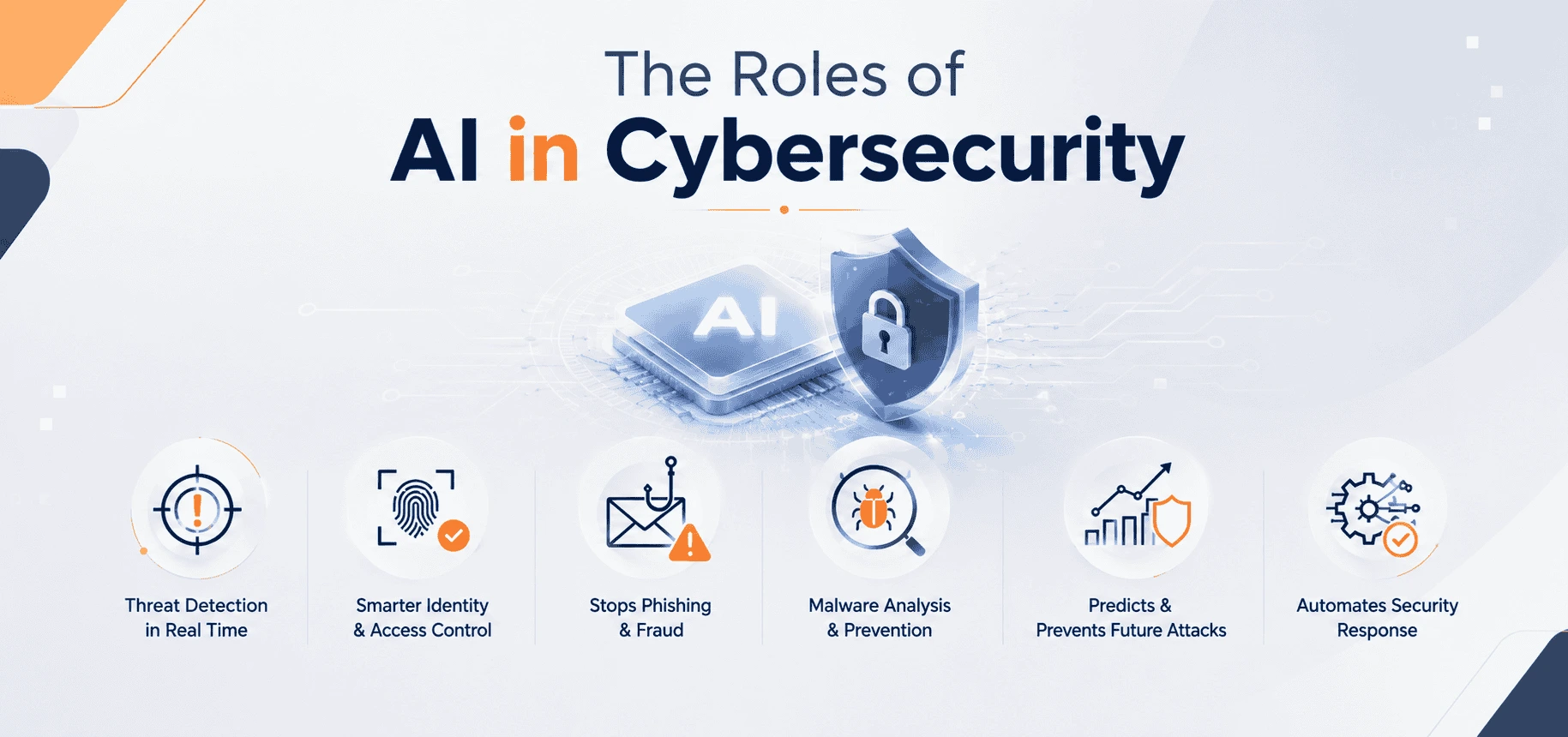
Threat Detection and Malware Analysis
Imagine catching a thief the moment they touch the doorknob, not after they've already emptied your house. That's what AI does with threats.
By learning what "normal" looks like for your network, AI can instantly flag anything that feels off. And it's not just fast, it's dramatically fast. IBM found that AI powered risk analysis speeds up alert investigation and triage by an average of 55 per cent.
Here's what that process actually looks like behind the scenes:
-
Reads malicious code, even in languages your analysts don't know
-
Identifies who's involved, users, devices and IP addresses tied to the event
-
Pulls real-time threat intelligence, checking URL reputations instantly
-
Maps attacker tactics, understanding exactly how the threat operates
-
Prioritizes based on risk, ranking threats against your most critical assets
-
Tracks lateral movement, spotting if an attacker is spreading across systems
-
Generates a full summary, so your team gets a clear report and next steps
What used to take analysts hours of manual digging now happens in the background, before most people even realize something went wrong.
1. Phishing Prevention
That email asking you to "verify your account immediately" isn't always what it looks like. And honestly, most of us wouldn't catch the difference. AI does.
It scans every email for the subtle signs of a scam, things a busy human eye would scroll right past:
-
Spots spoofed domains, catching misspelt or fake sender addresses
-
Analyzes writing patterns, flagging when an email doesn't sound like the real sender
-
Targets spear phishing, studies how executives actually write to catch impersonators
-
Blocks before delivery, stopping malicious links before they ever reach an inbox
It's like having someone proofread every suspicious email you get, except this someone never gets tired and never misses a detail.
2. Behavioral Analytics (UEBA)
Imagine this: a user normally logs in at 9 AM and works through regular files. Then one night at 3 AM, that same account suddenly downloads a massive chunk of data from an unfamiliar location. A human might miss it. AI won't.
This is called User and Entity Behavior Analytics, and it works by building a detailed profile of what normal looks like for every single user and device:
-
Learns daily patterns, understanding how each user typically behaves
-
Flags sudden shifts, catching unusual logins, downloads or access times
-
Catches insider threats, even when the attacker already has valid credentials
-
Detects zero-day attacks, identifying threats no one has seen before
3. Automated Incident Response
Think of this like the automatic braking system in a modern car. It doesn't wait for the driver to react; it slams the brakes whenever danger is detected. AI-driven incident response works the same way.
The moment a threat is confirmed, AI takes action instantly:
-
Isolates compromised devices, to cut off a threat immediately
-
Kills suspicious processes, shutting them down in real time
-
Stops lateral movement, preventing an attacker from spreading further
-
Acts before humans even notice, closing the gap between detection and response
By the time a human analyst opens the ticket, AI has often already contained the damage.
4. Vulnerability Management
Thousands of new vulnerabilities are reported every single year. No security team, no matter how skilled, can manually fix them all in order. So AI decides what actually matters first.
-
Prioritizes real threats, ranking vulnerabilities based on predicted exploitability
-
Filters out the noise, skipping bugs unlikely to be targeted anytime soon
-
Tracks hacker behavior, analyzing which vulnerabilities are actively being exploited right now
-
Focuses limited resources, helping teams fix what genuinely puts them at risk
Instead of playing catch-up with an endless list, AI helps teams fight the fires that actually matter.
5. Fraud Detection and Identity and Access Management (IAM)
Every single login attempt carries a question. Is this really you? AI answers that question in real time, every time.
This is called Adaptive Access Control, and here's how it works:
-
Checks device status, flagging logins from unmanaged or unfamiliar devices
-
Analyzes location data, noticing when a login comes from an unusual place
-
Reads behavioral patterns, studying typing style and even fingerprint data
-
Reduces fraud dramatically, this approach can cut fraud costs
Challenges and Risks of AI in Cybersecurity
While AI is a powerful ally, it remains a double-edged sword. You must critically analyze the risks associated with its deployment to maintain a secure posture.
1. False Positives and Bias
AI is only as good as the data it learns from. If your training data is skewed or limited, the model develops a bias. This can lead to missed threats or an overwhelming number of false positives. When a system generates too many false alarms, security teams become desensitized. This leads them to ignore a real threat when it finally arrives. High-quality and diverse training data is essential to avoid this pitfall.
2. Adversarial AI
Cybercriminals are not sitting idle. They are developing Adversarial AI to craft attacks specifically designed to evade detection. By understanding how your AI models work, hackers manipulate them into misclassifying malicious activity as normal. This ongoing arms race requires your defence models to undergo constant retraining and updates to stay effective.
3. Data Poisoning
Data poisoning occurs when an attacker corrupts the data used to train an AI model. By injecting subtle errors into the learning process, they compromise the model's ability to detect threats over time. This makes the integrity of your training data just as important as the security of the software itself. You must treat your data pipelines as critical infrastructure.
4. Privacy and Governance
The use of AI raises significant questions about data privacy and ethical oversight. Organizations need Explainable AI to build trust with analysts and regulators. If a system blocks a user, you must be able to audit exactly how that decision was reached. Clear governance policies are essential. They ensure that your use of AI remains responsible and compliant with emerging regulations. These questions of responsibility and oversight sit at the heart of the ethics in cybersecurity.
The reality is that hackers are already weaponizing these tools to increase the scale of their attacks. This leads to a critical question. How exactly are cybercriminals using AI today?
Conclusion
Recall that checkbox from the start? The one you selected without a moment's hesitation? That one click is precisely why this conflict is so significant. AI has evolved beyond a mere trend; it now serves as the safeguard for your digital entrance, the vigilant protector that remains alert at all times, and the essential ally that every security team craves.
It may not substitute for a human analyst's intuition, but it can handle the vast amounts of data that would otherwise overwhelm them. The collaboration between human insight and machine efficiency is the sole genuine means to protect the digital frontier.
If this unseen battlefield intrigues you, perhaps it's time to stop just reading about it and begin to participate in it. LPU's Online MCA in Cybersecurity is designed specifically for those who wish to transition from inquisitive learner to genuine protector.
Since there needs to be someone to watch over the entrance. Why not you?