

The Reality of the Modern Inbox
Recruiting used to be simpler. You'd scan a resume, spot a few strong verbs, maybe a recognizable company name, and you'd already have a feeling. Now? The inbox looks completely different. Almost every candidate who comes through has discovered the same trick: drop a few AI tools into the skills section and hope it lands.
ChatGPT. Gemini. Check, check. Next.
The issue isn't the listing. It's the silence that follows it. Most candidates plant the flag and walk away, as if showing up to the party counts as dancing. Recruiters have seen this pattern enough times now that they can spot it before they finish the first paragraph. The tools are there. The story behind them is never.
And the story is everything.
Because something real is happening out there, beyond the trend pieces and the LinkedIn hot takes. Businesses aren't dabbling in AI anymore. They're restructuring around it, quietly rewriting job descriptions, retiring old workflows, and raising the bar for what useful actually looks like. When 84% of CIOs say AI matters to their company the way the internet once did, they're not speaking in metaphors. They're describing the ground shifting under everyone's feet.
Recruiters feel that shift every single day. They're not hunting for someone who discovered ChatGPT last month and added it to their resume before the ink dried. They want the person who picked up a problem nobody wanted to touch, figured out how to use these tools to get somewhere new, and came out the other side with something to show for it.
Not a buzzword. A result. A moment where the work actually changed something.
That's the difference between a resume that gets filed away and one that gets a phone call before lunch.
How AI-Driven Companies Actually Think About Talent
How AI Companies Actually Think About Hiring?
There's a version of AI adoption that looks great in press releases. The tools are purchased, the announcement is made, and somewhere in a slide deck, a graph points confidently upward. Then reality shows up to the meeting.
Actually embedding AI into the way a business runs, into its decisions, its data, its daily rhythm, is genuinely hard. 95% of leaders point to integration as their biggest obstacle, not access to tools, not budget, not buy-in. Integration. The messy, unglamorous work of making new technology actually fit inside an organization that was built before it existed.
That's where talent comes in, and it's why AI-driven companies have started thinking about hiring in a completely different way.
They're not scouring resumes for someone who automates their email responses or uses a chatbot to summarize meeting notes. That bar cleared itself. What these companies are hunting for now is the person who looks at a broken workflow, understands the data sitting behind it, and figures out how to build something better with the tools available. Someone who doesn't just use AI but thinks alongside it.
The candidates who stand out at these firms are the ones who understand that a tool is only as smart as the person pointing it at the right problem. Leadership isn't impressed by familiarity with software. They're impressed by people who can take that software, fit it into something larger, and come back with results that actually move the business forward.
The gap between using AI and integrating it is where most companies are stuck right now. The people who can close that gap are exactly who everyone is looking for.
The Core Skills Recruiters Look for in AI Companies
The modern job market requires a specific blend of technical abilities and human judgment. These skills allow employees to work alongside digital labour effectively and produce high-quality work. These are the skills recruiters look for in AI companies when evaluating top-tier talent for any role.
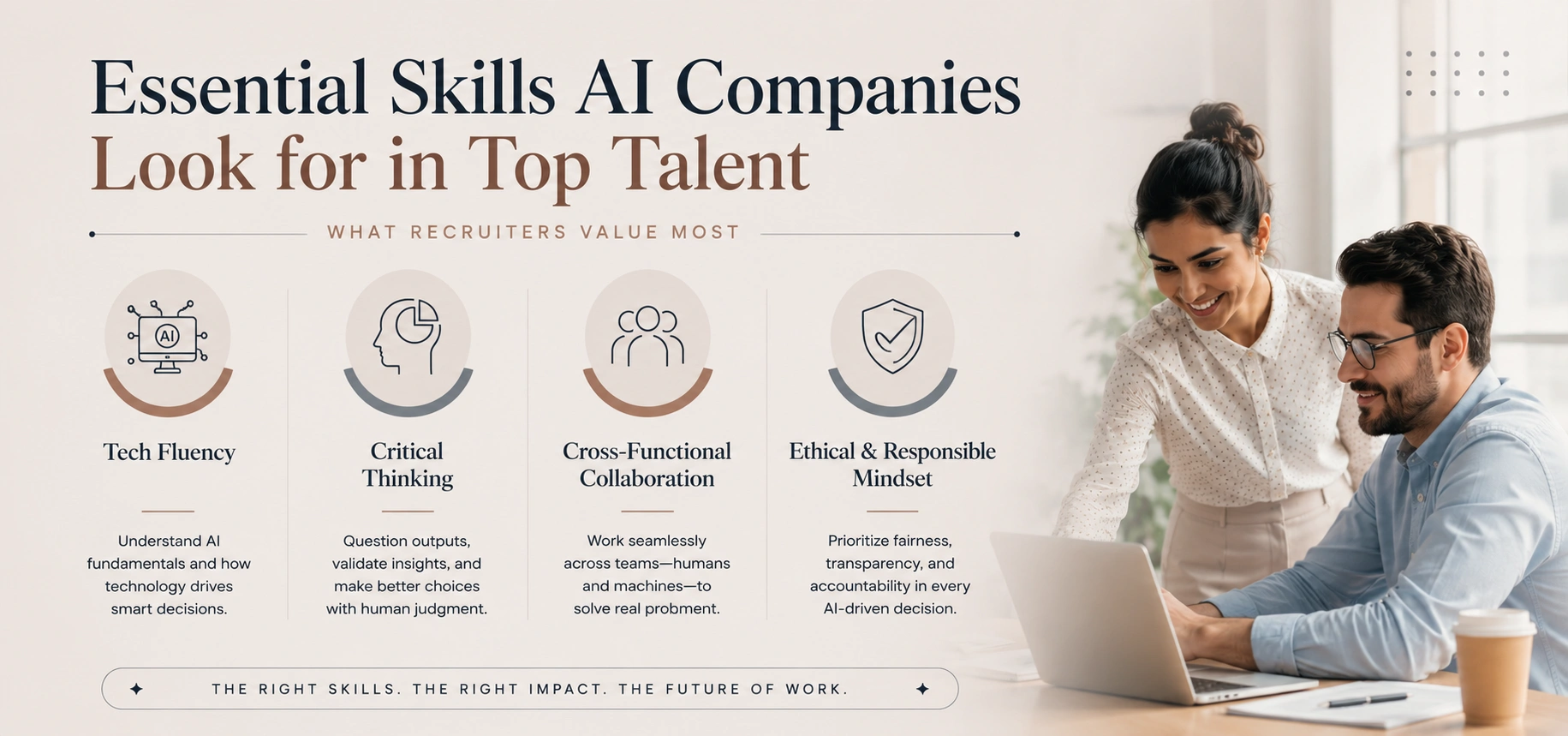
Technical Literacy
Technical literacy does not mean every employee must be a software developer or a computer scientist. It means having a deep understanding of how AI thinks and how it processes various inputs. Candidates should know how models process information to reach specific, data-driven conclusions.
Recruiters look for people who understand how models learn from different types of data. This includes knowing the difference between supervised learning and unsupervised learning formats. Understanding these foundations helps an employee know when a tool is likely to be helpful for a project.
Knowing the limits of the technology is just as important as knowing its primary strengths. A literate candidate can identify when a model is working with poor data or outdated information. This prevents the company from making expensive decisions based on flawed or biased automated outputs.
Technical literacy also involves an understanding of predictive modeling and how it impacts business goals. Recruiters want to know if you understand why a model suggests a specific outcome for a customer. This depth of knowledge ensures that you are a partner to the technology rather than a spectator.
Analytical Thinking
Analytical thinking is the necessity of questioning AI outputs constantly during the workday. Recruiters want to see that a candidate does not take automated results at face value without review. They look for a high level of professional skepticism and mature professional judgment in every hire.
A practical example of this is a worker double-checking a generated report for accuracy and logic. They might find that the AI missed a specific market trend or used statistics that do not apply. A strong candidate provides the human oversight required to ensure the final quality of any report.
Recruiters screen for the ability to identify hallucinations during the quality assurance phase of a project. They want to know that you can spot a confident but incorrect answer before it reaches a client. This skill protects the business from the strategic risks of relying on unverified automated data.
This skill also involves interpreting the outcomes reported by various AI tools and software agents. Companies need people who can look at an automated summary and find the deeper human meaning. Human insight remains essential to help the business understand why a tool makes certain choices.
Collaboration in Hybrid Teams
Modern work involves connecting human intelligence with digital agents to achieve a common goal. Recruiters look for people who can work across business and technical functions without confusion. This is necessary to break down data silos that often slow down large and complex organizations.
Collaboration now involves the human element of connecting different departments and their unique data. A marketing lead might need to work with a data science team to refine a customer interaction model. Being able to speak both the language of business and the language of tech is a major advantage.
A hybrid team collaborator must translate technical constraints into clear and actionable business outcomes. For example, they must explain why a data limitation might delay a specific marketing campaign. This prevents misunderstandings between the technical teams and the executive leadership.
Effective collaborators ensure that information flows freely between humans and their digital counterparts. They act as the glue that keeps hybrid teams functioning toward a single, unified business goal. This ability to connect disparate dots is a high priority for hiring managers in the current market.
Responsible AI Awareness
Ethics and responsible use are at the forefront of the modern hiring process in the tech world. Recruiters look for candidates who can identify potential bias in automated systems and data sets. They want to ensure that the company maintains data privacy and follows all evolving regulations.
Responsible use involves checking that data sources are accurate and ethically sourced from the start. It also means prioritizing the ethical treatment of customer information and maintaining strict privacy. Companies face significant risks if they use automated tools in a reckless or unmonitored way.
Hiring managers value candidates who prioritize ethical standards over quick and easy results. They want employees who will speak up if they notice a flaw in how a system handles sensitive data. This awareness protects the reputation and the legal standing of the entire organization.
The legal risk of biased AI can result in significant financial penalties for a modern corporation. A candidate who understands these risks is seen as a protector of the company brand and assets. Recruiters screen for this awareness to ensure that their workforce remains compliant and responsible.
In-Demand AI Skills Beyond Coding
You do not need to be a developer to possess a wide range of in-demand AI skills. Many of the most valuable roles focus on the application of the technology rather than its creation. These skills allow non-technical workers to maximize the value of their digital tools every day.
Prompt engineering is one of the most visible examples of this trend in the modern workplace. It is the practice of refining queries to get better answers from models without writing code. A skilled prompt engineer can get accurate results much faster than an average, untrained user.
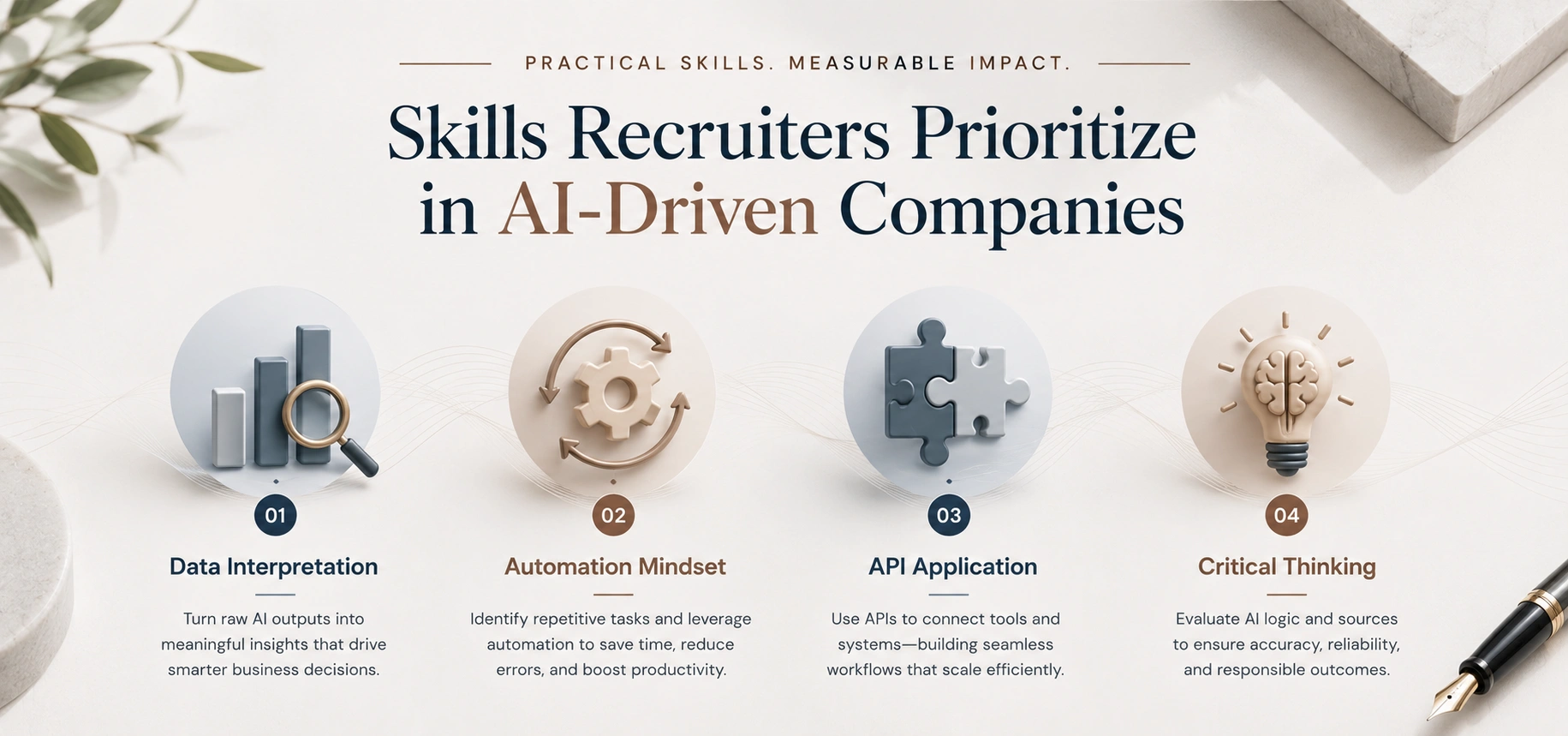
Recruiters also search for specific AI company skills that focus on practical and measurable outcomes. These include a variety of abilities that help a business run more smoothly using automation:
- Data interpretation to turn raw outputs into a coherent business strategy.
- An automation mindset to identify repetitive tasks that should be given to digital labour.
- The ability to apply application programming interfaces to connect different tools.
- Critical thinking to evaluate the logic and the sources used by automated agents.
An automation mindset involves auditing one's own daily schedule for tasks that can be delegated. For example, a sales lead might use an agent to summarize their calls and update the CRM automatically. This allows the employee to focus on building relationships rather than doing manual data entry.
Why Future Job Skills Are Becoming Hybrid
The future job skills that will define the next decade are a mix of many different disciplines. They combine traditional business judgment with a high level of technical curiosity and agility. This hybrid approach is necessary as digital labour becomes more common in every professional office.
The concept of the AI job is evolving rapidly across every industry and every geographic region. Soon, almost every role will involve regular interactions with digital agents or automated workflows. Employees will need to be comfortable managing these tools as if they were part of their direct team.
The AI market was worth $150 billion in 2023 and is projected to reach $1.3 trillion by 2030. This massive growth means that job security will depend on your ability to work with these systems. Professionals must be ready to evolve their roles as the technology becomes more integrated.
Continuous learning is the most important part of this hybrid skill set for any professional. The technology changes so quickly that static knowledge becomes outdated in just a few months. Candidates must show a willingness to adapt and learn new systems as they emerge in their field.
Using platforms like Trailhead or Coursera can help you demonstrate this commitment to a recruiter. By completing certifications and courses, you show that you are proactive about your career development. This adaptability allows a worker to move between different types of tasks and tools easily.
What Recruiters Actually Screen For
During the interview process, recruiters look for evidence of practical experience and real-world results. They often find that real projects are much more valuable than generic AI certificates on a resume. A certificate shows that you watched a video, but a project shows you can solve a problem.
Candidates should focus on explaining the specific reasoning behind their use of AI tools. It is not enough to say that you used a chatbot to help you write a long report. You should explain why you chose that tool and how you verified the accuracy of the final document.
A key tip for candidates is to describe your actual workflow, not just a list of tool names. Detail how you used automation to clean data and how that improved your team's quarterly sales. This shows a recruiter that you understand the business value of the technology you use.
Consider a case where a candidate managed an AI agent to categorise 5,000 customer tickets. The candidate should explain the specific human oversight steps they took during the categorisation process. They might describe how they audited the sentiment analysis to ensure customers were treated fairly.
Recruiters screen for people who have used upskilling at work to improve their personal performance. They want to see that you took the initiative to learn a new system on the job. This demonstrates both a proactive attitude and a practical understanding of what a business needs to grow.
Also Read: Top 5 AI Tools to Practice Mock Interviews Like a Pro
Conclusion: The Maturing AI Job Market
The hiring market is shifting from simply using AI to applying mature AI judgment to every task. Companies no longer just want people who can generate text or images with a simple prompt. They want employees who can integrate these tools into a broader and more effective professional strategy.
The skills recruiters look for in AI companies focus on the intersection of human decision-making and technical literacy. Professionals who can balance these two areas will be in the highest demand for years. They provide the human oversight and the strategic direction that technology cannot replace.
Success in this new market depends on a commitment to learning and a focus on analytical use. The future of work is not about machines replacing people in every role. It is about people who use technology to work more effectively than those who do not.
The intersection of business judgment and technical skill will define the leaders of the next decade. Developing these abilities today will ensure you remain a vital asset to any AI-driven organization. The focus must always remain on how human insight can improve the results of our digital tools.