

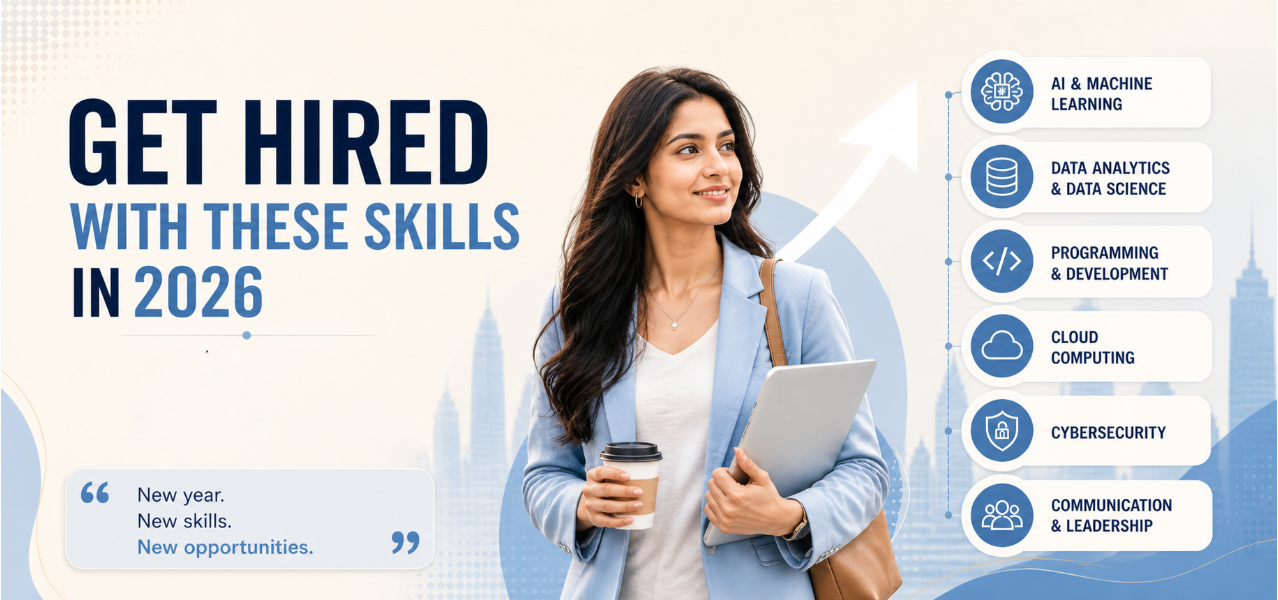
Let’s face it: every year, the tech world throws something new at us. One year it’s AI, next it's cloud, then cybersecurity, then GenAI, then AI agents, and then you’re left wondering: “What do I actually need to learn to stay relevant in 2026?”
You suddenly feel disconnected, you want to keep up with the trend, you too want to learn to use AI, to understand cybersecurity threats, and to be able to read data and follow the tech. You’re not alone. Every student, working professional, and career-switcher is asking the same question.
Maybe now is the time you finally take a step to learn something that will not just build your career but will make your career grow! The year 2026 is no longer a future you are waiting for; it is a tomorrow that is soon approaching, and it is going to bring something new. But this time, you don't want to experience it; you want to lead it.
This blog will detail the exact skills industries will demand in 2026 without fluff and confusing jargon.
Why Tech Skills Matter More Than Ever in 2026
Have you ever walked out of an interview feeling confident but later found a rejection email in your inbox? A rejection stating that you have hard-working skills, you have the potential, but you lack the skills required to survive in this tech-driven world.
You watch your peers getting promotions while you are repeating the same routine. No, it is not the degree they did, but it is their pace of following up with the trends. And in 2026, this pace and skills will turn “waiting for your turn” to “finally living it”. These skills are not just what you should run, but it is also what industries are looking for.
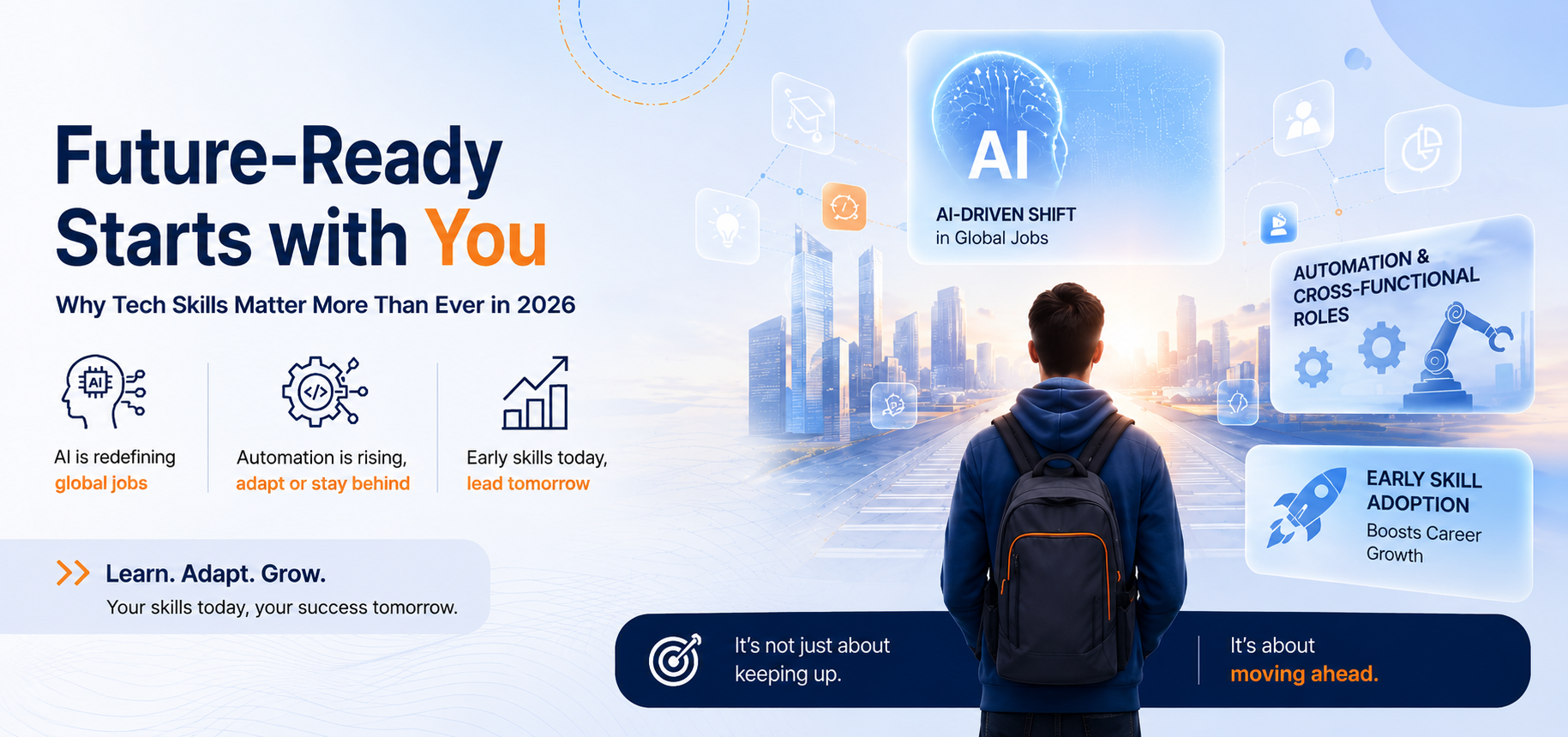
The paragraphs given below will explain exactly why tech skills are becoming non-negotiable as we step into 2026.
The AI-driven shift in global Jobs
This year, 2025, is almost at the end, and surely you might have come across situations where the work that was earlier done manually by humans is not done in collaboration with AI. You might also be taking help from AI tools to complete your tasks, like:
- Asking AI to make an Excel sheet for you
- Generate an image
- Draft an email
- Change the tone from informal to professional in the content.
Yes, that is how much AI has already been integrated into industry and different sectors. Now imagine what it will be like in 2026. Companies are not looking for candidates to just “do the job”, but now they want people who can understand and adapt to AI tools and work in digital workspaces.
This does not mean to master AI and become an AI Engineer; it simply means that you should know how AI impacts your domain, how to use AI tools, and how to stay relevant in the AI-powered workplaces.
Increased automation & need for cross-functional roles
You might have heard a common phrase, “working like robots”. This phrase could be seen live in today’s world. Now companies prefer individuals who can handle multiple responsibilities, collaborate across departments, and use tech to work smarter.
This is where cross-functional skills come in. Whether you are in HR, Finance, IT industries, or operations, employers want professionals who can:
- Understand the basics of tech
- Use digital tools confidently
- Analyze data
- Solve problems using technology
- Adapt when job roles evolve
AI and automation will not steal your jobs, but the productivity automation shows sets up expectations for employers from their employees. So these tech skills make you harder to replace, more portable, and more future-ready.
How early skills adoption boosts career growth
Now you know what the next year will expect from you, so why wait? Starting to adopt skills will prevent you from struggles and can provide promotions, standing out in interviews, build confidence, avoid the stress of learning all things at once, and make you suitable for high-growth roles.
Your future becomes easier not because the world slows down but because you speed up before everyone else does.
Most In-Demand Tech Skills for 2026
It’s 2026, and two people apply for the same job, with the same degree and qualifications. Out of the two, only 1 gets selected for the role, and the other doesn't even pass the screening. Why?
Because it was not just about qualifications, skills get you recognised, seen, and chosen. Below are the skills that separate professionals who grow from those who get left behind.
1. Artificial Intelligence & Machine Learning
While using AI tools, you might wonder how this tool is able to do multiple tasks within a few minutes. Whether it is writing an article or generating a task calendar, it just takes a few instructions, and you get the results. AI and Machine Learning are the skills that now seem mandatory for everyone to know. Think of AI skills as:
- Automating your routine tasks
- Creating smarter workflows
- Making better decisions
- Building AI-based mini tools
Why it matters in 2026: If you understand AI even at a basic level, you instantly become more relevant, more efficient, and more valuable than 90% of your competition.
2. Cloud Computing (AWS, Azure, GCP)
Every business is moving to the cloud because it’s cheaper, safer, and faster than traditional systems. Cloud isn’t just “hosting files”, but it’s the backbone of apps, AI models, security, payments, databases, and entire organisations. Cloud skills include:
- Setting up servers
- Managing large systems
- Deploying apps
- Keeping data safe
Why it matters: Companies need people who can manage the digital world in which they operate. Cloud-skilled professionals are the new “tech architects.”
3. Cybersecurity & Ethical Hacking
Everything you store on your digital devices could be stolen. Feeling scared? Because our digital devices and data are not just words and numbers, but they are everything we do, and companies operate on. A single security flaw can cost a business crores, damage trust, or shut them down completely. Cybersecurity skills help you:
- Identify vulnerabilities
- Prevent hacking attempts
- Protect sensitive data
- Secure cloud environments
Why it matters: Security professionals are no longer optional. They are the shield every company desperately needs in 2026.
4. Full Stack Development
Whenever you scroll through a website, you see whatever the developers want you to see. Full-stack developers are no longer just “developers.” They’re problem-solvers who understand how the entire system works, from the screen the user touches to the logic running at the backend. You learn how to:
- Build websites
- Create apps
- Manage databases
- Fix bugs
- Deploy products
Why it matters: Full-stack developers solve problems quickly, work independently, and deliver results faster, qualities every hiring manager values.
5. Data Science & Data Engineering
Businesses depend on data to understand customers, improve products, and plan their future. Data science makes sense of information. Data engineering builds the pipelines to move and clean that information. These skills help you:
- Analyze patterns
- Make predictions
- Build dashboards
- Power AI systems
Why it matters: Everyone has data. But very few know how to use it. That’s why data roles will always stay in demand.
6. DevOps & MLOps
Suppose you are using a software, and suddenly it stops, or there are some issues. The need for professionals who solve these issues before the users notice them ensures the smooth flow of the system. You learn how to:
- Automate processes
- Manage deployments
- Fix issues before users see them
- Keep systems running smoothly
- Deploy AI models
Why it matters: These roles directly support speed, stability, and innovation: the three factors every tech company depends on.

7. UI/UX & Product Design
There are so many websites for a particular thing, but each differs in terms of design, layout, and interface. Some might seem complicated to navigate, while others are creative and have an easy interface. Technology doesn’t win based on features; it wins based on how easy and enjoyable it is to use. UI/UX focuses on:
- Simple navigation
- Clean layouts
- Logical user journeys
- Emotion-driven design
Why it matters: Good design increases sales, improves user satisfaction, and builds trust. That’s why designers are becoming as important as developers.
8. Blockchain & Web3 Technologies
Blockchain isn’t just cryptocurrency anymore. It is a secure, decentralised way to store and track information. Web3 uses blockchain to make applications that are secure and transparent. It’s being used for:
- Digital identity
- Security
- Smart contracts
- Supply chain systems
- Healthcare records
Why it matters: Companies want people who understand modern, secure, transparent systems, not just old traditional databases.
9. AR/VR & Spatial Computing
You can experience adventurous activities like bungee jumping, scuba diving, or driving a car without actually being present at the place. The future of work, entertainment, education, and shopping will be far more immersive.
With spatial computing, you work with:
- 3D models
- Virtual workspaces
- AR filters
- VR training simulations
Why it matters: Industries are investing heavily in immersive technology, and they need talent who can bring these experiences to life.
10. Automation & No-Code/Low-Code Tools
You don’t have to be a programmer to build digital solutions anymore. Some tools allow automating tasks that are repetitive or building apps without any deep knowledge of coding. Automation tools allow you to:
- Create workflows
- Build mini apps
- Connect systems
- Save hours of manual effort
Why it matters: Companies want employees who can get more done without depending on tech teams all the time.
11. Robotics & IoT (Internet of Things)
Machines and devices are becoming smarter, from factories to homes to hospitals. Robots are no longer cleaning homes, cooking food for you, driving cars, running, dancing, and whatnot. But these are not just machines working; it's the brains behind these that work.
IoT and robotics skills help you:
- Connect devices
- Build smart systems
- Collect real-time data
- Automate physical tasks
Why it matters: Human + Machine collaboration is the next big shift. Industries need people who can operate in this hybrid environment.
12. Software Testing & QA (Manual + Automation)
As software grows, mistakes become costlier. Testing isn’t “just checking for bugs”; it’s ensuring the product is safe, fast, reliable, and user-friendly.
You learn to test:
- Web apps
- Mobile apps
- APIs
- Security
- Performance
Why it matters: Good testers save companies millions by preventing failures before launch.
How to choose the right Tech Skill for your Career
Have you ever opened Google, typed “Best tech skills to learn,” and instantly felt overwhelmed?
There are dozens of skills. Hundreds of courses. Thousands of opinions. But zero clarity. And if you’re already working, the pressure feels even heavier:
You’re trying to grow, trying to stay relevant, trying to stop your career from becoming “replaceable.” But every time you sit down to decide which skill to learn, you fear choosing the wrong skill and then not using it at all.
Choosing the right tech skill isn’t about guessing trends. It’s about understanding your journey, your strengths, and where the future is heading. A given checklist of points to consider can help you in finding the skill that you require and can put effort into learning it:
- Start with your own situation. Why do you want to learn a skill? Maybe it's for promotion, a career switch, or even to become effective in whatever you are working at present.
- Analyse your interests and find a skill that you would like to learn instead of just forcing yourself to learn something you are not even interested in. It will make the overall up-skilling process more complicated.
- Check what's missing in your career. Once you realise what is missing, the right skill will appear to be an obvious choice.
- Research on industry demand and trends for a particular skill, and not the hype.
- Is it a skill you would be using after 5 to 6 years as well?
- Try learning and gaining knowledge about that skill for 1 week and test its alignment with your interests, career, and vision.
Learning Path: How to build these skills in 2026?
Start small. Pick one direction. Learn consistently. Because in 2026, careers won’t be built by those who know everything but by those who finally choose something and commit to it.
Maybe you’ve already taken small courses that didn’t help.
Maybe you’ve tried learning on YouTube, only to feel more lost than before.
If numbers excite you more than people do, if dashboards feel satisfying, and if uncovering patterns feels like solving mysteries, then paths built through Data Science, Business Analytics, Finance, or AI/ML will feel like home.
If you like fixing things, building ideas from scratch, understanding how systems work, or protecting what matters, then Full Stack, Cybersecurity, Cloud, AR/VR, and AI development will give you the thrill you never felt in your current job.
If you’re someone who thinks visually, writes well, understands people, or enjoys creating experiences, then Digital Marketing, Marketing, UI/UX, and Product-driven programs will let your creativity finally breathe.
And if you naturally take charge, connect dots, plan, organise, lead teams, or want to influence decisions, then MBA programs in IT, Operations, HRM, International Business, Supply Chain, Business Analytics will help you step into rooms where strategy matters more than coding.
Choosing a tech skill isn’t about following trends. It’s about choosing your future self. The one who is confident, qualified, and doesn’t get rejected because of “missing skills” and the one who finally feels ready.
Conclusion
If there’s one thing your career has taught you so far, it’s this: nothing changes until you decide to change it.
Opportunities don’t slow down. Industries don’t wait. And 2026 is going to reward the people who are prepared, not the people who are simply hopeful. But here’s the truth you needed to hear today: You are not behind. You are just one right skill away from changing everything.
Tech skills aren’t just tools; they are the confidence you bring into interviews, the growth you unlock in your current role, and the value companies recognise the moment they see your resume.
LPU Online offers you the opportunity to take that step, to build a strong foundation, to learn with structure, support, and real industry-aligned programs. A place where your journey doesn’t just continue, it transforms.
FAQs
Which tech skills are most in demand in 2026?
Tech skills like cloud computing, AI/ML, automation, data science, data engineering, cybersecurity, full-stack development, UI/UX Design, etc, will be most in demand in 2026.
Why is cloud computing considered a future-proof skill?
Cloud Computing is considered a future-proof skill because it is like renting computing power and storage from big tech companies like AWS, Azure, GCP, etc. The majority of businesses run online now, so they need people who can effectively manage their cloud systems.
Can a non-developer learn full-stack development and succeed?
Full-stack combines front-end, database, and deployment. So anyone willing to learn can start building web applications. It is not about coding or developing; it is more about one’s interest and passion. Many full-stack developers start without prior deep specialisation.
Do design skills like UI/UX still matter in 2026 when AI is rising?
Yes, even with AI, human-centric design – what feels intuitive, what looks good, what empathises with users remains critical. Good UI/UX increases adoption, retention, and trust in products. Design will continue to be a differentiator.
Is a degree needed to start building these skills, or can these be learned through online courses or self-study?
You don’t always need a degree to learn something new. But a degree provides a structured learning platform and can help provide a deeper understanding and credibility. Also, having a degree along with skills is beneficial in career growth.
Which industries in India will value these tech skills the most in 2026?
Industries like IT & SaaS, Finance, healthcare, logistics, fintech, e-commerce, digital marketing, etc, all expect growth. Because these skills are broadly applicable, almost all industries require individuals well-equipped in these skills.