

The MBA Reality Check
For years, the Master of Business Administration (MBA) was the undisputed "golden ticket" to corporate leadership, top-tier pay, and professional distinction for many years. But as 2026 draws near, a deep sense of unease is spreading throughout the graduating community. Artificial intelligence is rewriting the fast, mechanised corporate world, not only changing it.
The harsh reality is that a regular MBA, which used to be a guarantee of a professional path, is currently experiencing a structural devaluation. The fast-paced, tool-driven execution needed by modern industry contrasts sharply with the theoretical frameworks taught in traditional courses. Candidates who have historical knowledge but lack the digital fluency to generate an instant return on investment are becoming less and less trusted by employers. The modern MBA student needs to evolve from a generalist to a tech-fluent strategist who can navigate a world where artificial intelligence (AI) is the main source of productivity if they want to stay relevant.
The Information Supporting the Depreciation
Economic indicators showing strong trends and a clear reduction in conventional recruiting behaviours highlight the changing perception of an MBA, and this is more than just hearsay. At present, a significant "productivity gap" is casting a shadow over the degree’s reputation, causing recruiters to question the "job-readiness" of even the most highly regarded graduates.
Employment and Economic Trends:
- Persistent Unemployment: Approximately 20–25% of MBA graduates remain unemployed or underemployed within 3–6 months of completing their degrees [LinkedIn Economic Graph, Financial Times].
- Hiring Contraction: Graduate-level MBA hiring in high-prestige sectors like consulting, technology, and corporate strategy declined by 15–20% between 2022 and 2025 [Bloomberg, Global Hiring Reports].
- The Oversupply Crisis: Global MBA graduate output has increased by more than 40% in the last decade, while growth in managerial and strategic roles has remained below 15% [OECD, International Labour Organisation].
- The Productivity Gap: Only 35–40% of MBA graduates are considered fully productive within their first year of employment, leading to increased scrutiny of the curriculum [Deloitte Human Capital Trends, Harvard Business Review].
- Underutilization of Talent: More than 60% of MBA graduates globally are now accepting roles that do not formally require an advanced degree [OECD Employment Outlook].
- The Skills Mismatch: Over 60% of employers report that graduates lack job-ready skills, specifically regarding AI usage and digital decision-making [World Economic Forum, PwC Talent Survey].
These statistics represent a fundamental pivot from "prestige hiring", where the institution's brand was the primary filter, to "skill hiring." In this new era, the candidate's ability to demonstrate fluency in specialised toolsets and real-time decision-making is the new metric of professional worth.
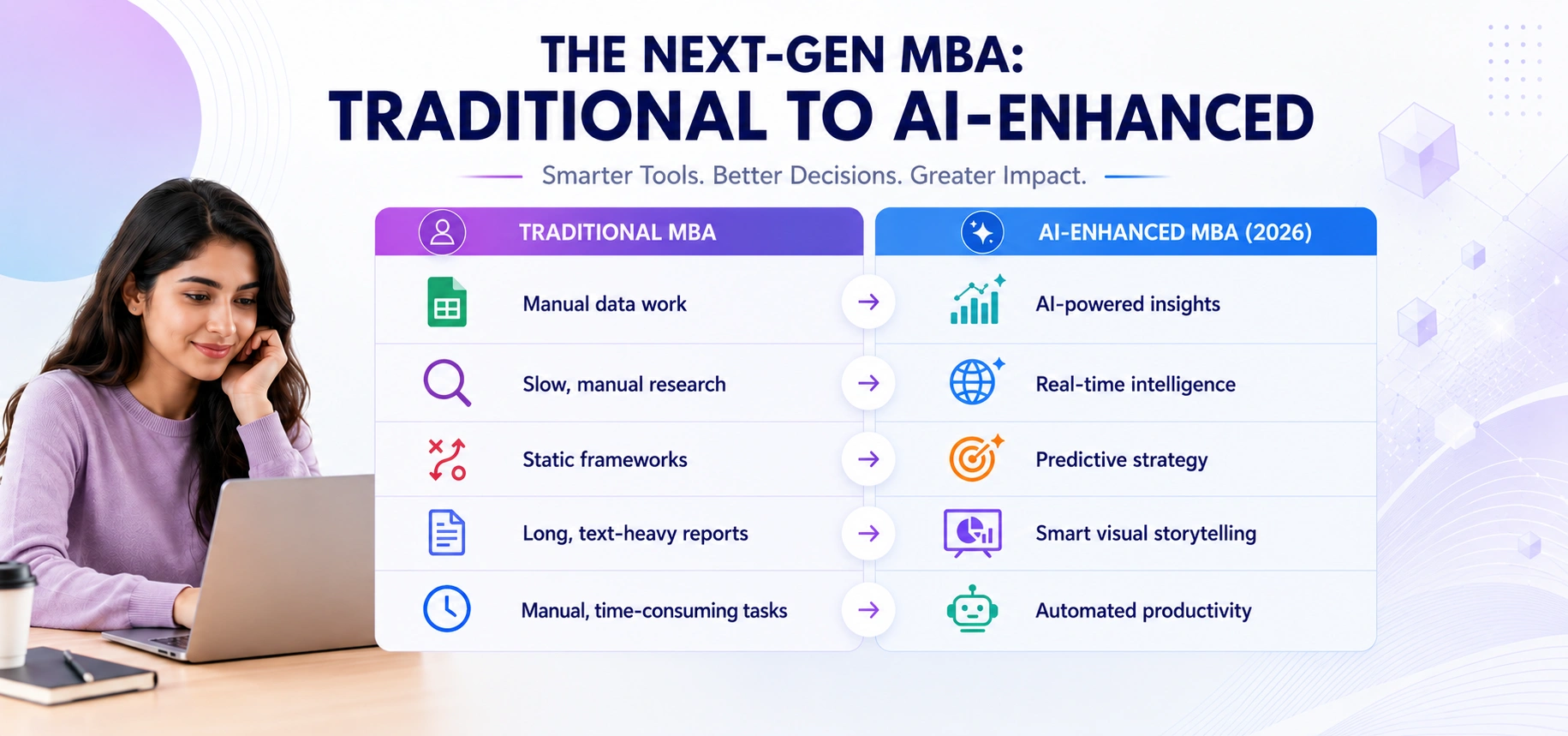
Mandatory Comparison: Traditional vs. AI-Enabled MBA
To survive the 2026 hiring cycle, students must understand how traditional management functions have been augmented by technology.
|
Feature |
Traditional MBA Approach |
AI-Enabled MBA (2026 Standard) |
|
Data Modeling |
Manual spreadsheet entry, complex formula building, and static pivots. |
AI-assisted forecasting, natural language data querying, and automated cleaning. |
|
Market Research |
Manual literature reviews, anecdotal evidence, and static quarterly reports. |
Real-time market intelligence, sentiment analysis, and vetted AI evidence synthesis. |
|
Strategy Development |
Reliance on static theoretical frameworks (e.g., SWOT, Porter’s Five Forces). |
Tool-driven execution with real-time scenario modelling and predictive impact analysis. |
|
Communication |
Long-form documentation, manual slide design, and text-heavy presentations. |
AI-augmented storytelling, automated visual dashboards, and dynamic reports. |
|
Productivity |
Manual task tracking, sequential workflows, and heavy administrative overhead. |
Automated workflows, AI-driven project prioritisation, and thread summarisation. |
Industry Mapping: Roles, Skills, and Toolsets
Modern MBA functions now require a precise alignment between core industry skills and the AI toolsets used to execute them at scale.
|
MBA Role |
Core Industry Skills Expected |
Essential AI Tools |
|
Marketing & Growth |
Performance analysis, Campaign ROI, SEO strategy, and customer retention. |
Jasper, Semrush, HubSpot AI, CRM insights. |
|
Finance & Analytics |
Financial modelling, scenario planning, risk analysis, and data interpretation. |
Microsoft Copilot, Bloomberg GPT, Tableau, and DataRobot. |
|
Operations & Supply Chain |
Process optimisation, capacity planning, and cost efficiency analysis. |
Zapier AI, Slack AI, Tableau, Workflow Automation. |
|
Strategy & Consulting |
Market sizing, problem structuring, and executive-level storytelling. |
AlphaSense, Refinitiv AI, Consensus, Beautiful.ai. |
|
Product Management |
KPI ownership, roadmap prioritisation, and user insight analysis. |
Notion AI, Asana with Work Graph AI, and Product Analytics platforms. |
The 2026 Solution: Bridging the Gap with AI Tools
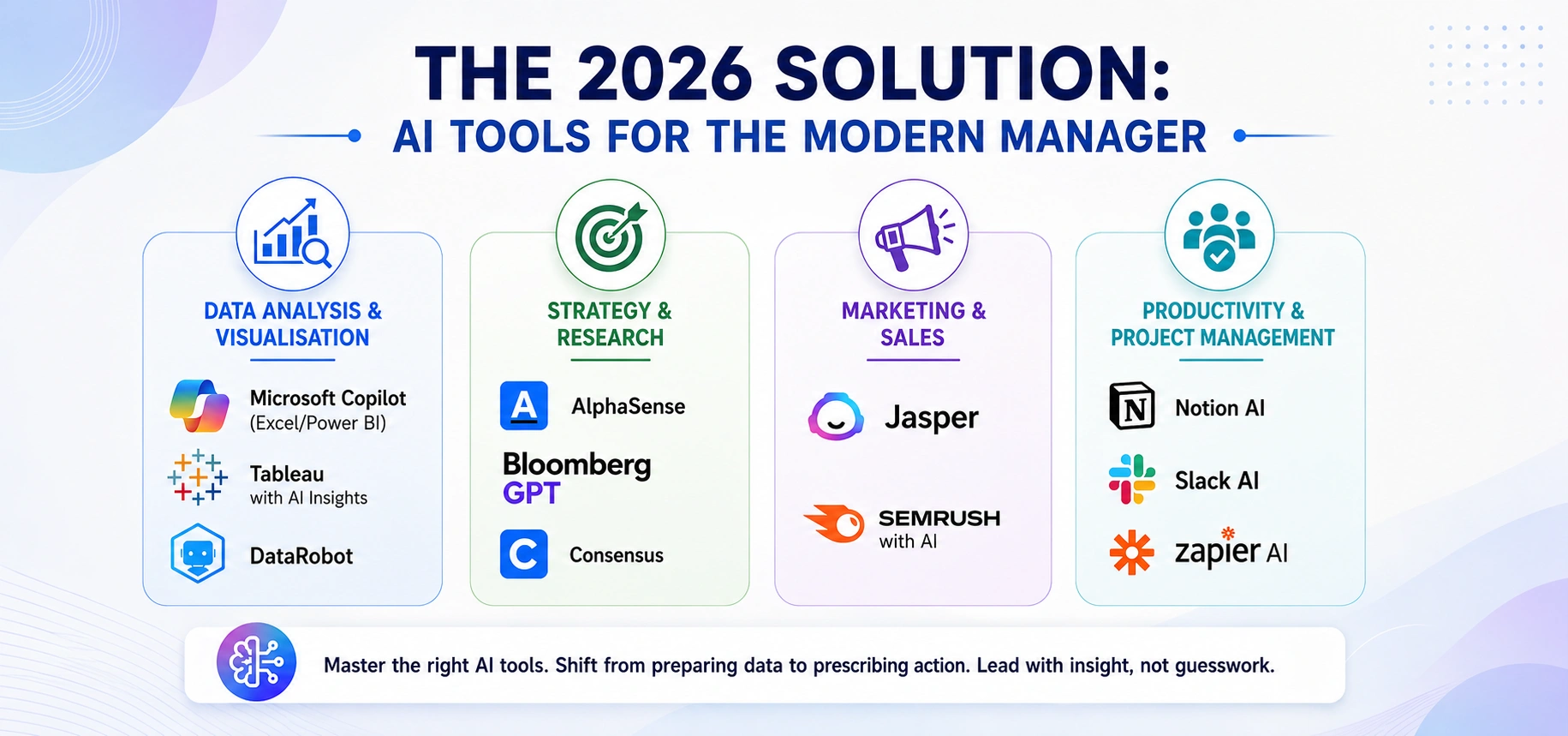
To meet the high-performance demands of the modern firm, students must master a specific "Power Suite" of AI tools for management studies. These tools shift the manager’s role from "preparing data" to "prescribing action."
Data Analysis & Visualisation
The goal is to move away from technical bottlenecks and toward high-level strategic interpretation.
- Microsoft Copilot (Excel/Power BI): Managers can use natural language to build complex models. Real-World Outcome: Reducing the time spent on data preparation by 70%, allowing for instant "what-if" scenario testing during executive meetings.
- Tableau with AI Insights: Automatically detects hidden patterns and outliers. Real-World Outcome: Shifting from reactive reporting to proactive discovery, identifying market shifts before they appear in standard quarterly reviews.
- DataRobot: An automated machine learning platform. Real-World Outcome: Enabling strategy students to build predictive models for customer churn or market demand without requiring a background in data science.
Strategy & Research
Modern strategy requires vetted, real-time intelligence over outdated academic case studies.
- AlphaSense & Bloomberg GPT: These provide AI-powered search across filings, transcripts, and news. Real-World Outcome: Compressing weeks of competitive research into minutes, enabling a "decision-ready" analysis of an entire industry sector.
- Consensus: A research assistant who pulls evidence from vetted academic sources. Real-World Outcome: Ensuring that business arguments are backed by verified, peer-reviewed evidence rather than hallucinated AI data.
Marketing & Sales
Efficiency is now measured by the speed of iteration and the precision of the growth funnel.
- Jasper: Tailored for generating high-converting marketing copy and campaign drafts. Real-World Outcome: Allowing a small marketing team to produce a month’s worth of multi-channel content in a single afternoon.
- Semrush with AI: Essential for keyword planning and competitive SEO. Real-World Outcome: Achieving organic growth targets by identifying high-value search trends before competitors.
Productivity & Project Management
Automation is the primary solution for the "ambiguity" and "oversupply" challenges facing new hires.
- Notion AI & Slack AI: These tools summarise long project threads and extract action items. Real-World Outcome: Eliminating "meeting fatigue" and ensuring that project momentum is maintained across cross-functional teams.
- Zapier AI: Automates repetitive workflows between different applications. Real-World Outcome: Creating "self-managing" administrative systems that free the manager to focus on high-impact commercial thinking.
"The industry is not rejecting MBAs as a qualification. It is rejecting generic, theory-heavy MBA profiles that lack applied skills, tool proficiency, and real-world decision-making exposure."
Strategic Analysis: The Portfolio Shift and Why Tool Fluency Wins
The 2026 hiring landscape is governed by the "60–90 Day Rule." Employers now expect MBA hires to contribute meaningful, measurable value within the first three months. The era of the two-year "ramp-up period" is over. Candidates who cannot leverage AI to shorten their learning curve are being left behind.
The Portfolio Shift: Beyond the GPA
A critical finding in recent industry surveys is that only 30–35% of MBA students work on live business projects before graduating [GMAC Global MBA Survey]. This creates a massive opportunity for differentiation. Recruiters are no longer looking for a high GPA; they are looking for a portfolio of tool-driven outcomes. Instead of claiming they "understand finance," a candidate should demonstrate an automated valuation model built using Koyfin AI or a market-entry strategy synthesised via AlphaSense.
Key Takeaways:
- Ownership Under Ambiguity: Employers value candidates who use AI to frame problems and start executing even when a full data set isn't available. This "bias toward action" is facilitated by rapid AI prototyping.
- Commercial Thinking: There is a heightened focus on ROI awareness. Tool fluency allows a manager to quickly calculate the revenue impact or cost-efficiency of a decision, aligning their work with the firm's bottom line.
- Applied Capability Over Prestige: Preference has shifted toward those who can interpret dashboards and KPIs in real-time. The ability to "talk to the data" using tools like Microsoft Copilot is now a baseline requirement for strategy roles.
Conclusion: The New Path to Success
The MBA degree continues to serve as a significant basis for a business career, but it has evolved beyond just being an endpoint. In the economy of 2026, this degree functions as the groundwork, while the integration of AI acts as the catalyst for growth. By becoming proficient in the vital array of AI tools relevant to management studies, graduates can transition from passive learners to "decision partners," individuals who not only grasp business concepts but also actively contribute to their advancement. As the job market becomes increasingly competitive and a global surplus of graduates emerges, consider this: Are you ready to demonstrate your worth from Day 1, or are you still depending on a degree that the industry indicates is insufficient?
Frequently Asked Questions (FAQs)
-
Why are traditional MBA graduates struggling to find jobs?
The challenge primarily stems from a "productivity gap" and an overwhelming surplus of graduates. Data from the industry indicates that the number of MBA graduates has risen by 40%, while the growth in managerial positions has only reached 15% [OECD, ILO]. Additionally, more than 60% of employers indicate that graduates lack the necessary job-ready skills in AI and digital decision-making, prompting recruiters to prefer candidates with demonstrated technical proficiency over those who possess only theoretical knowledge. -
What are the most important AI tools for management studies today?
The most critical tools are those that facilitate data-driven decision-making and rapid execution. These include Microsoft Copilot for data analysis, AlphaSense and Bloomberg GPT for market intelligence, Jasper for marketing execution, and Notion or Slack AI for workflow automation. These tools allow a manager to function as a high-level "decision partner." -
Does AI replace the need for a management degree?
No. The industry still values the strategic mindset and networking foundation a degree provides. However, it rejects "generic" profiles. AI is an accelerant; it allows a manager to execute the theoretical concepts of the MBA, like strategy and financial modelling, with ten times the speed and accuracy of a traditional graduate. -
How can an MBA student demonstrate their "AI fluency" to a recruiter?
Recruiters are increasingly valuing practical skills over formal certifications. Students can showcase their fluency by assembling a portfolio of projects that utilise AI for tasks such as predictive forecasting, synthesising research, or streamlining operational workflows. The capability to analyse a dashboard and make a business decision based on it is more significant than merely mentioning "AI" on a resume. -
What is the "60-90 day" contribution rule?
This is a modern employer expectation that MBA hires must solve problems and provide business value within 60 to 90 days of joining. Employers no longer want to invest in long, expensive training periods; they seek candidates who can hit the ground running by using digital tools to bridge their own knowledge gaps and contribute to ROI immediately.