

Learning no longer waits for a classroom bell to ring.
It happens while commuting, during late-night revisions, inside virtual labs, and through systems that adapt to how fast or slow you learn. Learning has moved beyond fixed timetables and classroom walls, becoming more adaptive, accessible, and personalised.
Yet many learners still feel something is missing.
Today’s industries are being shaped by AI, simulations, real-time data, and digital collaboration. But many traditional education models still struggle to evolve at the same pace. Students are expected to become future-ready while learning through systems built for a very different era.
This gap is exactly where EdTech steps in.
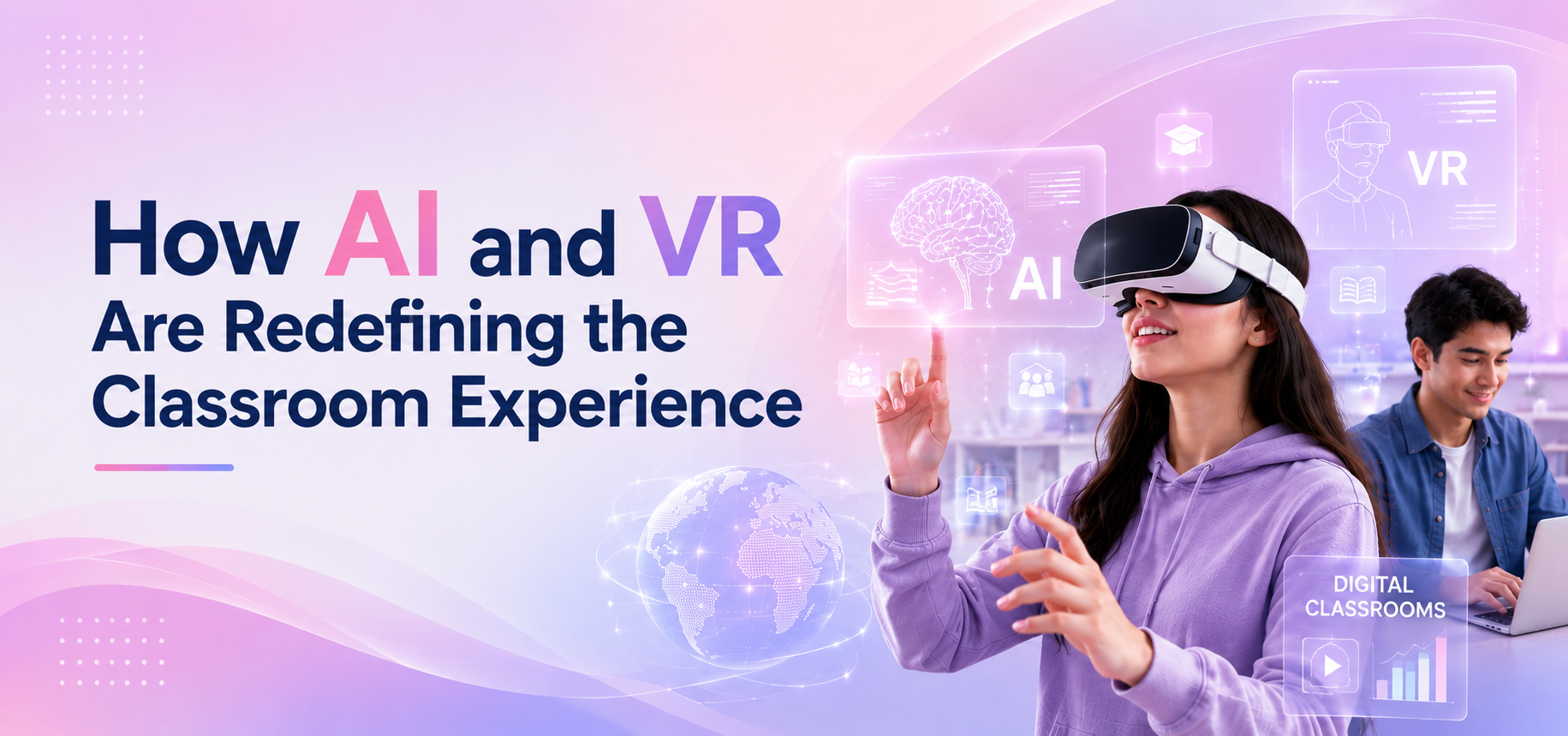
Artificial Intelligence, Virtual Reality, and digital classrooms are no longer experimental concepts. They are transforming how knowledge is delivered, understood, and applied. Not as replacements for education, but as tools that make learning more immersive, relevant, and aligned with real-world expectations.
In this blog, we explore the key EdTech trends driving next-generation learning and what they mean for students seeking an education that prepares them for more than just exams.
Why Education Is Undergoing a Digital Shift
Remember how, before the COVID pandemic, the thought of online classes never even crossed your mind? The moment classes started to be conducted online, it seemed temporary, but now it has become a common and even more flexible way of learning. Online classes are no longer a choice for people, but for some, it is the only option. People now prefer to learn sitting at home, in their own comfort.
This has also benefited educators to become more creative in teaching, including teaching through presentations, online simulations, proctoring tests online, and more.
Further upcoming paragraphs will detail the main reasons why education is shifting to digital.
The Changing Expectations of Learners
Today's learners aren't chasing facts. They're chasing the story those facts are trying to tell.
They expect learning to be flexible, relevant, interactive, and aligned with real-world skills. Recorded lectures alone aren’t enough. Static notes don’t answer evolving doubts. Learners want clarity, context, and application.
Education is no longer about “covering the syllabus.”
It’s about building confidence and capability.
Industry Demands Are Driving Educational Change
Industries now evolve faster than academic cycles.
New tools, platforms, and roles emerge every year. Employers expect graduates to be digitally fluent, comfortable with technology, and capable of learning continuously.
This pressure has pushed education providers to rethink how learning happens – not just what is taught.
Artificial Intelligence in Education: Learning That Adapts to You
Education is no longer about catching up.
It’s about staying relevant in a world that refuses to slow down.
As AI begins to guide learning paths, virtual environments replace static explanations, and digital classrooms erase geographical limits, one thing becomes clear: how you learn matters just as much as what you learn.
The future doesn’t reward those who wait for change.
It rewards those who learn from it. Because next-generation learning isn’t a distant concept. It’s the reality shaping careers right now.
And the students who choose to learn this way aren’t preparing for the future – they’re already part of it.
Personalised Learning Through AI
AI-powered learning systems don’t treat every student the same.
They track learning patterns, identify gaps, and adapt content accordingly. If a student struggles with a concept, AI-based platforms slow down, revise, or present it differently. If a student excels, the system moves ahead.
Learning becomes personalised instead of standardised.
AI as a Support System, Not a Replacement
AI doesn’t replace educators – it strengthens them.
It handles repetitive assessments, provides instant feedback, and helps instructors focus on mentoring, guidance, and higher-order thinking. Students receive faster support, and teachers gain better insights into learner progress.
The result? Smarter learning, not automated education.
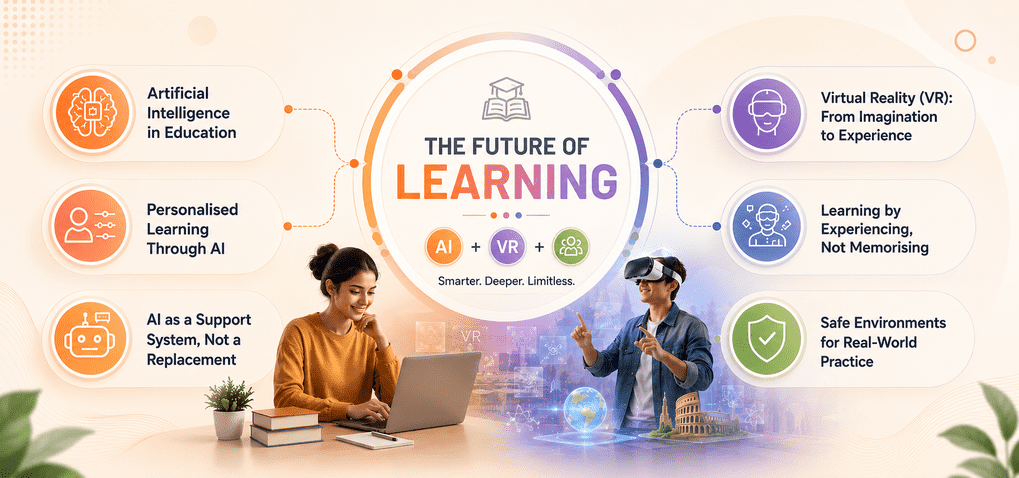
Virtual Reality (VR): From Imagination to Experience
Imagine learning anatomy by walking inside the human body.
Or understanding architecture by standing inside the structure before it’s ever built.
This is not science fiction anymore. This is Virtual Reality.
VR has quietly crossed the line from imagination to experience. What once felt like a futuristic experiment is now transforming how students learn, explore, and truly understand complex concepts. Instead of reading about ideas or watching them on a screen, learners are stepping into them.
In education, this shift is powerful. VR doesn’t just show information – it creates presence. It turns abstract theories into lived experiences, mistakes into safe practice, and curiosity into deep engagement.
As classrooms move beyond four walls, Virtual Reality is redefining what “learning by doing” actually means.
Learning by Experiencing, Not Memorising
Traditional learning often asks students to remember information long enough to pass an exam. Virtual Reality changes that expectation entirely. It replaces memorisation with immersion.
VR turns abstract concepts into lived experiences. Instead of reading about how a system works, students can step inside it. Instead of imagining a process, they can observe it unfolding and interact with it in real time. Concepts that once felt distant or confusing suddenly become clear, visual, and intuitive.
When learners experience ideas rather than just study them, understanding lasts longer. Lessons become stories the brain remembers, not facts it struggles to recall. This is especially transformative for technical, scientific, medical, engineering, and applied disciplines – where seeing, doing, and experimenting matter more than definitions on a page.
Safe Environments for Real-World Practice
One of VR’s most powerful advantages is the freedom to fail safely.
Virtual environments allow learners to practice real-world scenarios without real-world risks. Whether it’s conducting experiments, operating systems, handling complex tools, or responding to high-pressure situations, students can try, pause, correct mistakes, and try again.
There’s no fear of breaking equipment, harming outcomes, or being judged for getting it wrong. Learning becomes iterative and confidence-driven. Skills are refined through repetition, not pressure.
By the time students step into real workplaces or live environments, they’re no longer encountering situations for the first time. They’ve already practised, adjusted, and learned – virtually, but effectively.
Digital Classrooms – Learning Without Boundaries
Think about how learning used to happen. A fixed classroom. A fixed time. Miss one lecture, and you are already behind. The old model of learning was built for a life that no longer exists.
Careers are non-linear. Responsibilities overlap. Energy peaks at different hours for different people. And learning, if it’s going to survive in this reality, has to stop demanding perfect conditions.
Digital classrooms aren’t just online versions of physical rooms. They’re a complete rethink of how learning fits into real lives.
What truly sets digital classrooms apart is continuity. You’re not learning in isolation. Live interactions, peer discussions, collaborative tasks, real-time doubt resolution, and ongoing feedback keep the experience active and connected. Even without sharing a physical space, learners remain part of a shared academic journey.
Boundaries of location, rigid schedules, and one-size-fits-all pacing quietly dissolve. What remains is learning that adapts to you – rather than asking you to constantly adapt to it.
And when learning finally fits into life instead of fighting it, progress stops feeling forced. It starts feeling possible.
How EdTech Is Reshaping Skill Development
Remember when learning meant rushing to class, copying notes, and hoping you didn’t miss something important? That version of education is quietly fading.
Today, learning happens in moments between meetings, late at night after work, or early mornings before the world wakes up. Digital classrooms have changed where and how knowledge is accessed. No fixed seats. No rigid timelines. No single pace for everyone.
A lecture can be paused, replayed, and questioned. Discussions continue beyond scheduled hours. Doubts don’t wait for the next day – they’re resolved in real time. Learning adapts to your life instead of forcing your life to adapt to learning.
This isn’t convenience; it’s empowerment. Digital classrooms give learners control over their progress, their pace, and their priorities. Education stops being something you attend and becomes something you truly experience, anywhere, anytime.
From Theory-Heavy to Application-Focused Learning
For years, education followed a familiar pattern: understand the concept, memorise the definition, write the exam, move on. But when students stepped into the real world, many realised something uncomfortable – knowing about a skill wasn’t the same as knowing how to use it.
EdTech changes that equation.
Instead of stopping at explanations, modern learning platforms push learners into doing. Concepts are followed by projects. Lessons lead into simulations. Case studies mirror real industry challenges. You don’t just read how concepts work; you apply it, break it, fix it, and understand it deeply.
This shift is powerful because confidence comes from practice, not theory. When students build, analyse, test, and solve problems during learning itself, they stop fearing real-world tasks.
Continuous Learning Beyond the Degree
Today, a degree is no longer the final milestone; it is the first step toward continuous evolution.
Technologies evolve. Roles change. Skills that are valuable today can become outdated faster than ever. EdTech recognises this reality and supports learning as a continuous journey, not a one-time event.
Through short courses, certifications, skill updates, and focused modules, learners can reskill or upskill without starting from scratch. More importantly, they develop something far more valuable than any single tool or technology – the ability to adapt.
Why Online Degree Programs Fit the Future of Education
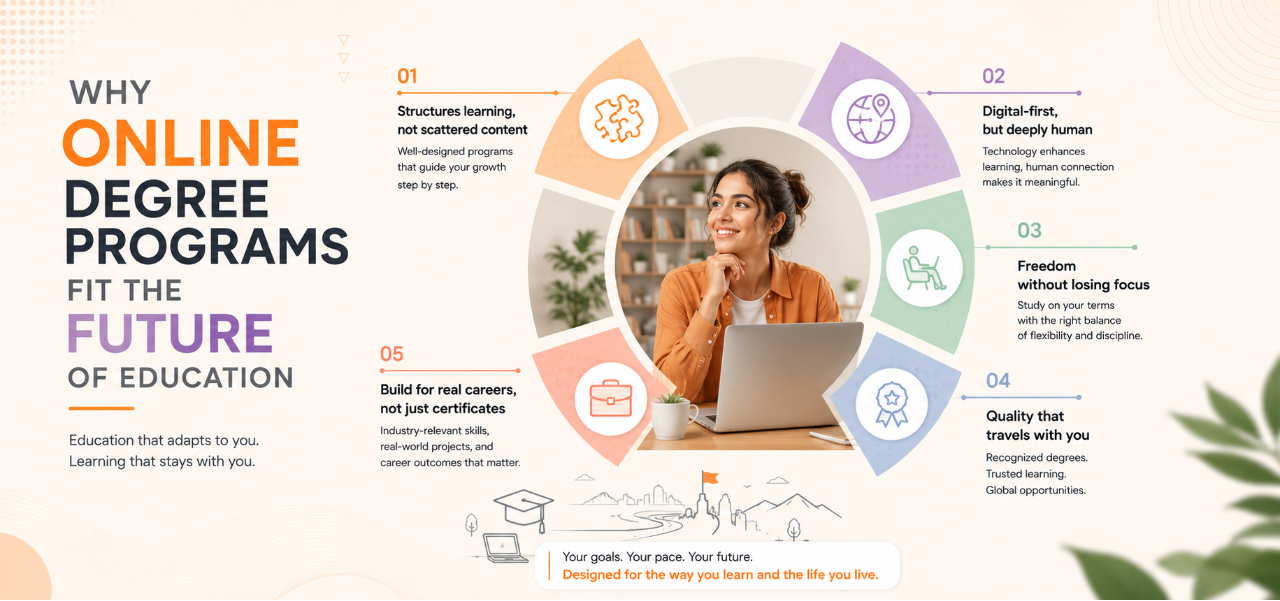
The future of education isn’t about choosing between structure and flexibility. It’s about bringing both together in a way that fits how people actually live, work, and grow today. That’s exactly where online degree programs stand apart.
- Guided learning, not fragmented information – A clear academic roadmap backed by a recognised curriculum, not random videos or short-term courses.
- Technology-enabled, yet personally connected – Interactive platforms, live sessions, discussions, and feedback that keep learning connected and engaging.
- Flexible learning with consistent direction – Learn at your pace, on your schedule, without stepping away from work or responsibilities.
- Education that goes beyond boundaries – Geography no longer decides access to good education; expert faculty and resources reach you wherever you are.
- Career-oriented learning that creates impact – Projects, case studies, and application-driven learning that prepare you for what comes after the degree.
Conclusion
Education today is no longer about keeping up. It's about staying ahead.
AI, VR, and digital classrooms have already redefined how learning works. Students no longer need programs that resist change or chase trends. They need programs that understand technology as a tool for better outcomes and build a curriculum around that understanding.
LPU Online does exactly that. Its online degree programs integrate digital classrooms, technology-driven learning tools, and industry-relevant curriculum into a structured academic experience that prepares learners for the real world. Students don't just earn degrees. They build digital fluency, adaptability, and the confidence to grow beyond what any classroom can predict.
Education and technology are no longer separate conversations. In a world where they are inseparable, the future belongs to learners who choose programs that evolve with them.
Next-generation learning isn't coming. It's already here. The only question is whether you want to become a part of it.