


Some journeys begin with a spark, not a classroom. Not a roll call.
Just you, a screen, and the quiet belief that your future can be shaped from anywhere.
That’s the magic of an Online Bachelor of Arts programme.
It’s for the dreamers who study between moments, the thinkers who turn curiosity into questions, and the creators who learn beyond the boundaries of walls and timetables.
Here, psychology becomes a window, political science becomes a mirror, and every subject becomes a new way of understanding the world and yourself.
But let’s be honest: online learning isn’t as simple as clicking “Join Class”. It requires the discipline to show up when no one is watching, the balance to juggle life and lessons, and the consistency to keep going even on the days when motivation disappears.
This blog shares the tips that help you do just that, not just to succeed in your Online BA programme, but to thrive, grow, and stand out. Because a BA isn’t just a degree, it’s a canvas waiting for your story. And every smart choice you make becomes a stroke of the masterpiece you’re creating..
What Makes an Online BA Journey Unique
An Online BA programme offers something traditional classrooms often can’t - freedom. The freedom to learn at your own pace, to explore ideas beyond fixed schedules, and to shape your academic journey around your life.
But with that freedom comes responsibility. There are no daily reminders, no physical classrooms, and no one constantly guiding your progress. Success depends on how consistently you show up, how well you manage your time, and how actively you engage with what you learn.
That’s why succeeding in an Online BA isn’t just about studying; it’s about building the right habits, mindset, and approach.
And that’s exactly what the following tips will help you develop.

1. Clear Goals and Time Management:
Every success begins with clarity, and before proceeding with your online Bachelor's program, ask yourself, “ Why are you doing this?” Your why could be anything - advancing your career, exploring your passion for any specialisation( sociology, psychology, etc.) or simply earning your degree. Use the SMART technique, which means that the goal must be specific, measurable, achievable and time-bound.
Break your goals into long-term and short-term goals: Break long-term goals ( graduating) into short-term goals by diving into each semester, each course, weekly assignments, mastering a new concept, etc. Use the Eisenhower Matrix Technique, in which you separate what's urgent vs important tasks. Prioritise your most urgent task rather than an important one.
2. Strategic Time Planning
Time management is often the biggest obstacle for online learners. The freedom that online study offers can easily become a trap if not structured wisely. But challenges can be converted into opportunities with a proper schedule and inner motivation.
Plan your week: Build a weekly Schedule, allot fixed time blocks for lectures, readings, revisions, and assignments. Treat these blocks like non-negotiable meetings.
Use digital planners: Tools like Google Calendar, Trello, or Notion can help you visualise deadlines and set reminders.
Avoid multitasking: Focus on one subject or task at a time. Research shows this boosts focus and productivity.
Stay consistent: Even one or two focused study hours daily can yield better results than cramming before deadlines.
Well-defined strategy transforms chaos into clarity. When you master your schedule, you not only stay on track academically but also free up time for work, hobbies, and rest, creating a healthy balance.
3. Self-Discipline and Consistent Motivation
Flexibility gives you independence, but that comes with responsibility. In the absence of teachers or classmates, maintaining focus can be tough. Motivation tends to fluctuate, and that’s normal. The key is learning how to reignite it when it dims.
Create a distraction-free zone: Identify the space where you stay focused, consistent and productive. Keep it tidy and technology-ready.
Follow the Pomodoro Technique: Study in 25-minute bursts with 5-minute breaks. Repeat this cycle till your task is complete. This method enhances focus and prevents burnout.
Reward yourself: After accomplishing a task, treat yourself to a snack, a short walk, or your favourite show. Rewards keep your brain motivated and consistent.
Balance work, study, and rest: If you’re a working professional or have family responsibilities, communicate your schedule clearly with those around you. Balance prevents burnout.
Motivation is like a muscle - the more you train it, the stronger it becomes. When you consistently remind yourself of your purpose, studying becomes not a chore but a choice.
4. Create the Right Learning Environment
The right environment isn’t a luxury - it's a learning strategy. Your environment shapes your mindset. A chaotic, noisy, or cluttered study space can easily drain your focus. Conversely, a calm, organised corner can boost concentration, creativity and productivity.
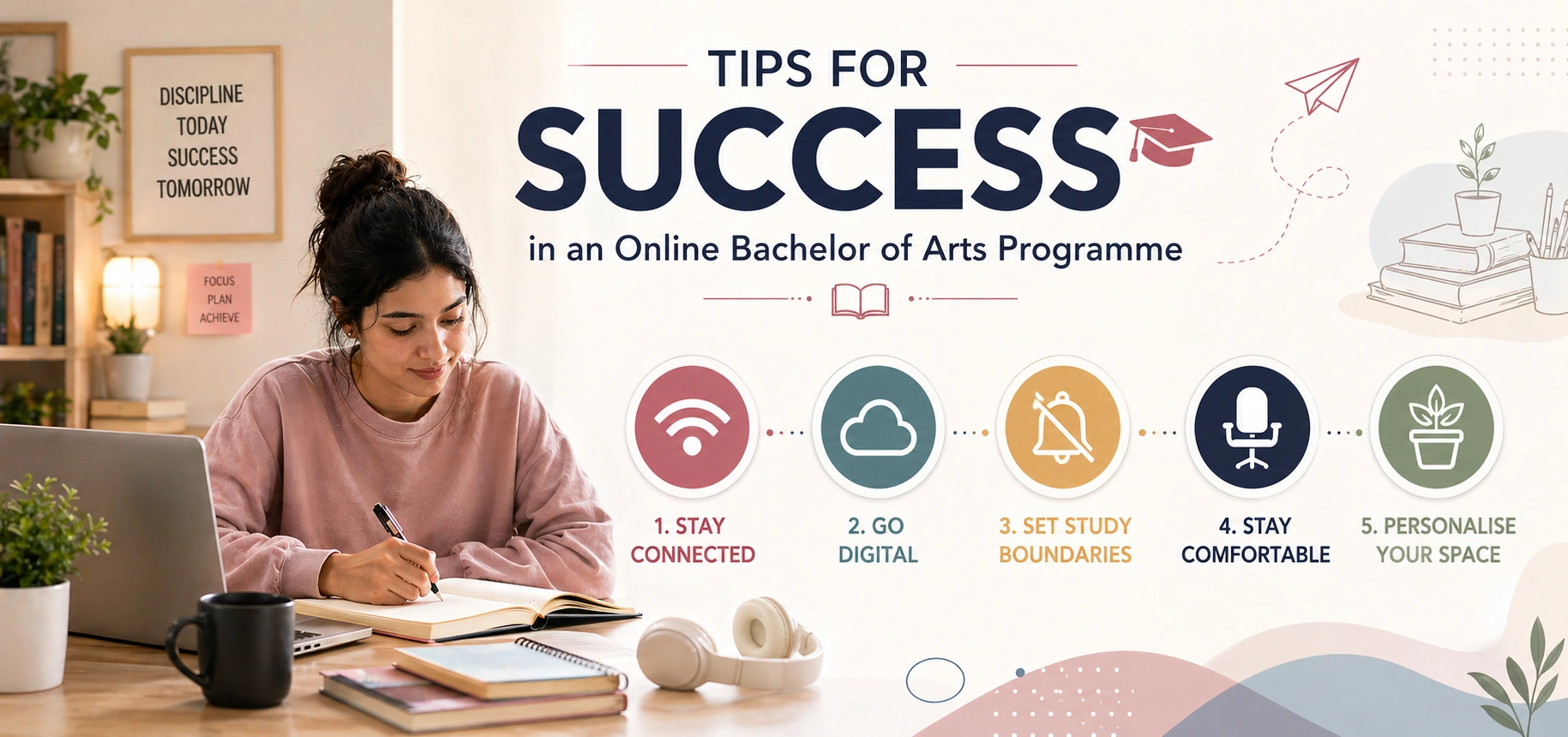
Ensure strong connectivity: A stable wi - fi connection and functional equipment like a laptop, headphones, and webcam are non-negotiable.
Go digital: Use various cloud storage services like Google Drive or Dropbox to organise notes and assignments. Explore digital note-taking apps like Notion or Evernote and access them when you are free.
Set study boundaries: Let family or roommates know your study hours. Silence notifications and social media distractions during study time.
Stay physically comfortable: Ergonomic seating, proper lighting, and posture matter more than you think, as it is directly linked with your productivity and creativity.
Personalise your space: Add motivational quotes, plants, or soothing music. Make your study area a place you want to return to.
5. Actively Engage and Network
Online learning doesn’t mean learning in isolation. The programme strongly emphasises active participation and networking - both within your course and beyond it. Networking not only deepens understanding but also opens up opportunities for collaboration, mentorship, and even future career prospects. Here’s how you can stay connected:
Participate in discussions: Join online forums, group discussions, class chats, or virtual group projects. Don’t hesitate to ask questions or share insights and feedback.
Connect with peers: Introduce yourself to classmates. Form virtual study groups or peer accountability circles to overcome barriers of isolation.
Engage with faculty: Attend virtual office hours, send thoughtful emails, or seek academic guidance. Professors appreciate proactive learners.
Join professional networks: Use LinkedIn to connect with industry professionals, alumni, and thought leaders in your chosen field.
Attend webinars and workshops: These events can expose you to new perspectives and trends beyond your syllabus.
Education thrives on the exchange of ideas, perspectives, and experiences. Even online, meaningful engagement can make your academic journey feel collaborative and alive.
6. Develop a Growth Mindset
Adaptability and self-improvement are core to success. An online BA programme isn’t just about memorising theories; it’s about evolving your way of thinking. A grown mindset, the belief that you can improve through effort, transforms challenges into opportunities.
When you adopt a mindset of continuous improvement, every challenge, from tough assignments to time constraints, becomes a stepping stone toward growth. Here’s how to nurture that mindset:
View feedback positively: Don’t fear criticism; treat it as a guide for growth and convert your criticism into your strength.
Experiment with learning styles: Try different methods like reading, audio lectures, mind maps, or quizzes to find what works best.
Be curious: Explore topics beyond your syllabus. Read books, watch documentaries, or follow relevant blogs and articles in the newspaper.
Reflect often: Keep a learning journal. Note what you’ve learned each week and how it connects to your goals. On weekends, revise your notes.
Be patient with yourself: Mastery takes time. Celebrate progress, not perfection. Small wins lead to a way of success.
7. Balance Life, Work, and Study
How do you stay consistent when life gets busy? How do you ensure that work, family and studies don’t compete for your attention? Balancing multiple commitments requires planning, communication, and self-care, and true success comes from balance. Here are some ways to achieve that:
Communicate boundaries: Have you ever found yourself trying to attend online lectures while responding to work emails? Inform your family, friends, or employer about your study hours. When people understand your commitments, they’re more likely to respect your focus time.
Set realistic expectations: You can’t do everything at once. Prioritise on what truly matters in the moment and delegate smaller tasks when possible
Include rest in your routine: Rest is productive. Schedule downtime to recharge mentally and emotionally. Plan short breaks or no study days to maintain a healthy routine.
Stay physically active: Exercise improves focus and reduces stress. Even short walks can make a big difference.
Avoid perfectionism: Are you aiming for progress or perfection? Strive for excellence, not flawlessness. Each step forward, even a small one, counts toward your growth.
8. Embrace Technology and Lifelong Learning
In an online BA programme, technology is your gateway to your classroom, your library, and your connection to the world. Embrace digital tools not as barriers, but as bridges.
Explore e-learning platforms: Beyond your coursework, platforms like Coursera and edX can complement your understanding.
Use productivity apps: Do you struggle with distractions or time management? Apps like Todoist or Forest can help you stay organised and avoid distractions.
Stay updated: Follow academic journals, podcasts, and online communities in your field.
Be adaptable: Technology evolves, so must you. Don’t fear new platforms or tools; approach them with curiosity.
Conclusion: Your Journey, Your Success
Pursuing an online Bachelor of Arts is not just about earning a degree - it’s about redefining the way you learn, think, and grow. The flexibility of online education empowers you to design your own academic rhythm, but it also calls for responsibility, resilience, and self-motivation.
By applying these strategies - setting clear goals, managing time, staying motivated, engaging with peers, nurturing a growth mindset, and balancing your life - you can make your online learning experience truly transformative.
At LPU Online, we believe that your success begins with your mindset. Every click, every class, every challenge you overcome shapes your path to becoming a more confident, capable version of yourself.
So, take charge of your learning journey. Stay curious, stay consistent, and keep growing. Because when you study with LPU Online, you’re not just working toward a degree - you’re creating a future that reflects your potential, passion, and purpose.