

Have you ever wondered how Netflix seems to know exactly what you might want to watch next? Or how Spotify creates playlists that feel surprisingly tailored to your taste?
Maybe you've noticed an online store recommending products you were already considering buying, or a food delivery app suggesting your usual order just when you're about to place it.
These experiences often feel effortless from the user's perspective. A recommendation appears, a playlist is generated, or a product suggestion catches your attention at exactly the right moment. But behind every one of these seemingly simple interactions lies a complex process of collecting, analysing, and interpreting vast amounts of data.
This is where data scientists come in.
For years, programming languages like Python and R have been considered the backbone of data science. They continue to play an important role in analysing data, building models, and solving complex problems. However, as data volumes grow and business challenges become more sophisticated, coding alone is no longer enough.
Modern data scientists increasingly rely on AI-powered platforms that can automate repetitive tasks, accelerate model development, uncover hidden patterns, and generate insights faster than traditional approaches.
From AI assistants and machine learning platforms to advanced analytics solutions, today's professionals have access to a growing ecosystem of machine learning tools and advanced analytics tools that are transforming the way organisations make decisions.
In this article, we'll explore some of the top AI tools for data scientists in 2026 and understand how they are reshaping modern data science workflows.
Why Data Scientists Need More Than Python and R
Python and R remain essential tools in the data scientist's toolkit. They offer flexibility, powerful libraries, and the ability to solve a wide range of analytical problems.
Yet the reality of modern data science has changed significantly.
Businesses generate enormous amounts of information every day through websites, apps, connected devices, customer interactions, and digital transactions. At the same time, decision-makers expect faster insights, more accurate predictions, and quicker responses to changing market conditions.
Managing these expectations entirely through manual coding can be challenging.
Today's data scientists are expected to move beyond building models. They need to explore data faster, collaborate across teams, communicate insights clearly, and deploy solutions efficiently.
This is why AI-powered tools have become increasingly important. They help automate routine tasks, reduce development time, and allow professionals to focus on solving meaningful business problems.
Rather than replacing Python and R, these tools enhance what data scientists can accomplish with them.
The New AI Toolkit for Data Scientists
A few years ago, most data science workflows revolved around notebooks, scripts, and manual model development.
Today, AI tools can assist with everything from code generation and data preparation to predictive modelling and insight generation.
As a result, the modern data scientist's toolkit looks very different from what it did even a few years ago.
Let's explore some of the most influential tools shaping the future of data science.
AI Assistants That Are Changing How Data Scientists Work
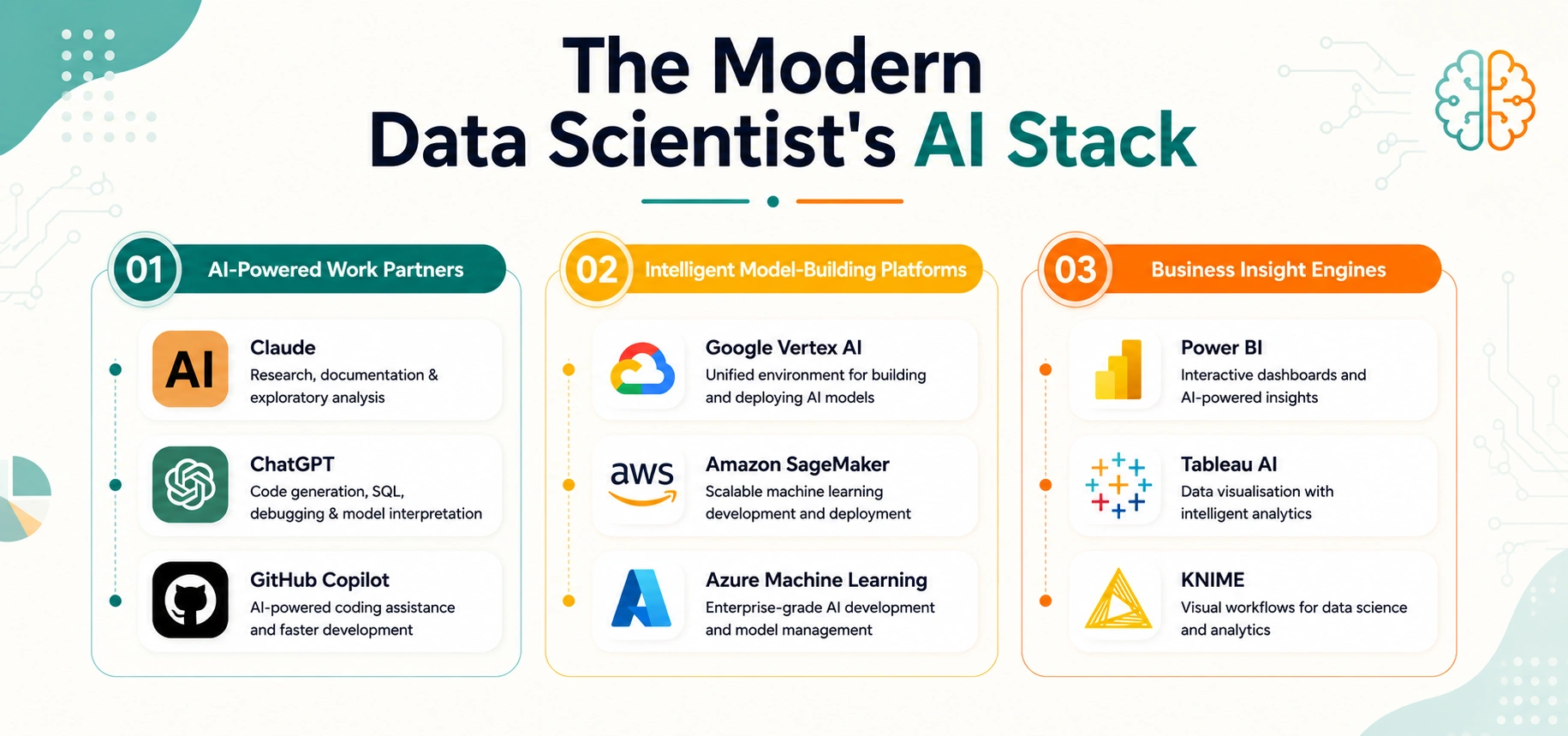
Claude
Data science involves much more than building models. Professionals often spend significant time analysing reports, understanding datasets, documenting findings, and communicating results.
Claude has emerged as a powerful assistant for many of these tasks.
Its ability to process large amounts of information makes it particularly useful for:
- Reviewing datasets and reports
- Explaining statistical concepts
- Generating documentation
- Analysing research material
- Supporting exploratory analysis
Many professionals use Claude as a collaborative partner during the problem-solving process, helping them organise information and think through complex challenges more effectively.
ChatGPT
ChatGPT has become one of the most widely adopted AI tools across industries, including data science.
Whether it's generating Python code, debugging scripts, creating SQL queries, or explaining machine learning concepts, ChatGPT helps streamline many everyday tasks.
Common applications include:
- Code generation and review
- Data cleaning assistance
- SQL query creation
- Exploratory data analysis
- Model interpretation
Its versatility makes it valuable for both beginners and experienced professionals.
GitHub Copilot
Writing efficient code remains a core part of data science.
GitHub Copilot functions as an AI-powered coding assistant that helps developers write code faster and reduce repetitive work.
For data scientists, this can mean:
- Faster script development
- Automated code suggestions
- Reduced debugging time
- Improved coding efficiency
As projects become increasingly complex, tools like Copilot can significantly improve productivity.
Machine Learning Tools Driving Modern AI Development
While AI assistants support day-to-day productivity, organisations also require platforms capable of building, deploying, and managing machine learning models at scale.
Google Vertex AI
Google Vertex AI provides an end-to-end environment for machine learning development.
It allows teams to build, train, deploy, and monitor models within a unified platform, helping organisations move more efficiently from experimentation to production.
Key advantages include:
- Automated model tuning
- Scalable infrastructure
- Integrated machine learning workflows
- Support for enterprise AI initiatives
Amazon SageMaker
Amazon SageMaker simplifies the machine learning lifecycle by providing managed tools for development, training, and deployment.
Its cloud-native architecture enables organisations to scale machine learning projects without managing extensive infrastructure.
Benefits include:
- Automated training workflows
- Real-time prediction capabilities
- Scalable deployment options
- Built-in machine learning frameworks
Azure Machine Learning
Azure Machine Learning offers a comprehensive platform for building and managing AI solutions.
Its integration with Microsoft's broader ecosystem makes it particularly useful for organisations seeking enterprise-grade machine learning capabilities.
Key features include:
- Automated machine learning
- Model management
- Responsible AI frameworks
- Team collaboration capabilities
These platforms represent some of the most important machine learning tools being used by organisations today.
Advanced Analytics Tools Helping Businesses Discover Better Insights
Machine learning models generate predictions, but organisations also need tools that help them understand data, uncover patterns, and communicate findings effectively.
This is where advanced analytics tools play a critical role.
Power BI
Power BI has become one of the most widely used business intelligence and analytics platforms across industries. With AI-powered capabilities such as natural language queries, automated insights, and interactive dashboards, it helps organisations transform complex datasets into clear, actionable business intelligence.
Tableau AI
Data is only valuable when insights can be communicated effectively.
Tableau AI enhances data visualisation through AI-powered capabilities that help users identify trends, generate insights, and explore data using natural language.
By simplifying data exploration, Tableau AI enables organisations to make faster and more informed decisions.
Alteryx
Alteryx helps automate data preparation and analytics workflows, reducing the time spent on repetitive tasks.
Its visual interface allows users to blend, prepare, and analyse data more efficiently while supporting predictive analytics and business intelligence initiatives.
KNIME
KNIME is known for its visual workflow approach to data science.
Rather than relying entirely on coding, users can build analytical processes through drag-and-drop components while still incorporating advanced machine learning techniques when required.
Its flexibility makes it useful for both technical and business-focused teams.
How AI Tools Are Transforming Data Science Workflows
The impact of AI on data science extends far beyond productivity improvements.
These tools are fundamentally changing how data science teams operate.
Tasks that once required hours of manual effort can now be completed in minutes. Data preparation can be automated. Models can be developed more quickly. Insights can be generated and shared faster than ever before.
Some of the most significant benefits include:
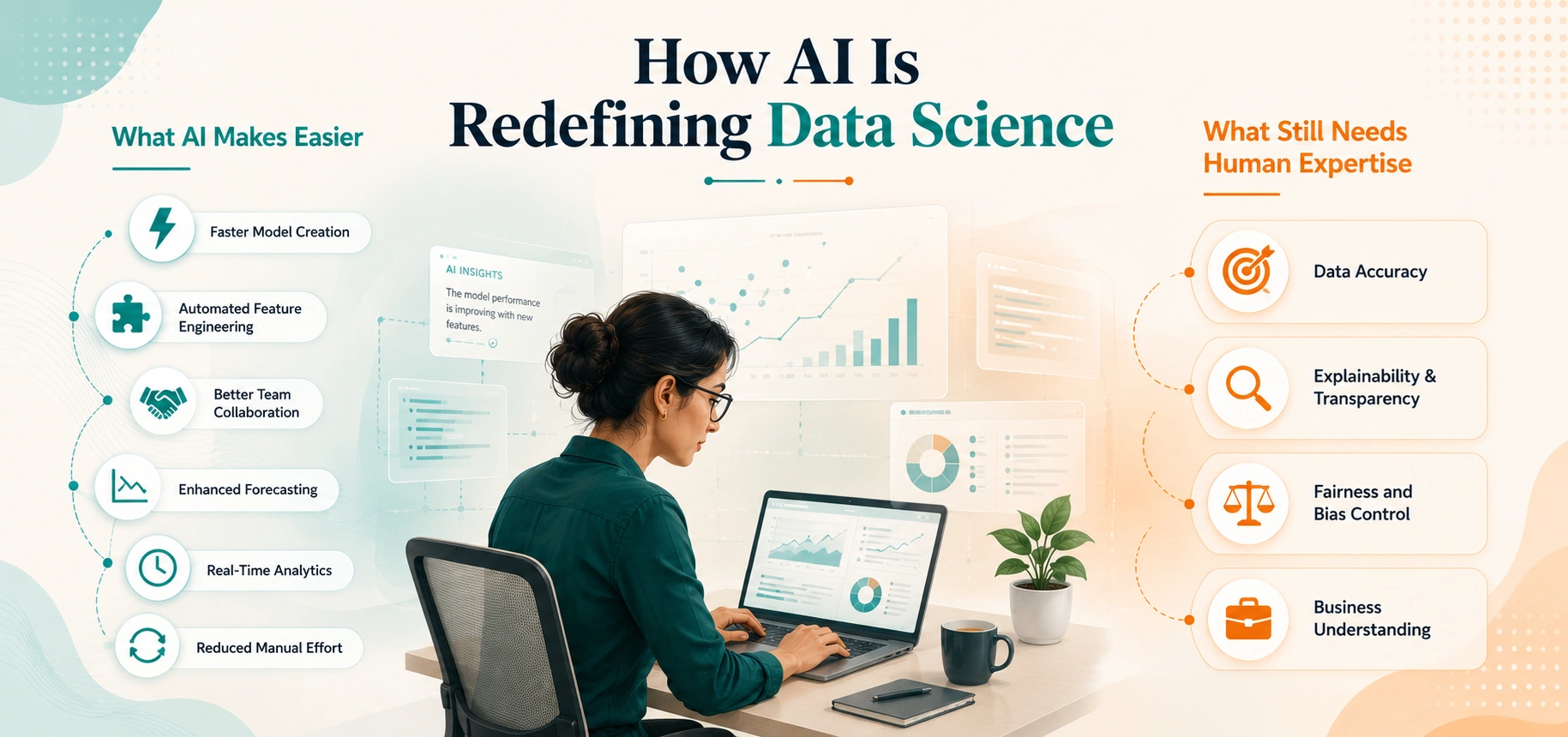
- Faster model development
- Automated feature engineering
- Improved collaboration
- Enhanced forecasting capabilities
- Real-time analytics
- Reduced manual workloads
As a result, data scientists can spend more time focusing on strategy, innovation, and decision-making.
Challenges of Relying on AI Tools
Despite their advantages, AI-powered tools are not a substitute for critical thinking and domain expertise.
Several challenges still require human oversight.
Data Quality
Even the most sophisticated AI systems depend on accurate and reliable data.
Transparency
Understanding how AI-generated recommendations are produced remains essential for trust and accountability.
Bias
Poor-quality training data can introduce bias into models and predictions.
Business Context
AI can generate insights, but humans are still needed to interpret those insights and apply them effectively within real-world situations.
Successful organisations combine technological capabilities with skilled professionals who understand both data and business objectives.
The Future of AI Software for Analytics
The next generation of data science will be shaped by increasingly intelligent and autonomous systems.
Emerging trends include:
- Explainable AI
- Autonomous machine learning
- Real-time decision intelligence
- Generative analytics
- Intelligent data management
As these technologies mature, the relationship between humans and AI will become more collaborative, allowing data scientists to focus less on repetitive tasks and more on innovation.
The role of the data scientist is not disappearing. It is evolving.
Also read: Why Data Science Jobs Are In High Demand
Conclusion
The recommendations you see on Netflix, the playlists curated by Spotify, and the personalised experiences delivered by digital platforms all highlight the growing influence of data science in everyday life.
Behind these intelligent systems are professionals who rely not only on programming languages like Python and R but also on a powerful ecosystem of AI-driven tools.
From Claude and ChatGPT to Vertex AI, SageMaker, Alteryx, and Tableau AI, today's machine learning tools and advanced analytics tools are helping organisations analyse data faster, build smarter models, and make more informed decisions.
As businesses continue embracing AI-driven decision-making, data scientists who can combine technical expertise with modern AI platforms will be best positioned to thrive. For learners looking to build future-ready skills in data science, analytics, and artificial intelligence, programmes offered through LPU Online can provide the knowledge and practical exposure needed to succeed in this rapidly evolving field.