


Imagine sending out dozens of job applications, refreshing your inbox every hour, wondering if anyone will ever call back. Now picture the complete opposite: recruiters sliding into your inbox, companies outbidding each other for your attention, and your inbox full of offers rather than silence. Sounds like a dream, right? What feels like a best-case scenario to many professionals is simply another Tuesday for some data scientists.
We live in a world buried in data. Every click, every purchase, every scroll, every heartbeat monitored by a smartwatch, all of it generates information at a scale the human mind can barely comprehend. By 2025, the accumulated volume of global data had reached 175 zettabytes. That's 175 trillion gigabytes! And yet, for all that abundance, most businesses are standing at the edge of a vast ocean with nothing but a teacup to collect it. They have the data. They just don't have the people who know what to do with it. That's the crisis, and it's exactly why data science careers have become the most sought-after professional path of our generation.
The Numbers That Tell the Whole Story
Before diving into what data science actually is and where it can take you, let's look at the hard facts because the numbers here are genuinely staggering.
86% of employers expect AI and information-processing technologies to transform their businesses by 2030. This is one of the strongest drivers behind the growing demand for data scientists, AI specialists, and analytics professionals. Think about that for a moment. Nearly nine out of ten major employers across the globe are actively restructuring their operations, their strategies, and their hiring priorities around data and artificial intelligence. This isn't a trend confined to tech startups or Silicon Valley giants; it spans manufacturing floors in Germany, hospitals in India, retail chains across Southeast Asia, and financial institutions in New York.
And the world's most credible labor market authority backs this up with equal force: according to the 2025 Future of Jobs Report, Big Data Specialists and AI & Machine Learning Specialists rank among the top three fastest-growing professions globally through 2030. The World Economic Forum further forecasts that emerging technologies will generate approximately 170 million new jobs globally by the end of this decade, with 11 million of those specifically in AI and data processing roles.
On a national level, the US Bureau of Labor Statistics projects 34% employment growth for data scientists between 2024 and 2034, roughly five times faster than the average for all occupations, with approximately 23,400 new openings created every single year. McKinsey Global Institute adds another layer of urgency: demand for data scientists in the United States is expected to exceed supply by over 50% as early as 2026. The talent gap isn't approaching. It's already here.
So, What Exactly Is Data Science?
At its core, data science is the discipline of turning raw, messy, overwhelming data into clear, actionable insight. It sits at the crossroads of mathematics, statistics, computer science, and domain expertise, and it powers some of the most consequential decisions made in business, medicine, government, and beyond.
A data scientist is part detective, part storyteller, part engineer. They ask the right questions, build the right models, and communicate findings in ways that drive real-world action. They're the ones who figure out why a retail chain is losing customers in one region but thriving in another. They're the ones who build the model that flags a fraudulent bank transaction before it clears. They predict disease outbreaks, optimize supply chains, personalize streaming recommendations, and help governments allocate public resources more fairly.
This is why data science careers sit at a unique intersection of impact and opportunity. It's not just a well-paying job; it's a front-row seat to the decisions that shape industries, economies, and lives.
Why Demand Is Growing Faster Than Supply

Several powerful forces are converging to drive the extraordinary demand for data science professionals, and understanding them helps explain why this momentum isn't slowing down anytime soon.
The AI revolution needs human architects. Many people assume that the rise of AI threatens data science jobs. The reality is precisely the opposite. Artificial intelligence doesn't eliminate the need for data scientists; it amplifies it. Every AI system needs to be designed, trained on quality data, interpreted, monitored for bias, and improved over time. According to PwC's 2025 Global AI Jobs Barometer, skills in AI-exposed roles are evolving 66% faster than in other occupations, and professionals with AI skills command a significant wage premium over their peers. More AI means more demand for the humans who can build and govern it responsibly.
Every industry has become a data industry. This is perhaps the most underappreciated fact about data science careers: the demand is not siloed. Healthcare organizations use data science for drug discovery, patient outcome prediction, and operational efficiency. Banks use it for fraud detection, algorithmic trading, and personalised financial planning. E-commerce platforms use it for demand forecasting and recommendation engines. Governments use it for urban planning, public health, and policy evaluation. Manufacturing firms use it for predictive maintenance and quality control. LinkedIn data shows that data science-related job postings have grown by 256% since 2013 and that growth now spans virtually every sector of the global economy.
The hiring gap is real and widening. The average time to fill an AI or data science role currently sits at 142 days, nearly five months. Meanwhile, 87% of companies report significant difficulty finding qualified candidates, and attrition rates in in-house data teams have risen 19% over the past two years. This chronic shortage means that qualified professionals don't just find jobs, they negotiate them, on their own terms, with salaries and perks to match.
The Landscape of Data Science Careers
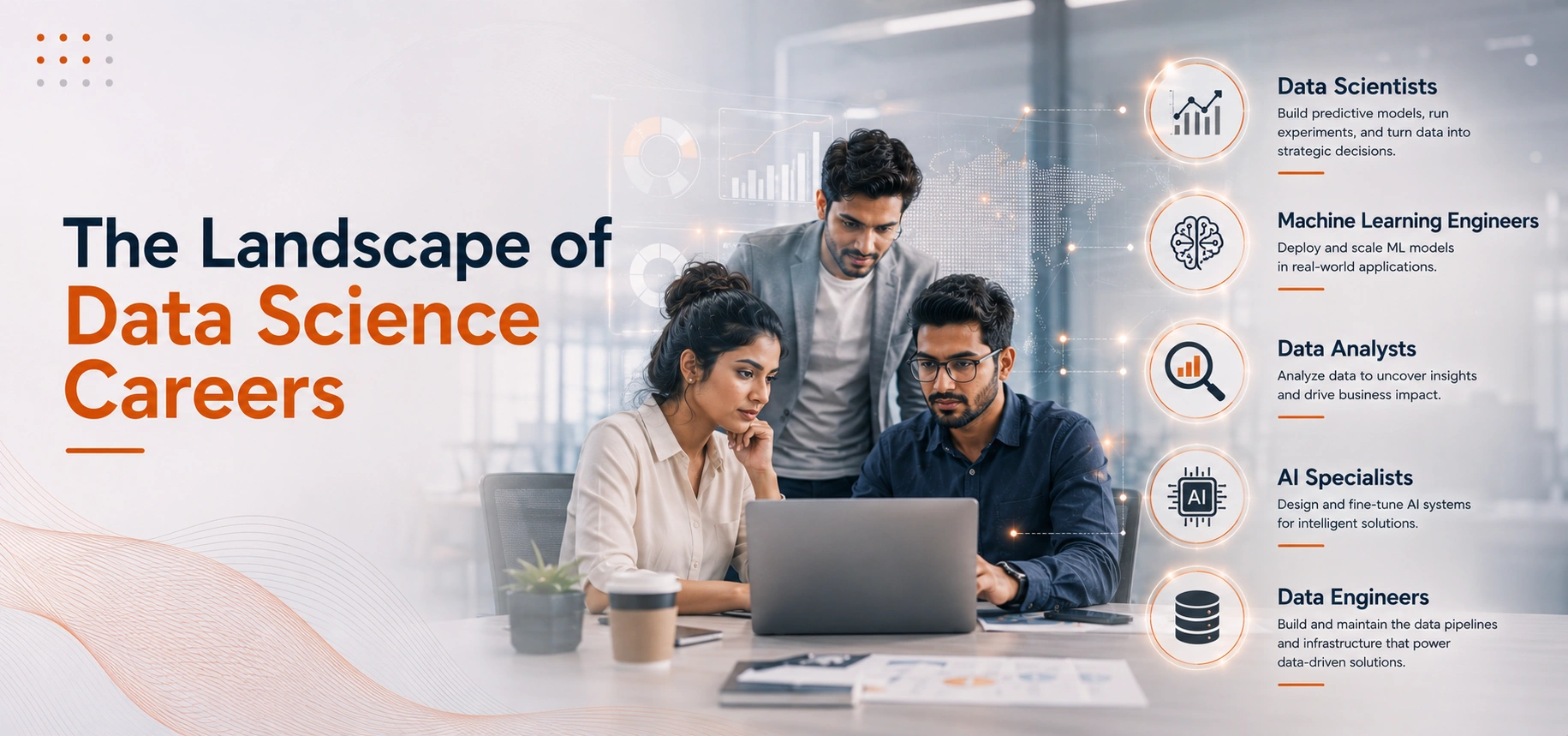
One of the most compelling things about entering this field is the sheer diversity of roles available. Data science careers are not a single track; they're a rich ecosystem of specialisations, each with its own demands and rewards.
Data Scientists sit at the heart of the field, designing experiments, building predictive models, and translating complex analysis into strategic recommendations. Average salaries in the US range from $120,000 to over $200,000, with top professionals commanding even more. Machine Learning Engineers focus on deploying and scaling ML models into production environments, bridging the gap between data science and software engineering. Data Analysts interpret existing data to surface business insights, and with entry-level salaries now reaching $90,000 (up $20,000 from 2024 alone), even the starting point is exceptional. AI Specialists design and fine-tune artificial intelligence systems, representing one of the fastest-growing and highest-compensated niches in the entire technology sector. Data Engineers build the infrastructure, the pipelines, databases, and systems that make large-scale data science possible.
Each of these paths offers strong career progression, global mobility, and the kind of cross-industry relevance that insulates professionals from economic downturns.
The Skills That Get You Through the Door
The good news about data science careers is that the core skill set, while demanding, is learnable. Python is the undisputed programming language of the field, appearing in the overwhelming majority of job postings. SQL is foundational for anyone working with structured data. Machine learning knowledge, understanding how models are built, trained, validated, and deployed, is now a baseline expectation for most data scientist roles. Natural Language Processing has surged as a required skill, growing from just 5% to 19% of job requirements between 2024 and 2025, driven by the explosion of generative AI applications.
Beyond technical skills, employers consistently highlight the ability to communicate findings clearly to non-technical stakeholders. A data scientist who can build a brilliant model but can't explain its implications to a boardroom is only half as valuable as one who can do both. Critical thinking, intellectual curiosity, and the willingness to keep learning round out the profile of the professionals companies are most desperate to hire.
The Window Is Open, But It Won't Be Forever
Opportunity windows are rare. The particular alignment of forces that's creating this extraordinary demand for data science professionals, mass AI adoption, data explosion, digital transformation across every industry, and a severe shortage of qualified talent represents a once-in-a-generation career inflection point.
The 2025 Future of Jobs Report projects 110% growth for Big Data Specialists globally through 2030. The US BLS sees data scientist employment growing at 34% over the next decade. And with 86% of employers planning to reshape their businesses around AI and data by 2030, the professionals who build their expertise now will be the ones leading those transformations, not watching them from the sidelines.
Data science careers aren't just in demand. They are defining what professional success looks like in the 21st century. The data is clear. The direction is set. The only question left is whether you're ready to be part of it.
The future belongs to those who can read it, and in today's world, it's written entirely in data.
Note: The statistics and industry insights highlighted throughout this article are sourced from the respective research, surveys, and publications conducted by the World Economic Forum (Future of Jobs Report), the U.S. Bureau of Labor Statistics, the McKinsey Global Institute, PwC (Global AI Jobs Barometer), and LinkedIn. We gratefully acknowledge these organizations for their valuable data contributions to the field.