


It all started in the post-independence phase of industrialization, particularly in the early 1960s, when global trade began to expand, and businesses needed skilled professionals to manage cross-border finances. At that time, there was a limited understanding of international pricing, trade laws, and export-import systems, which created a clear skills gap.
Later, around 1991, economic liberalization completely reshaped India’s geo-strategic trade dynamics. With markets opening up and foreign companies entering the country, international business corridors expanded rapidly. This shift accelerated the need for professionals who could navigate global markets, manage international operations, and drive business beyond domestic boundaries.
From the 1990s to today, global business has not just expanded, it has redefined what it means to be a manager. What was once a niche skill is now a baseline expectation, which is why programs like an Online MBA in international business are increasingly becoming relevant for aspiring global professionals. Let’s understand this movement through empirical insights.
The Data Behind the Shift: Global Trade vs Talent Evolution
Global trade expanded from around 15% of the world economy in the 1990s to over $34 trillion today. While business scaled across borders, the growth of internationally skilled professionals didn’t keep the same pace.
If we break it down:
Global Trade Growth ≈ 5×
Skilled Talent Growth ≈ 3× (derived from growth in management education, global hiring demand, and employer preference data, such as the 78% international exposure requirement)
Coverage Ratio = E(t) / G(t) = 3 / 5 = 0.6
In simple terms, only about 60% of global business demand is backed by professionals with the right international expertise, leaving a 40% gap in managing cross-border operations effectively. Here is the complete trend representation that shows the gap between foreign trade-offs and the experts handling them.
📊 Trend Representation
|
Time Period |
Global Trade Index (G) |
Expert Availability Index (E) |
Coverage Ratio (E/G) |
Gap Level |
|
1990s |
1.0 |
1.0 |
1.0 (100%) |
Minimal |
|
2000s |
2.5 |
1.5 |
0.6 (60%) |
Emerging |
|
2010s |
4.0 |
2.5 |
0.62 (62%) |
Growing |
|
2020s |
5.0+ |
3.0 |
~0.6 (60%) |
Significant |
Evolving Skillsets Required to Navigate Global Business Complexity
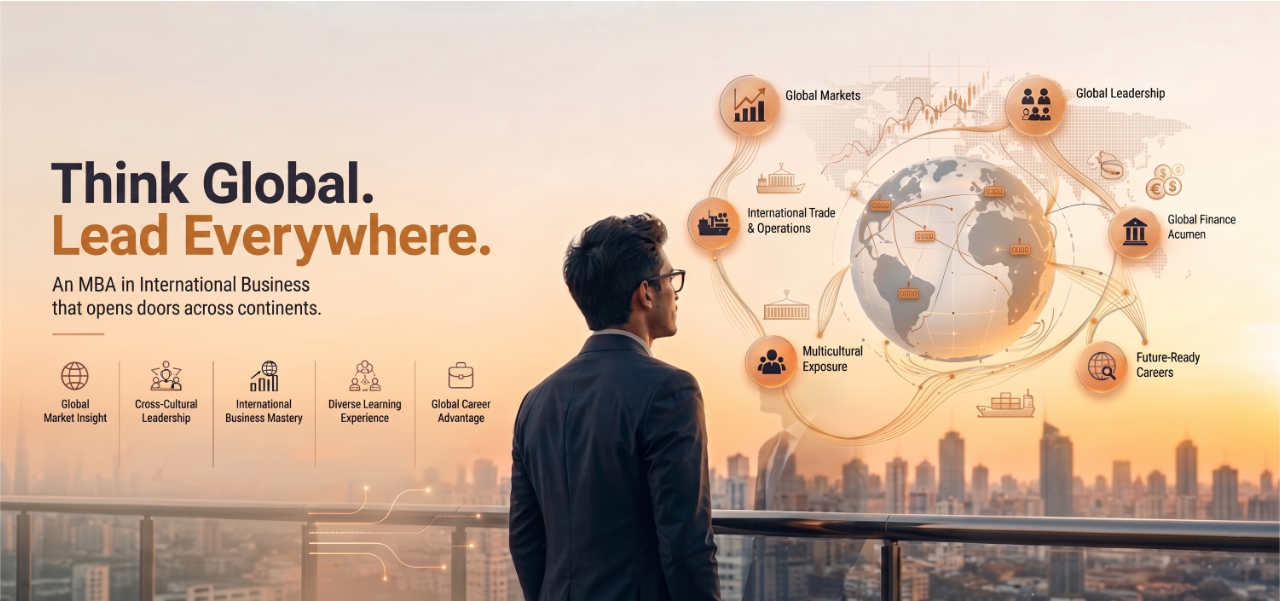
1. Understanding How Global Markets Really Work
The boundaries of business have shifted. Even organizations that operate domestically interact with international suppliers, global payment systems, or worldwide customers. An MBA in International Business helps professionals decode the constant movement of global markets, exchange rate patterns, international regulatory structures, trade blocs, geopolitical changes, and economic dependencies.
This deeper comprehension allows managers to make decisions aligned with international realities rather than relying solely on local perspectives. As industries expand across continents, this kind of judgment becomes essential.
2. Developing Strategic Insight for International Leadership Roles
Leading a global team or managing an organization with international operations requires a skill set that goes far beyond technical knowledge. Leaders must understand cultural preferences, adapt communication styles, negotiate across borders, and design strategies that work in diverse markets.
International Business programmes focus heavily on:
- Global strategic management
- Cross-border leadership
- Corporate diplomacy
- International organizational behaviour
These capabilities allow professionals to step confidently into leadership positions where decisions need to be culturally aware and globally consistent.
3. Gaining Exposure to International Trade, Finance, and Operations
Global business depends on the smooth functioning of logistics, trade pathways, and financial systems. This MBA helps learners understand the mechanics behind:
- Foreign trade policies
- Customs and export–import regulations
- International financial markets
- Global supply networks
- Cross-border business laws
- Mergers and acquisitions involving multinational entities
Professionals trained in these areas are better equipped to support their organization’s expansion into new countries or to manage international partnerships.
4. Experiencing a Multicultural Learning Environment
One of the strongest benefits of this programme is the exposure to peers and faculty from different cultural, professional, and regional backgrounds. Group discussions, live projects, and case-based learning mimic real global interactions, giving students firsthand experience in adapting to contrasting viewpoints and working styles.
Such exposure increases cultural intelligence, an essential asset in an interconnected business world.
5. Staying Aligned With Evolving Global Employability Trends
Hiring patterns worldwide show a consistent preference for professionals who understand global operations. Companies in technology, finance, consulting, retail, manufacturing, and logistics increasingly value employees who can navigate international complexities.
As a result, an MBA in International Business is emerging as a qualification that fits future market needs, not just current ones.
How an Online MBA in International Business Brings It All Together
1. Balancing Education With Career Growth
A major reason why many professionals hesitate to enrol in a full-time MBA is the fear of pausing their jobs. The online format resolves this conflict. Learners can continue working, apply new insights immediately to their roles, and avoid interruptions to income or career progression.
This approach is especially beneficial for mid-career professionals who want global exposure without stepping away from existing responsibilities.
2. Access to Quality Education Without Geographical Limits
Online programmes remove the barrier of location. Learners can access high-quality faculty, global classroom experiences, and international case studies without travelling abroad. Many programmes also include elements such as:
- Virtual international workshops
- Interactions with global industry experts
- Live projects with multinational companies
- Online simulations of global business scenarios
For many, this creates an experience equivalent to, or even richer than, traditional on-campus learning.
3. A Tech-Enabled, Engaging Learning Environment
Modern online MBAs are supported by advanced digital tools that enable an engaging and interactive experience. These features include:
- Immersive case simulations
- Digital whiteboards
- Interactive quizzes
- AI-supported analysis platforms
- Virtual breakout rooms for teamwork
- Recorded sessions for revision
This creates a flexible yet structured learning ecosystem that mirrors contemporary digital workplaces.
4. A Cross-Border Professional Network
While many assume networking happens only on campus, online MBA programmes often bring together learners from various cities, countries, and industries. These diverse cohorts help professionals build a global network, an advantage that usually requires years of international employment.
Connections formed in such programmes often lead to:
- Cross-country collaborations
- Access to global job opportunities
- Mentorship from multinational professionals
- Partnerships for new ventures
This network becomes a long-term professional asset.
Career Opportunities After an MBA in International Business
Graduates of this MBA unlock career paths in multinational companies, global startups, international agencies, and cross-border consulting firms. The degree offers flexibility because it blends strategy, operations, finance, and market understanding.

1. International Marketing Manager
Oversees global campaigns, adapts products for different cultural contexts, and builds branding strategies that resonate across regions.
2. Global Supply Chain and Logistics Manager
Responsible for large-scale sourcing, vendor negotiations across countries, international distribution systems, and global inventory optimization.
3. International Consultant
Provides expert guidance on market entry strategies, foreign expansion, competitive analysis, and operational improvements for clients operating across borders.
4. Export–Import Operations Manager
Manages documentation, compliance, freight coordination, customs procedures, and trade relationships. Critical for companies engaged in international commerce.
5. Global Finance Analyst or Manager
Handles cross-border financial planning, risk assessments, international taxation, and foreign currency management.
6. Global HR and Talent Manager
Leads international recruitment, manages expatriate assignments, and builds systems that cater to multicultural workforce expectations.
7. International Business Development Manager
Identifies overseas markets, nurtures global partnerships, and drives expansion strategies.
8. Global Product Manager
Coordinates launch strategies for products designed for multiple countries while aligning with regulatory, cultural, and economic variations.
Who Should Consider This Program?
An MBA in International Business fits individuals who:
- Want to work with multinational companies
- Aspire to leadership roles that require global decision-making
- Aim to build careers abroad
- Lead or plan to lead cross-border teams
- Are entrepreneurs looking to access foreign markets
- Prefer strategic roles involving global coordination
This programme shapes professionals who can think globally while acting locally—a combination that the modern world demands.
The Future of Global Business Education
The global business environment is growing more interconnected each year. Digital trade, international fintech, global e-commerce, and multinational startup ecosystems are expanding rapidly. Companies now depend on leaders who not only understand global complexity but can also respond swiftly to it.
Online learning plays an important role in this transformation. With its wide reach, strong acceptance, and technology-driven tools, it empowers learners from any location to develop global-level competencies.
This combination of international business expertise delivered through a flexible online format creates professionals who are ready to lead in a business environment where borders continue to fade.
Conclusion: Converting the Global Skill Gap into a Strategic Advantage
An MBA in International Business has evolved into one of the most effective stepping stones for professionals aspiring to global careers. Organizations value leaders who can navigate diverse markets, understand global systems, and manage cross-cultural teams. This programme builds those capabilities with precision.
When pursued online, the degree gains even more relevance. Learners acquire international exposure, industry-aligned skills, and global networks while maintaining their existing career trajectory.
For professionals aiming to step into multinational roles or build careers that transcend borders, this MBA is a powerful catalyst, a qualification that aligns ambition with global opportunity.
According to the latest World Trade Statistics published by the World Trade Organization, global trade trends continue to reflect significant shifts in merchandise and services exports, highlighting the evolving dynamics of the international economy.
According to data and analysis published by the World Trade Organization (WTO), global trade patterns and their evolution continue to play a significant role in shaping international economic growth and market dynamics.
According to data published by ResearchGate and supported by World Bank development indicators, global trade has experienced significant long-term expansion from 1990 to 2024, reflecting the increasing integration of economies through international commerce and globalization.