
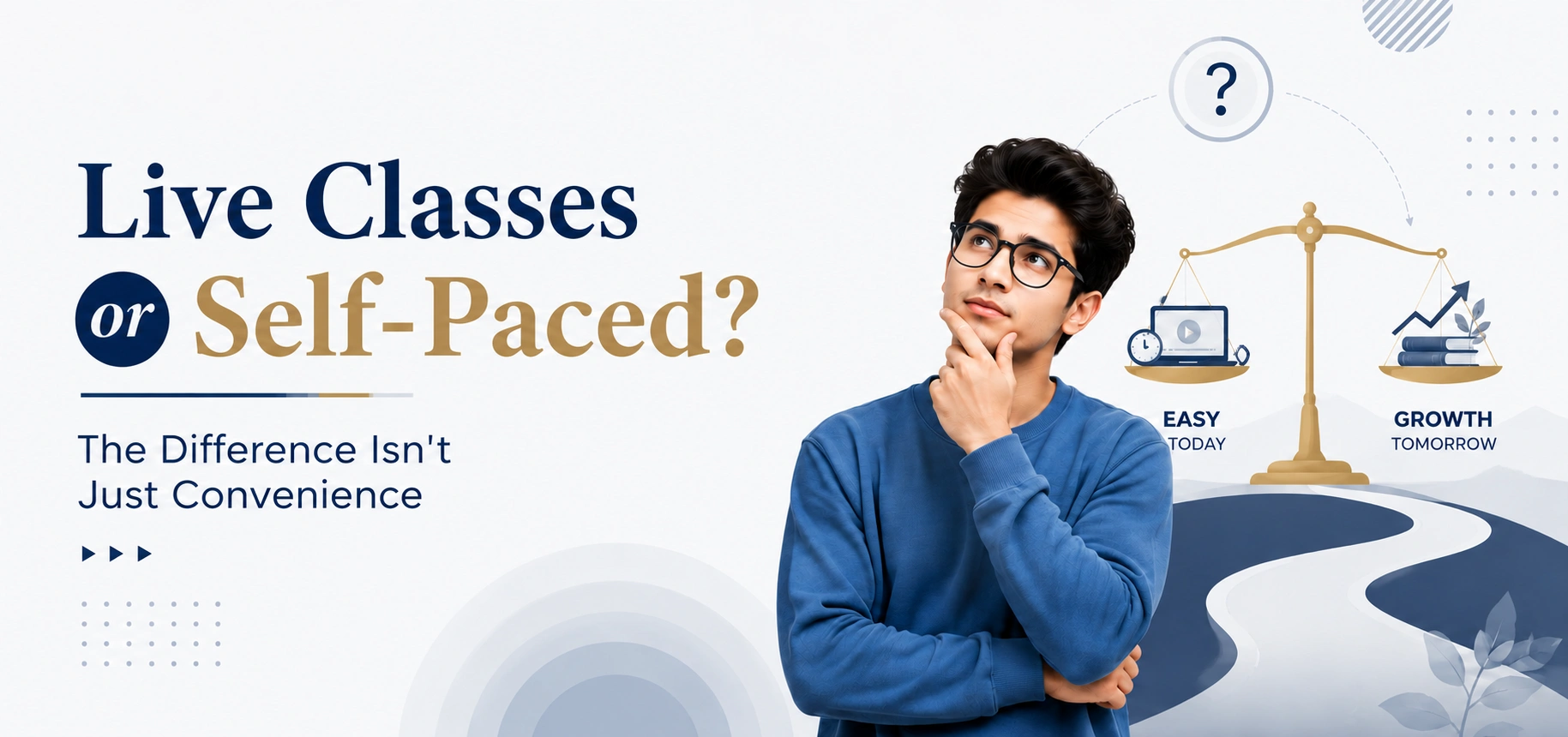
The Digital Learning Dilemma
The modern EdTech industry is currently grappling with a systemic crisis that few are willing to name: we have optimised for consumption at the expense of comprehension. The "anytime, anywhere" marketing of the contemporary Online Program promises a frictionless path to mastery, suggesting that convenience is the ultimate pedagogical virtue. However, this focus on low-barrier access has given rise to a generation of "highly certified" learners who can navigate a learning management system with ease but struggle to recall core concepts 48 hours after the final exam.
As a specialist in digital pedagogy, I see this daily. We have mistaken "user retention", keeping a student clicking through modules, for "knowledge retention." To understand why your educational investment might be yielding diminishing returns, we must look at a central analogy: the difference between attending a live concert and listening to a studio album. While the latter is efficient, it is the former that creates the transformative, "Spontaneous Spark" of true learning.
The Analogy: Concerts vs. Studio Albums
When evaluating the delivery architecture of an Online Program, the experience usually falls into one of two modalities: synchronous live sessions or asynchronous self-paced modules.
Live Sessions as the "Concert" A live session is a "Live Concert." It is raw, unscripted, and anchored in a specific moment in time. Whether it occurs in a physical lecture hall or a digital Zoom room, there is a collective energy and a shared cognitive load that defines the experience. You cannot "pause" a concert. This lack of control is a deliberate pedagogical feature, not a bug. It forces a state of "Active Presence." If you lose focus, you miss the "vibe" and the immediate, unpolished insights that only occur in real-time dialogue.
Self-Paced Modules as the "Studio Album" Conversely, self-paced modules are the "Studio Album." This is the polished, optimised version of the information. In this format, every "um" and "ah" is edited out, the audio is crisp, and the delivery is streamlined. You have the luxury of rewinding difficult tracks, skipping the "filler," and listening at 2x speed. While this is undeniably more efficient for the schedule, it lacks the visceral urgency of a live performance. We gravitate toward the "album" for its convenience, yet we find our most profound intellectual shifts occur during the "concert."
Key Takeaways: How Learning Format Impacts Attention and Retention
Takeaway 1: The Friction Paradox
There is a prevailing myth in instructional design that the best Online Program is the one that offers the least resistance. In reality, the brain requires "friction" to encode memory. This is the Friction Paradox: the easier a piece of information is to consume, the easier it is to forget.
Self-paced learning often fails because it lacks "Social Friction", the healthy, psychological pressure of being seen by a peer or a mentor. When you are part of a live cohort, your presence (or lack thereof) has weight.
"Social Friction is the healthy pressure of being seen by a peer or mentor, actually cements memory better than a solo video."
Without this friction, the brain naturally defaults to the "path of least resistance." In a solo environment, the cognitive labour required to process information deeply is often bypassed in favour of simple completion.
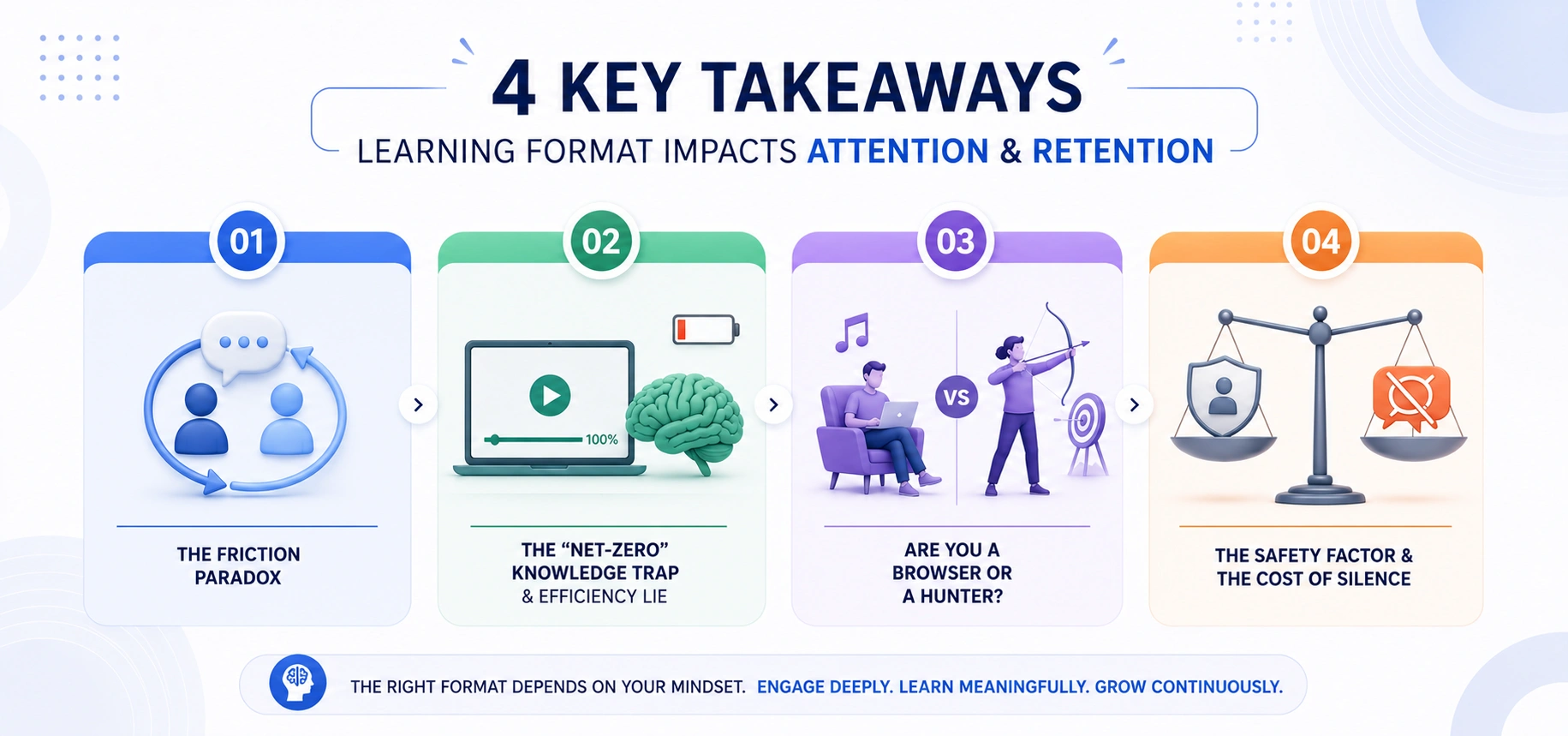
Takeaway 2: The "Net-Zero" Knowledge Trap and the Efficiency Lie
The rise of asynchronous delivery has birthed the "Net-Zero Knowledge Trap," where education is treated like Netflix binge-watching. Learners consume hours of high-definition video content in a single sitting, moving the progress bar to 100% while their actual neural connectivity remains stagnant. This is fueled by the "Efficiency Lie", the seductive idea that "faster" is a proxy for "better."
This lie is underpinned by the Dunning-Kruger effect. Because a student finds a video easy to follow (a phenomenon known as the "fluency heuristic"), they mistake ease of understanding the instructor for mastery of the skill itself. They feel productive because they are "finishing" the course, but they are merely observers, not practitioners. A 60-minute live session where you are forced to synthesise a thought or ask a single "Aha!" question is infinitely more valuable than 10 hours of unengaged video watching. Mastery is built through the exhaustion of engagement, not the speed of consumption.
Comparative Analysis: Choosing Your Learning Mode
When selecting your next Online Program, use the following matrix to determine which pedagogical architecture aligns with your psychological needs.
|
Feature |
Live Sessions (The Concert) |
Self-Paced Modules (The Studio Album) |
|
Tone & Vibe |
Raw, spontaneous, and unscripted. |
Polished, perfect, and curated. |
|
Flexibility |
Rigid; requires synchronous presence. |
High features 2x speed and skip options. |
|
Retention Catalyst |
Social Friction and peer visibility. |
Repetition and efficiency focus. |
|
Interaction Level |
High; real-time inquiry and feedback. |
Low; solitary consumption. |
|
Ideal Persona |
The "Hunter" |
The "Browser" |
|
Psychological Barrier |
Performance Anxiety (High Stakes). |
Isolation and Boredom (Low Stakes). |
Takeaway 3: Are You a Browser or a Hunter?
Success in an Online Program is rarely about the curriculum; it is about the archetype of the learner.
- The Browser: These individuals view education as an acquisition process. They enjoy the self-paced "Studio Album" because it allows them to collect information at leisure. However, they often fall into the trap of collecting certificates rather than competencies.
- The Hunter: These learners view education as a pursuit. They thrive in "Concert" environments because they need to chase down answers in real-time. They aren't looking for a library of videos; they are looking for the "Spontaneous Spark" that comes from direct, high-stakes inquiry.
Takeaway 4: The Safety Factor and the Cost of Silence
In a live session, there is an inherent "danger", the possibility of being called on or being forced to defend a position. While this causes anxiety, it is a primary driver of cognitive engagement. The fear of being "put on the spot" makes you sharper. However, there is a nuance: if the "danger" of a live session causes you to completely shut down, the self-paced format is your necessary sanctuary.
But for most, the "Cost of Silence" is the real danger. If you are the type of learner who hides in the shadows and never asks a question, a self-paced Online Program might be a total waste of your investment. You are paying for the content, but you are missing the transformation. In these cases, you need the live environment to force you out of your shell. Silence in a solo module is free; silence in a live session is an expensive missed opportunity.
Conclusion: Rethinking the Path to Mastery
True mastery is never a result of the most convenient path. As we look toward the future of education, I predict a move toward "Hybrid Friction", a model where the next generation of the Online Program uses AI to simulate social pressure in asynchronous environments, bridging the gap between the "Concert" and the "Album."
Until then, you must choose your path with intention. Are you choosing your current program for the ease of the journey or the depth of the destination? Mastery requires you to embrace the "danger" of being seen and the healthy friction that makes learning stick.