

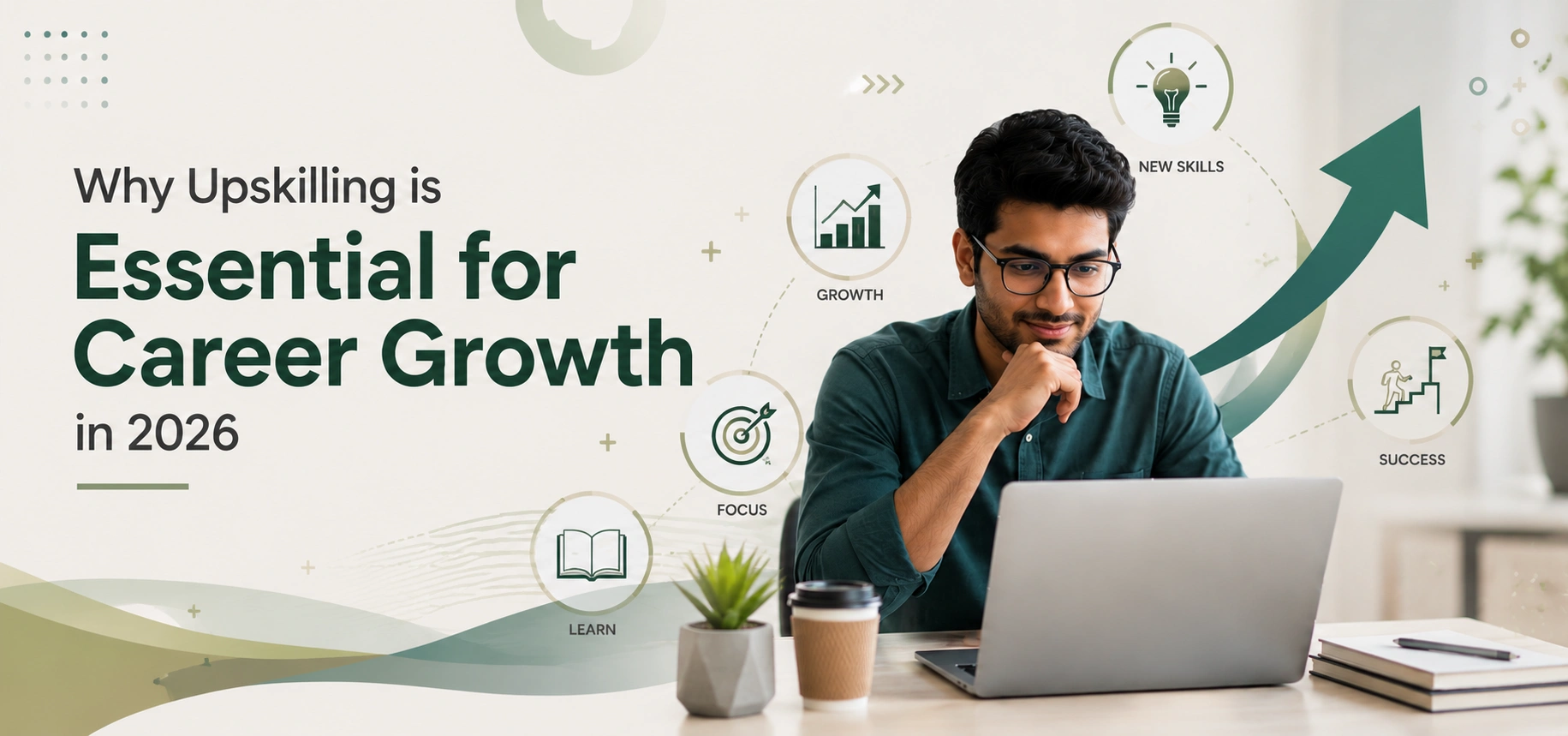
The Need for Upskilling in 2026
Your career comes with an expiry date, and this is what no one tells you about it.
You are armed with a degree that represents years of effort, ambitions, and late-night study sessions. Landing your first job feels like crossing the final line. You learn the systems, understand your responsibilities, and begin building professional credibility. Then unexpectedly, reality changes.
A new digital tool replaces the software you just mastered. Automation takes over tasks that once defined your daily contribution. Industry conversations revolve around concepts you never studied in your syllabus. Job descriptions in your own field now demand certifications, data literacy, or technological expertise.
Suddenly, experience alone no longer feels sufficient.
This is the new reality students and professionals face today. The pace of change is relentless. Industries evolve faster than academic curricula. Competition extends beyond cities and countries. Employers no longer seek static qualifications; they seek evolving capabilities.
In this environment, a degree is not a destination; it is a launchpad. To remain relevant, competitive, and future-ready, professionals must treat learning as a continuous process. Upskilling every two years is no longer ambitious; it is essential for sustainable career growth.
What Is Upskilling?
Let’s start with the basics: upskilling and reskilling are two distinct concepts, and the difference matters.
Upskilling means learning new competencies or mastering the existing ones, so you stay relevant and competitive in your current field. Reskilling, on the other hand, is about retraining for a completely different career path. Think of upskilling as upgrading your smartphone’s operating system. You are still the same device, but you are running smarter, faster, and better.
So what skills actually matter right now? Here’s what employers across industries are actively looking for:
- Data literacy and analytical thinking- ability to read, interpret, and act on data
- Artificial intelligence and machine learning fundamentals.
- Digital communication and remote collaboration tools.
- Critical thinking, adaptability and creative problem solving
- Emotional intelligence and cross-cultural leadership.
Whether you are in the health care, financial, marketing or educational sector, these capabilities are quickly becoming the baseline.
The Shrinking Shelf life of skills
There was a time when mastering one specialisation could sustain an entire career. Today, this concept doesn’t exist. Skills now have a “Shelf life.” Due to technological innovation, artificial intelligence, automation, digital transformation and evolving consumer behaviour.
Finance professionals are expected to be more proficient with fintech technologies and other digital platforms. Marketing professionals now need to be proficient in analytics and marketing strategies. Engineers are expected to have expertise in smart systems and automation.
This rapid transformation of certain expertise does not mean that professionals are becoming less capable, but it means that industries are becoming more dynamic, and when the environment shifts, stagnation becomes a risk.
Upskilling should be regularised, and professionals should bridge the gap between academic and current industry demand. It transforms reactive learning into proactive growth.
The Role of Technology Disruption
Famous phrase “ Fourth Industrial Revolution” still relevant these days? What does it actually mean for your career?
We are in that phase of life where digital, biological and physical technologies are converging and changing how entire economies function. Automation is no longer confined to the factory floor, but today, AI is writing content, analysing legal documents, diagnosing medical images and generating financial reports. Are the cognitive tasks that used to be exclusively human territory? They are being automated too.
Don't just take our word for it. The numbers tell a pretty compelling story:
|
Statistic |
Figure |
Source |
|
Jobs at high risk from automation |
85 million by 2025 |
World Economic Forum |
|
New roles created by tech disruption |
97 million by 2025 |
WEF Future of Jobs Report |
|
Workers who need reskilling/upskilling |
1 billion globally |
McKinsey Global Institute |
|
Increase in demand for AI & ML skills |
+71% year-over-year |
LinkedIn Workforce Report |
|
Professionals who upskilled got promoted |
64% |
PwC Global Workforce Survey |
|
Average salary premium for upskilled workers |
15–20% higher |
Burning Glass Technologies |
|
Companies are facing skills gap challenges |
87% |
McKinsey, 2023 |
Look at the numbers - 97 million new roles are being created, and 1 billion workers need to upskill. Now the question arises, “ Are you ready to walk through the door?”
How AI & Automation Are Redefining Jobs
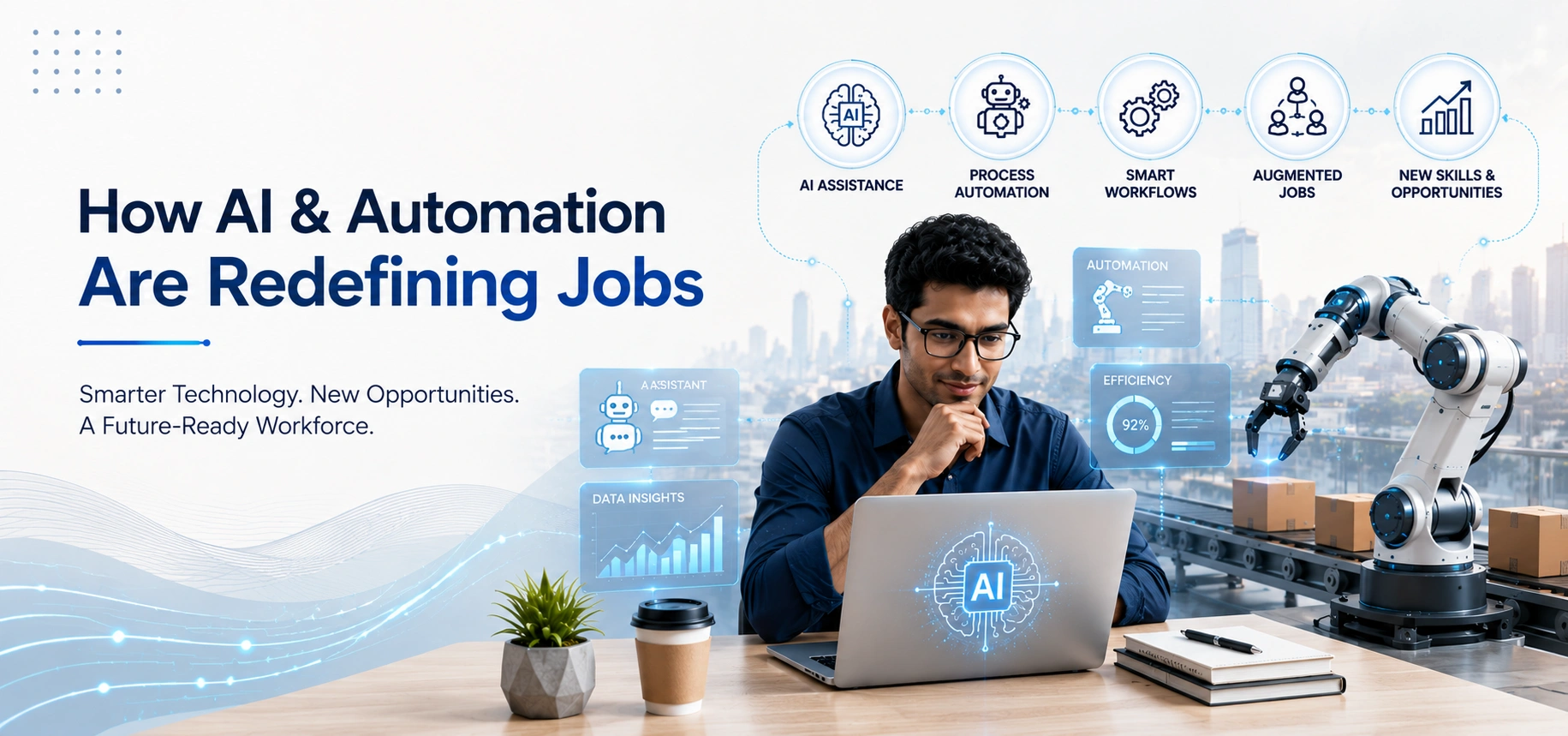
Roles Most at Risk
Every mid-level knowledge role, like junior accountants, paralegals, and certain other positions, is being impacted by AI augmentation. If your role involves doing the same task, the same every time, it's worth paying attention because many roles are under pressure.
Roles Evolving or Being Created
Roles that need human judgement, empathy, creativity, decision making are not impacted anymore, but they are expanding. Think AI ethicists, data storytellers, and digital transformation consultants. These roles didn't even exist in meaningful numbers ten years ago. Today, they command premium salaries and serious competition. The talent gap is real, and it's your opportunity.
Hybrid Jobs and the Skills They Require
The most exciting shift right now is the rise of hybrid roles. Today, managers expect employees to have a mix of technical background with deep domain expertise and people skills. For example, an architect who uses parametric design software. A nurse who works with predictive health analytics. They don’t need to become a full-stack developer, but need to become digitally fluent enough to collaborate with technology.
The Consequences of Not Upskilling
What happens when you decide that your current skill set is enough? What happens when you rely on experience and assume growth will happen with the passage of time?
In a workplace where industries are changing dynamically, standing still is not enough - it is regressive. While you remain comfortable with the existing system and enhance it, others are investing in other tools to upskill, earning certifications and enhancing digital capabilities. Here is how the cost of inaction typically reveals:
- Career stagnation: When working professionals around you continuously add new competencies, they bring fresh value to the organisation. They bring innovative value, quick decision-making and problem-solving skills to the table. On the other hand, those who rely on tenure may find themselves performing the same responsibilities year after year.
- Reduced job security: Ask yourself: If your roles were evaluated purely on future contribution, would your skill set align with where the industry is heading?
When automation replaces the daily routine tasks and digital tools streamline processes, professionals who have not evolved may find their roles diminished.
- Lower earning potential: According to PwC’s Global Workforce Survey, employees who actively upskill are 64% more likely to receive promotions. Additionally, research from Burning Glass indicates that professionals possessing in-demand digital skills command a salary premium of 15–20%.
Over the course of a career, this difference compounds substantially. A 15% salary increase sustained over the years translates into significantly higher lifetime earnings. Professionals who invest in developing relevant, market-aligned skills are not merely enhancing employability - they are increasing long-term financial growth.
Benefits of Regular Upskilling
Now, the most interesting part: “ What happens when individuals actively choose to grow? What changes when professionals dedicate themselves to updating their knowledge regularly rather than waiting for change to force them into it?
The answer is simple: upskilling shifts your career from proactive survival to proactive growth. Regular upskilling creates multiple advantages that extend far beyond financial reward.
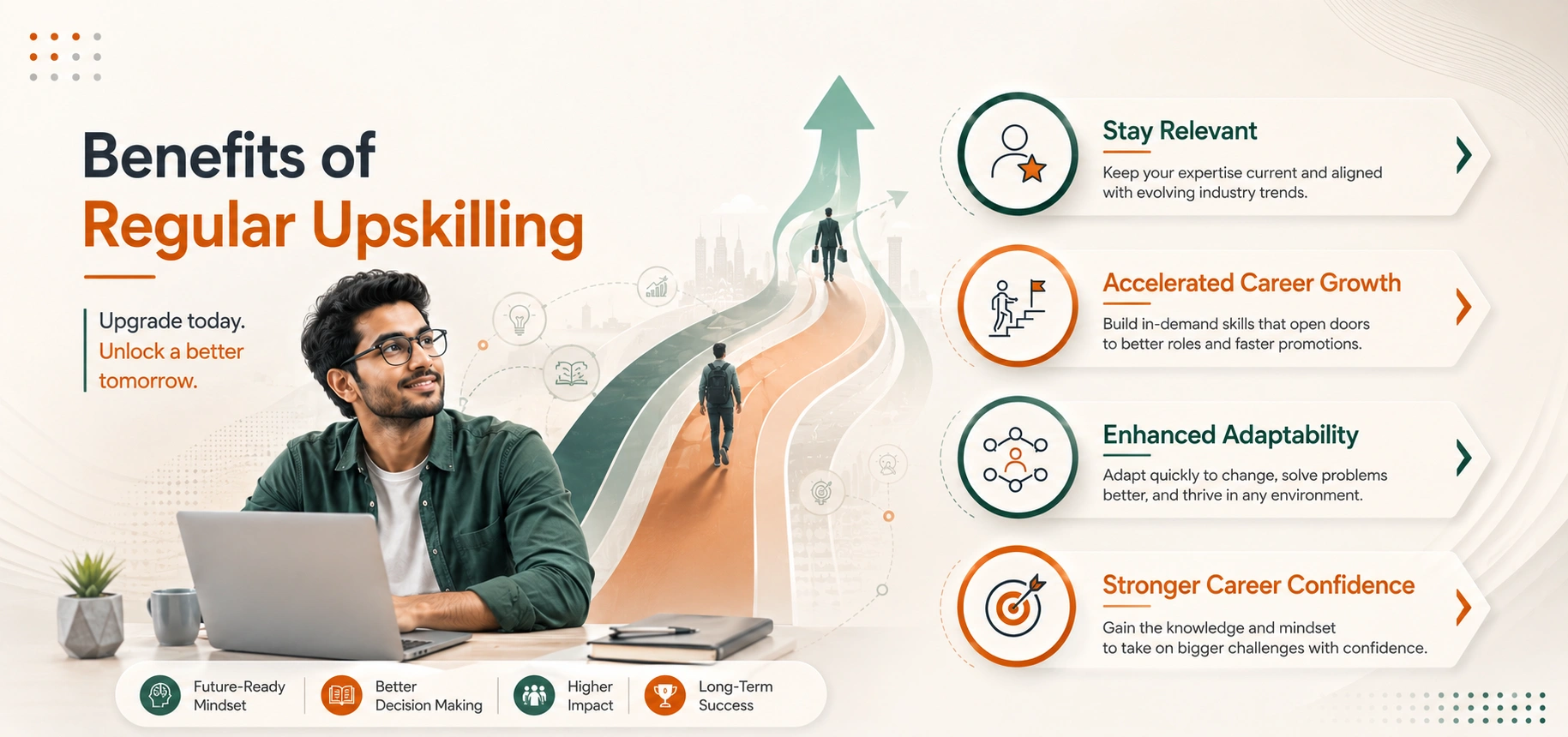
- Stay Relevant:
In such a dynamic environment, professionals who upgrade their skills regularly develop a deeper awareness of technological shifts and emerging methodologies. This approach allows them to contribute valuable insight during insight remain aligned with the industry. Upskilling ensures ht your expertise evolves alongside your profession.
- Faster Promotions and create confidence:
Organisation rewards individuals who demonstrate the ability to take on expanded responsibilities.
Professionals acquire new competencies, whether in digital tools, data analytics, or leadership - they become more capable of decision making, problem solving. It shows employers that an individual is invested not only in their own development but also in the long-term success of the organisation.
- Greater Adaptability:
Adaptability is a key attribute that employers often assess during the interview process. The ability to adjust to new environments and changing circumstances enables individuals to integrate effectively within an organisation and approach complex challenges with greater confidence and efficiency.
Learning itself becomes a skill. They are better equipped to manage uncertainty and collaborate across disciplines.
Real-Life Examples: Industries Transformed
This isn't an abstract theory; the transformation is already happening, and the professionals thriving in it all have one thing in common: they chose to keep learning.
Take software development. When AI coding assistants arrived, a lot of junior developers panicked. But those who learned to work with AI tools, review outputs, and build smarter workflows became significantly more productive and more valuable. They didn't get replaced. They got promoted.
In finance, quantitative analysts who layered natural language processing skills on top of their existing mathematics and portfolio management expertise became some of the most sought-after professionals in investment banking. The hybrid profile was simply worth more.
In manufacturing, floor operators who were trained in robotics maintenance and predictive analytics didn't lose their jobs when automation arrived. They moved into supervisory and diagnostic roles, often with meaningful pay increases. They became the human intelligence layer that automation can't replicate.
The pattern is consistent: upskilling doesn't just protect your career. It elevates it.
How to Create Your 2-Year Upskilling Plan
At this point, you are aware of the pros and cons of upskilling, but now question arises: “ Where do you actually start?” Don't worry, these three steps teach how to upskill yourself.
Step 1: Honest skills assessment
Identify three to five skill sets that matter most in the next three to five years in your sector. Now compare your current competency level with others'. The LinkedIn assessment and the industry competencies framework are great tools for examination. Be honest, this is your baseline.
Step 2: Choose the Right Courses and Certifications
After identifying, prioritise pathways that are credentialled, practical and industry - recognised. Platforms like Coursera, edX, and LinkedIn offer structured programmes that employers actually respect. Where possible, choose certifications that include real projects because recruiters increasingly value demonstrated ability over just listed credentials.
Step 3: Set Measurable Goals and Stick to Them
A plan without milestones is a wish. Get specific: finish Module 3 by March, earn the certification by June, and apply the new skills in a live project by September. Tell someone, a colleague, a study group, a mentor. Accountability doesn't make learning easier, but it makes following through significantly more likely. Revisit and adjust your roadmap every quarter as the market evolves.
Upskill the Smart Way with LPU Online
If you're ready to take your career to the next level without pressing pause on your life, LPU Online is built for exactly that.
Lovely Professional University's online learning platform brings the same academic rigour and industry-aligned curriculum that LPU is known for right to your screen, on your schedule. Whether you're a working professional looking to add a specialisation, a graduate wanting to deepen your expertise, or someone making a strategic career pivot, LPU Online offers flexible degree and certification programmes across business, technology, data science, management, and more.
What makes LPU Online stand out? It's not just about the courses. It's about being part of one of India's largest and most innovative university ecosystems with faculty who have real industry experience, a curriculum that's updated to reflect what employers actually need right now, and a learner community that spans industries and geographies.
You don't have to choose between growing in your career today and preparing for where it's going tomorrow. With LPU Online, you can do both at your own pace, from wherever you are.
Conclusion: Your Degree Was the Beginning
The professionals who will shape the next decade aren't necessarily the most talented or the most experienced. They're the most adaptable.
In a world where AI rewrites job descriptions, automation absorbs routine tasks, and industries pivot faster than curricula can keep up, the ability and the willingness to keep learning is the most powerful career asset you can hold.
Upskilling isn't a one-time checkbox. It's a posture. A commitment to stay curious, challenge your own expertise, and grow deliberately in the direction the world is moving. Every course you complete, every certification you earn, every skill you add - it's a deposit into a professional account that compounds over time.
So here's the question worth sitting with: are you treating your career as something you build continuously or something you earned once and hope holds its value?
Because in today's job market, that distinction is everything.