


When Patients Lose Patience, Something Is Broken
You’ve probably seen this happen in a hospital before.
A patient waits for hours despite arriving on time.
Families keep moving from one counter to another for approvals, reports, or billing updates.
Someone is frustrated because no doctor is available yet. Someone else is arguing at the reception desk because there’s confusion around bed availability or emergency response.
And almost every time, people say the same thing:
“Management hi theek nahi hai.”
That frustration feels familiar because hospitals today are handling an enormous number of patients every single day. AIIMS Delhi alone recorded over 22 lakh outpatient visits in 2024–25, while many major hospitals across India continue to face overcrowding, coordination delays, operational pressure, and resource management challenges.
The reality is, modern hospitals are no longer run only through medical expertise. Behind every smoothly functioning system is strong coordination between administration, operations, technology, finance, patient handling, and decision-making teams working together in real time.
And when that coordination breaks down, patients feel it immediately.
Why Healthcare Needs More Than Doctors Today
For years, healthcare careers were viewed mainly through clinical roles like doctors, nurses, surgeons, and specialists. But the industry has evolved far beyond that structure.
Today, hospitals and healthcare organisations need professionals who can manage systems as efficiently as doctors manage treatment. People who can improve patient experience, streamline operations, reduce chaos, handle large-scale coordination, and make healthcare services more organised, accessible, and reliable.
This shift has created growing opportunities across hospital administration, healthcare operations, health-tech companies, insurance, consulting, digital healthcare platforms, and public health management.
And the most important part? Professionals no longer need to pause their careers to move into these leadership positions.
This is where an Online MBA in Healthcare Management changes the conversation.
Not by taking professionals away from the industry, but by preparing them to improve how the entire system functions.
In this blog, we explore the modern healthcare career roadmap after an Online MBA in Healthcare Management, including emerging leadership opportunities, evolving industry roles, and how professionals are building careers that influence the future of patient care beyond clinical practice.
Rethinking Healthcare Careers in the Post-Pandemic Decade
Healthcare careers used to follow a predictable script. You studied medicine, nursing, or life sciences. You joined a hospital. You transformed from resident or practitioner to consultant, executive to administrator, and your entire professional identity stayed tied to a single institution.
That script no longer holds. The post-pandemic decade has quietly rewritten the rules of how healthcare worlds and, more importantly, how healthcare professionals build long, resilient careers. Today, the most impactful healthcare roles are not always found inside hospital corridors. They are found where strategy meets systems, where decisions affect thousands of patients long before a doctor ever sees them.
Why Traditional Hospital Career Paths are Shrinking?
Hospitals will always matter. But relying only on hospitals for long-term career growth is becoming increasingly risky. Healthcare delivery has expanded beyond physical infrastructure. Telemedicine platforms, home healthcare models, diagnostics startups, insurance networks, pharma companies, and health-tech firms now handle large parts of the patient journey.
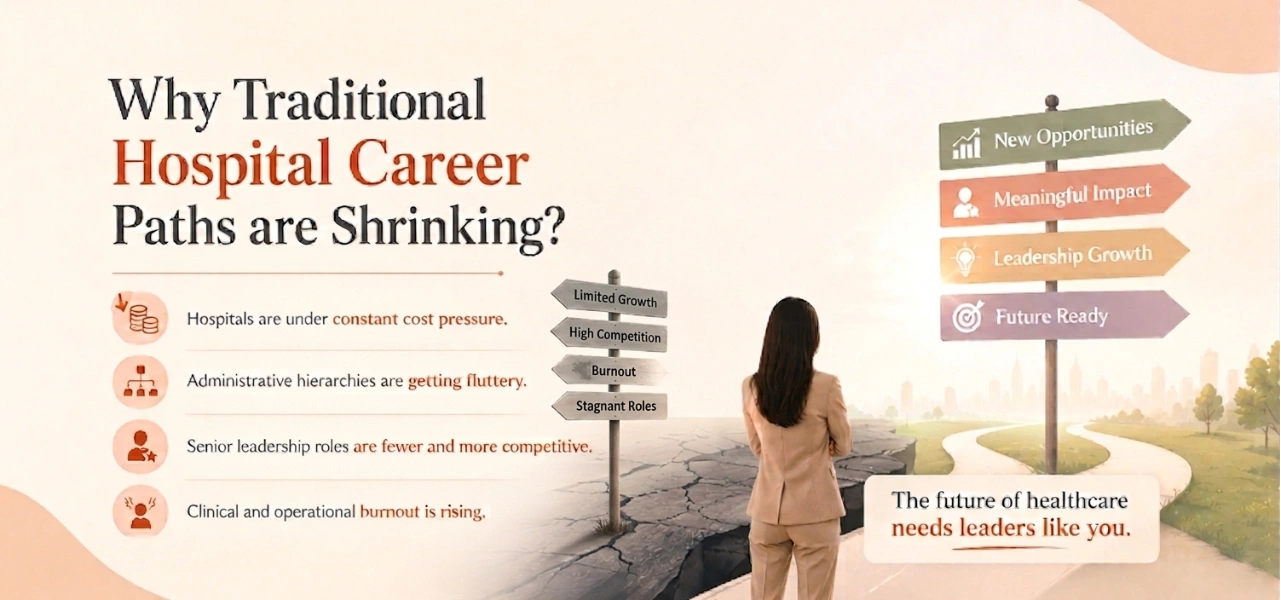
As a result:
- Hospitals are under constant cost pressure.
- Administrative hierarchies are getting fluttery.
- Senior leadership roles are fewer and more competitive.
- Clinical and operational burnout is rising.
For many professionals, this means slower promotions, limited decision-making authority, and careers that peak early.
The opportunity hasn’t disappeared, but it has shifted location.
Healthcare leadership is propelling into planning, policy, operations, analytics, and business design. Professionals who understand how healthcare systems function and not just how care is delivered are the ones finding sustainable growth.
What an Online MBA in Healthcare Actually Changes (Beyond your Job Title)
Most professionals approach an Online MBA expecting a title change: Manager, Consultant, Administrator, or a Strategy Lead.
What they don’t expect is a fundamental shift in how they think about healthcare itself.
An Online MBA in Healthcare Management doesn’t just add business skills to your resume. It rewires how you view problems, decisions, and outcomes, moving you away from isolated tasks and toward system-wide impact.
From Clinical Thinking to Systems Thinking
Clinical thinking is precise, focused, and immediate.
You diagnose the problem in front of you. You act. You move to the next case.
But modern healthcare failures rarely come from a lack of clinical expertise. They come from broken systems: inefficient workflows, poor capacity planning, delayed approvals, misaligned incentives, and fragmented accountability.
An Online MBA introduces you to operations management, healthcare economics, data-driven decision-making, and strategic planning not as abstract subjects but as lenses.
You begin to see how one scheduling policy affects patient wait times across departments. How one procurement decision impacts clinical outcomes months later. How small process changes can improve care for thousands, not just one patient at a time.
This shift is subtle, but powerful. It’s the difference between solving cases and designing systems that prevent them.
The Healthcare Value Chain: Where MBA Graduates are really needed
Most healthcare careers focus on where care is delivered. Very few focus on how healthcare actually moves.
Behind every patient interaction sits a complex value chain, one that decides access, affordability, quality, and scale long before treatment begins. Understanding this chain is what separates functional professionals from system-level leaders.
Providers are Only One Piece of the Puzzle
Hospitals and clinics are the most visible part of healthcare, but they are not where most strategic decisions are made. Upstream players influence what care is possible, sustainable, and in the budget. Downstream players determine continuity, outcomes, and long-term impact.
Once you start viewing healthcare as a value chain, you see roles differently:
- Diagnostics determine the speed and accuracy of treatment.
- Procurement and supply chains influence safety and availability.
- Insurance and payers shape patient behavior.
- Policy frameworks define operational limits.
This perspective helps professionals move beyond execution roles into coordination, optimisation, and leadership positions.
The Rise of Data, Policy, and Platform-Led Healthcare
Healthcare is no longer organized around buildings, but it’s organized around data flows, policy frameworks, and digital platforms. Electronic health records, AI diagnostics, telehealth platforms, population health dashboards, and insurance analytics now guide decision-making at scale.
This shift has created demand for professionals who can:
- Interpret clinical data for strategic use.
- Align digital tools with regulatory requirements.
- Design scalable healthcare delivery models.
An Online MBA-trainer healthcare professional doesn’t compete with clinicians; they enable entire systems to function better.
Career Roadmap: Roles you can Target
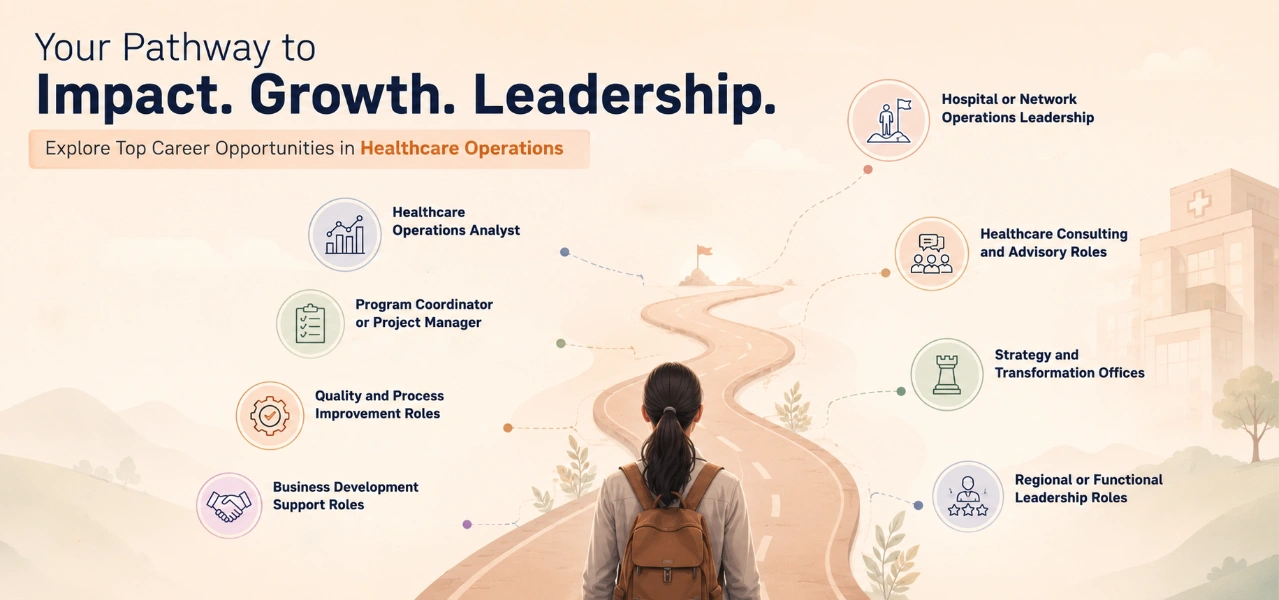
Career transitions rarely happen overnight, and the real advantage of an Online MBA lies in sequencing. It is knowing which roles to target now, which to prepare for, and which to grow into over time.
During the Online MBA, credibility builds gradually. Early shifts are about proximity to decision-making, not hierarchy. Professionals often move into roles such as:
- Healthcare Operations Analyst
- Program Coordinator or Project Manager
- Quality and Process Improvement Roles
- Business Development Support Roles
These positions expose you to systems and metrics that lay the groundwork for leadership.
The Leadership and Strategic Roles an Online MBA Unlocks
Online MBA in Healthcare Management brings experience and intersects with systems thinking. With time and demonstrated impact, professionals transition into more advanced roles such as:
- Hospital or Network Operations Leadership
- Healthcare Consulting and Advisory Roles
- Strategy and Transformation Offices
- Regional or Functional Leadership Roles
These roles influence policy, capital allocation, and long-term service design, which are far beyond day-to-day operations.
High-Growth Career Paths Most Blogs Don’t Talk About
Not all healthcare careers sit inside hospitals with white coats, as some of the fastest-growing ones sit entirely outside them.
These paths require cross-functional thinking, regulatory awareness, and business fluency, making them ideal for MBA-trained professionals. These career paths are:
- Healthcare Consulting and Advisory Roles: Healthcare consultants solve problems that hospitals don’t have time to step back and analyse. They work on capacity planning, turnaround strategies, digital transformation, and policy alignment, which often influence entire systems rather than single departments.
- Pharma, MedTech, and Digital Health Strategy Teams: These organisations shape treatment availability long before care delivery. Roles in product strategy, market access, regulatory affairs, and commercial planning influence which innovations reach patients and how quickly.
- Insurance, Payers, and Population Health Management: The future of healthcare lies in prevention, risk management, and long-term outcomes. Professionals in this space design models that reward wellness, manage chronic disease at scale, and optimise resource allocation across populations.
Conclusion
Healthcare careers don't stall because professionals stop working hand in hand. They stall because the industry changes faster than individual roles do.
An Online MBA in Healthcare Management is not about stepping away from healthcare. It is about stepping back far enough to see how the entire system fits together. For professionals who want to move from execution to influence, from role-based growth to responsibility-based growth, this shift in perspective becomes essential.
What makes this transition practical today is flexibility. Online MBA program in Healthcare Management offered by LPU Online is designed for professionals and graduates already part of the healthcare ecosystem, allowing them to learn on their schedule and apply insights while they are still relevant. This program brings light to career paths beyond traditional hospital roles and provides an opportunity to step away into something new while remaining part of healthcare.
Content insights for this article have been sourced and referenced from the article "All India Institute of Medical Sciences, New Delhi" available on Wikipedia.